

Frequent SOL entries and reductions
A maker/taker book and USDT settlement suit repeated execution without a Solana transaction for every order.
Why this fitsTrading from an existing Solana balance
A public wallet quote makes the input, position size and payout route visible before deciding whether the convenience is worth its charges.
Why this fitsBinance or Jupiter for SOL perps?
A limit entry has different economics on these SOL products. On Binance it may earn the maker rate if it rests before filling. Jupiter’s JLP market still charges its position-opening fee when a limit triggers, then adds holding costs while the position remains open.
For active SOL trading, our preference is Binance. Its SOLUSDT order book offers a conventional maker/taker choice, while Jupiter's SOL JLP market charges an opening fee even when an entry is triggered by a limit. Jupiter still has a distinct use case: it removes the exchange-deposit stage for an eligible reader already operating on Solana. That convenience is worth evaluating in dollars, rather than treating either custody model as an automatic winner.
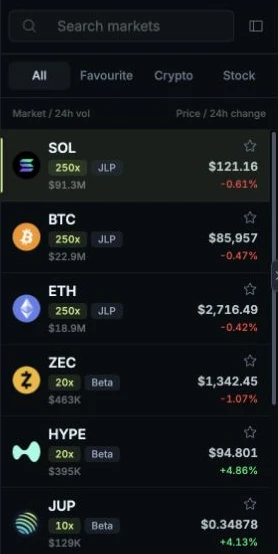
The comparison below concerns Binance SOLUSDT perpetuals and Jupiter's SOL JLP market. Jupiter now also documents GUM-powered Beta markets, which use a different trading engine. Their hourly funding and maker/taker model do not describe the SOL pool product. A page that says all Jupiter perpetuals work identically would miss this distinction. The Jupiter market overview identifies the two product families.
| Decision | Binance SOLUSDT | Jupiter SOL JLP |
|---|---|---|
| Entry mechanism | Orders matched against a book | Wallet request fulfilled against pool liquidity |
| Reference opening charge | 0.02% maker / 0.05% taker | 0.06% opening plus applicable impact and transaction components |
| Holding charge | Periodic funding: direction can pay or receive | Variable borrowing associated with pool use |
| Working balance | USDT settlement in this contract | SOL underlying collateral for long; USDC for short |
| Useful distinction | Resting orders can earn maker treatment | A SOL limit trigger does not create a maker discount |

A real Jupiter quote: what 10 SOL actually opened
We inspected Jupiter's public SOL form on 5 October 2026 without connecting a wallet or sending an order. With 10 SOL entered and 10x selected, the form showed approximately 99.3 SOL of long exposure, worth about $11,964 at the observed price near $120.49. It did not simply display a clean 100 SOL position. The quote incorporates its own fee and collateral treatment, which is why multiplying the input by the slider can give the wrong usable size.
The expanded long quote showed an opening charge around $7.18 and price impact around $1.20, totaling about $8.38. Network charges and account rent were not populated in that disconnected quote. We therefore report the visible opening components, not a completed transaction cost. The SOL price and quote changed while the form was open; the saved public quote records retain the individual observations and their limits.
For comparison, applying Binance's 0.05% reference taker rate to $11,964 of filled value gives about $5.98 in commission. A maker fill at the 0.02% reference rate would cost about $2.39. Those are fee calculations at a matched value, not claims that Binance offered the identical execution price at the same instant. The Binance fee explanation supplies the reference rates; personal discounts and account pricing can change them.
Compare exposure after charges, not just the slider
A trader funding a position with roughly $1,205 wants to know what exposure remains after the opening operation. An interface that deducts charges within the amount entered will not produce the same number as a worksheet that treats fees as extra cash outside the margin. Neither convention is inherently wrong. The mistake is comparing the first screen's net size with the second calculation's gross size and calling the difference slippage.
| Observation | Long | Short |
|---|---|---|
| Resulting SOL exposure | About 99.3 SOL | 99.1808 SOL |
| Position value | $11,964.32 | $11,950.53 |
| Opening fee | About $7.18 | $7.1703 |
| Displayed dollar impact | About $1.20 | $1.1951 |
| Visible combined opening components | About $8.38 | About $8.37 |
The quote also exposed a small presentation inconsistency worth handling carefully: its rounded price-impact percentage did not reconcile cleanly with the dollar impact displayed beside it. We use the dollar amounts actually shown and do not reconstruct a supposedly exact pool formula from that rounded label. A second quote or a completed position record would be needed to resolve the discrepancy for an executed trade.
For a SOL trader choosing between the two, the immediate conclusion is clear: Binance's reference commission is lower for this opening value; Jupiter must justify the difference through its wallet workflow or another requirement. That is a narrower, defensible conclusion than saying the whole trade is cheaper on Binance, because borrowing, funding, future execution and output conversion have not yet happened.
Does a Binance limit order work like a Jupiter limit order?
The word “limit” hides an important difference. A resting Binance futures order can add liquidity to the book and receive maker treatment when filled. Jupiter's SOL limit is a conditional instruction fulfilled through the pool mechanism. It does not earn Binance-style maker pricing merely because you selected a target price. This matters for traders whose entries depend on patiently waiting for SOL to revisit a level.
On Binance, an immediately executable limit can still be a taker. If SOL's best available offer is below your buy limit, the instruction allows an immediate purchase. Post-only behavior is relevant when adding liquidity is part of the plan. The saving must be evaluated against the possibility of no fill, rather than assuming every order called a limit produces the lower fee.
On Jupiter, the practical advantage of a limit is the entry condition itself. You can leave a target rather than watch every candle. But the request is still subject to the pool's execution and capacity rules when it triggers. The positions and collateral documentation says pending limits are independent of existing positions and can remain active after those positions close.
Imagine that you enter a SOL long and leave a second conditional buy lower down. You later close the live position because the trade idea has expired. If the unused instruction is still active, a later decline can create new exposure. This is a specific order-management issue, not an argument against limit orders. It makes reviewing the Open Orders tab part of finishing a Jupiter trade.
A confirmed request is not always a completed position
Jupiter documents a request transaction followed by a keeper's fulfillment transaction. The position becomes live after fulfillment, not merely after the wallet signs the request. That distinction explains why repeatedly submitting an order while waiting can be a poor response to an apparently slow screen. The execution reference describes the two-stage process.
Where does the SOL order wait?
Binance
Accepted orderCan rest in the matching book
Fill reportedThe executed quantity becomes exposure
Jupiter SOL
Request submittedA wallet signature starts the operation
Keeper fulfillsThe completed action creates the position
The choice depends on what you want to control. Binance offers book placement and a maker queue; Jupiter offers a wallet request with an oracle-based condition. A person managing several closely spaced SOL orders will usually find the exchange model easier to compare fill by fill. A person placing one wallet-based position may prefer Jupiter's more direct relationship with their Solana balance.
Neither description proves which interface is faster on your connection. We did not measure authenticated order latency. The meaningful documented difference is where the instruction waits and what event turns it into exposure. That is the information needed to avoid confusing a pending request, an unfilled order and an open trade.
Holding SOL overnight: funding versus the pool's borrowing charge
Binance SOLUSDT uses periodic funding transfers between long and short positions. Jupiter's SOL JLP market has a borrowing charge associated with using pool liquidity. A negative exchange funding rate can favor the long; the pool's borrowing charge is not a matching payment from a short trader to a long trader. The two costs should be compared over the intended holding period, rather than by looking at the smallest percentage on either screen.
Our Binance SOLUSDT record contains nine settled observations covering 72 hours, after 2 October 2026 at 16:00 UTC through 5 October at 16:00 UTC. Their sum was 0.029703%. At a modeled constant $12,000 position value, that corresponds to $3.56436 paid by the long, or received by the short, before fees and price P&L. The underlying events are included in the funding dataset.
During the Jupiter interface check, the SOL long header showed 0.0016% per hour and the short header 0.0007% per hour. Those are displayed rates at one moment, not a settled 72-hour history. Treating them as constant effective inputs produces $13.824 for the long and $6.048 for the short on $12,000 over 72 hours. That sensitivity calculation shows why duration matters; it does not establish what Jupiter actually charged over that past window.
A better question than “which percentage is smaller?”
For a planned eight-hour hold, the same illustrative Jupiter long input produces $1.536. For 24 hours it produces $4.608. The dollar increase is easy to understand without converting the rate into a frightening annual percentage that assumes the position stays open all year. The appropriate comparison is with the settlements your Binance position would actually cross, whose final values are not known in advance.
How duration changes a $12,000 SOL borrowing budget
Jupiter's public materials describe borrowing in more than one way: the main fee explanation uses pool utilization and position size, while another worked example discusses a borrowed portion. We have not treated those examples as an exact reconstruction of an authenticated account bill. In the model here, the displayed rate is an effective hourly input applied once; utilization is not multiplied into it a second time. This keeps the example transparent while preserving the distinction between a model and a posted charge.
The Jupiter fees page and Binance funding rules explain the mechanisms. For the actual decision, the important conclusion is that a short wallet-based trade and a multi-day hold deserve different budgets. A small opening convenience can remain worthwhile for hours and become expensive over days, even when SOL finishes near the original price.
This does not make Binance a permanent funding winner. The next settled rates may be materially different, and the chosen direction changes who pays on an exchange. The observed history is useful evidence about one completed window. It is not a reason to assume that a positive funding receipt will continue or that the position's trading loss cannot exceed it.
Long and short use different collateral on Jupiter
The SOL JLP long uses SOL as its underlying collateral token; the short uses USDC. Other supported input tokens can be converted as part of the operation. Binance SOLUSDT, by contrast, has USDT-denominated settlement in the ordinary contract comparison. This is why selecting the same direction and the same dollar exposure does not necessarily produce the same deposit or closing receipt.
In our public form check, changing from long to short while leaving 10 SOL as the input produced roughly 99.1808 SOL of short exposure, around $11,950.53 at that moment. The opening fee was approximately $7.1703 and displayed impact approximately $1.1951. The smaller exposure should not be attributed entirely to one cause: the quote refreshed at a different time and the short has a different underlying collateral route. We did not execute the conversion or verify its final charge.
The useful lesson is operational. A trader whose goal is a USDC-backed SOL short can begin with USDC rather than assume a SOL input is economically identical. A trader deliberately holding SOL for a long may value the native input. The funding token is part of the trade design, especially when repeated conversions would be required between positions.
Receiving SOL does not mean the position kept a fixed token balance
Jupiter records the collateral's USD value at deposit according to its current documentation. Its default long payout is expressed in the underlying token, while the close form can offer an alternative output. Those facts should not be replaced with a generic claim that the collateral simply appreciates like a separate spot SOL holding throughout the trade.
As an arithmetic example, suppose a close produces $1,260 of net value and SOL is $126. Receiving SOL would mean 10 SOL at that conversion point. If SOL were $120 for the same net dollar value, it would mean 10.5 SOL. The change in token count is not another trading fee or a second loss. It is the denomination of the payout. This example is invented to isolate that distinction and does not reproduce a Jupiter transaction.
Someone whose next use for the proceeds is another Solana trade may prefer SOL. Someone who wants to hold the completed result in a stable asset may choose USDC where offered. The relevant comparison with Binance is therefore not just the green P&L number. It is whether the settled asset matches the next intended use without another unnecessary exchange.
For more on the pool-specific alternatives, our GMX vs Jupiter comparison examines that separate choice. Here, the decision remains a Solana wallet position versus a centralized SOLUSDT account; the collateral difference matters because it changes the path of this particular trade.
Stops, partial closes and a liquidation price that can move
Jupiter's SOL product supports take-profit and stop-loss instructions, but a trigger should not be read as insurance for an exact final payout. The keeper, oracle and transaction process still have to complete the close. Binance also distinguishes triggering an order from the price at which its quantity is filled. When the market moves quickly, the displayed stop level alone is not enough to compare the two outcomes.
An especially relevant Jupiter detail is the effect of reducing a position. Its documentation describes proportional collateral adjustment when part of a position is closed, preserving the leverage ratio. Closing half therefore does not automatically mean that the entire original collateral remains behind to support the other half. A trader who intends to reduce leverage as well as exposure should inspect both resulting values.
Consider an illustrative $12,000 position with $1,200 allocated collateral, ignoring P&L and fees for the moment. Reducing the position and collateral by half leaves $6,000 against $600, still a 10x ratio. Keeping $1,200 against the smaller exposure would be 5x, but that is a different action. This explains why a partial-close button and an add-collateral action solve different problems.
The opening maximum is not a maintenance formula
The Jupiter JLP interface currently presents a 250x trading ceiling. Its liquidation documentation separately refers to a 500x protocol parameter used in a maintenance calculation. These are not two conflicting offers of selectable leverage. Publishing 500x as the user-facing maximum would misrepresent the reviewed product.
At the displayed 250x ceiling, a small price move and accumulated costs can consume a large part of the allocated margin. The practical comparison is the accepted position, remaining buffer and planned exit. We do not award Jupiter the overall recommendation simply because its headline number exceeds the multiplier another venue will approve for a particular account.
Borrowing can move the liquidation boundary even when the SOL market goes sideways. The current estimate should therefore be reviewed after a prolonged hold or a collateral withdrawal, not only when the position first opens. Binance's mark-based risk calculation can also change with account equity and funding. Those mechanisms are different enough that copying the liquidation price from one product into the other is not a valid comparison.
Solana congestion, transaction money and mobile execution
A Binance SOLUSDT fill is an exchange trade referencing SOL; it is not a Solana blockchain transaction for every buy and sell. Solana network conditions can affect a deposit or withdrawal on that network, but they do not turn every internal order into an onchain operation. Jupiter's JLP actions, in contrast, require Solana transaction processing. This is a meaningful distinction for a trader making many adjustments during a busy market.
Keep a transaction balance separate from the amount intended as collateral. Jupiter's close documentation currently warns when a wallet has less than the recommended 0.03 SOL for fees and account rent. That is a suggested buffer, not a fixed charge per trade. Presenting it as a guaranteed 0.03 SOL withdrawal fee would overstate the cost and confuse a reserve with money actually spent.
During our disconnected browser check, the trading form and quote were available while the embedded chart reported a loading failure. We do not use one browser session to label the whole platform unreliable. It does illustrate why a quote, a chart and a live position should be treated as separate pieces of information. An unavailable chart is not proof that a pending transaction was canceled or that a position disappeared.
What is useful on a small screen?
For a Jupiter position, the important mobile controls are the visible market and side, the current position amount and the chosen close action. Quick Close has a different purpose from opening the full close form: the documented shortcut closes everything and uses USDC output. A trader who wants only a partial reduction or another payout token should use the normal close form instead of discovering that distinction after tapping a shortcut.
For Binance, a mobile user needs to distinguish the open position from working entries and any closing instructions. A chart showing the correct SOL symbol does not settle the quantity question. A preset percentage may reference the available balance or the existing position depending on the control. We have not run a funded mobile comparison; these are the documented action differences that deserve attention when choosing a workflow.
The recommendation is not based on which app has more indicators. It is based on the number and kind of actions needed for your trade. A wallet-native entry that rarely changes can be straightforward on Jupiter. An active sequence of passive orders, partial fills and reductions can favor Binance's centralized order management, without requiring a broader debate about whether all CEXs or all DEXs are better.
A SOL scalping budget versus a single wallet position
For a strategy targeting a small SOL price move, turn the opening charge into the price improvement needed to cover it. On roughly $12,000 of exposure, a 0.10% favorable move produces about $12 of gross price P&L. Two Binance reference taker commissions at unchanged value also total about $12, before spread or funding. That target would therefore leave little room for a net gain even on the lower-commission route.
The same exercise on Jupiter should use both the entry and the planned close quote. The observed opening components alone were about $8.38 on $11,964 of long exposure. They already consumed roughly 70% of a hypothetical 0.10% favorable move at that value. A closing charge, future impact and borrowing still have to be paid. This does not predict the trade result; it explains why a wallet route that is convenient for a larger directional idea can be unsuitable for repeatedly targeting tiny price changes.
What size saving would justify moving an existing balance?
At $12,000 per side, replacing two Binance taker fills with two genuine maker fills reduces the reference commission from $12 to $4.80, saving $7.20. That comparison assumes unchanged position value and successful passive execution. If a strategy requires immediately chasing the market on both sides, the maker saving is unavailable regardless of which button the trader initially intended to use.
For someone already holding SOL in a wallet, transferring and converting funds to reach a different venue has its own cost. Suppose those actual additional costs total $9. A one-off expected commission saving of $7.20 would not recover them. Repeated trades might, but only if the lower-rate fills actually occur; a missed passive entry cannot be recorded as a successful cheap trade. The $9 is an invented threshold example, not a quoted Solana transfer fee.
This gives each venue a more precise role. Binance is compelling when the strategy generates enough SOL turnover to use its order-book pricing. Jupiter is easier to justify when it serves a specific wallet-based position and avoids an otherwise unnecessary funding journey. The calculation starts with the trade's intended price move and frequency, rather than the maximum leverage available on either platform.
Access, withdrawals and the final SOL choice
Neither an accessible public quote nor an exchange symbol listing establishes that every reader can use the product. Binance Futures and Jupiter's interface have their own eligibility conditions. A wallet connection does not erase the latter. Review the eligibility conditions presented by the actual interface before moving funds; our country pages organize the local context.
Once a Binance SOLUSDT trade has ended, withdrawing SOL requires having SOL available in the correct account and choosing a supported withdrawal route. Closing the derivative itself settles its result in the contract's settlement currency. On Jupiter, closing can return assets directly to the wallet after the transaction completes. These are different paths to spendable funds, not two names for the same withdrawal operation.
The best choice is consequently specific. Use Binance for an eligible, stablecoin-funded SOL strategy that relies on order-book execution and frequent adjustments. Consider Jupiter when the money and subsequent activity are already on Solana and its full quote fits the intended hold. The public long quote showed a real opening premium over Binance's reference commission; the pool's borrowing charge makes duration another material consideration.
Before choosing Jupiter for an extended hold, calculate the expected duration in hours and the cost sensitivity if the displayed rate changes. Before moving a wallet balance to Binance for a short trade, account for the actual deposit, conversion and eventual withdrawal path. These are different pieces of the decision: one is the cost of staying in the position, the other is the cost of reaching and leaving the venue.
Binance vs Jupiter: frequently asked questions
Does Jupiter charge a maker fee on SOL limit orders?
A Jupiter SOL JLP limit is a conditional pool instruction, not an order resting in Binance’s maker queue. It should not be assigned Binance-style maker pricing just because it uses a target entry. Binance limits can qualify as maker fills when they add liquidity, but immediately executable limits can still be takers. That difference matters to a strategy making repeated passive SOL entries.
Why did 10 SOL at 10x show less than 100 SOL of exposure?
The disconnected Jupiter quote showed roughly 99.3 SOL long exposure after the form’s fee and collateral treatment. Multiplying the gross input by the leverage slider ignores those deductions. Compare the resulting position value and visible dollar charges. We did not submit the order, and network fees or rent were not populated, so the observation is not a completed transaction invoice.
Can I short SOL on Jupiter using a SOL wallet balance?
The reviewed form accepted SOL as an input for a short, but the underlying short collateral is USDC. An input conversion can therefore be part of that operation. Someone specifically seeking a USDC-backed short should compare the quote from USDC directly rather than assume the SOL input is equivalent. Our long and short quotes refreshed at different moments and are not an isolated measurement of the conversion spread.
Is Jupiter’s 0.03 SOL recommendation a fixed trading fee?
No. The documentation recommends a wallet buffer for transaction fees and account rent; that reserve is different from a charge actually consumed by one action. Do not multiply 0.03 SOL by every planned trade when estimating commission. The usable transaction amount depends on the operation and network conditions, while the separate opening, closing and borrowing components belong to the perpetual position.
Will closing my Jupiter position cancel a pending SOL limit entry?
Do not assume it will. The documented SOL limit instructions are independent and can remain after a position closes. A later trigger can create fresh exposure even though you finished the earlier trade. Review unused entries when the trade idea ends. This is especially relevant when a position and several conditional entries were created at different times.
Does reducing a Jupiter long by half also halve its leverage?
Not under the documented proportional collateral adjustment. If both position value and collateral are reduced by half, their ratio stays the same. In a simplified example, $12,000 against $1,200 becomes $6,000 against $600, still 10x. Lower exposure and lower leverage are separate objectives; inspect the remaining collateral instead of assuming a partial close achieves both.
Can the displayed borrowing rate predict the cost of a three-day hold?
It can be used as a scenario input, not a guaranteed bill. The illustrated $12,000 long costs $13.824 over 72 hours only if 0.0016% per hour remains the effective rate throughout. The real rate can change. Binance’s historical settled funding is a different type of evidence and should not be presented as a synchronized historical comparison with a single Jupiter rate observation.
Does Jupiter Quick Close let me choose a partial exit and payout token?
The documented shortcut closes the entire position with USDC output. Use the ordinary close form when the intended action is a partial reduction or a different supported output. This distinction is useful on mobile, where a convenient shortcut can be mistaken for the full closing workflow. Confirm the resulting transaction rather than treating a signed request as proof that the position has already ended.
Open the evidenceSources and research
Sources and research
Reviewed 5 October 2026 against official product documentation and public observations. Download links retain the dated source data and calculation assumptions. No funded order, authenticated account or withdrawal test was performed.