Fits your trade size Options for your country Costs and risks explained
Leverage setup finder
Which exchange fits your trade?
Enter where you live, what you want to trade and how large the trade will be. You can also adjust your budget, order type and time in the trade.
Results use researched contract limits and fees. Funding uses your assumption; slippage and account-specific offers are excluded.
Fine-tune this tradeYour budget, order type and time in the trade
What the Finder calculates
Divide the full trade size by leverage to estimate the deposit you need. For example, a $10,000 trade at 10× starts with $1,000. Trading fees depend on how your orders fill; exchanges that quote a price from a pool of funds have their own opening, closing and borrowing charges.
Holding costs use the funding rate you enter, scaled to the time you plan to hold. They exclude variable borrowing charges. The estimated distance to a forced closure uses leverage and the minimum balance rule. Fees, changes in the price you get and adjustments for larger positions can change the actual result.
These are estimates to help you compare. Before trading, check the exchange’s current price, contract terms and rules for your country.
Second example / the cost of staying in
A $1 fee gap. A $21 holding cost.
Keeping a $10,000 Bitcoin buy open for a week can cost more than the fee to place it. Change how the orders fill and how long you hold the trade to see the difference.
Bybit
$32.00Estimated trading + holding costs
Open + close
$11.00
21 funding payments
$21.00
OKX
$31.00Estimated trading + holding costs
Open + close
$10.00
21 funding payments
$21.00
What changes the choice?
Opening and closing the trade costs $1 less on OKX at these standard rates. Keeping it open longer doesn’t change that $1 difference.
Over seven days, the assumed payments for keeping the trade open add up to $21 on either exchange. Those rates can matter more than a small difference in trading fees.
For this example, each opening and closing order is worth $10,000. We use standard global fees without discounts and assume you pay 0.01% every eight hours to keep the trade open, called funding. These are example rates, not current quotes, and we leave out costs from differences in buying and selling prices. The maker rate applies only when your order waits for another trader to fill it.
Each new trade means another set of opening and closing fees. Keep one trade open instead, and the regular funding payments become more important. The rate can change, and sometimes you receive a payment instead of making one.
Fees are charged on the full trade. If you put up $1,000 to open a $10,000 position at 10×, the fee is still calculated on $10,000. Try your own numbers in the fee and break-even calculator to include how you buy, sell and keep the trade open.
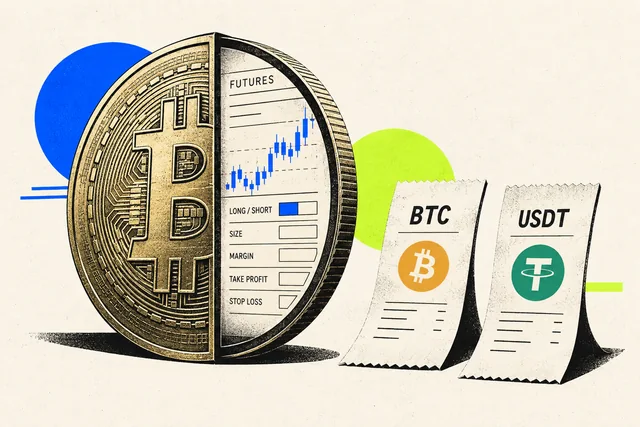
You can trade Bitcoin’s price without owning Bitcoin. But the money or coins backing that trade still matter: they affect your balance when the market moves.
Futures can pay your profit in Bitcoin or in a stablecoin such as USDT. That choice also changes how losses reach your balance.
Bitcoin futures
Buying Bitcoin, or protecting coins you already own?
Some Bitcoin futures pay gains and losses in USDT or another stablecoin; others pay in Bitcoin. With Bitcoin backing the trade, those coins change in dollar value too. That matters if you track your results in dollars.
Suppose you own one BTC bought at $60,000. A rise to $63,000 adds $3,000 to its value. A separate, dollar-settled futures trade against Bitcoin—a short—for one BTC would lose $3,000 before costs. The two offset each other in this example. But the gain on your coin won’t automatically top up the separate futures account; that account still needs enough money to keep the short open.
Ethereum: when the coins backing your trade fall too
If you use ETH to back a trade that profits when ETH rises, a price drop hits both at once: your trade loses money and the ETH you posted is worth less. Using USDT or another stablecoin removes that second source of ETH price risk.
SOL, TON, Render and POL futures have their own details. One unit on the trading screen might represent a bundle of tokens. An older symbol may still appear after a token changes name. And an exchange can offer the futures trade without accepting deposits of that token. The coin’s logo alone won’t tell you what you’re trading.
Two exchanges can suit different ways of trading. Here’s how they compare when the size of your order, the time you hold it or the controls you want change.
A price on the screen may cover only a small trade. Buy or sell more, and part of your order may fill at a different price. Here’s what that looked like in our data.
Find futures exchanges for your coin
Choose a coin to see where you can trade it, what it costs and which features are worth comparing.
We estimated the extra price cost of buying and selling SUI at ten exchanges. The middle result was about $3.63 for $10,000 orders and $120.30 for $100,000 orders, before trading fees. Buying more meant reaching offers at less favorable prices.
A simulated $100,000 Bitcoin buy on Bybit cost about $2.10 more than if the whole order had filled at the lowest price offered. A separate sale of the same size could have filled entirely at the highest price buyers were offering.
These are separate calculations using the orders visible at that moment. No trades were placed, and later orders may get different prices.
The best fit depends on how you trade. Some exchanges save you money on frequent trades; others give you more control over exits or let you use a wallet. Here’s where each one stands out.
Small fees add up when you trade Bitcoin often. At standard futures rates, an order that fills immediately costs less on Binance than on Bybit. That saving matters most when you’re opening and closing trades throughout the day.
OKX gives you room to organize several trades in one account. Keep money set aside for one position, or share a balance across others. Useful flexibility once you’re doing more than opening a single Bitcoin trade.
You don’t have to close a winning trade all at once. Bybit lets you take some profit at one price and leave the rest running, with separate exit orders for each part.
Kraken brings regular crypto buying and futures together with the same provider. It also accepts several assets to back a futures position, giving you a choice of which balances to use.
On Gate’s Bitcoin market, an order left waiting for another trader to fill can earn a small rebate. If you prefer to buy or sell immediately, a different fee applies.
A 100× trade / worked example
What 100× does to $100.
Put $100 behind a $10,000 Bitcoin buy, and a 0.5% price fall means a $50 loss before costs. That’s what 100× does here. Try a different price move below.
Starting deposit$100
Leverage100×
Trade size$10,000
Loss before costs−$50
Balance after this move: $50, before trading costs.
This dollar-settled example shows the price gain or loss only. The exchange can close a trade before the full $100 is lost: it requires a minimum balance and leaves room for closing fees. Payments for keeping the trade open also change your balance. Using 10× instead would require a $1,000 deposit for the same $10,000 trade. The dollar gain or loss from the price move stays the same. Estimate when a trade could be closed.
Learning garage
Get comfortable with leverage, one step at a time.