
Which OKX futures account should you choose?
Account mode and position mode are different decisions
OKX's current global guide groups the account choices into Spot, Futures and Advanced. Advanced contains multi-currency and portfolio margin. One-way versus hedge mode is another setting: it controls whether opposing trades offset the same position or can remain separate long and short positions. Selecting Advanced does not by itself express whether you want to hedge. Current account comparison.
Which OKX balance do you want to use?
- USDT for one trade
- Futures mode · isolated
Allocate margin to the position. Keep the decision centered on that trade.
- USDT across several trades
- Futures mode · cross
Share the settlement-currency pool without making other coins collateral.
- Several collateral coins
- Advanced · multi-currency
Recognized USD values support cross-margin risk. Borrowing can add another cost.
- Offsetting derivative legs
- Advanced · portfolio
Risk-based margin considers the combination; closing a hedge can change the requirement.
Global futures and European X-Perps
European readers should identify the product before applying the rest of this review. OKX offers X-Perps to eligible EEA customers under a separate framework, with up to 10x leverage. The global BTC-USDT-SWAP specification inspected here shows up to 100x in its first position tier. These numbers describe different products and should not be combined into a single “OKX maximum.”
Multi-currency margin: when sharing collateral helps
An OKX trader can have sufficient account value while holding little of the currency in which a contract settles. Multi-currency margin addresses that situation by valuing eligible collateral in USD. It is particularly relevant to someone keeping BTC or ETH while trading stablecoin-settled derivatives. The benefit is fewer forced conversions solely to organize margin, rather than free additional buying power.
A dollar of market value is not always a dollar of collateral
OKX applies collateral discount rates when calculating adjusted equity. Different assets and balance tiers can receive different recognition. Our diagram illustrates the categories rather than asserting that BTC, ETH and a stablecoin always have the same rate. The amount that matters for opening capacity is the account's recognized collateral, not the total you would receive in a perfect sale of everything.
Imagine an account with 8,000 USD of eligible coin value and 4,000 USDT. If a hypothetical discount recognized only 95% of the coin value, the starting recognized amount would be 11,600 USD, not 12,000. That simplified example excludes positions, orders, liabilities and fees. The 95% is an illustration, not a published current OKX rate for a named coin.
The point is practical: changing the mix of assets can change usable margin even when the headline wallet total barely changes. A trader measuring capacity from a portfolio tracker may therefore overestimate what the order ticket can accept. OKX's multi-currency guide explains adjusted equity and the deductions for committed balances.
Sharing a currency versus sharing all selected collateral
In Futures mode, cross-margin positions with the same margin currency share that currency's pool. In multi-currency cross margin, customized eligible collateral is assessed together in USD. This can be useful when your intended reserve is spread across several assets. It can be undesirable when one coin holding was never meant to support another trade.
Our preferred use case is a trader who can name the connection: “These assets form the reserve for these positions.” If instead the account is a mixture of long-term holdings, experimental altcoin trades and funds earmarked for withdrawal, the single aggregate balance can hide competing purposes. More available margin is not automatically a better-organized account.
Auto-borrow changes the bill you are running
Under the documented multi-currency auto-borrow setup, insufficient available settlement currency can produce a liability despite positive overall USD equity. Interest treatment includes exemptions for qualifying unrealized derivatives losses within the relevant allowance; it is not correct to assume every negative figure incurs the same charge. Borrowing and repayment.
For a trader holding ETH but trading a USDT contract, we would compare two arrangements: retain the ETH as collateral and accept the resulting financing rules, or allocate enough USDT to keep the trading ledger simpler. The right choice depends on whether preserving the ETH exposure is part of the strategy. If it is merely a leftover balance, financing a mismatch may add complexity without serving the trade.
Turning off an optional borrowing setting should also not be interpreted as erasing an existing liability. The repayment record is the place to establish that a debt has been settled. A position can be closed while an account obligation remains, especially if its losses or expenses were paid in a currency the account did not hold.
Eligibility is meaningful here
OKX's global account comparison lists at least 10,000 USD of account equity and a one-time knowledge assessment for the first switch into multi-currency mode. Futures mode does not have that same equity threshold. Therefore, a small USDT account is not missing a necessary futures feature by staying in Futures mode. It is using the arrangement that already fits its balance and activity.
Portfolio margin: useful for hedges, unnecessary for many trades
Portfolio margin is the OKX feature most likely to be oversold in a general review. It is designed to consider relationships among exposures under a risk model. The potential advantage is reduced margin when positions offset one another in ways the model recognizes. It does not mean the exchange ignores risk, and it does not guarantee that every opposite-looking trade receives a useful offset.
Consider someone who owns coin exposure and deliberately takes an opposing derivative position. Evaluating each leg independently may reserve more margin than evaluating the recognized combination. By contrast, a trader who opens three bullish altcoin positions has not created a diversified hedge merely by choosing three tickers. If they fall together, the account can remain strongly directional.
The hedge can be more valuable than its visible P&L
A losing leg is not necessarily the least useful position in a portfolio-margined account. It may offset another exposure and reduce the combined requirement. Closing it can make the remaining account more directional, potentially raising required margin. That is why selecting “close the red position” is a poor standalone rule for this mode.

OKX's portfolio documentation describes risk units and stress-based assessment, with different versions of the model. The application depends on the instruments and configuration. We would use its margin preview for the proposed post-trade portfolio rather than infer a new requirement by subtracting the old leg's displayed margin. Portfolio comparison.
This is a real reason to shortlist OKX for a combined derivatives strategy, but it is not a benefit that should be assigned to every reader. If you cannot explain which exposures offset and what remains after one leg closes, Futures mode is the more transparent choice. It can still support serious trading; fewer account interactions can make a strategy easier to supervise.
A withdrawal can change the same calculation
Removing a collateral asset while maintaining the derivative side also changes the portfolio. The resulting risk can be different from merely reducing an idle cash balance. Similarly, a coin accepted at one collateral rate can be subject to tiers or other limits. For a portfolio user, withdrawal capacity should be assessed against the remaining combination, not only the amount of the coin being withdrawn.
The risk-unit merge documentation is useful for understanding the model's scope. Most readers do not need to reproduce its formulas. What matters for choosing the exchange is whether the recognized offsets match the strategy they intend to run, and whether the account makes the resulting margin changes clear enough to manage.
OKX perpetual contracts and leverage at your position size
The contract selector deserves attention before the leverage slider. A stablecoin-settled BTC perpetual, a coin-margined BTC product and a dated BTC future are not interchangeable entries in a list. They differ in settlement currency, contract units and holding costs. A market name can contain the same underlying coin while requiring a different balance and producing a different transaction history.
Reading BTC-USDT-SWAP correctly
On 6 October 2026, the public instrument record for BTC-USDT-SWAP specified 0.01 BTC per contract. That makes 100 contracts equal to 1 BTC of exposure. At a hypothetical price of 80,000 USDT, those contracts represent 80,000 USDT, not 100 USDT and not 100 BTC. The unit is especially important for anyone comparing an API quantity with the app's chosen display unit.
The inspected cross-margin tier schedule allowed up to 100x through 1,000 contracts, equivalent to 10 BTC. The next band extended through 5,000 contracts, or 50 BTC, with a lower leverage ceiling. Reporting those bands in BTC avoids pretending the USDT value stays fixed while Bitcoin's price changes.
| Position band | Equivalent BTC ceiling | Maximum leverage |
|---|---|---|
| Up to 1,000 contracts | 10 BTC | 100x |
| Above 1,000, up to 5,000 | 50 BTC | 66.66x |
| Above 5,000, up to 20,000 | 200 BTC | 50x |
What changes when your BTC position grows?
The first band always ends at 10 BTC in this snapshot. Its dollar equivalent is 800,000 USDT at an 80,000 price, or 900,000 USDT at 90,000. A BTC-denominated holding can stay in the same band while its dollar exposure rises. Contract specification and position tiers.
USDT or coin margin: two different BTC contracts
The reviewed catalogue returned BTC-USDT-SWAP as a linear contract representing 0.01 BTC, settled in USDT. BTC-USD-SWAP was inverse: each contract represented 100 USD, with settlement in BTC. At a hypothetical 80,000 USDT per BTC and dollar parity, 100 linear contracts represent one BTC, while 100 inverse contracts represent 10,000 USD—about 0.125 BTC. Copying the number 100 between these tickets would produce very different exposure. Public swap catalogue.
For a USDT-funded trader who wants profits measured in the same balance, the linear contract is the more direct fit. The inverse contract serves a different decision: retaining BTC collateral and receiving the result in BTC. Its dollar value changes with Bitcoin, so a positive BTC result does not by itself describe the change in the dollar value of the whole account. That is a reason to choose deliberately between the two products, not a reason to rank one above the other for everyone.
Do not assume there is a matching BTC/USDC perpetual simply because OKX supports USDC elsewhere. Our public global catalogue on 6 October returned these two BTC swap families; a direct BTC-USDC-SWAP lookup returned no instrument. That observation does not establish the complete offer of every regional entity. A trader specifically holding USDC should identify the available settlement product before transferring it, rather than treating a deposit currency as proof of a futures contract.
Dated futures introduce an expiry and associated settlement terms. A trader seeking a continuing position should compare the cost of the dated contract and any future roll with the funding paid on a perpetual. The absence of a perpetual funding line does not mean there is no holding cost: the dated contract's price relative to spot may already include one.
OKX futures fees: standard rates and the current VIP ladder
OKX's September 2026 schedule lists regular Standard Group futures fees of 0.020% maker and 0.050% taker. Its current table puts VIP 1 at 0.016% maker and 0.045% taker, with qualification through the stated assets or volume paths. Older fee-framework articles show a different VIP 1 combination; this review uses the later, explicitly effective schedule. September fee notice.
| Tier | Maker | Taker |
|---|---|---|
| Regular | 0.020% | 0.050% |
| VIP 1 | 0.016% | 0.045% |
| VIP 2 | 0.015% | 0.036% |
| VIP 3 | 0.010% | 0.028% |
The cost of changing a hedge several times
Suppose a trader opens a 30,000 USDT futures hedge, reduces 10,000, adds 10,000 again and finally closes 30,000. Total executed volume is 80,000 USDT if prices are unchanged. At the regular taker rate, commission is 40 USDT. The fact that the largest position was only 30,000 does not reduce the volume already traded.
If the first 30,000 entry genuinely adds liquidity and all subsequent fills take liquidity, the estimate becomes 6 plus 25, or 31 USDT. The nine-USDT difference is the value of that maker entry in this example. It does not justify missing a hedge that must be established immediately. The appropriate order type follows the purpose of the trade, then the fee comparison follows its expected execution.
This example suits OKX's account-oriented proposition: a trader may adjust a hedge while keeping other balances and exposures in place. The commission belongs to each adjustment, not only the final closing order. An account statement can therefore show a profitable final exit while the complete sequence earned less after repeated rebalancing.
When VIP eligibility is already within reach
The cited current schedule lists VIP 1 eligibility at 100,000 USD in assets or 5 million USD in 30-day futures volume for this group. At 5 million of taker executions, a 0.005-percentage-point reduction is 250 USDT. That arithmetic shows the potential saving; it does not imply the lower rate applied retroactively to all executions used to qualify.
A high-balance trader may qualify without frequent turnover, whereas an active trader may qualify through volume. Either way, check the rate currently assigned before estimating the next order. If a review uses an older lower taker rate for the same VIP label, the apparent savings may be exaggerated. Comparing tier names without comparing their actual current rates is not enough.
Which currency pays the fee?
OKX's fee rules distinguish stablecoin-margined and coin-margined contracts. Stablecoin executions use the contract quantity, size and fill price to calculate the notional fee. Coin-margined calculations use the contract's face value and price to arrive at a coin amount. Expiry settlement and liquidation can have their own charges. Fee calculation rules.
That is useful when a transaction log does not look like a simple USDT deduction. Convert the result consistently if you are comparing a coin-margined strategy with a USDT alternative. Otherwise, a movement in the fee currency's price can be mistaken for a change in the exchange's commission.
Trading on OKX: positions, split entries and closing orders
OKX offers more than one way to organize multiple entries in the same contract. The important choice is whether you want one combined position or separate records for individual entries. Traders running a short-term idea alongside a longer holding may prefer separate management, but a visual separation is not necessarily a separation of liquidation risk.
What Split Position does—and what it does not
The current Split Position feature creates a separately displayed sub-position for each new opening order in supported USDT-margined perpetuals. Entries can have their own P&L and TP/SL management. However, OKX says margin and liquidation remain calculated at the aggregated position level. The split view therefore helps organize decisions; it does not turn every entry into an independent account. Split Position documentation.
Imagine two BTC entries made for different reasons. You want to exit the shorter-term trade while leaving the other intact. A per-entry close can make that intention easier to track than mentally subtracting a quantity from a blended position. But if the combined position is under margin pressure, the favorable-looking sub-position is not protected merely because it has a separate row.
This is a distinct strength for someone maintaining several setups on the same contract. It is less relevant to a trader who always scales one single idea in and out. We would not activate it solely to make the position list look more detailed. The benefit is attribution: knowing which entry a later exit was intended to manage.
Choose the position mode before relying on a closing order
In one-way mode, an opposite order can reduce a position and, if permitted and large enough, create exposure the other way. In hedge mode, opening and closing directions are distinct. OKX documents closing orders as reduce-only by default in hedge mode; one-way users can explicitly select reduce-only when appropriate. Order behavior.
A useful example is a trader long 100 contracts who intends to sell 30. A close of 30 should leave 70, not open a separate short. The relevant control is the order's closing intention and the current position mode. The price chart cannot show whether the order form is expressing that intention correctly.
Large closes and price protection
OKX's order documentation also separates position limits from maximum size per market order. A large close-all request can be split into smaller executions. Price limits can affect whether market orders fill promptly when liquidity is insufficient. “Market” therefore does not mean a guaranteed instant fill at an unlimited price.
For someone trading large size, inspect the resulting order state rather than assuming one button press means the entire position disappeared. That matters even when the initial margin and position-tier calculations were correct. An accepted position is a risk-engine decision; filling its exit requires counterparties in the book.
TP/SL changes on a phone
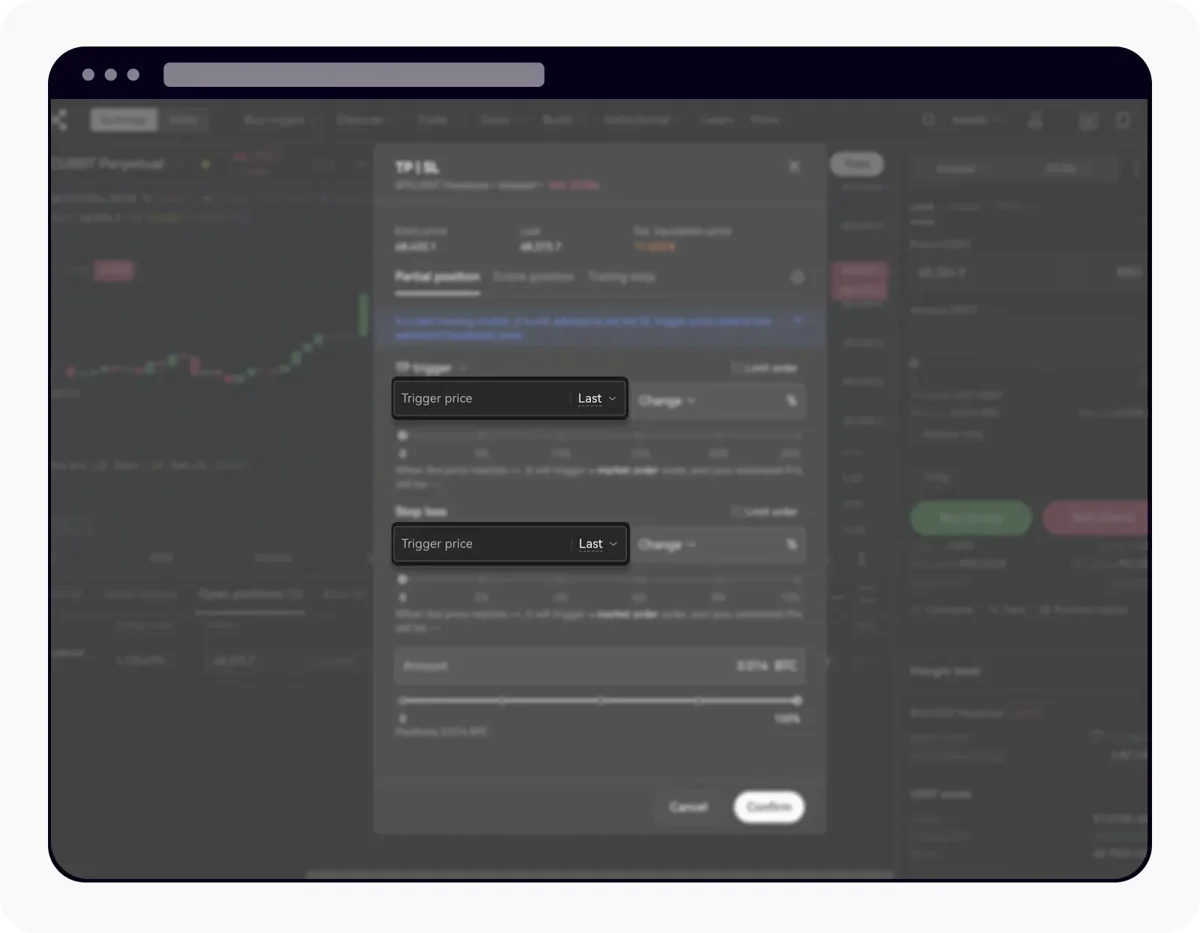
When modifying a TP/SL, OKX lets the trader inspect the selected trigger reference. A chart displaying last price may differ from a mark-triggered instruction. The most useful mobile habit is to read the order's reference and scope before adjusting the level. Moving it based only on the candle can turn an intended exit into a different instruction. Modifying TP/SL.
For split entries, also inspect the combined view when evaluating margin. A convenient per-entry P&L screen should not replace the account's risk view. This is where OKX rewards a little initial setup: once the chosen views match your trading routine, the platform can make complex activity easier to organize. Without that setup, additional panels may obscure the simple question of what remains open.
OKX funding intervals can change while you hold a position
Funding is especially important for the trader attracted to OKX for hedged or multi-position strategies. A directionally offset portfolio can still have a net holding cost if its legs settle at different rates or times. Price neutrality is not cost neutrality, and a margin offset does not remove cash flows between long and short holders.
OKX's current mechanism supports one-, two-, four- and eight-hour settlement intervals. It also describes automatic frequency adjustments for crypto perpetuals under specified market conditions. A contract can therefore move to more frequent assessments; its familiar historical timetable should not be treated as a permanent setting. Funding mechanism.
Compare a holding period, not two isolated percentages
Suppose one contract charges a positive 0.01% per eight-hour event and another shows 0.003% per hour. If those hypothetical rates remained unchanged for 24 hours, the totals would be 0.03% and 0.072% respectively. The smaller displayed rate would produce the larger daily charge. Actual rates vary, so this is a unit comparison rather than a forecast.
For a 25,000 USDT long, those simplified totals are 7.50 and 18 USDT. That difference can exceed a small commission saving. A trader comparing an OKX hedge with a position elsewhere should record the event times and settled rates for both legs, not just capture whichever current number looks more attractive.
Funding is taken from the relevant position or account balance under the selected margin arrangement. If the buffer is thin, a payment can affect margin health even without a dramatic change in the underlying price. This is another reason to distinguish a continuing funding obligation from the one-time fee paid when opening the trade.
Event boundaries are not a free timing guarantee
OKX says funding assessment can take time to complete. Opening just after the nominal timestamp does not necessarily establish that you missed the assessment. Planning to exploit a few seconds around the event is therefore different from simply deciding whether a multi-day hold is affordable.
For most readers, the useful control is to compare the position's next settlement and the cost already accumulated. A strategy that only works if a payment can always be escaped at the last second has an execution dependency that a general exchange review cannot validate. We do not treat a projected funding receipt as a guaranteed return.
OKX X-Perps in Europe: a separate 10x product
OKX's European X-Perps are expiry futures with a funding mechanism. The product combines a perpetual-like trading experience with a fixed expiry, so the word “perp” should not be read as proof that the contract never expires. The official European product page advertises up to 10x leverage and starting standard commission of two basis points maker and five taker, equivalent to 0.02% and 0.05%. X-Perps product details.
Who can access the European product?
The official eligibility page states availability across the 30 EEA countries, subject to identity verification, the appropriateness assessment and account-level checks. It identifies OKX Europe Markets Limited and the relevant Malta authorization. That is more informative than saying “OKX is licensed in Europe,” because it ties the access statement to a specific derivatives product and entity. EEA eligibility.
A verified spot account is not necessarily ready to submit an X-Perps order. The derivatives assessment is part of the access process. Conversely, an eligible European trader should not assume all OKX derivatives are unavailable merely because older reviews discussed a different offering. The correct answer depends on the current product, not a blanket conclusion about the brand.
What the amount field actually represents
OKX's European leverage guide clarifies that the Amount field expresses position size. Entering 2,400 USDC at 6x means a 2,400 USDC position with roughly 400 USDC initial margin before other requirements; it does not create a 14,400 USDC position. Increasing the multiplier while leaving Amount unchanged changes margin behind the same exposure. X-Perps leverage guide.
If you actually want 14,400 USDC of X-Perps exposure at 6x, the Amount field needs to show 14,400, and the initial margin starts around 2,400 USDC before other requirements. This is particularly useful when moving from an app whose input represents margin: copying its amount into X-Perps without changing the unit would create a different trade.
Why a funded European account may show no trading balance
The X-Perps guide distinguishes Funding and Trading balances once the derivatives account is established. A transfer may be needed before funds appear in the trading account. It also notes that earlier-stage accounts can show only one balance, so the absence of a Transfer button does not by itself mean funds are missing. X-Perps balance workflow.
For a European reader, this makes X-Perps a product to evaluate on its own terms: eligibility, eligible contracts, its leverage range, execution cost and balance flow. It should not be judged against an impossible expectation of receiving every feature or maximum shown in the global advanced account. Our country pages provide the local context without duplicating an entire regional legal guide here.
Moving OKX profits out without disrupting other positions
OKX's app withdrawal guide allows supported source-account choices, including Funding and Trading. Where Trading is offered as the source, a separate manual transfer to Funding is unnecessary. The European X-Perps flow has its own account presentation, described above. In either case, the available amount is more useful than a headline total that includes committed balances. App withdrawal instructions.
Why profit and available cash can differ
A closed trade may increase equity while another position continues using that equity. In a shared-margin arrangement, releasing one leg does not necessarily release an identical amount for withdrawal. If a portfolio offset changed at the same time, the requirement for what remains can also change. For this reason, withdrawing the displayed profit is not always a neutral action on the rest of the account.
The choice of settlement currency also matters. A BTC-denominated profit is a coin balance, not automatically the USDT needed for the next trade or the asset expected by a receiving wallet. Converting it can create a further cost and a new transaction record. That is a genuine operational consideration for an account mixing contract families.
A restriction message should determine the remedy
OKX documents temporary withdrawal restrictions after certain security-setting changes, including password or verification changes. It also distinguishes trading commitments, token/network availability and other account restrictions. Those are different causes; canceling open orders cannot resolve a security waiting period. Account restrictions.
If a network is unavailable, a different network is an option only when the destination supports the same asset on that network. It is not enough for the token's ticker to match. This is particularly relevant when moving a trading reserve directly between exchanges, where the receiving deposit page specifies the supported chain and any memo.
Withdrawal delays can have the causes listed in OKX’s troubleshooting guide. We have not timed a personal withdrawal, so the guide cannot support a fixed processing-time promise.
OKX alternatives and reserve transparency
Compare the feature you will actually use
Bybit deserves comparison when staged exits and account-level closing controls are central to your routine. MEXC deserves a separate look when a particular altcoin contract or eligible manual-trading fee offer changes the choice. Those are concrete alternatives; “more features” or “more coins” alone does not settle a futures comparison. See Bybit vs OKX for a closer account and trading comparison.
What reserve transparency can establish
OKX publishes periodic Proof of Reserves information and verification files. Those materials allow investigation of the assets and liabilities within the stated process; they are more useful than an unsupported claim that customer funds are simply “safe.” They do not establish future solvency, an uninterrupted order service or a guaranteed fill during a fast market. Reserve information and verification downloads.
OKX futures: your questions
Do I need Advanced mode to trade OKX perpetual futures?
No. The global Futures mode already supports perpetual and expiry futures. Advanced mode adds multi-currency and portfolio arrangements. For an ordinary USDT-funded position, those additional arrangements are not prerequisites.
Why does OKX show my BTC order in contracts rather than coins?
The contract has a defined face value. Our BTC-USDT-SWAP observation showed 0.01 BTC per contract, so 100 contracts represent 1 BTC. Check the selected input unit; copying a quantity from another platform can create a different exposure.
Does Split Position isolate the liquidation of each entry?
No. OKX describes it as a display and management layer. Entries can have their own management records, but risk and liquidation are assessed on the aggregated position. Use the combined view for those figures.
Why can closing a hedge reduce my available margin?
Under portfolio-based assessment, the closed leg may have offset another exposure. Removing it can increase the remaining portfolio’s required margin. The P&L color of a leg does not tell you how much protection it contributed.
Is the global 100x BTC limit available on European X-Perps?
No. The inspected global BTC-USDT-SWAP tier and the European X-Perps product have different rules. X-Perps advertises up to 10x for eligible EEA accounts, subject to the selected contract and account checks.
Can an OKX funding interval change after I open a trade?
Yes. The current global crypto-perpetual mechanism allows automatic settlement-frequency changes under stated conditions. Read the selected contract’s next settlement and history; an older eight-hour assumption may no longer describe it.
What is the current OKX VIP 1 futures rate?
The Standard Group schedule effective September 2026 lists 0.016% maker and 0.045% taker. Older framework pages may show a different combination. The account’s assigned rate and the relevant product group determine the actual charge.
Why can I see money on OKX but not place an X-Perps order?
The derivatives account may still require its assessment, or funds may sit outside the Trading balance used for X-Perps. Existing orders, positions and liabilities can also use the available amount. Match the displayed error to the account state before changing leverage.
Evidence behind this reviewSources and research
Sources and research
Official product documentation and public contract data checked on 5–6 October 2026 (UTC). Calculated examples are labeled. We did not place trades, open customer accounts or test deposits and withdrawals. Interface evidence is limited to the public material identified in its caption. Contract and order-book observations are dated snapshots, not live quotes.
- Current global account modes
- Multi-currency cross-margin mechanics
- Portfolio margin comparison
- Portfolio risk-unit merge
- Borrowing and repayment
- September 2026 fee schedule
- Trading-fee calculation rules
- BTC-USDT-SWAP public specification
- BTC-USDT cross-margin position tiers
- Basic and reduce-only orders
- Modifying TP/SL
- Split Position scope and limitations
- Perpetual funding and automatic interval changes
- X-Perps product and fees
- X-Perps eligibility in the EEA
- X-Perps leverage
- X-Perps funding and trading accounts
- App withdrawals
- Withdrawal restrictions
- Security-related account restrictions
- Proof of Reserves
- Reserve verification files
- Current public swap contract catalogue