Best Crypto Futures Exchanges
Choose the exchange for the contract you want to trade: collateral, payout, leverage and exit all matter.
Short answer
Binance offers the strongest starting comparison for perpetuals, dated futures and different payout currencies. Bybit suits active USDT or USDC perpetual trading; Deribit deserves attention for coin settlement. Choose the contract and settlement asset before comparing account fees.
Visit BinanceThe shortlist by futures product
Editorial choices for eligible accounts. Check your country for the product available to you.
Compare stablecoin and coin-settled products, including dated crypto futures.
Read the comparisonUSDT and USDC products have distinct limits and settlement behavior.
Read the comparisonThe public BTC swap records identify different payout assets and order units.
Read the comparisonInverse and linear products, with continuous perpetual funding.
Read the comparisonSelect the derivatives service actually available to your residence.
Read the comparisonAn on-chain order-book alternative when a dated contract is not required.
Read the comparisonBest crypto futures exchanges: which product earns each place?

1. Binance: the broadest starting point for comparing futures families
Binance is our opening recommendation for an eligible trader who wants to compare perpetuals with fixed-expiry contracts and choose between stablecoin and coin settlement. The distinction has practical value: someone holding USDT, someone holding BTC, and someone targeting a specific expiry date are not asking for the same futures account. Binance brings those choices into a single exchange family.
Its USDⓈ-M and COIN-M explanation establishes the different collateral and payout arrangements. The September listing announcement identifies the assets and settlement dates for its new quarterly contracts. For a trader whose plan requires a dated crypto contract, that is a stronger reason to shortlist Binance than an exchange-wide maximum leverage figure.
For ordinary USDT perpetual trading, Binance does not win automatically. OKX uses the same regular maker/taker commission in this comparison, while Bybit has a useful alternative account structure. The better executable quote for the exact size may decide between them. Binance leads this product-focused ranking because of its range of contract families, not because we measured superior fills across every coin.
A reader looking only for a specific altcoin perpetual should skip straight to that contract's availability. A reader who expects to change between perpetual and expiry positions has more reason to value the broader product choice. Access still depends on the applicable account: a Binance-branded local spot service should not be confused with the global futures catalogue.
2. Bybit: a strong choice for active stablecoin perpetual trading
Bybit is the closer fit when your main activity is managing USDT or USDC perpetual positions and their exits. The collected contract records show why those products deserve separate treatment. BTCUSDT publishes a 150x ceiling, while the USDC-settled BTCPERP record publishes 125x. Those are contract ceilings, not a promise that an account or a large position qualifies for the maximum.
The USDC product also has session settlement. Its profit and loss can be moved into the cash balance while the position remains open, and the displayed average entry price can reset. A trader who values this cash-flow behavior has a specific reason to consider the USDC contract; someone simply wanting their existing USDT balance to fund a trade may prefer BTCUSDT instead.
Bybit’s current USDC FAQ lists both one-way and hedge modes. A reader who previously ruled out USDC because of an older one-way-only description can therefore reconsider that product. The more important remaining differences are its session settlement and contract-specific limits, rather than an obsolete account-mode restriction.
Our conclusion is to shortlist Bybit for active perpetual management, particularly when the collateral and session-settlement choices are useful. For a wider fixed-expiry decision, compare Binance and Deribit as well. For repeated immediate entries and exits, remember that Bybit's regular taker tariff is slightly higher than the Binance and OKX USDT rates used here.

3. OKX: a clear comparison between USDT and BTC settlement
OKX offers both BTC-USDT-SWAP, which settles in USDT, and BTC-USD-SWAP, which settles in BTC. Both were live in the collected records. The choice determines which asset receives the trade’s result.
The order units differ too. The linear record uses a contract value of 0.01 BTC, while the inverse record uses 100 USD. Comparing the raw quantity boxes would therefore misstate the size of the trade. A reader placing orders through an integration should resolve those units before comparing apparent minimum orders or copying a size from another exchange.
OKX also supports perpetual and expiry futures through the account modes described in its mode comparison. This makes it relevant to someone who wants an integrated exchange account rather than a product specialist. Compare it when several contract families need to share one account configuration; a separate account at a product specialist would split the balances you manage.
For an existing OKX customer with the right collateral, the product choice may be simpler than opening another account. If the desired contract is missing or its quote is materially worse, the convenience is not enough. Compare the actual listed market rather than counting spot pairs or currencies held in the account.

4. Deribit: a specialist for coin-settled and stablecoin derivatives
Deribit deserves a prominent place when settlement and contract structure are central to the trade. Its inverse BTC perpetual settles in BTC; the linear BTC perpetual settles in USDC. That gives a BTC holder and a stablecoin-funded trader distinct products without pretending their results are interchangeable. The product specifications also distinguish listed markets from instruments that merely appear in a reference table.
For its inverse BTC contract, the published contract size is 10 USD. That does not mean 10 BTC. A reader comparing exchange APIs or sizing a large order can make a substantial mistake by interpreting every contract-size field as coin units. Deribit's own specification explicitly addresses that ambiguity.
Funding on its perpetuals is measured continuously. An eight-hour rate quotation is not evidence that a trader can avoid the entire payment simply by closing a moment before a single eight-hour event. For someone frequently opening and closing between settlements, this difference changes the comparison with products that assess positions at discrete times.
Deribit is our specialist choice when these product distinctions matter more than a broad retail exchange catalogue. The Standard 0.035% taker tariff also undercuts the regular centralized profiles compared here. The official fee-change announcement establishes 1 August 2026 as the effective date, resolving the older wording still present in the fee help page.

5. Kraken: a derivatives choice defined by the regional account
Kraken belongs in this futures comparison because it publishes distinct derivative contract families and a specific eligibility record. A non-US derivatives account and Kraken Derivatives US are different services. The appropriate comparison is between the product the reader can actually access and the alternatives available to the same residence, not between two global marketing pages.
For an eligible non-US account, its coin and multi-collateral arrangements make the settlement and funding decision relevant. Holding an accepted asset can avoid one immediate sale, but conversion and collateral-related charges may still affect the completed result. A trader who wants to keep a particular asset as backing should compare that process with funding the contract directly in its settlement currency.
Kraken becomes especially relevant when its available regional product is a better fit than a globally ranked but unavailable exchange. It should not be advertised as universal access to the same perpetuals everywhere. Find the product rules for your residence in the geographic comparison, before choosing the account.

6. Hyperliquid: the wallet-based perpetual alternative
Hyperliquid is the relevant addition for a reader who wants an order-book perpetual through a wallet-connected trading environment. It should be compared as a perpetual venue, rather than credited with every dated-futures feature of a centralized exchange. If the objective is a standard on-chain perp, an expiry calendar may be irrelevant to the decision.
The strongest case is an existing wallet-funded trader who already has the required collateral path and finds the target contract suitable. Compare its paid commission with Paradex Retail or Lighter Standard, but include the executable quote and funding. A free order elsewhere can still produce a worse result if the entry or exit price differs enough.
Hyperliquid answers the wallet-based perpetual requirement, while Binance and Deribit remain the relevant comparisons for the named expiry products. If a fixed settlement date is essential, the extra wallet option does not substitute for it. For choosing between on-chain perpetual venues themselves, compare the DEX product shortlist.
USDT, USDC or coin-margined futures: which should you choose?
Start with the asset you intend to receive after a winning trade. A reader budgeting in stablecoin will usually find a stablecoin-settled contract easier to reconcile with that goal. Someone deliberately managing a BTC balance may value a BTC-settled contract. The asset in the market name tells you what price is being traded; it does not always tell you what funds the margin or pays the result.
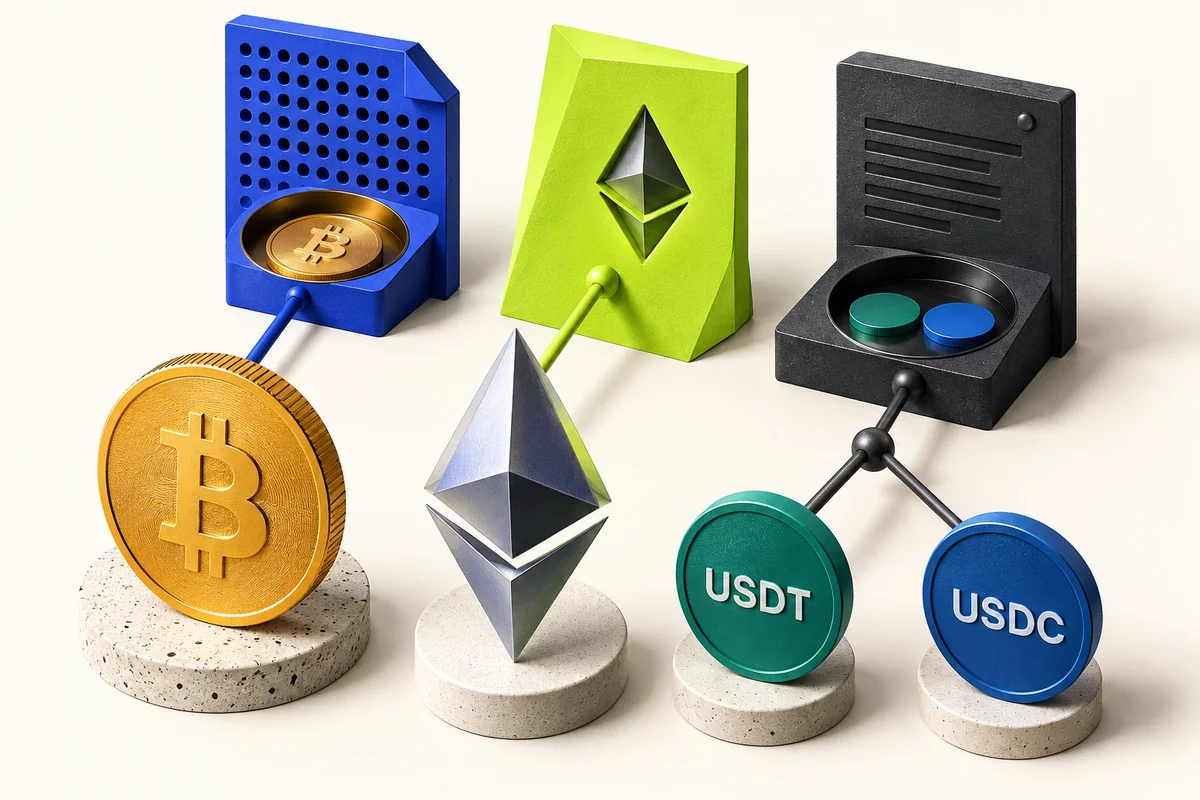
| Exchange / symbol | Contract / status | Settlement asset | Sizing unit |
|---|---|---|---|
| Binance · BTCUSDT | Linear perpetual · trading | USDT | BTC quantity |
| Bybit · BTCUSDT | Linear perpetual · trading | USDT | BTC quantity |
| Bybit · BTCPERP | Linear perpetual · trading | USDC | BTC quantity |
| OKX · BTC-USDT-SWAP | Linear swap · live | USDT | 0.01 BTC per contract |
| OKX · BTC-USD-SWAP | Inverse swap · live | BTC | 100 USD per contract |
| Deribit · BTC-PERPETUAL | Inverse perpetual · specification | BTC | 10 USD contract size |
Download the named contract records to inspect the original symbols, settlement assets and sizing fields.
A BTC trade funded in USDT is still a BTC trade
On a linear BTC/USDT perpetual, exposure follows the quantity of BTC, while profit and loss are calculated in USDT. Consider a hypothetical 0.1 BTC long opened at 100,000 USDT and closed at 105,000. The price difference is 5,000, so gross trading profit is 500 USDT. Fees and funding come afterward. The margin deposited to support the trade does not change that gross price result.
This is why USDT is often the natural first comparison for someone whose trading budget already sits in USDT. Converting to another collateral asset just to unlock a higher advertised multiplier adds a new cost and another balance to manage. It can be justified by a better contract or a specific strategy, but it is not automatically an improvement.
USDC linear products can serve the same broad stablecoin objective, yet their contract rules need a separate reading. Bybit's session settlement is one example; available markets and maximum tiers can differ as well. A cheaper USDC commission also has to offset any cost of obtaining USDC and converting the eventual result back to the asset you use.
Coin settlement changes the payout, not just the label
For a coin-settled inverse contract, the profit arrives in the underlying coin. Using the same hypothetical 100,000-to-105,000 BTC price move and a 10,000 USD inverse long, gross profit is approximately 0.0047619 BTC. At the assumed closing price, that equals 500 USD. The coin quantity is different from simply dividing a fixed percentage by the initial margin, and its later dollar value will move with BTC.
The choice matters after the trade too. A trader who closes with a BTC profit and continues holding that BTC still has spot exposure. A reader whose goal was to lock a stablecoin result would need a separate conversion. A BTC-focused trader may want exactly that coin balance. Neither preference makes the other contract inferior; they solve different payout requirements.
There is a second effect when the collateral itself is volatile. A BTC-backed long can lose on the position while the dollar value of its backing falls. That is a reason to examine the margin arrangement carefully when choosing the contract, rather than comparing only the maximum multiplier. The point is the interaction between the selected product and the balance you plan to keep.
Several accepted assets do not make settlement currency disappear
A multi-collateral account can accept an asset that differs from the contract's payout currency. The exchange may discount its value for margin purposes, convert balances or create a liability when a loss has to be paid in another currency. It is therefore possible to have positive total account equity and still incur a currency-specific financing cost.
For a trader who already holds several assets, that arrangement can be useful. For someone who only wants one USDT perpetual, directly funding the settlement currency may make the result easier to follow. Compare the benefit of keeping the original asset with the extra conversion or borrowing rules; an integrated account is a choice, not a requirement for trading futures.
How much crypto futures leverage is actually available?
The contract ceiling answers only the first part of this question. The exchange may apply a lower limit to a particular account, residence or position tier. Adding size can reduce the permitted leverage even when the ticker remains unchanged. A general ranking that prints one maximum beside an exchange logo misses the distinction that matters when the order is submitted.
| Contract | Published ceiling | Minimum / market-order cap |
|---|---|---|
| Bybit BTCUSDT | 150x | 0.001 BTC minimum; 150 BTC maximum market order |
| Bybit BTCPERP (USDC) | 125x | 0.001 BTC minimum; 200 BTC maximum market order |
| OKX BTC-USDT-SWAP | 100x | 0.01 contract minimum × 0.01 BTC contract value |
| OKX BTC-USD-SWAP | 100x | 0.1 contract minimum × 100 USD contract value |
The Bybit records provide a concrete example: the USDT and USDC BTC perpetuals have different ceilings, and different maximum market-order quantities. The minimum quantity happens to match at 0.001 BTC, but the matching minimum does not make the products identical. Nor does a 150 BTC market-order cap mean a trader can open that entire amount at 150x. Order size and risk-tier allowance are separate constraints.
The OKX records introduce another comparison issue: quantity is expressed in contracts whose values differ between linear and inverse products. In the collected linear record, a 0.01-contract minimum multiplied by a 0.01 BTC contract value represents 0.0001 BTC. In the inverse record, 0.1 contract multiplied by 100 USD represents 10 USD. These are recorded quantity minimums, not a guarantee that a private account can submit every such order at every price.
For a small position, the practical question is whether the required multiplier is available at that size. For a substantial position, the useful question becomes how much exposure the selected tier permits, what maintenance margin it requires and how the order can be executed. A smaller published maximum with a better usable position tier may be more relevant than an impressive number available only on tiny trades.
We do not infer Binance's maximum from its public exchange-information response: the collected record establishes the BTCUSDT product and settlement asset, but does not provide the account's leverage bracket. The large-position comparison addresses size as the primary selection criterion.
Perpetual or fixed-expiry futures for a longer trade?
Perpetuals suit a trade whose end date is flexible. An expiry contract suits a plan tied to a particular date or a trader who wants to compare a fixed forward price with ongoing perpetual funding. That does not make expiry futures free to hold: the quoted price can include a premium or discount relative to spot, and a trader who extends the position must consider the next contract.
Binance's September announcement listed new quarterly contracts across specific stablecoin and coin-settled markets. The useful fact is that an actual dated product exists for the intended asset, not that every coin on the exchange has the same choice. The announced leverage also varied by market. An altcoin trade therefore needs its own listed maturity, even when BTC already has the date you want.
The saved Binance instrument response identifies BTCUSDT_261225 and BTCUSDT_270326 as trading quarterly contracts, both using USDT margin. Their expiry dates are 25 December 2026 and 26 March 2027. Those are concrete candidates for a BTC trader comparing dates; they do not imply an equivalent dated contract exists for every token. The downloadable records retain the symbols and delivery timestamps.
An open-ended trade or a fixed finish date?
- OpenEnter at the perpetual’s quote.
- While openFunding can be paid or received.
- CloseExit when your plan calls for it.
- OpenThe quote may differ from spot.
- Before expiryYou can close the trade early.
- 25 Dec 2026Settlement if still held at expiry.
Want exposure beyond December? The March 2027 contract is a separate trade, with its own quote and fees.
A hypothetical one-month comparison
Suppose spot BTC is 100,000 and a contract expiring near your intended exit is quoted at 101,000. A 0.1 BTC long begins with a 100 USD premium relative to spot exposure. A perpetual instead trades near spot but can charge or pay funding throughout the holding period. Compare the relevant funding expectation with that premium, commissions and executable prices; do not label one product cheaper solely because it has no periodic funding line.
The expiry result also depends on whether you hold to settlement or close early. Before expiry, the contract can trade at a changing premium. A trader ending the position sooner than planned is exposed to that change, just as a perpetual trader is exposed to changing funding. The correct comparison follows the intended exit, not a simplified assumption that every holder waits until the final settlement.
For a short, the direction of the premium and funding benefit changes. A positive forward premium can be attractive to a hedger selling the dated contract, but it does not remove the margin requirement or protect against liquidation before the hedge finishes. The comparison concerns the contract's pricing, not a claim of guaranteed income.
When expiry adds unnecessary work
If you trade in and out frequently and do not care about a particular date, comparing several expiry months may add little value. A well-supported perpetual can be the more direct choice. If you expect to maintain exposure for months, however, the expiry alternative deserves a calculation. That is the reader for whom Binance's contract range or Deribit's specialist focus can materially change the shortlist.
Funding, session settlement and the cost of keeping a position open
Funding is a contract-level transfer, not a fixed daily charge that can be copied across an exchange. We collected matching public BTCUSDT funding observations from Binance, Bybit and OKX. Over the 72-hour window ending 4 October 2026 at 16:00 UTC, a constant 10,000 USDT long would have paid the amounts below. The calculation uses nine settled observations per product and does not compound them.
72-hour BTC funding comparison
10,000 USDT constant long exposure · ending 4 Oct 2026, 16:00 UTC
View calculations and download the observations
| Product | Funding | Long + fees | Short + fees |
|---|---|---|---|
| binance | 2.9260 | 12.9260 | 7.0740 |
| bybit | 2.5168 | 13.5168 | 8.4832 |
| okx | 2.7388 | 12.7388 | 7.2612 |
Sum of 9 settled rates × 10,000. No compounding. USDT treated at USD parity. Short reverses the funding sign.
Download dated observationsBybit had the smallest funding total in that window, approximately 2.52 USDT, followed by OKX at 2.74 and Binance at 2.93. Yet after adding two regular taker fills, the calculated long totals become about 13.52, 12.74 and 12.93 USDT respectively. The funding leader did not become the lowest completed commission-plus-funding result. Execution, conversion and transfer costs are still outside this calculation.
This is a useful product comparison because it changes with direction and duration. A short receives the positive funding in the sample, and a longer holding window can give the funding difference more time to outweigh the commission difference. The fee ranking examines the seven-day case and provides the raw observations, rather than turning one short sample into a permanent exchange score.
Quoted intervals do not always mean identical payment mechanics
The collected Binance, Bybit and OKX histories can be aligned by settled timestamps for this BTC sample. That does not justify assuming every perpetual uses the same schedule. A different coin can have a different interval, and a platform can change a contract's timing. Comparing the raw percentage without the period can make a more expensive product look cheaper.
Deribit's continuous funding is particularly relevant here. A trader looking at an eight-hour rate must account for how long the position was held under that rate, rather than treating the entire interval as a single all-or-nothing event. This difference belongs in the product comparison because a strategy based on entering or exiting around settlement cannot be transferred unchanged between venues.
Why a Bybit USDC entry price can move without another order
Bybit's USDC session mechanism realizes the period's trading result and resets the position's reference entry to the settlement mark. The position can remain open. A trader comparing yesterday's screenshot with today's average entry may otherwise mistake the change for an unauthorized trade or lost profit. Look at the realized cash movement and the remaining position together.
Session settlement and funding are different lines in the account history, even when their timing coincides. One moves trading profit or loss into cash; the other transfers value between opposing positions. Adding both as if they were fees would overstate the cost. Equally, treating a realized profit transfer as a new trading gain on top of the original total would double count the result.
What matters when opening and closing the actual futures contract?
Compare the quote at your size, not exchange-wide volume
An exchange can be busy overall while a particular altcoin perpetual has a thin book. The relevant comparison is the amount available near the desired entry and exit prices for that contract. BTC volume does not prove good execution in a newly listed token; spot volume does not prove futures liquidity. This is why our product recommendations stop short of declaring a universal liquidity winner.
For a hypothetical 20,000 USDT order, an extra 0.10% execution cost is 20 USDT on that side. That can exceed the difference between several regular commission schedules. A visible best price is only the first available level, not necessarily the average price for the entire order. If a limit order waits instead, its lower fee has to be weighed against the chance it never executes.
A fair comparison uses the same direction, size and moment. Comparing one platform's buy quote with another platform's sell quote, or quotes recorded several minutes apart, mixes market movement with venue quality. For a real decision, the final order preview is more relevant than a broad claim about being a top-volume exchange. We have not presented hypothetical quote differences as measured fills.
Position mode determines what an opposite order does
In one-way mode, an opposite-side trade normally reduces or reverses the net position. In hedge mode, the account can maintain separate long and short sides under the product's rules. This matters when the task is taking partial profit: the trader wants the existing exposure reduced, not a second position opened by mistake.
Bybit's current USDC documentation and OKX's futures-mode table both support a more precise comparison than a generic hedge-mode badge. The selected account and contract still determine the available workflow. A hedge feature is useful to someone deliberately running separate sides, but adds no automatic advantage for a trader who wants one net BTC position.
Closing a perpetual and settling an expiry contract
A perpetual remains open until it is closed, liquidated or otherwise settled under the product rules; a dated future adds a scheduled settlement. On the saved Binance BTC contracts, choosing December rather than March changes the date at which the contract finishes. A trader intending to remain exposed past December would need to manage that transition instead of assuming the existing symbol continues indefinitely.
Closing the December contract early uses the price available for that contract then. Buying the March contract creates a separate entry whose premium can differ. Even with the same underlying BTC amount, those two fills need their own execution prices and commissions. The useful platform feature for this task is access to both intended maturities and their books; the 100x ranking covers the separate stop and liquidation sequence.
Contract availability, withdrawals and regional access
For a specific altcoin, confirm the active perpetual before considering the exchange's position in this ranking. A spot listing, an announcement of a future launch and a live derivatives contract are three different states. The public records used in the table above explicitly identify trading status.
The same precision applies to collateral transfers. A token accepted for deposit is not necessarily enabled as margin for every product. A supported withdrawal asset can also have network-specific availability. If the purpose of funding an account is a particular futures trade, the deposit, trading and eventual withdrawal must form one usable route.
Residence determines which exchange entity and products are available. A global perpetual account, a regional spot account and a separate US futures service are not interchangeable. Kraken's eligibility documentation makes that separation explicit. Readers in restricted markets should use the relevant country page to compare available products, rather than treating a wallet connection or a global website as proof of eligibility.
December or March BTC futures: avoid an unnecessary roll
The saved Binance records include BTCUSDT_261225 and BTCUSDT_270326. For a plan ending in January, the December contract introduces a transition before that intended finish, whereas the March contract extends beyond it. This does not automatically make March cheaper: compare its quoted premium and executable depth. It does identify an extra transaction the December route would require if exposure is to continue.
As an illustrative price comparison, suppose the December future trades at 101,000 and March at 102,000 while the intended amount is 0.1 BTC. The difference between those contract prices represents 100 USDT at that quantity. It is a difference in forward pricing, not a fee charged by the exchange or a guaranteed profit from switching maturities. Commissions apply to the actual trades, and both futures prices can change before a planned switch.
For a trader who needs no fixed finish date, a perpetual avoids choosing a maturity but substitutes variable funding for that calendar decision. Binance’s range earns its place when dates and payout currency matter; Bybit’s active-perpetual controls address another task. Choosing the contract family first makes the exchange comparison shorter and more useful than treating every product with a Futures label as interchangeable.
Crypto futures exchange FAQ
Do USDT and USDC futures share the same order book?
Do not treat them as one market. The named USDT and USDC products have separate contract records and can show different prices, liquidity and parameters. An excellent BTCUSDT quote does not establish the price available for a USDC-settled BTC order. If you switch settlement asset, repeat the comparison using that product rather than carrying over the first market’s spread or leverage limit.
Do I receive Bitcoin when a BTC futures trade is profitable?
Only if the selected product pays in BTC. A BTC/USDT linear perpetual produces its trading result in USDT; a coin-settled inverse BTC contract produces a BTC amount. The underlying asset and payout asset are different fields. This matters if your objective is accumulating Bitcoin, preserving a stablecoin budget or avoiding a conversion after closing the position.
Why does the same BTC market have different leverage on USDT and USDC?
They are separate products with their own parameters. In our collected Bybit records, BTCUSDT publishes 150x and BTCPERP publishes 125x. Neither is a universal account entitlement, and their order-size limits differ as well. A comparison that transfers the larger ceiling to both products would be wrong even though both track Bitcoin.
How do I reconcile profit after several USDC session settlements?
Combine the realized amounts transferred during the sessions with the remaining unrealized result, then account for fees and funding separately. For example, 120 USDC realized earlier plus 30 USDC still unrealized represents 150 USDC of gross trading result, not 270. A reset entry price describes the current session; it does not erase earlier cash movements from the position history.
Are crypto expiry futures always cheaper than perpetuals for a month?
No. A dated future can include a premium or discount, while a perpetual has changing funding. Your direction, exit date and executable quotes decide the comparison. Closing the dated contract early also exposes you to changes in its premium. The absence of a periodic funding charge is only one feature of the price, not proof that the completed trade costs less.
Can a delisted perpetual be replaced by the exchange’s spot market?
Not as an equivalent position. Spot ownership has different funding, exposure and liquidation mechanics from a futures contract. A derivatives delisting also has its own closing or settlement process, which the relevant exchange announcement should specify. If keeping the same futures exposure is necessary, compare an active contract elsewhere and include the cost of closing, transferring collateral and reopening.
Does holding both long and short remove futures costs?
No. Separate sides can incur commission on multiple fills and may still consume margin under the account's rules. Funding may offset for equal exposure in the same product, but different sizes or contracts need their own calculation. Hedge mode describes a position-management capability; it is not a discount or a guarantee of a cost-free neutral strategy.
Is a public contract record proof I can trade it from my country?
No. It establishes a published instrument and its recorded parameters, not the permissions of a private account. The product may be unavailable through the regional business serving your residence, or your account may have a lower limit. Use the instrument record to compare products and the country-specific account rules to establish access; both are needed for a usable recommendation.
Sources and research
Official documentation reviewed on 4 October 2026. Account-specific screens can apply different terms. Funding has its own dated collection window.
- Binance — USDⓈ-M and COIN-M products
- Binance — September delivery contract listing
- Bybit — USDC contract questions
- Bybit — attached exits and reduce-only instructions
- Bybit — Unified Trading Account
- OKX — futures and multi-currency account modes
- Deribit — listed linear perpetual contracts
- Deribit — inverse perpetual specifications
- Kraken — derivative contract families
- Kraken — derivatives eligibility
- Hyperliquid — fee schedules
- Bybit — public instrument parameters
- OKX — public instrument API
- Binance — USDⓈ-M exchange information
- Bybit — BTCUSDT settled funding records
- OKX — BTC-USDT-SWAP settled funding records
- Binance — BTCUSDT settled funding records
- Deribit — fee schedule effective 1 August 2026