
Who should choose Deribit for crypto futures?
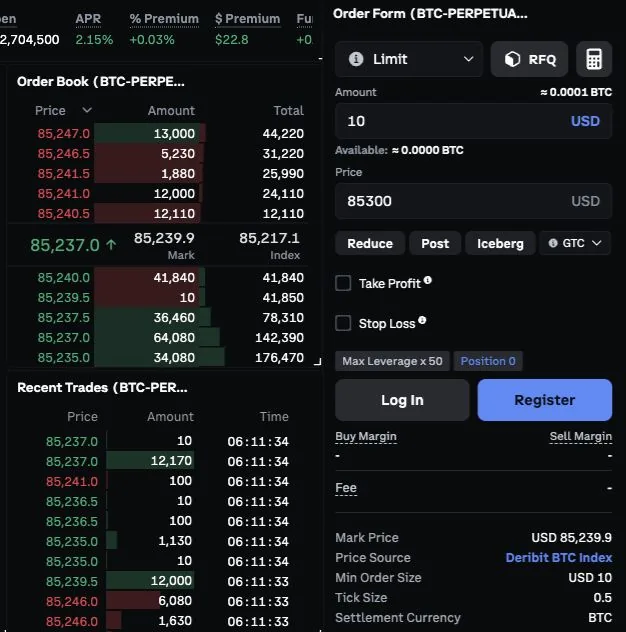
A simple BTC perpetual does not require an options strategy. The public BTC-PERPETUAL ticket still offers recognizable controls: limit pricing, Reduce, Post, take profit and stop loss. An eligible trader can use those without becoming an options specialist. The question is whether the account's settlement and margin structure fits the trade, rather than whether the exchange is famous for another product.
For a pure directional trader, the strongest immediate comparison is current execution cost and the exact contract. Deribit's standard taker reference is competitive, but BTC-settled and USDC-settled markets produce different balances. A reader who wants a familiar stablecoin result should examine the linear market rather than defaulting to BTC-PERPETUAL because it appears first.
Perpetual or dated future: choose the reason for holding it
Deribit offers perpetuals without an expiry and futures with a specified maturity. The practical distinction is the way you expect to carry and finish the trade. A perpetual is convenient for an open-ended directional view, with funding accruing along the way. A dated contract can align a hedge with an event or an option expiry, but its price includes a premium or discount relative to the underlying market.

Suppose the intended hedge lasts until a particular options expiry. A matching dated future can be more coherent than carrying an unrelated perpetual and deciding later how to unwind it. Conversely, a trader repeatedly changing direction over short periods may have little use for a distant maturity. The dated contract's existence is not a reason to introduce an extra rolling decision.
A futures premium is also not an automatic return. If a later-dated contract trades above spot, the comparison must include the hedge, financing or collateral costs, execution on both legs and the plan for settlement. Buying the expensive future by itself is a directional trade with an entry price, not a way to collect the displayed annualized premium.
Deribit’s catalogue contains BTC inverse maturities and USDC-settled contracts, plus non-crypto instruments. The comparison below uses named crypto contracts so that a large total instrument count does not obscure the actual futures choice.
For most readers comparing exchanges, the useful order is: choose the holding purpose, then expiry or perpetual, then settlement currency. Selecting an account's margin model comes after those choices. Starting with the most advanced margin setting and finding a trade to use it on reverses that process.
BTC settlement versus USDC settlement on Deribit
BTC-PERPETUAL is quoted in USD but settles in BTC. Its minimum trade amount is 10 USD of contract exposure in the current public record. A quantity of 1,000 on that inverse market therefore means 1,000 USD, not 1,000 BTC. The coin-equivalent estimate in the ticket helps make that distinction visible.
BTC_USDC-PERPETUAL is linear and uses BTC quantity with USDC settlement. The published minimum is 0.0001 BTC. At an illustrative BTC price of 85,000, that represents 8.50 USDC of exposure. These are two different minimum-order conventions, not evidence that one venue requires a ten-BTC starting balance or that every Deribit order is entered in dollars.
| Instrument | Order amount | Settlement |
|---|---|---|
| BTC-PERPETUAL inverse | USD; 10 USD minimum | BTC |
| BTC_USDC-PERPETUAL linear | BTC; 0.0001 BTC minimum | USDC |
The settlement decision affects how you judge the result. With inverse BTC exposure, gains and losses change the BTC balance. If the value of BTC itself moves, the dollar value of that balance changes as well. With a linear USDC contract, the trading result is easier to track in stablecoin units, though the collateral and account model can still introduce other exposures.
For example, a reader who holds BTC for the long term and wants a coin-denominated hedge may find inverse settlement deliberate and useful. Another reader who budgets each strategy in stablecoins may prefer linear settlement so that a winning trade produces the unit used for the next trade. Neither choice is universally superior; it follows from what balance the reader wants to manage afterward.
Cross collateral can let an asset support a contract settled in another currency. It does not rename the settlement currency of the contract. That is the point at which a profitable overall account can still have a negative balance in one currency. We explain that account consequence separately below rather than imply that all balances become interchangeable once cross collateral is enabled.
Deribit leverage limits changed: perpetuals and dated futures differ
Deribit's standard-margin guidance updated in September 2026 uses a position-size curve. The starting maximum applies only to the initial part of permitted size; available leverage falls as exposure grows. The current BTC, ETH, SOL and XRP perpetual group starts at 50x. Major dated futures belong to a different group that starts at 25x.
That means a reader moving from a BTC perpetual to a BTC maturity should not carry over the 50x assumption. It is the same underlying coin, but not the same risk schedule. The captured BTC instrument catalogue corroborates the distinction between the perpetual maximum and dated-contract maximum. The headline belongs to the product, not to the exchange as a whole.
Same BTC market view, different starting allowance
Starts at 50x
BTC standard-margin perpetual group; leverage decreases with size.
Starts at 25x
A separate schedule applies when the contract has a maturity.
A published linear BTC example uses a maximum amount of 1,769 BTC and retains the 50x start through five percent of that amount, or 88.45 BTC. Beyond that range the curve reduces leverage. At 150 BTC, the documented example is approximately 25.51x, corresponding to around 3.92% initial margin. It is not a flat 50x allowance for any size that fits beneath the total position cap.
For a small directional position, the distinction may seem remote, but it matters when a portfolio already has exposure in the same market or a strategy scales up. It also changes how reviews should compare maximum leverage: Deribit's 50x starting point and another venue's larger headline do not describe the same size allowance or account structure.
Portfolio-margin accounts do not simply apply this standard-position formula to each trade. Their requirement comes from the combined portfolio assessment. The size curve above applies to standard margin; it cannot calculate a portfolio-margin requirement. A single leverage number cannot summarize every Deribit account.
Deribit futures fees: what the current standard rate means
The current fee table gives 0.015% maker and 0.035% taker for standard futures and perpetual trading. Our public instrument capture returned matching fee fields. These replace the older zero-maker and 0.05% taker figures still found in some reviews. Rates for a qualified account can be lower, but a new reader should not be assigned an unearned VIP tier in a comparison.
Consider a 60,000 USD-equivalent entry followed by a 63,000 exit. If the entry adds liquidity and the exit takes it, reference commission is nine plus 22.05, or 31.05 USD-equivalent. Two taker executions at those same respective values cost 43.05. The example isolates commission; an inverse contract charges the applicable settlement-currency amount rather than depositing a dollar-denominated bill into the account.
The order's behavior matters more than its label. A marketable limit order can remove liquidity. Deribit's Post setting is relevant when the intention is to remain a maker, while the fee guide gives special treatment to hidden iceberg quantity. The public ticket exposes those controls together, but activating an iceberg does not justify assuming the entire fill receives maker pricing.
For a frequent trader, the difference between nine and 21 on a 60,000 entry is worth comparing, but it should not dominate every choice. An unfilled resting order can miss the trade, and a poor exit can overwhelm the commission saving. We use the reference rates to build a realistic cost baseline, not to claim execution quality from a fee table alone.
VIP qualification also separates futures volume from options volume; reaching a qualifying tier in one can affect rates across products, but the two volume figures are not simply added together to reach a threshold. Equity-based qualification has its own currency and averaging requirements. This is relevant to an existing Deribit account, but it is not a reason to move a large balance merely to make the review's cheapest example apply.
Continuous funding: the eight-hour label is not an escape window
Deribit expresses perpetual funding on an eight-hour basis while accruing it continuously over the time the position is held. That is materially different from interpreting “Funding/8h” as a single charge that can always be avoided by leaving just before a timestamp. The public terminal's eight-hour label describes the rate basis; the funding specification explains the accrual.
A controlled example shows the consequence. Assume a stable 20,000 USDC position and an unchanged funding rate of 0.016% per eight hours. Holding it for two hours corresponds to 0.80 USDC of funding at that rate: one quarter of the full eight-hour amount. A real position's size and rate can move, so the actual calculation follows those changing inputs rather than this fixed example.
Funding is recorded through realized P&L, with cash movement associated with daily settlement. That settlement does not mean the perpetual expires or that the trading venue closes for the day. A reader reconciling the account needs to distinguish the open position, the running result and the cash balance available for withdrawal. Those can show different stages of the same trading result.
The funding formula also includes a dampening range and product-specific caps. We do not interpret a small quoted premium over the index as an identical funding charge without those adjustments. Nor do we extrapolate a brief negative rate into a durable income opportunity. The relevant comparison is the carrying cost of the intended position over its actual holding period.
For a longer hedge tied to a known date, this is a reason to compare a dated future rather than automatically roll a perpetual through successive funding periods. The dated contract has its own premium, execution and settlement costs. There is no universal answer that funding or a futures premium is cheaper; the market prices and the hedge horizon decide.
Dated futures expiry: what settles and what does not
Deribit dated futures are cash settled in the contract's settlement currency. Holding a BTC inverse future to expiry does not cause a spot purchase or physical delivery of the full contract's BTC amount. The profit or loss is settled instead. Linear futures use USDC, while inverse BTC and ETH products use their respective coins.
The published delivery method uses an index average over the final thirty-minute window, rather than the last trade printed at the instant of expiry. That difference matters to a reader hedging an exposure against a single spot-exchange price. A position can settle as designed while producing a small difference from the final price seen on another chart.
| Product | Cash result | Carry or final event |
|---|---|---|
| Inverse perpetual | BTC | Continuous funding; no expiry |
| Linear perpetual | USDC | Continuous funding; no expiry |
| Inverse dated future | BTC | Specified index-based expiry |
| Linear dated future | USDC | Specified index-based expiry |
Expiry also has a cost distinction. The fee schedule includes delivery charges, with a stated BTC/ETH weekly-futures exemption and separate rows for other futures. We would identify the exact instrument before relying on an exemption, particularly across inverse and linear products. Closing before expiry pays an execution cost; holding to delivery may involve a different charge and avoids the need for a closing fill.
A practical comparison is therefore between two complete endings to the same trade. One plan closes into the order book, accepting its spread and commission. Another waits for the specified settlement calculation and relevant delivery charge. The second plan is not automatically cheaper just because it omits a manual exit order, and it may not match the time at which the underlying exposure ends.
If the position is part of a futures-and-options combination, expiry can also change the portfolio itself. Deribit's linear option settlement can create an expiry-future position that then nets against an existing future before cash settlement. That is a specific reason to inspect the combined expiry exposure. It does not require an options encyclopedia, but it does mean the futures leg should not be reviewed in isolation.
Standard or portfolio margin: which fits your Deribit account?
Deribit has two separate account decisions. Standard versus portfolio margin determines how the positions' risk is assessed. Segregated versus cross collateral determines how supporting currencies are treated. Combining those choices gives four modes. Cross collateral and portfolio margin are not interchangeable names for one advanced setting.
Under standard margin, position requirements are calculated separately and then combined. A relatively small, simple futures position can be easier to understand in this arrangement and may require less margin than it would under portfolio margin. The advanced-sounding label is not evidence of a better result for that trade.
Make two different margin decisions
- How is risk measured?
- Standard or portfolio
Individual position requirements versus combined scenario testing.
- Which balances support it?
- Segregated or cross collateral
Settlement-currency separation versus eligible currencies supporting the account together.
Under portfolio margin, the account is tested across a set of adverse price and volatility scenarios. Some positions may reduce the risk contributed by others, but the margin result depends on the whole portfolio and additional charges. The worst scenario tested by the model is not a promise about the maximum loss that could occur in the real world.
“Segregated” requires careful reading here. In segregated standard margin, the separation is by settlement currency; it is not a promise that each BTC trade has an isolated collateral pot. Several BTC-settled positions can still draw on the same relevant balance. Someone expecting a separate isolated-margin loss budget per trade should not infer that behavior from the word alone.
Our decision rule is to start with the actual positions, not the prestige of a mode. A single USDC perpetual does not establish a need for portfolio margin. A collection of futures and options with offsetting exposures provides a reason to model it. Cross collateral then answers the different question of whether balances in other currencies should help support that portfolio.
When futures and options can offset—and why a hedge is not a free pass
Imagine a portfolio with a short BTC call and a BTC futures hedge intended to reduce its immediate upward-price exposure. Those legs are connected, so summing their standalone margin requirements can miss part of the relationship. Portfolio analysis can recognize that some adverse moves in one leg are helped by the other.
However, matching the current directional exposure does not make the positions identical. The option's response changes with price, time and expected volatility, while the future behaves differently. A hedge that looks balanced at today's price can become unbalanced after a large move. That is why the useful test includes more than a single unchanged-price snapshot.
The timing of the legs matters as well. If an option expires before the futures hedge, the account can be left with an unwanted directional future. If the hedge is removed first, the remaining option can demand more margin. The portfolio should be assessed both as it stands and as it would look after the intended next action. A good combined entry does not guarantee a good partial exit.
What happens when one leg ends first?
Deribit's portfolio models evaluate those relationships within their documented currency and risk framework. They do not give every BTC/ETH pair a fixed diversification discount, nor eliminate charges merely because one leg is long and another short. We therefore avoid publishing an invented universal percentage saving for switching modes.
For a futures-focused reader, this is the decisive benefit of considering options at all: they may change the structure of an existing hedge or exposure. If the reader has no such need, a simpler perpetual account may be more appropriate. Deribit is strongest when the extra analysis produces a concrete decision, not when a review simply lists Greeks and margin formulas.
Use Position Builder to test the next change, not just the entry
Deribit's Position Builder allows hypothetical futures-and-options portfolios without placing trades. Its documentation distinguishes simulated equity and positions from live account execution. The margin-model selector changes the simulation rather than the account's actual setting. This makes it useful for evaluating a proposed structure before treating the model's result as a reason to trade.
A worthwhile first scenario is the portfolio after removing a hedge. If your plan includes selling an option back or closing a future first, model that remaining exposure. The original combined trade can look comfortable while the intermediate state is considerably more demanding. That is an account-management question an isolated payoff chart can miss.
A second useful scenario moves time beyond the first expiry. The tool intentionally retains expired options' expiry P&L in its calculations rather than erasing their contribution to a multi-expiry strategy. If the question is only about currently active risk, the relevant expired positions must be excluded from the simulated view. Otherwise, a user may mistake a historical payoff contribution for ongoing protection.
Our recommendation is to use the tool to expose dependencies: which leg is doing the hedging, when that protection changes and which balance supports the remaining position. It is less useful to select the most attractive simulated outcome and treat it as a forecast. The result depends on model assumptions and does not establish available execution prices or the final authenticated margin requirement.
The Position Builder can help compare a proposed portfolio under different conditions. We did not connect a private account or backtest a funded portfolio; the diagram identifies the inputs to test.
Model what remains after the next action
- Before the changeIdentify which futures leg offsets the options exposure.
- After removing that hedgeReassess the remaining risk and margin requirement.
- After the first expirySeparate the settled result from protection that is still active.
Cross collateral: one supported portfolio can still owe a currency
Cross collateral lets eligible balances help support positions settled in other currencies. Deribit's current specification values them in USD and applies the relevant treatment. For example, the published standard cross-collateral haircut for USDT is two percent, while other assets have different rules. A 10,000 USD-equivalent USDT holding would contribute 9,800 before any other applicable constraints in that simplified example.
The economic benefit is reduced need to reshuffle collateral for every settlement currency. The cost is that balances become connected. A trader who deliberately wanted a BTC reserve outside the support for another strategy should consider whether cross collateral matches that intention. More usable collateral is not automatically better account organization.
A negative settlement-currency balance can also remain even when the total portfolio is solvent. The fee schedule describes a collateral charge and rebalancing conditions. That is a separate issue from the perpetual's funding rate. A reader seeing an unexpected cost should establish whether it came from market funding, trading commission or a currency deficit before comparing the account with another venue.
For reporting, use the account's relevant total rather than adding every displayed currency-equivalent margin value. Some figures are converted presentations of the same cross-collateral result. Summing them can double-count the available support. This is a practical reading issue in a multi-currency interface, not a new source of extra margin.
We would enable this structure only where the supporting assets and the intended settlement obligations make sense together. If all trading is in a single USDC contract funded with USDC, its incremental benefit may be small. When several settlement currencies are actively managed, the flexibility can be substantial, but so is the need to reconcile the resulting balances.
Deribit liquidation can leave positions to manage afterward
Deribit's liquidation process attempts to reduce risk incrementally when account margin is insufficient. It does not necessarily close every position at once. During the process, the trader loses control over the liquidation actions until the account returns within the required maintenance condition. Waiting for a discretionary margin-call conversation is not part of the documented mechanism.
Portfolio-margin liquidation has a particularly important consequence: the system can establish a futures hedge as part of reducing portfolio risk. If the process stops after margin is restored, such a hedge can remain open. The account holder then has a position to manage that may differ from the original strategy.
That makes the post-liquidation account review essential. The relevant question is not only how much balance remains, but what positions and exposures remain with it. Assuming the account must be flat because liquidation occurred can leave an unintended future unattended. This is one of the concrete reasons portfolio margin deserves more preparation than a simple single-position interface.
The fee table lists a one-percent total liquidation charge for the named BTC, ETH and USDC futures/perpetual products. That total includes the ordinary trading component; it should not be described as one percent plus another full standard taker charge. An ordinary voluntary close is a different event. We do not include liquidation as an expected routine cost in the maker/taker examples.
Deribit by Coinbase: the trading channel still matters
The Coinbase integration changes the product environment, but it does not make every account route interchangeable. Existing Deribit users, Coinbase retail users and institutions onboarding through Coinbase have different account relationships. The official transition explanation preserves the existing retail app/web route and describes a separate institutional migration.
Coinbase's current institutional onboarding page specifies eligible non-US institutions for that named Global Exchange product, with its own application and trading channels. Separate announcements about eligible US institutional options access concern a different arrangement and timeline. Neither statement establishes unrestricted direct Deribit perpetual access for a US retail reader.
For someone comparing futures venues, the practical questions are where the account is held, which instrument is available through that route and which fee and margin terms apply. A shared matching engine does not by itself answer those questions. Our Deribit figures describe the direct product and the public documentation cited, not every possible Coinbase screen.
The integration also broadens the catalogue beyond the older BTC/ETH-centric description of Deribit. We verified current public instruments rather than assume a pre-integration review still represents the product. At the same time, advertised additional contracts include non-crypto markets; they should not inflate a claim about the number of crypto perpetuals.
Readers using Coinbase as their account home should consult our separate Coinbase derivatives review alongside this one. The aim is to preserve the useful distinction between the execution venue and the account through which the reader reaches it. Treating the acquisition as a universal geographic permission would be both unhelpful and inaccurate.
Reading the Deribit ticket and announced contract changes
The inspected BTC-PERPETUAL order form identifies USD as the quantity unit and BTC as settlement. It also presents Reduce, Post and Iceberg, with separate take-profit and stop-loss controls. Those labels are useful, but the most important first check is still the contract identity. A similar-looking USDC instrument can use a different quantity convention.
Some linear perpetual specifications also have scheduled parameter changes. The documentation available during this review announced changes to selected altcoin tick sizes and quantities after 09:00 UTC on 6 October. The research capture preceded that time, so we do not label the scheduled change as a verified deployment. For this particular update, Deribit says quantities and prices conforming to the old increments also conform to the smaller new increments. Existing valid instructions do not need arbitrary resizing simply because the change was announced.
Deribit or a simpler perpetual exchange?
Choose a simpler perpetual workflow if the strategy does not benefit from those relationships. A single stablecoin-funded BTC position may be easier to manage in an account whose controls already fit the reader. Phemex's separate long/short organization or Bybit's account workflow can be more relevant than Deribit's options toolkit for that particular need.
For a reader moving from another derivatives venue, the fair comparison includes the same settlement currency, exposure, likely execution type and holding period. It should also compare what happens when one leg is removed or an expiry passes. An attractive initial margin figure is insufficient if the intended exit leaves a difficult remainder.
Deribit futures: your questions
Is Deribit BTC-PERPETUAL the same as BTC_USDC-PERPETUAL?
No. BTC-PERPETUAL is inverse, uses USD order amounts and settles in BTC. The linear BTC_USDC perpetual uses BTC quantities and settles in USDC. Choose the balance you want to manage rather than assuming similar tickers describe identical contracts.
Does Deribit currently offer 50x on dated BTC futures?
The current standard-margin tables separate products. Major perpetuals start at 50x; major dated futures start at 25x, with available leverage declining as size grows. Portfolio-margin requirements use a different account-level assessment.
Can I avoid Deribit funding by closing just before eight hours?
The funding rate is expressed over eight hours but accrues continuously. A shorter holding period can still accumulate funding. Daily cash settlement is a separate accounting event, not the moment at which all funding suddenly becomes payable.
Is Deribit segregated margin isolated for every position?
No. Segregated refers to settlement-currency separation. Several BTC-settled positions can share the relevant BTC support. Do not treat it as a separate loss budget for each trade merely because the name includes segregated.
Can a Deribit liquidation leave a new futures position open?
Yes. Under portfolio margin, the documented liquidation process can use a futures hedge to reduce risk. If liquidation stops after the margin condition improves, that hedge can remain and must be managed with the rest of the account.
Does the one-percent Deribit liquidation rate exclude the trading fee?
The published total for the named futures and perpetual products includes both the regular trading component and the additional liquidation charge. Adding another full standard taker fee to that total would double-count that component.
Can Position Builder place the trades it simulates?
No. It models hypothetical positions and portfolio outcomes. Changing the simulation margin model does not change the real account setting. Its results depend on assumptions and do not prove an executable price or final account permission.
Does Coinbase ownership make direct Deribit perpetuals available to every US user?
No. Direct Deribit, Coinbase retail derivatives and Coinbase institutional arrangements have separate eligibility and product terms. Announcements about a particular US institutional options route do not establish unrestricted direct perpetual access.
Evidence behind this reviewSources and research
Sources and research
Review based on official product documentation, public contract data and signed-out interface inspection on 6 October 2026. No funded trading, identity verification or withdrawals were tested. Numerical scenarios are calculations, not execution results.
- Deribit current fees and liquidation totals
- BTC instrument catalogue
- USDC instrument catalogue
- Standard-margin product groups and size curve
- Inverse perpetual settlement and funding
- Linear perpetual contract specifications
- Inverse dated futures
- Linear futures and option-expiry interaction
- Funding calculation specifications
- Margin modes and account scope
- Portfolio-margin framework
- Position Builder capabilities and limitations
- Cross-collateral currencies and valuation
- Incremental and portfolio liquidation
- Coinbase and Deribit account-channel transition
- Coinbase institutional onboarding scope
- Inspected Deribit perpetual terminal