
Coinbase perpetual futures: what are you choosing?
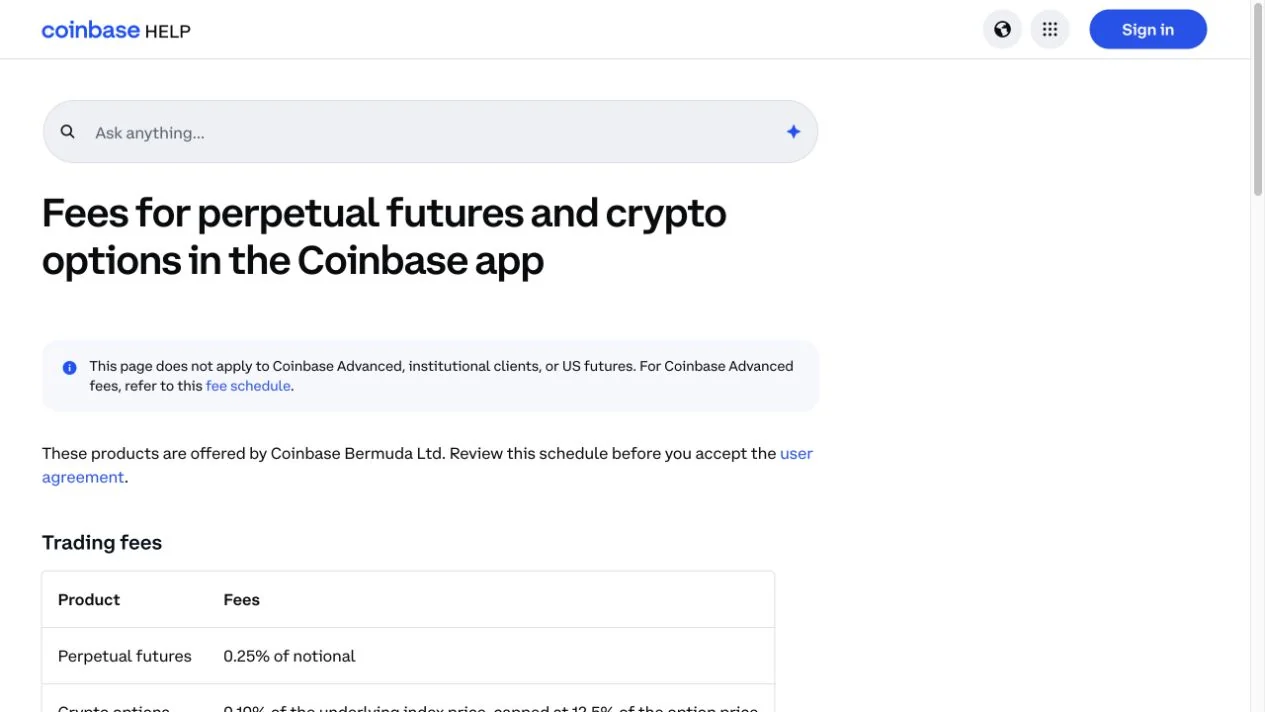
Our preference is Coinbase Advanced for a reader who actively manages futures positions and wants more control over orders. The simpler app experience may be easier to navigate, but its published perpetual fee is 0.25% of notional on both opening and closing. Advanced has a separate account-based schedule. Comparing those modes is more consequential than choosing between two cosmetic versions of the same screen.
This dossier retains the familiar Coinbase International Exchange route while reviewing the Global Derivatives rules effective from October 2026. Coinbase’s integration brings Deribit execution infrastructure into the service. For retail users, the important question is which Coinbase interface and account terms apply; for institutions, the transition also changes APIs, subaccounts and records. Those are separate reviews even when both use the same underlying venue.

Coinbase Advanced, the simple app and Deribit are different routes
Retail users stay in Coinbase
Coinbase's transition notice says retail users continue trading through its app and website, including Advanced. The execution infrastructure changes behind that interface. That does not mean a customer must move funds to an unrelated website because a review mentions Deribit, nor does it mean every product listed directly on Deribit automatically appears in Coinbase.
| Route | Why choose it | What to compare |
|---|---|---|
| Advanced retail | Order-book controls inside an existing Coinbase account | Your authenticated derivatives fee tier and eligible contracts. |
| Simple Coinbase app | Simpler position workflow | The published 0.25% charge on both entry and exit. |
| CBBM institutional routing | Dedicated institutional account and Deribit access | Deribit fee schedule, subaccounts and account agreement. |
| US derivatives | Domestic product eligibility | US contract specifications; global perps rules do not transfer. |
For a trader comparing exchanges, the distinction is valuable. The interface determines the order controls you can use and the fee schedule you see. The execution venue influences how the contract is matched and managed. The account entity establishes the agreement and eligibility. Those layers can belong to the same corporate group without becoming one identical product for every user.
International institutions have a separate operational change
The institutional FAQ describes Coinbase Bermuda as broker and custodian, routing orders to Deribit. It also describes mapped subaccounts, new trading API credentials and endpoints, and legacy International Exchange access for historical data. These are substantive changes for a business running automated orders, but they should not be presented as setup requirements for every individual Coinbase customer.
The old and new histories need separate handling. An automated strategy that can still retrieve an old trade record has not proved that its old endpoint accepts new trades. For a migration review, data retrieval and order submission are two independent capabilities. We did not submit orders or authenticate either system; the distinction here comes from the documented transition rather than a claimed institutional account test.
US futures are outside this global retail schedule
The current Global Derivatives help pages describe an eligible non-US offering. US Coinbase futures operate through a separate domestic product. The announced expansion of global crypto options for eligible US institutions should not be misread as approval for every US retail account to trade these global perpetuals. Our United States guide covers the domestic choices in their own context.
Similarly, a Coinbase account used to buy bitcoin is not automatically a Global Derivatives account. The onboarding guide requires an existing spot account plus the derivatives eligibility process. In Australia, the published route is for qualifying wholesale investors. Product permission is therefore a more useful first filter than the ability to install the app or see a public BTC price.
Coinbase perpetual fees: the mode you use changes the bill
The simple app's published 0.25% rate
For the simple Coinbase app product, the perpetual fee page publishes 0.25% of notional, charged when opening and closing. It explicitly excludes Advanced, institutional accounts and US futures. A $16,000 position therefore costs $40 to open at that rate; closing at the same notional adds $40. The resulting $80 is trading commission alone, before funding or price impact.
The margin deposited is not the fee base. If that hypothetical $16,000 position is supported by $2,000, the $80 round-trip commission represents 4% of the supporting amount. That does not mean the exchange charges a 4% commission rate: it shows how a notional-based charge feels relative to the smaller capital behind a leveraged trade. This is the comparison that matters for someone taking frequent small-profit exits.
Suppose the same trade captures a 0.30% favorable price move. Gross profit on $16,000 is $48. Using the unchanged-notional simplification, the two $40 commissions exceed that gain before funding and slippage. The point is not that profitable trading is impossible; it is that a strategy seeking tiny moves should not treat the simple interface's convenience as free. The exit notional changes slightly in a real profitable trade, so exact fees must use the actual fills.
Advanced prices depend on the account and product
The Advanced fee guide directs customers to their signed-in fee tier and order preview. It distinguishes spot, futures/perpetuals and options qualification criteria. Consequently, this review does not publish the legacy International Exchange 0.02%/0.04% schedule as a guaranteed current Advanced rate. A historical marketing table is not enough to establish the price of today's order.
You can still make a concrete comparison. For the intended trade, record the Advanced opening commission and the expected closing commission at the same size and order behavior. Compare that total with the simple app's published rate. If Advanced quoted an illustrative 0.05% on each side, the unchanged $16,000 round trip would be $16 instead of $80. That 0.05% is a sensitivity example, not a verified fee for your account.
A mixed fill needs mixed fees. An order can execute immediately in part and leave the rest resting. If $6,000 fills immediately and $10,000 later adds liquidity, its opening cost is $6,000 multiplied by the taker rate plus $10,000 multiplied by the maker rate. Labeling the entire order “limit” does not answer which rate applied. Coinbase explicitly describes this split in its Advanced fee guidance.
A $16,000 entry and exit in the simple app
Advanced has a separate fee schedule. Its trade preview supplies the rate to compare with this $80 benchmark.
Institutional Deribit fees must not be copied into retail promises
Deribit's current fee document states that institutional clients using Coinbase Bermuda as broker pay its listed rates. Its standard perpetual/futures row is 1.5 basis points maker and 3.5 taker, or 0.015% and 0.035%. That supports an institutional comparison. It does not establish that a retail user in the Coinbase app receives the same price.
For an illustrative $100,000 institutional fill at that row, the charges are $15 maker or $35 taker. If both sides take liquidity at unchanged notional, the round trip is $70. Publishing that calculation beside the $16,000 retail example is useful only because the account categories are labeled. Without those labels, the apparently contradictory fees would be an error in the review rather than a property of the products.
The most attractive Coinbase route for a frequent trader is therefore not necessarily the first trading mode they encounter. Advanced deserves the first cost comparison. An institutional account should be assessed against its broker agreement and Deribit tier. The simple app's fixed public price can be evaluated immediately, but its ease of use does not remove the importance of transaction frequency.
What can you trade, and how much leverage is available?
Linear crypto perpetuals, with USDC settlement
The current linear perpetual specifications describe contracts quoted and settled in USDC, with quantities expressed in the underlying asset. A 0.2 BTC position is therefore a BTC quantity, while its gain or loss is accounted for in USDC. Supported cross collateral can back the position, but isolated positions use USDC.
For example, a 0.2 BTC long opened at 90,000 and closed at 93,000 USDC produces 600 USDC of gross trading profit. That calculation is independent of whether eligible BTC or another asset supplied collateral in cross mode. The collateral's own changing value can affect the account separately. Keeping the trade result and the supporting asset distinct makes the account much easier to reconcile.
Coinbase's specification also says that instruments available directly on Deribit may differ from those offered through Coinbase. We therefore do not count the entire Deribit catalog as Coinbase retail coverage. Nor do we interpret the consolidation announcement's additional contracts as a verified total of crypto perpetuals in every account: the announcement includes other asset classes and phased product availability.
Current leverage is contract- and account-specific
The new leverage guide explains standard-margin leverage selection and portfolio-margin calculations without giving one universal maximum for all users. Older International Derivatives pages still contain 50x descriptions. The current Australian wholesale onboarding page also mentions up to 50x for that particular route. These statements do not justify attaching a worldwide 50x entitlement to every new Global Derivatives product.
Our choice is to report the current limitation honestly: your contract, account classification and margin framework determine the available setting. This is a narrower answer than an eye-catching maximum, but it prevents an unsupported recommendation. For comparing venues, decide whether the account supports your intended position at your intended collateral amount. A trader seeking 5x on BTC has a different requirement from someone seeking the largest possible position in an altcoin.
Consider an account with 4,000 USDC supporting a 20,000 USDC position. Its simple exposure-to-equity ratio is 5x. Increasing a permitted ceiling does not alter that ratio until size or supporting equity changes. Under portfolio margin, the platform assesses the portfolio rather than presenting a separate fixed leverage choice for every cross position. This is relevant if you move from a single perpetual into a hedged derivatives book.
The current documentation is materially different from the legacy International Exchange model. We have therefore not carried its old unrestricted-balance offsets or published historical position caps into this recommendation. A dated legacy rule can remain useful for explaining old records, but it should not be used to promise current capacity after a product transition.
Cross collateral: understand what the extra balance really buys
A haircut reserves margin; it does not erase your tokens
Coinbase's cross-collateral specifications explain haircuts as additional initial-margin reservations. They do not directly reduce the displayed margin balance. In the published Cross Standard Margin table, USDT has a 2% haircut and SOL has 15%. This presentation differs from interfaces that show only an already-discounted collateral value.
For an illustrative account holding $5,000 of eligible SOL, a 15% haircut reserves $750 before other position requirements. The account has not paid a $750 trading commission or lost $750 worth of SOL. It has less capacity available for additional trades. Explaining that difference is more useful than calling the entire wallet balance “buying power” and leaving the trader to discover the reservation after a rejected order.
Suppose another $2,000 of position initial margin is required. With no other assets, orders, PnL or restrictions, the simplified remaining capacity would be $5,000 − $750 − $2,000 = $2,250. That example illustrates the accounting order, not a complete reproduction of Coinbase's risk engine. A real portfolio adds market movements and account-specific constraints, so it should not be converted into a guaranteed maximum position.
A solvent account can still owe a particular currency
A USDC-settled loss can leave USDC negative while positive BTC collateral keeps the total account solvent. That is different from immediate account-wide insolvency. The published cross-collateral policy describes currency rebalancing and a default collateral fee of 0.05% per day while a currency's equity remains negative, accrued for the time it stays negative.
If a hypothetical negative balance stays at 800 USDC for twelve hours, that component is 800 × 0.0005 × 12/24, or 0.20 USDC. This fee is separate from perpetual funding. A profitable portfolio overall can still have a settlement-currency deficit, so judging costs only from the total PnL overlooks an operational reason to maintain settlement funds.
The useful decision is whether retaining the non-USDC asset is worth the extra moving parts. If you are deliberately keeping BTC while trading a USDC perpetual, cross collateral serves a real purpose. If you simply want one speculative BTC trade and intend to withdraw USDC, using USDC collateral is easier to audit. Neither choice needs a generic claim that more supported collateral automatically makes an exchange better.
Standard or portfolio margin for Coinbase futures?
The margin-mode guide identifies Cross Standard Margin as the default account model, with Cross Portfolio Margin available to eligible customers. Isolated positions use Segregated Standard Margin. That retail presentation is not identical to the four margin modes described for institutional Deribit accounts, so a retail review should not instruct everyone to select an unavailable account-level segregated mode.
For one or two directional perpetuals, standard margin offers the more readily understandable calculation: requirements are assessed for positions and combined. Portfolio margin is aimed at a more complex book whose hedges can change the stress-test outcome. It should not be described as an automatic leverage upgrade or as a simple way to make every position cheaper to hold.
One especially important detail is that the current Coinbase guide does not risk-net different underlying assets against one another. A BTC long and an ETH short should not be advertised as receiving the same offset as a genuine hedge within one asset's portfolio. Profits and losses can flow into the shared USD-valued pool without the risk model treating the two markets as interchangeable.
| Mode | Relevant use | Trade-off |
|---|---|---|
| Cross Standard | Positions assessed separately against pooled collateral | Another position can use the shared balance. |
| Cross Portfolio, if eligible | A qualifying book whose offsets reduce risk | Closing a hedge can increase the remaining requirement. |
| Isolated / Segregated Standard | Separating supported exposure into its designated pool | Extra money elsewhere is not automatically the position’s buffer. |
A trader hedging bitcoin exposure with another bitcoin instrument has a different margin question from a trader betting that bitcoin will outperform ether. Both strategies can involve two positions, but “two legs” alone does not establish risk relief. This is where a product-specific explanation is necessary; an isolated-versus-cross glossary would not answer whether Coinbase's portfolio model fits the intended trade.
Portfolio margin also changes what a liquidation can leave behind. Coinbase's liquidation guide describes a process that may add futures hedges while reducing portfolio risk. Such hedges can remain after liquidation stops. That makes the residual positions list essential after an event; the account is not necessarily flat just because the emergency process ended.
For our target reader managing straightforward leveraged crypto exposure, standard or isolated margin is usually the clearer product to assess first. Portfolio margin becomes interesting when a defined hedge justifies it and the trader understands the resulting positions. The recommendation is about matching the account model to the strategy, rather than treating the most sophisticated menu option as inherently superior.
Funding payments and the daily settlement distinction
An eight-hour rate is not an eight-hour charge event
The updated funding specifications express funding as an eight-hour rate but accrue it continuously. The account's session result reflects it in real time; cash settlement happens daily at 08:00 UTC. This is different from the old hourly International Exchange description. It also means that closing before a familiar timestamp does not erase funding already accrued.
A simplified 12,000-USDC position at an unchanged positive 0.04% eight-hour funding rate costs a long 1.80 USDC over three hours: 12,000 × 0.0004 × 3/8. A short receives that amount under the same assumptions. Real funding changes with the market, so this calculation illustrates the time fraction rather than forecasting the next three hours.
The current linear USDC rules include a funding dead band around the index and instrument-specific parameters. A small difference between mark and index need not create a payment. This is useful when comparing carry across venues: a premium percentage on one screen and an already-adjusted funding percentage on another are not the same input.
Funding builds up before cash settlement
- While the position is openFunding accrues continuously at the prevailing rate.
- Example: three hours held$12,000 × 0.04% × 3 ÷ 8 = $1.80
- Daily 08:00 UTC settlementThe session result reaches the cash balance. The perpetual stays open.
Profit can support trading before it can leave the portfolio
The settlement explanation distinguishes daily realization from final delivery. A perpetual can remain open across the daily process; settlement does not close its market exposure. Session profits may support margin before they are available to transfer out, and completed settlement does not override other margin or account holds.
Imagine a trade showing 450 USDC of session profit while you still hold another position. It is possible for that profit to improve trading capacity without increasing immediate withdrawal capacity by 450 USDC. The first question is whether it is settled; the second is whether other positions and orders still require it. Calling the difference a hidden withdrawal fee would misdiagnose the accounting.
For a trader planning to remove profits regularly, this settlement distinction is relevant to venue choice. It does not make Coinbase unsuitable, but it is less convenient than assuming every closed trade's result becomes transferable immediately. The comparison should use the actual product's withdrawal and settlement framework, not a generic claim that all crypto markets operate identically around the clock.
The profit-and-loss guide separates session and total PnL. After a daily reset, a smaller session number does not mean that earlier gains disappeared. The correct reconciliation combines the realized cash movement with the remaining position's current result. This also helps distinguish daily accounting from a new fill or a position reduction.
Exit controls that matter on Coinbase Advanced
Attached take-profit and stop-loss orders
The current TP/SL instructions describe reduce-only exits that can reduce or close a position without creating an opposite one. Attached exits become active as the opening order fills. That is a useful protection for a reader who would otherwise enter a futures position first and then race to assemble the exit instructions separately.
The order-attributes guide describes proportional activation for those attached exits. If only part of an entry is filled, the protected size should be understood in relation to that filled portion. A large requested entry is not yet a large position. The distinction matters when a slow limit entry is followed by a fast market move.
Post-only behavior also deserves product-specific wording. The current Coinbase guide describes an order that would cross being placed one tick away from the best available price, rather than simply guaranteeing immediate execution at the requested level. For a trader expecting maker treatment, that behavior can affect where the order rests. Compare the accepted order price and eventual fills, not just the number originally typed.
Trailing stops and trigger references
Coinbase documents trailing stops for futures and perpetuals, with a configurable offset and a selected mark, index or last-price trigger. They are not available for crypto options under that guide. The trailing-stop page is useful for distinguishing a moving exit from a fixed stop, without implying a guaranteed execution price.
For an illustrative long at 75,000, an offset of 2,000 would initially put the reference-based stop at 73,000. If the chosen reference rises to 79,000, the stop follows to 77,000; a subsequent fall does not move it down again. Execution can differ from the trigger level. The purpose is to follow a favorable move, not to guarantee that the final trade captures exactly the distance shown.
On mobile, the review should focus on the active position and accepted exit instructions after any amendment. A successful order submission is not proof of a full fill, and an edited order should be checked in its resulting state. Coinbase's orders guide also notes that outstanding orders reserve funds, which can explain reduced available balance even without a new position.
These controls make Advanced the more relevant comparison for an active perpetual trader. They do not establish that every feature is present for every market or in the simple app. Our assessment is based on current public instructions; we have not submitted a live stop or verified an authenticated mobile account's full menu.
The October transition: what belongs in your records?
The transition is important enough to document, but it should not dominate a new trader's entire review. Existing retail users may see recreated positions, reset average entries or additional migration records under Coinbase's published process. Those records should be reconciled against the pre-transition position and balance, rather than automatically interpreted as fresh discretionary trades.
For an institutional user, the more urgent distinction is between the old International Exchange history and the new execution environment. Exporting the old records preserves entry, funding and settlement information that may not appear in the new platform's history. Coinbase's institutional FAQ describes approximately twelve months of legacy historical API access, but that is not a reason to leave the archive until the last moment.
Coinbase’s status page listed International Derivatives and the Deribit website as operational in our 6 October check. That is a service-level observation, not confirmation of a particular customer’s migration records or trading permissions. We use the updated retail rules for their named product and the institutional instructions for the separately documented institutional service.
That qualification also affects comparisons. A screenshot from September showing an old funding interval cannot establish the October product's economics. A current Deribit catalog cannot establish every retail Coinbase market. We have rebuilt the recommendation around the current retail documentation and clearly scoped institutional pricing, rather than blending the most attractive numbers from several generations of the product.
When Coinbase beats an alternative—and when it does not
Kraken is the closest alternative in this review for someone prioritizing cash and crypto collateral choices together with explicit public regional schedules. Direct Deribit deserves consideration for a trader whose strategy specifically requires its broader derivatives environment, subject to that venue's own eligibility. Neither is automatically better because its published headline fee is lower than one Coinbase mode; compare the actual account route and market.
For frequent small-target trades, the simple app's 0.25% opening and closing charges are a significant reason to investigate Advanced or another venue. For a complex portfolio, the suitability of Coinbase's margin treatment and available contracts matters more than interface familiarity. For an ineligible jurisdiction, brand recognition cannot substitute for product permission.
Coinbase futures: your questions
Why did Coinbase change the price of my post-only futures order?
The current Global Derivatives order guide describes repricing an order that would immediately cross the book to one tick away from the best available price. That keeps the instruction from immediately taking liquidity, but changes where it rests. Check the accepted limit price and fill record; a post-only instruction does not guarantee a fill at the number you entered.
Is the 0.25% Coinbase perpetual fee also charged on Advanced?
The published 0.25% schedule explicitly excludes Advanced, institutional clients and US futures. It applies to the simple app perpetual product and is charged on both opening and closing. Advanced prices belong to the signed-in fee tier and order preview, so a review should not apply either schedule to both modes.
Do I need a separate Deribit login to trade through Coinbase Advanced?
The retail transition notice says you continue using Coinbase. Institutional International Exchange customers have separate migration and API requirements. Mentioning Deribit as the execution infrastructure does not mean an ordinary Coinbase retail user must follow the institutional onboarding workflow.
Can I still rely on an old Coinbase 50x leverage table?
Not as a universal current promise. New Global Derivatives guidance makes leverage depend on contract, margin and account eligibility. The Australian wholesale page describes up to 50x for that specific route, while legacy International Exchange pages also retain 50x language. Neither proves the maximum available to every customer on the updated framework.
Why is my Coinbase futures profit available to trade but not withdraw?
Session profit can support margin before daily settlement turns it into settled cash. Transfers also remain subject to position margin, orders and other holds. A perpetual staying open across settlement retains its market exposure; the daily accounting event does not itself close the trade.
Does a BTC long offset an ETH short under Coinbase portfolio margin?
The current guide says positions in different underlying assets are not risk-netted against one another. Their PnL can share the account’s USD-valued collateral pool, but that is different from receiving a hedge offset. Evaluate same-asset hedges and cross-asset relative-value trades separately.
Is Coinbase funding charged once every eight hours?
Under the updated Global Derivatives rules, the displayed rate uses an eight-hour basis but funding accrues continuously. It enters the session result and cash-settles daily at 08:00 UTC. Closing shortly before a displayed interval boundary does not remove funding already accrued while the position was open.
Can Coinbase liquidation leave an additional futures position open?
The current portfolio-margin liquidation guide says the engine may create futures hedges to reduce risk. Those hedges can remain after liquidation stops. Review the resulting positions instead of assuming the account is flat; this behavior is distinct from an ordinary reduce-only exit you place yourself.
Evidence behind this reviewSources and research
Sources and research
Coinbase documentation was reviewed on 6 October 2026 by product: simple retail app, Advanced, and institutional CBBM routing. We captured the simple-app fee table and read the updated retail margin and settlement rules. The former INTX status URL now redirects; current service status was read at status.coinbase.com. Account fees, permissions and individual migration records were not authenticated.
- Transition notice
- Institutional transition
- Retail onboarding
- Simple app fees
- Advanced fees
- Deribit fee schedule
- Linear perpetuals
- Leverage
- Cross collateral
- Margin models
- Liquidations
- Funding
- Settlement
- Profit and loss
- TP/SL
- Order attributes
- Trailing stops
- Orders
- Service status