
Is Kraken Futures a good choice for your trading?
Kraken is particularly useful when you want leveraged crypto positions without first selling every asset you intend to use as collateral. Its Multi-M account can support USD-settled contracts with several cash currencies, stablecoins and cryptocurrencies. That flexibility matters more than the number beside the leverage slider: a trader holding euros and bitcoin has a different funding problem from someone arriving with a wallet full of USDT.
Kraken Pro also gives an active trader more control over exits than a simple buy-or-sell screen. A reduce-only instruction can lower an existing position without creating the reverse exposure, and conditional orders let you choose the price reference that triggers the exit. Those controls are useful when your futures trade hedges coins you still own: closing the hedge should not accidentally create a fresh bet in the opposite direction.
Which Kraken derivatives product can you actually use?
Global, European and US accounts
The non-US derivatives service and Kraken Derivatives US have separate eligibility rules. The US service provides access to US-listed contracts through Kraken Pro; it is not a regional switch that unlocks the international perpetual order book. For non-US customers, fully verified personal accounts and qualifying verified business accounts are the starting point. The eligibility page identifies excluded locations and exceptions.
Canada and New Zealand are excluded from the non-US derivatives service. Australian access is restricted to wholesale clients, while UK access requires professional-client classification. Those restrictions concern derivatives: the presence of a Kraken spot account or a local bank-transfer option does not establish access to leveraged futures. A Canadian dollar appearing in the collateral table is similarly not permission for a Canadian resident to use that product.
| Your situation | Relevant route | Decision |
|---|---|---|
| Eligible non-US trader | Multi-M / Coin-M | Compare settlement currency and the regional schedule. |
| EEA client | EEA derivatives account | Use the EEA contract, collateral and fee documents. |
| US resident | Kraken Derivatives US | Compare domestic listed contracts and per-contract fees. |
| Canada or New Zealand resident | International service excluded | A spot account does not unlock global futures. |
European eligibility needs one further distinction. Kraken publishes an EEA derivatives product through Payward Europe Digital Solutions (CY), with its own collateral and fee documents. Its EEA contract guide describes leverage up to 10x. The public instrument response also contains separate schedules for different platforms and classifications. Consequently, the international maximum cannot be applied to every European account merely because the BTC contract has the same underlying asset.
Why the same BTC market can show different limits
In our 6 October contract snapshot, PF_XBTUSD contained a general initial-margin entry of 1%, an europa retail entry of 10%, and a dlt retail entry of 50%. Those correspond mathematically to 100x, 10x and 2x at the start of their respective schedules. The public feed does not identify which platform an individual reader's account has been assigned to. It does, however, demonstrate exactly why a single worldwide Kraken leverage number is misleading.
That is a meaningful distinction for comparing exchanges. Someone eligible for the general schedule is comparing a different product from a reader assigned a 2x retail schedule. Our table reports the schedule names as published, rather than turning an internal platform label into an unsupported promise about every person in a country. The account's legal entity, classification and order ticket resolve which schedule applies.
If you recently moved countries, use the updated verified residence on the account. Citizenship alone does not establish the applicable product. Conversely, finding a public international trading screen from a restricted location proves only that the screen loads. It does not establish that verification, deposits for derivatives or new orders will be accepted. This is especially relevant for readers who already use Kraken for spot purchases and expect the derivatives tab to work automatically.
Linear or inverse: choose what you want your profit paid in
Multi-M: trade the coin, account for the result in dollars
Kraken's linear contracts make the relationship between price movement and trading profit relatively transparent. A long of 0.4 BTC gains $800 if its contract price rises by $2,000, before fees and funding. The deposit used to support that position could be USD, EUR or a supported crypto asset; it does not change the contract's linear profit calculation. The linear specifications separate the traded asset from the collateral.
This distinction helps a euro-funded trader. You can assess a BTC trade in dollar terms without assuming the market must be quoted in euros because euros financed the account. There is still exchange-rate exposure in the collateral's USD valuation. If the euro falls against the dollar, the collateral can provide less support even when the BTC contract price has barely changed. That is a funding choice, not an additional BTC trading loss.
Our preference for an ordinary short-term BTC or ETH trade is to keep the settlement side uncomplicated. A sufficient USD or supported dollar-stablecoin balance makes it easier to understand trading charges and losses. Holding volatile collateral is a deliberate additional exposure, useful in some portfolios but unnecessary if your only objective is a single directional futures position.
Coin-M: a separate decision for coin-denominated returns
The inverse BTC contract uses bitcoin collateral and produces results in bitcoin. It therefore suits someone measuring their trading balance in BTC, including a holder who wants to reduce the dollar exposure of existing bitcoin. It is not simply the linear market with a different display currency. Contract quantities, fee currency and profit calculations differ, which matters when transferring a strategy or copying an order size between interfaces.
Consider an illustrative $12,000 inverse BTC long opened at $80,000 and closed at $88,000. Its gross gain is 12,000 × (1/80,000 − 1/88,000), or approximately 0.013636 BTC. At the closing price that is $1,200. The coin amount would be different at another exit price, even where a dollar summary looks familiar. This example assumes matching contract prices and excludes every trading charge; it is a calculation, not an observed trade.
A BTC holder can prefer that accounting, but it also means their collateral's dollar value changes with bitcoin. A falling BTC market can hurt a long position while weakening the collateral behind it. Kraken's Coin-M margin explanation describes separate asset wallets and cross margin within each wallet. Funds in another coin wallet do not automatically repair a BTC wallet deficit.
A multi-asset trader should therefore avoid choosing Coin-M purely because it saves an initial conversion. If your intended result, expenses and withdrawals are all in dollars, the extra bookkeeping may outweigh that convenience. If your actual objective is to maintain or hedge a BTC treasury, coin settlement is a substantive feature. The distinction is about the desired exposure, not which contract name sounds more advanced.
What should the trade pay you in?
The contract’s profit is measured in dollars. Eligible coins or cash can support it.
Fits a dollar-based trading budgetThe number of BTC or ETH changes with the contract result; its dollar value also moves.
Fits a deliberate coin-denominated strategyKraken Futures fees: calculate the complete trade
Entry-level fees and the European volume difference
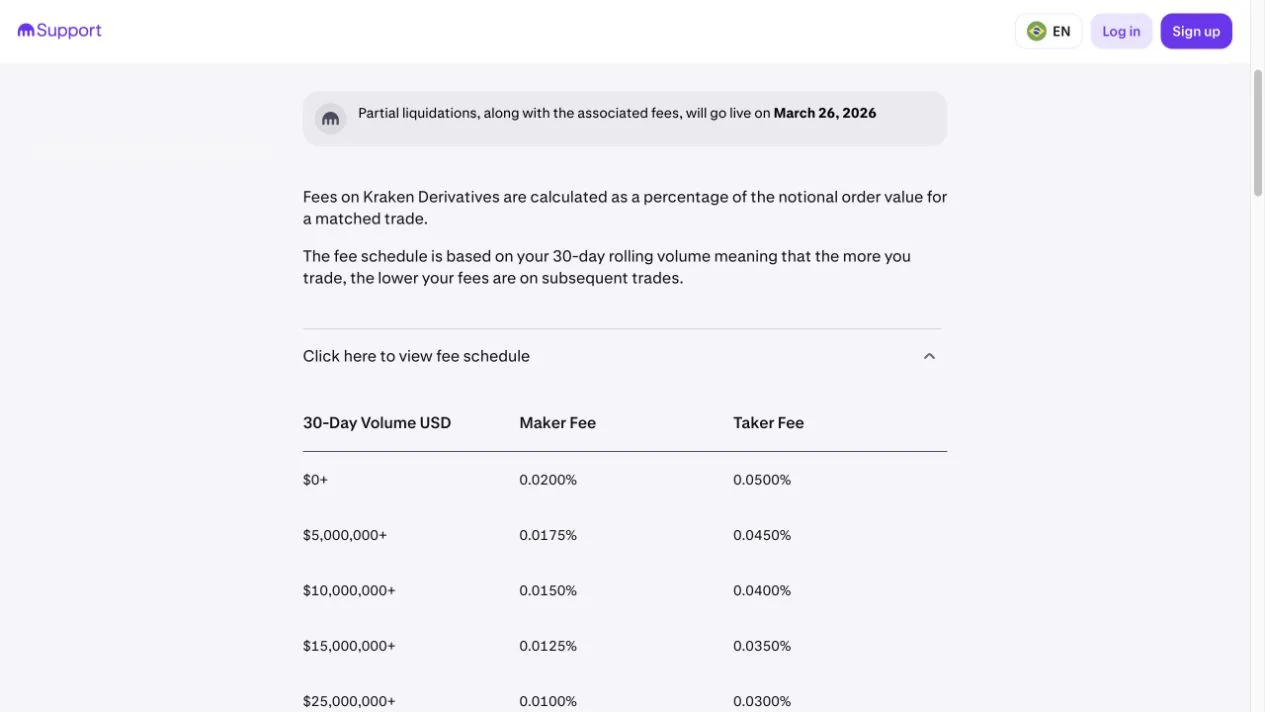
The current standard non-US schedule starts at 0.02% maker and 0.05% taker, charged on the filled position value. A hypothetical $18,000 opening order costs $3.60 as maker or $9 as taker. Closing an unchanged $18,000 position adds another charge: $7.20 for two maker fills, $12.60 for maker entry and taker exit, or $18 for two taker fills. Price movement changes the closing notional, so real totals need not equal those examples.
Those figures make Kraken competitive enough to evaluate seriously, but they are not its whole cost. Funding belongs to the holding period. Conversions belong to the collateral and settlement choices. A forced liquidation has separate charges. Comparing only a maker rate against a competitor's taker rate would produce a flattering but useless recommendation; compare the same order behavior on both venues.
The global fee ladder and EEA ladder begin at the same base rates but diverge at higher volume. At $5 million of rolling volume, the published global row is 0.0175%/0.045%, while the EEA row is 0.0125%/0.04%. That is why an account-specific comparison should not lift a favorable row from one region and attach it to another.
For someone trading $40,000 a month, these high-volume differences are mostly irrelevant. The base tier, fill quality and frequency of market exits are the practical comparison. For someone trading several million, the regional ladder can change the venue calculation materially. More volume should come from an existing strategy, rather than extra trades placed merely to chase a lower future commission.
Collateral costs can outweigh a small commission saving
Kraken's current global collateral table lists BTC and ETH with 1% haircuts and 0.20% conversion fees, while USDC and USDT have 0.50% haircuts and zero conversion fees. A haircut reduces recognized collateral value; it is not itself a cash fee on every deposit. The collateral table also lists asset-specific limits, and the separate EEA version must be used for that product.
For an illustrative $8,000 BTC balance, a 1% haircut leaves $7,920 of recognized value before trading losses. If $600 later has to be converted at a 0.20% conversion charge, that conversion component is $1.20. These are different calculations applied to different amounts. Subtracting 1.20% from the whole deposit would incorrectly combine a valuation adjustment with a conversion fee.
Uncovered losses introduce another cost. The global fee document starts the charge for qualifying non-USD-backed unrealized losses at 0.0025% per hour. A constant $2,400 uncovered loss over ten hours would therefore cost $0.60 at that first rate. The example is deliberately small enough to stay in the first published band; it excludes other charges and assumes no changing loss balance. Sufficient USD or the listed equivalent stablecoins avoids this particular charge under the documented policy.
This is why collateral selection belongs in a futures review, rather than a footnote about deposits. A trader who holds a losing position for days using only volatile collateral has a different bill from a trader who closes within minutes using dollars. The headline commission can be identical while the actual economics differ. Our decision would favor simpler settlement funding unless retaining the collateral asset is part of the strategy.
How much leverage is available on BTC, ETH and SOL?
The first risk band is different for each market
Our archived public instruments response shows a 1% initial-margin starting band for the general PF_XBTUSD, PF_ETHUSD and PF_SOLUSD schedules. The next threshold starts at $1 million for BTC, $500,000 for ETH and $200,000 for SOL. The common 100x starting maximum therefore does not imply equal capacity at that maximum.
An illustrative $300,000 position makes the distinction visible. It remains below BTC's first threshold and ETH's first threshold, but exceeds SOL's. The recorded SOL schedule then shows 2% initial margin, equivalent to a 50x ceiling before account-specific constraints. A market-selection decision that treats all three as identical 100x products misses the size at which their requirements separate.
Kraken also publishes a maximum position quantity. In the same response it was 1,200 BTC for PF_XBTUSD, 21,000 ETH for PF_ETHUSD and 280,000 SOL for PF_SOLUSD. These are contract-level position caps, not promises that the order book can fill that size at the displayed price. A dollar-denominated risk threshold and a coin-denominated position cap answer different questions; passing one does not eliminate the other.
A displayed maximum is not the leverage you are using
Suppose your BTC position is worth $24,000 and your available supporting equity is $6,000. That position represents 4x exposure relative to that equity, even if its eligible contract schedule permits much more. Selecting a high account ceiling does not by itself make a fixed position larger. The meaningful change happens when you use the released capacity to increase position size or withdraw supporting funds.
For planning, start with the intended position and the loss you can tolerate, then inspect the required margin. Working backward from the largest available multiplier encourages an oversized trade. On Kraken this matters particularly with mixed collateral, because an unchanged coin quantity does not mean unchanged dollar equity. Your effective leverage can rise as collateral prices fall, without you pressing the leverage control again.
The first 100x band ends at different sizes
General global linear schedule · first position band
- BTC
- $1 million
- ETH
- $500,000
- SOL
- $200,000
At $300,000, the sampled SOL position has already entered its 50x band. BTC and ETH remain inside their first bands.
The international inverse BTC contract is another exception to a site-wide headline. PI_XBTUSD began at 2% initial margin in our general schedule snapshot, corresponding to 50x, rather than the linear BTC market's 100x starting band. Its next recorded threshold was $500,000 of contract value. The practical recommendation is to choose settlement first and size second; do not switch to a different settlement model merely to obtain a larger displayed maximum.
An altcoin listing can end before your trading plan does
Kraken’s derivatives delisting record lists several contracts settled on 1 October 2026, including PF_API3USD, PF_NMRUSD and PF_ARKMUSD. A spot listing or an old futures review therefore cannot establish that the corresponding perpetual is still open. For an altcoin strategy, identify the exact live contract before transferring collateral; retaining the token in spot does not preserve its former leveraged market.
A suspension also differs from an ordinary resting limit order. Kraken can put an entire contract into post-only mode: orders may rest, but matching and liquidations pause until that restriction is removed. Your personal post-only instruction merely prevents that order from taking liquidity. Confusing the two could lead you to expect an immediate market exit from a market that has temporarily stopped matching.
For a delisting, Kraken closes the contract through a settlement process. Its published record supplies settlement values rather than treating the last chart trade as the inevitable closing price. A trader holding the underlying coin and a futures hedge must then decide what to do with the remaining coin exposure. Once the hedge has settled, the spot balance continues moving even though the derivative no longer offsets it.
This matters most for strategies intended to run for weeks. Choosing a niche contract because its funding briefly looks attractive creates a second dependency: that market must remain available throughout the intended holding period. The useful comparison is between active, eligible contracts with an exit you can execute, not between every ticker a venue has ever advertised.
Using Kraken Pro: entries, exits and mobile controls
Bracket orders turn an entry into a complete instruction
Kraken documents a bracket workflow that can attach take-profit and stop-loss instructions to an opening trade. The useful feature is the relationship between those orders: once one of the linked exits triggers, the other is canceled under its one-cancels-the-other behavior. This is more helpful for an active futures trader than a long list of chart indicators, because it addresses what happens after the entry is filled.
The order-type guide distinguishes stop-market, stop-limit and maker-only instructions. A stop-market prioritizes sending an executable exit once triggered; it does not reserve the trigger price. A stop-limit controls the worst accepted price but can remain unfilled. Maker-only can reject an order that would execute immediately. Those are intentional differences, not three ways to request the same outcome.
Imagine entering 0.3 BTC and planning to exit part of it before the final target. The review point after that partial exit is the remaining position and its attached instructions. The original entry quantity is no longer a reliable summary of what you still hold. On a phone, return to the position panel rather than judging completion from a briefly displayed order notification. A canceled or resting instruction is not equivalent to a closed position.
Trigger reference and execution price deserve separate attention
A futures chart can display a last-traded price while risk calculations use a mark price. An exit triggered by one reference can behave differently from an exit tied to another. When setting the stop, identify the reference selected in the ticket and keep the same reference in view when reviewing why it fired. Otherwise, a legitimate trigger can look inexplicable beside a chart showing a different price series.
For a market exit, the relevant execution evidence is the fill record. For a limit exit, it is the filled quantity plus any remaining order. This is especially important after a sharp move: the price you requested, the price that triggered an instruction and the average price actually received need not match. Kraken's derivatives history provides a place to reconcile those items without guessing from the profit number alone.
Keep the mobile funding path distinct from the trade
The Kraken Pro transfer instructions describe moving eligible assets from spot into the Multi-Collateral wallet. On mobile, the transfer is made from Portfolio, with the currency, amount and direction reviewed before confirmation. Moving funds back reverses that direction. Kraken describes internal transfers as free, with published asset-specific minimums.
The practical advantage is a relatively direct transition from existing holdings to futures collateral. The practical trap is assuming a balance shown somewhere in Portfolio already supports the open trade. A spot balance and a derivatives balance serve different purposes. Before adding exposure, use the margin figure belonging to the relevant derivatives wallet; before withdrawing, use its transferable amount rather than the site's total account value.
On a small screen, the most useful final review is compact: market name, long or short direction, position quantity, margin mode, and linked exits. These are the fields that determine the trade. There is little value in copying a desktop layout full of indicators if the position size and exit controls become harder to inspect. We reviewed the public workflow, not an authenticated mobile trade or an actual transfer.
Funding, partial liquidation and what isolation does not cover
Funding accrues while you hold the perpetual
Kraken's non-US perpetual funding accrues continuously and is realized hourly. That differs from assuming you can hold a position most of the interval and avoid every payment by closing just before a single exchange-wide timestamp. A dated future has a maturity instead; it should not be assigned the perpetual's ongoing funding calculation simply because it appears beside a perpetual in the market selector.
For a hypothetical $20,000 position with a constant effective funding rate of 0.001% per hour, the cost over six hours is $1.20. This is a normalized illustration, not the rate observed in our ticker snapshot. Actual rates and position values change. A public API field expressed in coin or dollars per contract also needs conversion before it can be compared with a percentage quoted for an eight-hour period elsewhere.
The useful trading question is whether the funding expectation changes the holding decision. A scalper's commission may dominate a brief trade; a position held through several expensive funding periods can reverse that balance. Kraken's continuously accrued model makes the actual duration relevant, so we would compare the expected holding window rather than place a single current funding number in a permanent “cheap exchange” verdict.
Isolated margin still sits inside an account structure
Kraken's Multi-M liquidation rules distinguish isolated-position, cross-position and account-wide events. An isolated allocation separates the position's ordinary margin calculation, but the documentation also describes account-wide liquidation when total wallet equity cannot meet maintenance requirements. That nuance matters when volatile assets supply the wallet's collateral.
A simple way to understand the issue is to separate the trade from the collateral supporting it. You can isolate an ETH position while holding BTC collateral. If BTC loses a large part of its dollar value, the wallet has less backing even before considering what ETH does. Isolation does not turn the BTC collateral into a dollar deposit. That is a reason to choose the collateral deliberately, not a reason to dismiss the isolated setting as useless.
Kraken’s documented partial-liquidation framework took effect in March 2026. A forced reduction can leave a position open, so its remaining size and margin still matter. Liquidation depends on account equity, collateral prices, position bands and execution, not leverage alone.
The larger conclusion is specific to Kraken's appeal: Multi-M offers flexibility, but that flexibility connects assets that a trader might mentally regard as separate. It works best when you know which assets are supporting which positions. A screenshot showing a large overall balance is weak evidence of how much loss a particular wallet can absorb.
US crypto futures on Kraken: a separate comparison
Kraken Derivatives US is operated through NinjaTrader Clearing, doing business as Kraken Derivatives US. Its crypto offering includes exchange-listed futures, and the current US perpetual guide describes Bitnomial-listed perpetual contracts with USD collateral. These should be evaluated using their domestic contract specifications rather than the international PF and PI examples above.
The US fee page lists a total $0.15 per contract per side for Bitnomial perpetuals. That is a contract-count fee, not 0.15% of the position. Eight contracts opened and later closed would therefore incur $2.40 in those listed trading charges. The economic exposure still depends on the chosen contract's size, so “eight contracts” cannot be treated as eight bitcoins.
CME-listed contracts use a different fee breakdown and different contract sizes. If you want perpetual crypto exposure specifically, identify the perpetual market in the ticket instead of selecting a familiar BTC symbol and discovering later that you chose a dated product. The useful distinction here is expiry, collateral, size and charges; a long discussion of unrelated equity or interest-rate futures would not help answer which crypto position to choose.
Our 6 October status snapshot showed the US derivatives components, including Bitnomial order placement, as operational. That is evidence of the published service status at the time of review, not a guarantee of every instrument's continued listing or every applicant's approval. We found no basis in the current official pages to describe US Kraken perpetuals as universally unavailable. The dated status record is retained so this conclusion can be checked later.
The international and domestic products may share a Kraken Pro interface, but their risk and settlement rules should remain separate in your records. A US trader comparing Kraken with Coinbase should compare the respective domestic crypto contracts. Comparing Kraken's US per-contract charge with Coinbase's non-US percentage fee without normalizing exposure would not establish which is cheaper.
Transfers, withdrawals and checking your trade records
Decide which balance you want to recover at the end
A futures position can be profitable while the account's total coin holdings or withdrawable cash change in a way you did not expect. The reason may be settlement currency, conversion of collateral, funding or a remaining order reserving margin. To evaluate the experience, decide at the outset whether your target withdrawal is dollars, euros, USDC or bitcoin. That makes the final reconciliation much easier.
An internal transfer back to spot is different from an external bank or blockchain withdrawal. The former changes the wallet inside Kraken; the latter has its own available methods, minimums, fees and processing requirements. This review does not attach a universal withdrawal price to Kraken Futures because that would hide differences between assets and networks. The derivatives-specific question is how much can leave the margin wallet without breaching its requirements.
Closing a position is only part of that process if other orders or positions remain. If a limit order still reserves margin, a lower transferable amount need not mean that a withdrawal is malfunctioning. Inspect the remaining instructions and the relevant wallet first. A balance held in spot can be available for a different purpose from a balance still backing another derivatives trade.
Reconcile your Kraken derivatives ledger
For the first production trade, preserve the actual fill price, executed size, commission currency and funding entries. Those records let you compare the result with your intended order: a limit price alone says nothing about how much filled, and an opening commission alone does not tell you the complete holding cost. The Multi-M account ledger is especially useful when a fee or loss requires conversion from another collateral currency.
The recommendation uses product rules, public contract data and worked calculations. It includes no funded orders or timed withdrawals. For a large order, current spread and available size still need a separate check.
Kraken versus the closest futures alternatives
For a trader already holding eligible collateral at Kraken, its strongest advantage is reducing the friction between spot holdings and a deliberate derivatives position. Coinbase Advanced is the more direct alternative for someone whose existing account and settlement workflow already center on Coinbase. Our Kraken versus Coinbase comparison examines the product distinction rather than treating brand familiarity as a reason to ignore futures costs.
Binance is worth comparing when contract breadth, frequent new markets or a different stablecoin-settled workflow drives the choice. Kraken's detailed fiat and mixed-collateral support can be more valuable for another trader. The relevant comparison is your actual market, region and account tier, not the total number of products listed on a marketing page. A venue winning on an unrelated token does not improve execution for the BTC position you intend to hold.
For BTC-denominated strategies, compare Kraken Coin-M with other coin-settled products. For an ordinary dollar PnL trade, compare Multi-M with linear perpetuals instead. Mixing those categories can make a fee saving look larger than it is, because collateral conversions and different settlement exposures are being ignored. A good alternative should solve the specific drawback you found in Kraken, rather than simply carry a larger maximum-leverage badge.
Kraken futures: your questions
Can I use euros instead of USDT for Kraken Futures?
The global Multi-M collateral table includes EUR with a zero haircut and zero listed conversion fee at this review date. The contract still calculates its result in USD, and euro collateral changes in dollar value with the exchange rate. European accounts have separate documentation; using euros does not determine your legal entity or eligible leverage.
Why did my Kraken spot balance not increase my futures margin?
Spot and derivatives use different wallets. Eligible funds must be transferred into the wallet supporting the contract. A Coin-M BTC wallet also cannot rely on an unrelated ETH Coin-M wallet. The relevant margin balance, rather than the total value displayed across Kraken, determines the support available to that position.
Are US Kraken perpetuals the same as international Kraken Futures?
No. Kraken’s current US guide describes Bitnomial-listed perpetuals accessed through Kraken Derivatives US with USD collateral. International Multi-M and Coin-M products have different contracts, fee calculations and eligibility. Our recorded US perpetual trading charge is $0.15 per contract per side; international fees are percentages of the filled notional.
Does holding BTC collateral mean my Kraken trade settles in BTC?
Only if the selected product uses that settlement model. A linear Multi-M position can use BTC collateral while calculating trading PnL in USD. An inverse Coin-M BTC contract produces BTC-denominated PnL. The collateral asset, quote currency and settlement result are separate fields, so the bitcoin deposit alone does not answer the question.
Do Kraken spot trading volumes reduce my derivatives fees?
The published schedules separate spot and derivatives volume. Global Multi-M and Coin-M derivatives volumes are aggregated for the derivatives tier, but spot volume does not automatically transfer into that tier. EEA derivatives have their own volume ladder, so use the schedule assigned to the account when calculating a higher-volume discount.
Can an isolated Kraken position be affected by falling collateral?
Yes. Isolation allocates margin to a position but does not freeze the dollar value of its collateral. Kraken also documents account-wide liquidation conditions in Multi-M. A position backed by volatile collateral therefore has a different risk profile from the same position supported by an adequate dollar balance.
What happens to a Kraken futures hedge when its contract is delisted?
Kraken settles the derivative under the published delisting terms. If you also own the underlying coin, that spot holding remains after the futures hedge has ended. The delisting record supplies the settlement value; it need not equal the last trade you saw on the chart. Review the remaining coin exposure separately from the closed contract.
Evidence behind this reviewSources and research
Sources and research
The 6 October 2026 Kraken review compares global and regional documents with the public instruments response. The three contract bands are observed parameters; settlement, fee and collateral examples are calculations. US product status was checked separately. We did not fund an account or test live fills and withdrawals.
- Eligibility
- EEA contracts
- Linear specifications
- Coin-M margin
- Global fees
- EEA fees
- Collateral
- EEA collateral
- Public instrument schedules
- Orders
- Transfers
- Multi-M liquidation
- US perpetuals
- US fees
- US specs
- Service status
- Public status response
- Kraken derivatives suspensions and delistings