
Is Bybit good for futures trading?
Bybit makes its strongest case when managing a position matters as much as entering it. A trader who builds a BTC position in stages, takes profit in pieces and leaves the remainder protected has more to evaluate here than a leverage slider. Its position-level and partial TP/SL tools, closing-order controls and unified account give that trader several ways to organize the same trade.
Who gets the most from the unified account?
UTA becomes more useful when your trading balance is split across assets or several positions. You can avoid treating every product as a separate pocket of money, but you also need to decide which assets may support losses. A BTC holding used as collateral is doing a second job: it remains exposed to Bitcoin while supporting derivatives. That can be useful for a deliberate hedge; it can complicate a directional trade.
When another exchange deserves the first look
Frequent market-order traders should compare OKX before committing. Its current regular futures taker reference is 0.05%, against Bybit's 0.055%. That is a modest difference per fill, but repeated turnover makes it measurable. Bybit can still be preferable if its exit controls fit your routine better; that is a usability decision, not proof that the higher fee disappears.
Bybit futures fees: what an active month costs
The published non-VIP rate for ordinary perpetual and futures executions is 0.020% maker and 0.055% taker. The maker rate applies to liquidity-adding fills, not simply to every order labeled Limit. An immediately executable limit order can take liquidity. Bybit tells users to consult their account's My Fee Rate because region and account conditions can affect the applicable schedule. Official fee structure.
A monthly example with an actual order mix
Consider a hypothetical month with 40 completed trades, each opening and closing about 12,500 USDT of exposure. That produces 1 million USDT of executed volume, not 500,000. Suppose 60% of that volume fills as maker and 40% as taker. At the standard rates, commission is 120 plus 220: 340 USDT before funding, spread and market impact.
This is a more useful budget than multiplying your deposit by the fee. A trader can turn over the same balance many times. Conversely, a large account that rarely changes positions may generate little commission. The relevant input is the sum of executions, including partial closes and subsequent re-entries, rather than the highest balance shown during the month.
Same trading month. Different commission.
40 trades × 12,500 USDT each way · 60% maker / 40% taker volume
With all fills taking liquidity, the same million of turnover costs 550 USDT. With all fills genuinely adding liquidity, it costs 200 USDT. Those are endpoints, not realistic promises of what an active strategy will achieve. An urgent exit cannot always wait for a maker fill. Budgeting every stop as maker pricing would make the comparison look cheaper while ignoring how you intend to trade.
Does VIP status change the verdict?
Bybit's listed VIP 1 derivatives rates are 0.018% maker and 0.040% taker. Applied to our stated mix, commission falls to 108 plus 160, or 268 USDT: a 72 USDT saving. The schedule lists qualification paths including 100,000 USD in assets or 10 million USD in 30-day derivatives volume. Our example month alone does not meet that volume threshold.
The useful decision is whether you qualify through activity or assets you already intended to maintain. Generating extra trades just to reduce the rate can cost more than it saves. Likewise, moving a much larger balance onto an exchange creates a custody decision; it is not a free fee discount. We would not treat VIP status as part of the base offer for a reader whose account has not earned it.
Separate execution fees from the rest of the trade
An unchanged-price, 12,500 USDT trade with a maker entry and taker exit costs 2.50 plus 6.875, or about 9.38 USDT in commission. Price movement changes the closing notional, so the final amount can differ. Funding payments, borrowing interest and any conversion needed to repay a settlement-currency deficit are separate items.
Special product labels matter too. The headline standard fee should not automatically be pasted onto a pre-market or Innovation Zone contract. A lower displayed promotional rate is useful only for the eligible product and account. Before comparing two venues, match the contract category and execution method; comparing a special offer on one with an ordinary taker fee on the other produces a misleading winner.
For a direct comparison of commission and captured BTC order books, see Binance vs Bybit. That study addresses measured observations; this section estimates a trading month under explicit assumptions. Neither establishes that today's order will fill at the same spread.
Bybit leverage limits: BTC size and pending orders
Our 6 October 2026 check of Bybit's public BTCUSDT specification returned a maximum of 150x. Its risk table permits that ceiling only in the first band, up to 300,000 USDT of effective position value. The next band allows up to 100x. An account therefore cannot assume that selecting 150x once makes every subsequent increase acceptable.
| Effective value ceiling | Maximum leverage | Maintenance requirement |
|---|---|---|
| 300,000 USDT | 150x | 0.33% of value |
| 2,000,000 USDT | 100x | 0.50% of value − 510 USDT |
| 2,600,000 USDT | 90x | 0.56% of value − 1,710 USDT |
ETH and SOL do not inherit the same capacity
The live ETHUSDT record also allowed 150× through 300,000 USDT, but its next 100× band ended at 900,000 USDT, versus 2 million for BTC. SOLUSDT was different from the start: up to 100× through 50,000 USDT, then 90× through 100,000. A trader carrying a 75,000 USDT SOL position therefore cannot use the first-band 100× limit, even though a BTC or ETH position of that dollar size remains inside its first band. The distinction matters when moving a strategy between majors: contract choice changes capacity before any change to the trader’s account tier. ETH risk bands; SOL risk bands.
Why an order can be refused before it fills
Bybit evaluates effective risk using existing positions and relevant active opening orders. Imagine a 240,000 USDT long with an additional 80,000 USDT buy order. The new order would take the long side to 320,000 USDT. At a 150x setting, that no longer fits the first band. The problem is not necessarily a broken order ticket or a disappearing balance.
An unfilled order can move the BTC risk tier
The total passes the 300,000 USDT first-tier ceiling. A 150x setting no longer fits; the next tier permits up to 100x.
For this example, reducing the intended increase or selecting a leverage setting allowed by the next band addresses the size constraint. Lowering leverage also raises the initial margin needed, so it will not solve an insufficient-balance problem automatically. Canceling an unrelated opening order can release capacity, but a working exit should not be canceled merely because it appears in the open-order list. How Bybit counts risk.
Maintenance margin: the deduction matters
At 320,000 USDT, the second band's maintenance calculation is 320,000 × 0.005 − 510 = 1,090 USDT, before other applicable account items. It is not 1,600 USDT. At the 300,000 boundary, 0.33% gives 990 USDT; the next band's formula at that boundary also gives 990. The deduction prevents the crude jump produced by applying the new percentage to the entire position without adjustment.
This is why we do not use a single fixed 0.50% assumption for every Bybit example. Initial margin, maintenance margin and the final liquidation estimate answer different questions. At 10x, a 320,000 USDT position starts with roughly 32,000 USDT of initial margin before fees. Its maintenance requirement does not mean you can safely open it with 1,090 USDT. Margin calculations.
Minimum orders and the size of a single market close
The BTC specification also separates order-size rules from the risk bands. Its minimum quantity and quantity step were 0.001 BTC in this observation, with a separate minimum notional requirement. The permitted market-order quantity was smaller than the limit-order quantity. A position can satisfy one limit and still fail another.
For BTCUSDT, the observed market-order ceiling was 150 BTC, versus 1,500 BTC for limit orders, with a 5 USDT minimum notional. Those are per-order constraints, separate from the position’s risk tier. An order quantity of 0.0015 BTC would also fail the 0.001 BTC increment even if its dollar value exceeded the minimum. The BTC API response records the separate quantity, value and market-order fields.
Bybit UTA: using collateral without an accidental loan
The account question is not simply whether Bybit supports cross margin. It is which balance should be allowed to support this position. Isolated margin keeps the position's allocation distinct. Cross margin can draw on the account's eligible collateral. Portfolio margin evaluates combinations of exposures and is more appropriate when those relationships are intentional.
For a trader making independent USDT bets, isolated positions are the easier arrangement to audit. You can identify the margin attached to each idea without treating an unrelated BTC holding as its emergency reserve. If you intentionally add margin later, that is a new allocation to the trade, not evidence that its original loss budget stayed unchanged.
Collateral is a setting, not just a coin balance
Bybit allows eligible assets to be enabled or disabled as collateral in cross and portfolio modes. Some settlement assets are automatically collateral. Disabling an asset can be restricted when it is borrowed or account margin is already under pressure. Therefore, deciding what may support a trade is best done before the position is close to its limits. Collateral settings.
A practical arrangement is to keep the balance intended for futures visibly separate from coins you do not want involved. If you hold ETH as a long-term asset but trade a highly volatile altcoin, including ETH as collateral links those decisions. You may get more opening capacity, but an adverse move in both assets weakens the account from two directions. The extra capacity is not an independent cash reserve.
Bybit also documents a platform-wide collateral limit for eligible coins. If aggregate usage reaches that ceiling, further use of the asset as collateral may be restricted even when an individual trader still owns it. This affects cross and portfolio margin rather than isolated margin. A single-coin balance can therefore be less flexible than its market value suggests. Platform collateral limit.
How a futures trade can create borrowing
UTA can automatically borrow a settlement asset when its balance cannot cover a transaction. Trading fees, funding or realized losses may create a liability even when another collateral coin has a positive value. Unrealized derivatives losses can qualify for an interest-free range; a borrowed amount covering a realized expense is treated differently. The borrowing rate can change. Borrowing and repayment rules.
For example, holding BTC does not give you a USDC wallet balance. If a USDC trade creates a fee while you hold no USDC, collateral may support the account while the fee still needs financing. Our preferred interpretation is straightforward: shared collateral can solve a funding mismatch, but it does not erase the currency in which a bill must be paid.
A trader who wants a cleaner ledger can hold the relevant settlement currency alongside the position. Someone deliberately keeping coin collateral should inspect liabilities as well as unrealized P&L. Otherwise, a winning trade may look cheaper than it was because the account-level borrowing charge was overlooked. This is one of the main reasons UTA is more valuable to an organized multi-asset trader than to someone using every available setting by default.
Why some assets are marked “in use”
An open order reserves resources before it becomes a position. Bybit's asset-in-use view accounts for margin committed to positions and orders; the treatment differs between isolated and shared account modes. A visible wallet total is therefore not all available for another order or withdrawal. Understanding assets in use.
If available funds seem unexpectedly low, start by matching each reservation to an actual task: an entry waiting to fill, a live position or a liability. That is more productive than repeatedly moving coins between accounts. It also reveals stale entries left behind after a change of plan. Releasing an unused opening order may be reasonable; removing the collateral beneath a position changes the trade itself.
Managing Bybit futures on mobile: partial exits and stops
The strongest reason to learn Bybit's order controls is that they let you separate the exit of a trade from its entry. Its current TP/SL workflow supports whole-position protection and partial allocations. Those serve different intentions: a whole-position stop follows the exposure being protected, whereas partial exits divide it into chosen quantities.
Whole position or selected quantity?
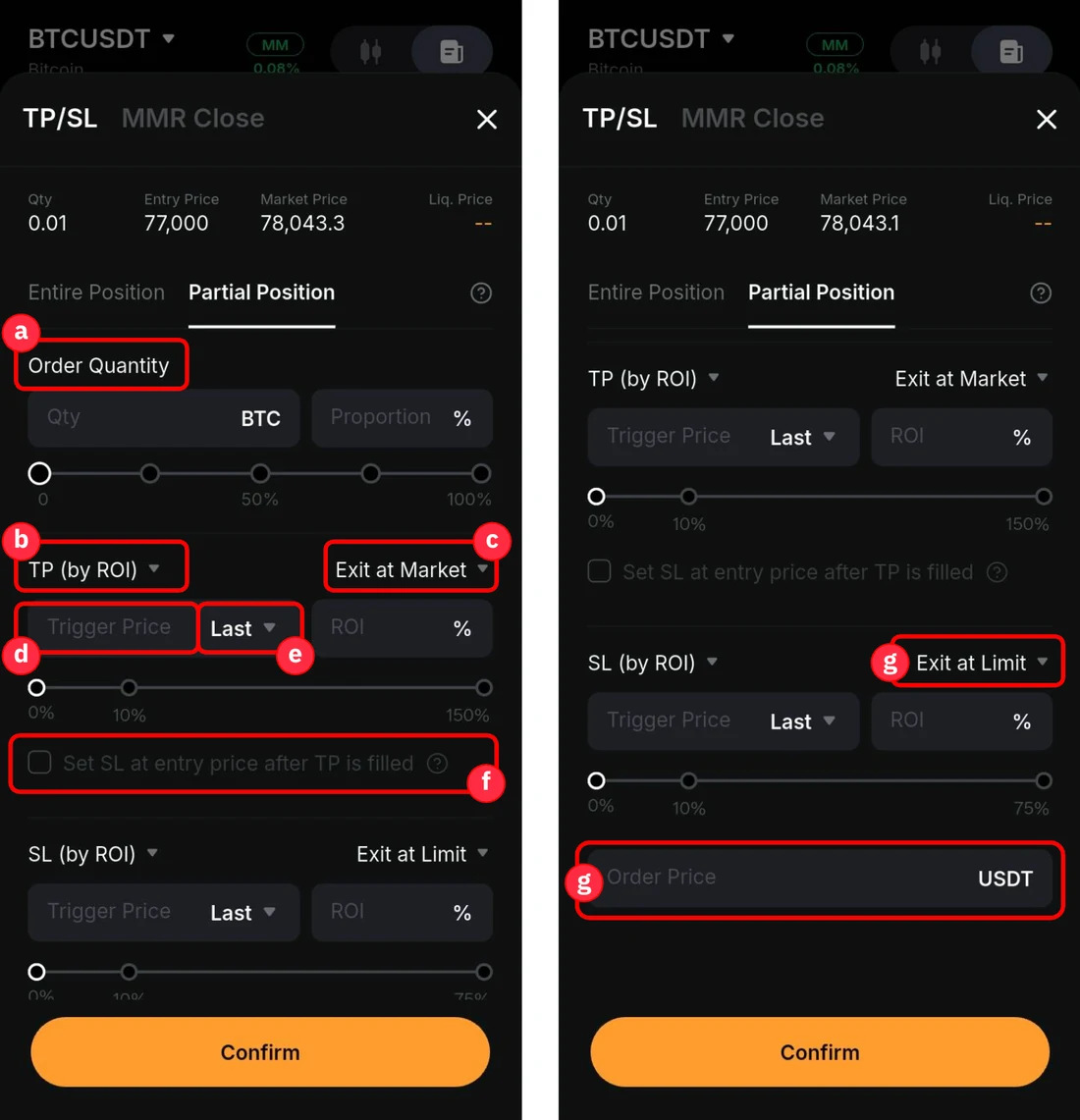
Suppose you enter 0.12 BTC and want to take profit on 0.04 BTC while retaining 0.08 BTC. The quantity of the partial close matters more than the displayed percentage return. If you later add another 0.06 BTC, a fixed partial exit does not magically become a complete protection plan for the enlarged position. Review the remaining quantity after the change.
Bybit distinguishes entire-position and partial-position TP/SL. Entire-position market exits can follow the changing position size, while partial instructions have their own quantities and execution choices. The current help page also describes moving a stop to entry after a partial take-profit fill under its supported market-order setup. Current TP/SL controls.
Our recommendation for a staged exit is to make the intended remainder explicit. Decide what closes at the first target and what protects the rest. This avoids a common ambiguity: seeing a green TP/SL label and assuming every unit of the position is covered. The important evidence is the order quantity and its scope, not the presence of a label.
The trigger and the fill are two separate prices
Bybit offers trigger choices including last traded, mark and index prices. A stop can therefore wait while the ordinary trade chart appears to cross your chosen level, because the selected reference has not crossed it. That is a reason to display the relevant reference, not to keep moving the stop closer until it fires.
A market exit prioritizes execution at available prices. A limit exit imposes a price condition and can remain unfilled after activation. Choose between those according to what failure would be worse for that particular exit. A planned profit-taking limit and an urgent stop need not use the same execution method. Position and partial TP/SL behavior.
Reduce-only and Close on Trigger
A reduce-only instruction is useful when an order must shrink exposure rather than create a new opposite trade. Post-only solves a different problem: it prevents a submitted limit order from immediately taking liquidity. These are not interchangeable toggles. The first governs exposure; the second governs how an entry or exit interacts with the book. Available order types.
Close on Trigger applies the closing intention to a conditional order. Bybit can adjust or cancel it when the remaining position is smaller or absent. It does not guarantee that a conditional limit order will find a fill at its chosen price. For a mobile trader, that distinction helps when an earlier manual close has changed the size before the conditional order activates. Close on Trigger.
Closing by account margin pressure
Bybit's MMR Close Order is a separate cross-margin control. It can close a selected position when the account maintenance-margin ratio reaches the chosen threshold. It is not available for portfolio margin, does not provide a partial close and is not a promise to act before a sudden jump into liquidation. Closing a hedge can also increase overall account risk, which affects whether the instruction is accepted. MMR Close Order.
This is most relevant when one asset's price alone does not describe your account stress. It should not replace an ordinary price-based exit for someone managing one isolated BTC position. The useful feature is the additional account-level trigger; the wrong interpretation is that it makes shared collateral impossible to liquidate.
For a first rehearsal, Bybit's demo account supports simulated UTA trading. Practice adding to a position, partially closing it and inspecting what remains. A demo can reveal an unsuitable workflow, but simulated execution is not evidence of live liquidity or real withdrawal performance. Demo account scope.
An account-wide profit target is a different control
Bybit’s All Futures TP/SL can close the futures basket when its tracked combined profit or loss reaches a target. It includes realized results, unrealized results, fees and funding during the strategy lifecycle. It supports isolated and cross margin, but not Portfolio Margin, spot or options; setup requires at least two open futures positions. After triggering market closes, the strategy ends and must be enabled again for another cycle.
This is useful when two individually acceptable positions have reached a combined result at which you want to stop trading. A winning position can offset a losing one in the tracked total. It is therefore a basket decision, not a substitute for deciding how much loss is acceptable on each individual position. Market execution can also leave the final result different from the target.
For an illustrative two-position basket, imagine BTC showing a 220 USDT gain and ETH a 130 USDT loss, with 20 USDT already spent in fees and funding. The combined result is 70 USDT, not the 220 displayed on the winning position. A trader looking only at the BTC row could mistake a modestly profitable basket for a much stronger session. Keeping the basket result separate from each position’s exit plan makes the additional control meaningful.
Price tolerance can protect an entry without filling it all
Bybit’s market-order slippage tolerance restricts execution to a chosen range from the best available bid or ask and cancels the portion outside it. BTC and ETH support an amount setting rather than the percentage setting described for other markets. The control is also available for market close, but not for conditional or trailing-stop orders.
Suppose the best BTC ask is 80,000 USDT and an illustrative buy tolerance is 40 USDT. The upper execution boundary is 80,040. If only 0.06 BTC is available inside that range for a requested 0.10 BTC entry, the unfilled 0.04 BTC is canceled. The trader has limited the entry price at the cost of receiving less exposure. Automatically resending the remainder at a worse price would defeat that original decision.
For an exit, the priority may be different: a tight tolerance can leave exposure that you intended to remove. That is why the quantity remaining in Positions is the relevant confirmation after a partial market close. The feature gives an active trader an explicit price-versus-completion choice; it does not turn a protected order into a guaranteed fill.
USDT, USDC and inverse futures: choose the right balance
For most readers funding an account with stablecoins, USDT perpetuals provide the easiest starting point. Their collateral and P&L are expressed in USDT, making it easier to reconcile a trading result with the balance you allocated. That does not make USDT risk-free; it keeps the trade's settlement unit familiar.
Inverse contracts have a different purpose. Their coin-denominated outcome can suit someone who deliberately wants to manage coin holdings, but it complicates a dollar-based performance target. A positive coin result and a positive dollar result are not always the same thing. Do not choose an inverse BTC contract merely because its name looks similar to BTCUSDT. USDT contract comparison.
Why the entry price changes on a USDC position
Bybit's USDC perpetuals use session settlement. At a settlement event, unrealized P&L is settled into the account and the position's reference entry price is reset to the mark price. The position remains open. The documented interval follows the contract's funding interval, so there is no single session length for every market. USDC settlement mechanism.
Imagine a position opened at 80,000 that is settled at 81,000. Seeing 81,000 as the new entry reference does not mean your original purchase disappeared or that the trade earned nothing. Part of the result has moved into the account's realized history. To judge the full trade, combine settled results with the remaining open-position P&L and the associated costs.
This matters particularly for someone comparing screenshots across days. The current position panel and a full transaction history answer different questions. A single current P&L figure may exclude gains or losses already settled earlier. USDT and USDC trades should therefore be compared using a consistent start and end point, not only the number visible beside each open position.
The current USDC FAQ describes both one-way and hedge modes. Older reviews that say USDC is necessarily one-way only should not determine your setup. Still, the contract and account must support the selected mode; having a feature somewhere in the product family is not proof that every regional account exposes it.
Funding and withdrawing Bybit trading profits
Funding can change the cost of holding a position without any new trade being executed. Bybit updates the projected rate during the period; the eventual settled rate is what belongs in a completed-trade calculation. Read the selected contract's interval and next event rather than assuming every perpetual settles on the same schedule. Funding-rate mechanics.
For a hypothetical 15,000 USDT position, three positive settled rates of 0.01%, 0.02% and 0.005% produce payments totaling 5.25 USDT for a long, assuming unchanged notional. A short receives the opposite amount in that simplified example. If the next event turns negative, the direction of payment changes. Extending one currently displayed rate across a whole week would miss that variation.
The practical comparison for a swing trader is commission plus the actual settlements during the holding period. For a short intraday trade, execution quality may dominate instead. Bybit's stronger position controls cannot cancel an expensive funding period, just as a cheaper commission does not ensure the cheapest multi-day hold.
From a realized gain to a withdrawable balance
Bybit's on-chain withdrawal instructions allow selecting supported source accounts, including UTA; it is inaccurate to say every withdrawal must first be manually transferred to Funding. The relevant constraint is the amount available to withdraw after account requirements. Network, asset, minimum amount and the displayed fee still need to match the destination. On-chain withdrawal instructions.
A realized profit may continue supporting other open positions. Removing it changes the remaining account cushion. That is especially relevant after closing one profitable leg while leaving a losing leg in cross margin. The closed trade may be finished, but the account still uses the released equity. Treat a withdrawal as a balance change affecting what remains, not as an unrelated administrative action.
Internal transfer is not an on-chain withdrawal
Bybit-to-Bybit internal transfers have a separate flow and are documented as free for supported transfers. They do not demonstrate that withdrawing to your own blockchain wallet is free or equally fast. An address, network and transaction confirmation belong to the on-chain route; a verified internal recipient belongs to the internal route. Internal transfer guide.
If funds are unavailable, identify whether they are reserved for trading, affected by a withdrawal restriction or still subject to another transaction's release. Those conditions require different remedies. Increasing leverage to free margin just so a withdrawal becomes possible also changes the account's risk. It is not equivalent to releasing an unused order.
Bybit's Funding account guide distinguishes available and frozen balances and explains its transaction records. The withdrawal FAQ covers verification and account limits. Neither provides a universal completion time for every network and account. This review does not claim a successful test withdrawal; its conclusions come from the documented flows.
Bybit access, security and the limits of this recommendation
Bybit's global restricted-jurisdiction notice excludes several major markets, including the United States, Canada, mainland China, Hong Kong and Singapore. A global referral link does not change those terms. Residency and the entity serving an account matter more than the language selected on a help page. Current restrictions.
For Europe, do not confuse Bybit EU's documented spot-margin product with global perpetual futures. Borrowing against a spot trade and opening a perpetual are different offers. This article's global fee, risk-tier and UTA examples should not be treated as confirmation that a Bybit EU account receives the same derivatives. Use the relevant country review alongside the entity-specific product information.
What the 2025 incident changes in a review
Bybit's own incident timeline describes the February 2025 wallet compromise. Its subsequent statement says customer-asset backing was restored and references an independently reviewed reserve snapshot. Both belong in the assessment: the incident is material, and the response is relevant. Neither justifies pretending the event never happened or assuming the platform remained in the same state afterward. Incident timeline and reserve-restoration announcement.
A reserve snapshot addresses a defined set of assets and a particular date. It does not measure how your stop will execute during a sharp move, nor does it guarantee future access to withdrawals. For a futures trader, keeping the intended trading balance distinguishable from unrelated savings is a more concrete response than assigning the exchange an unexplained safety score.
Bybit versus Binance or OKX: our conclusion
Choose to compare OKX more closely when settlement-currency groups and advanced account modes are central to your setup, or when your activity is heavily taker-driven. Its regular 0.05% taker reference saves 50 USDT per million of taker executions versus Bybit's 0.055%, before other costs. The Bybit vs OKX comparison examines the trade-off in greater detail.
Bybit futures: your questions
Can I use global Bybit futures through a Bybit EU account?
Do not assume so. Bybit EU has its own product and eligibility framework; its spot-margin guide does not establish access to the global perpetuals reviewed here. Match the legal entity and the named product before using global leverage or fee figures.
Why does my Bybit stop cover less than my current position?
A partial TP/SL instruction can have a fixed quantity. Adding to the position afterward can leave more exposure than that instruction covers. Inspect the remaining position and active closing quantities. Whole-position and partial protection are separate choices.
Does depositing BTC into UTA automatically mean I can withdraw its full value?
No. Withdrawable value depends on collateral settings, margin in use and liabilities. A positive BTC balance can support other positions even when no BTC trade is open. The asset balance and the amount available for withdrawal are different figures.
Can Bybit charge borrowing interest without a manual loan?
Yes. A settlement-currency shortfall can trigger automatic borrowing. A fee or realized loss has different interest treatment from an eligible unrealized-loss amount. Review the UTA borrowing record rather than assuming all costs appear in the futures commission line.
Why did the entry price of my USDC perpetual change?
USDC session settlement can realize the period’s P&L and reset the reference entry price while leaving the position open. Reconcile settled transactions with the remaining unrealized result to evaluate the complete trade.
Can a 150x BTC order be rejected even with enough USDT?
Yes. The first BTCUSDT risk band ends at 300,000 USDT of effective value in our dated observation. Opening orders can push the relevant side beyond that band. The next band permits less leverage, and separate order-size rules also apply.
Is a Bybit VIP upgrade worth increasing my trading volume?
Not automatically. In our one-million-USDT example, the stated order mix saves 72 USDT at VIP 1, but that month alone does not earn the volume qualification. Extra turnover has its own fees and execution costs; use an upgrade you genuinely qualify for rather than trading solely to obtain it.
Evidence behind this reviewSources and research
Sources and research
Official product documentation and public contract data checked on 5–6 October 2026 (UTC). Calculated examples are labeled. We did not place trades, open customer accounts or test deposits and withdrawals. Interface evidence is limited to the public material identified in its caption. Contract and order-book observations are dated snapshots, not live quotes.
- Trading fee structure
- USDT perpetual and expiry contracts
- Risk limits and active orders
- BTCUSDT risk tiers, public API
- BTCUSDT contract specification
- Borrowing, interest and repayment in UTA
- Collateral and borrowable assets
- Platform collateral limit
- Margin calculations by mode
- Understanding assets in use
- Take profit and stop loss: current controls
- Position versus partial TP/SL
- Close on Trigger
- Available order types
- MMR Close Order
- USDC session settlement
- USDC contract FAQ
- Funding rate introduction
- Submitting an on-chain withdrawal
- Internal transfers
- Funding account and history
- Crypto withdrawal FAQ
- Demo trading
- Service restrictions
- February 2025 security incident
- Post-incident reserve restoration
- Bybit EU spot margin
- OKX current futures fee schedule
- All Futures TP/SL
- Market-order slippage tolerance
- ETHUSDT current risk bands
- SOLUSDT current risk bands