
Is Binance Futures worth using?
For a trader who moves between Bitcoin, major altcoins and occasional hedges, Binance’s useful advantage is the range of contract structures. You can trade a BTC price move with stablecoin collateral, keep Bitcoin as collateral for an inverse contract, or use a dated contract when its settlement date matches your hedge. Those are different jobs. Picking the appropriate contract does more for the result than selecting the highest multiplier available on the ticket.
There are two important qualifications to that recommendation. First, a large catalogue does not make every altcoin equally liquid. Second, this review covers the global futures product, not Binance.US or a promise that every Binance account can use derivatives. A trader whose account cannot open the relevant futures market should choose an eligible venue, not deposit first and hope that the product unlocks afterward.
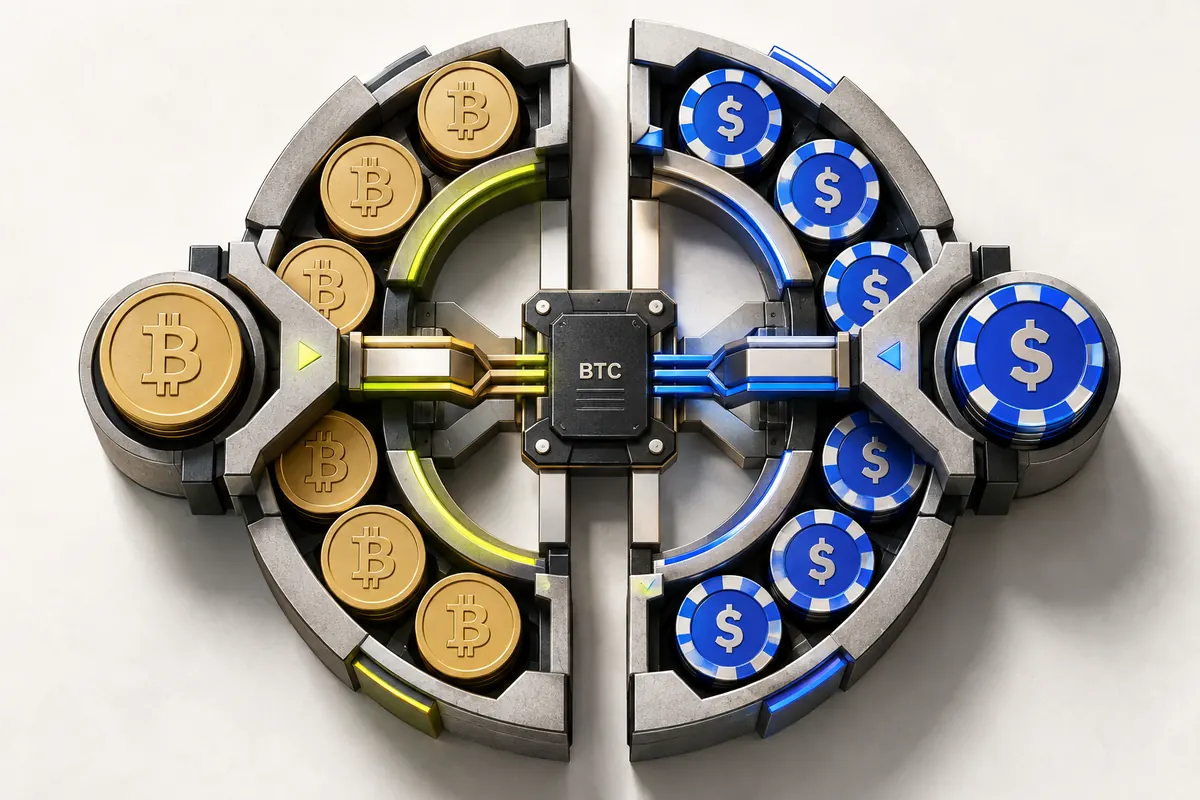
USD-M or COIN-M: which Binance futures contract should you choose?
Start with the currency in which you want to measure the outcome. In a BTCUSDT linear position, a one-BTC long gains 1,000 USDT when the contract rises by 1,000 USDT, before costs. With BTCUSD coin-margined futures, the contract has a fixed dollar face value and the profit or loss is paid in BTC. The number of bitcoins represented by that fixed dollar amount changes with the price.
Our 6 October COIN-M contract capture records a 100 USD face value for BTCUSD_PERP. Therefore, 100 of those contracts represent 10,000 USD of face value, not 100 BTC. The same response includes perpetuals and December 2026 and March 2027 delivery contracts. These are distinct instruments; a ticker ending in a date should not be mistaken for a perpetual position without an expiry.
Use USDT settlement for a trading budget in stablecoins
USD-M is the more direct choice when you allocate, for example, 2,000 USDT to a trading account and want to compare each closed trade with that budget. You can see realized profits, commission and funding in a familiar settlement currency. You do not also need to decide whether to retain a changing quantity of BTC earned by the trade.
This is especially useful when comparing several altcoin trades. A SOLUSDT loss and an ETHUSDT gain can be reviewed in USDT without converting two different settlement coins. It makes recordkeeping simpler, but it does not remove the risks of the stablecoin, the exchange or the positions. The practical benefit is a clearer measure of trading performance.
USDC contracts are another possibility where supported. Their available markets, funding and temporary fee offers should be compared with the corresponding USDT market. Holding USDC does not automatically make the USDC contract cheaper overall: a commission saving can be offset by a wider spread or a less favorable funding history. Compare the two order books at the size you intend to trade.
Use COIN-M when the coin balance is part of the objective
A Bitcoin holder may prefer a hedge whose collateral and settlement stay in Bitcoin. Suppose you own one BTC worth 80,000 USD and short 800 BTCUSD contracts, each with a 100 USD face value. That is an 80,000 USD inverse short. If the contract falls to 72,000 USD, the short earns approximately 0.111111 BTC before commission and funding.
You then have about 1.111111 BTC worth 72,000 USD each: approximately 80,000 USD altogether. If Bitcoin instead rises to 88,000 USD, the inverse short loses approximately 0.090909 BTC. The remaining 0.909091 BTC is again worth approximately 80,000 USD. This demonstrates a dollar-value hedge, not a strategy that profits whichever way Bitcoin moves.
Keep the dollars steady. Let the BTC quantity change.
Start: 1 BTC at $80,000 + an $80,000 inverse short
Short result: +0.111111 BTC
Combined balance: 1.111111 BTC
Short result: −0.090909 BTC
Combined balance: 0.909091 BTC
The example assumes matching spot and futures prices, sufficient collateral, no liquidation and no costs. In practice, basis differences, funding and the exchange’s margin rules change the result. If you sell some of the BTC while leaving the full short open, the original hedge becomes too large. If you add BTC without increasing the hedge, part of the holding remains unhedged. The position should follow the holding it is intended to protect.
For a small directional trade, that extra settlement arithmetic rarely offers an advantage over BTCUSDT. For a holder explicitly trying to stabilize a coin portfolio’s dollar value, it can be the main reason to use COIN-M. Binance’s profit calculation guide supports the inverse formula used in the example; it should not be replaced with the linear USDT calculation.
Binance futures fees: the standard rate and the BNB decision
The regular-user USDT schedule reviewed for this article lists 0.020% maker and 0.050% taker. On 25,000 USDT of executed value, that means 5 USDT for a maker fill or 12.50 USDT for a taker fill. Opening and closing are separate executions. At unchanged position value, two taker executions cost 25 USDT before funding or price impact.
Those rates describe the global USDT reference, not every regional account, VIP level or promotion. The published futures fee schedule separates the USDT columns, eligible BNB-payment rates and USDC offers. A strike-through or campaign rate needs its own conditions; it should not become the permanent headline rate for the entire exchange.
| Pricing basis | Maker | Taker |
|---|---|---|
| USDT · regular | 0.020% | 0.050% |
| USDT · qualifying BNB payment | 0.018% | 0.045% |
| USDC · eligible promotional rate | 0% | 0.040% |
| USDC · promotion + qualifying BNB | 0% | 0.036% |
Is paying futures fees in BNB worthwhile?
For eligible USD-M trading, Binance documents a 10% commission discount when fees are paid with sufficient BNB in the futures account. Applied to the standard USDT rates, that gives 0.018% maker and 0.045% taker. It reduces the 25 USDT two-taker example to 22.50 USDT. The saving is 2.50 USDT, not 10% of the trade’s position value.
A useful way to evaluate the setting is to compare the expected commission saving with the BNB balance you would need and are willing to hold. On 500,000 USDT of monthly taker executions, standard commission would be 250 USDT and the discount would save 25 USDT. That calculation does not justify acquiring a large speculative BNB position simply to reduce fees.
If you already keep a modest BNB balance for execution costs, the feature can be convenient. If you do not, include the conversion spread and the possibility that BNB changes in value while held. The fee-payment instructions also state that insufficient BNB causes fees to be deducted in USDT without that discount. A toggle alone is not enough.
VIP qualification is separate from the fee calculation
The reviewed schedule requires both the relevant trading volume and BNB balance for the futures-volume route to VIP 1. It lists at least 5 million USD of 30-day futures volume and at least 5 BNB. Other VIP programs can qualify an account differently. Do not assume that one high-volume trading day permanently changes the rate or that spot and futures qualification thresholds are identical.
At regular rates, entering passively and exiting as a taker costs 0.07% of equal-sized executions before other costs. With eligible BNB payment, the equivalent is 0.063%. This is a useful comparison for traders who rest entries but prioritize getting out when a setup fails. A maker-only exit can lower commission but is not an equivalent replacement for an exit that must execute quickly.
Compare your actual mix of fills, not an idealized all-maker strategy. An order may be partly filled immediately and partly rest on the book. The transaction record determines what you paid on each fill. That is also why the lowest advertised maker tier is a poor budget for a trader who mostly uses market orders.
USDC futures: when a promotional rate changes the calculation
Binance’s USDC perpetual promotion, extended until further notice, lists 0% maker and 0.04% taker pricing for eligible regular users; the qualifying BNB taker rate is 0.036%. This is a separate promotional schedule, not a revision of the ordinary USDT contract rate. It makes the choice of settlement currency commercially relevant even for two contracts tracking the same coin.
Suppose a trader executes 600,000 dollars of maker volume and 400,000 dollars of taker volume in a month. At standard USDT pricing, the bill is 120 plus 200, or 320 dollars. At the stated USDC promotion it is zero plus 160, or 160 dollars before any BNB benefit. Assume dollar parity solely for this comparison. The 160-dollar difference is the budget available to absorb any additional conversion, spread, funding or execution cost before switching loses its advantage.
For example, if obtaining and later converting the required USDC costs 35 dollars in total, 125 dollars of that modeled advantage remain. If poorer fills in the USDC market cost another 140 dollars over the month, the switch is 15 dollars worse despite the attractive headline fee. Those extra costs are hypothetical; we have not measured a matched USDT-versus-USDC execution sample. The example establishes a break-even test rather than declaring the promotional market universally cheaper.
A trader whose existing capital and intended withdrawals are already in USDC avoids one reason to prefer USDT. Someone who trades an altcoin offered only in USDT has no equivalent USDC contract to substitute. The live catalogue establishes which choice exists; a promotion page alone cannot. For BTC and ETH, inspect the actual USDC pair before moving collateral, and save the account fee shown while the promotion is active.
The offer has no fixed end date in the checked announcement. That makes it worth using when available, but unsuitable as a permanent assumption in a six-month strategy budget. Keep a second cost estimate using the regular schedule that would apply after the offer. An expired promotion should change the fee comparison, not invalidate the entire trading plan.
How much leverage can you actually use on Binance?
The latest public BTCUSDT brackets captured for this review allow up to 150x within 300,000 USDT of position value. The following bracket allows 100x up to 800,000 USDT, then 75x up to 3 million USDT. ETHUSDT has the same first three limits in our capture. These figures replace the stale idea that Binance has one universal 125x futures maximum.
SOLUSDT is different. Its first 50,000 USDT bracket allows 100x; the next extends to 400,000 USDT at 75x. The current bracket data therefore changes the answer for someone choosing between a large BTC position and the same-sized SOL position. The exchange name alone cannot answer that question.
| USDT perpetual | First-band ceiling | Maximum leverage |
|---|---|---|
| BTCUSDT | 300,000 USDT | 150× |
| ETHUSDT | 300,000 USDT | 150× |
| SOLUSDT | 50,000 USDT | 100× |
For example, 100,000 USDT of BTC exposure is inside the first BTC band, whereas 100,000 USDT of SOL exposure is in SOL’s second band. A 100x setting fits the published BTC ceiling but exceeds the SOL ceiling at that size. This is an account-independent comparison of the contract rules, not confirmation that an individual account is approved for either setting.
The useful consequence for scaling a position
A trader starting with a small position may plan to add after a breakout. The future size should be considered before the first entry. If the intended completed position crosses a bracket boundary, the original leverage setting may no longer fit. Lower leverage means more initial margin for the same exposure; keeping only enough collateral for the starter position can make the planned addition impossible.
There is no need to memorize twelve BTC brackets to manage a moderate position. Identify the band containing your planned maximum exposure and leave room for changes in position value. A rising market can increase a long position’s notional even when its coin quantity stays unchanged. The relevant boundary is measured in position value, not the amount originally deposited.
Do not confuse the bracket’s maximum leverage with its maintenance margin. Maximum leverage controls how little initial collateral may be accepted. Maintenance margin is part of the test that keeps a position open. Binance’s table also contains cumulative maintenance deductions, so multiplying a large position by a headline maintenance percentage can overstate the requirement.
For a concrete check, a hypothetical 500,000 USDT BTCUSDT position falls in the second recorded bracket. Its maintenance calculation is 500,000 × 0.005 minus the 300 USDT cumulative deduction, or 2,200 USDT. That is not its initial margin at 100x, and it is not a standalone liquidation-price forecast. Fees, account balances and other positions still matter.
Why the catalogue and the bracket table have different jobs
The USD-M exchange-information feed identifies valid symbols, price steps, quantity filters and order types. Its generic margin fields should not replace the dedicated bracket table. For the review we checked both: one establishes which instrument and order format exist, while the other supplies the size-dependent leverage rule.
That distinction prevents a common practical error: copying the BTC maximum into an altcoin recommendation. It also helps when an order is rejected. A quantity can be too small, exceed an order-specific filter, or fail the account’s margin requirement even though the selected leverage is below the contract headline. Those are separate checks with separate remedies.
Order controls that make Binance useful for active futures trading
Binance’s futures toolkit is most valuable when it expresses the exit you actually want. A stop-market order prioritizes execution after its trigger, accepting the available market price. A stop-limit order introduces a price condition for the resulting order, which can leave it unfilled. The choice is not simply which button has the lower fee; it is whether remaining in the trade is acceptable if the market gaps past your limit.
The distinction becomes important when taking partial profits. You might want to close a portion at a resting limit price and keep a stop for the remainder. The quantities of those closing orders must still correspond to the position after fills. Otherwise, a stale order can be rejected or cancel another planned action. Review the remaining position, not merely the initial order ticket.
One-way and hedge mode serve different workflows
In one-way mode, opposite trades on the same contract adjust one net position. Hedge mode supports separate long and short sides. That can help a trader keep a longer-lived hedge distinct from a short-term trade, but it does not make their combined commission or funding disappear. Two sides create more records and more opportunities to close the wrong leg.
Binance’s June 2026 position-mode update aligned COIN-M position settings with USD-M. Older tutorials describing them as independent settings can therefore mislead a returning trader. The relevant question is whether today’s account is in the intended mode before new orders are prepared, especially when both product families are being used.
A reduce-only order is helpful when the intention is strictly to shrink exposure. It cannot create a new position after the existing one has closed. If such an order is rejected, examine the current position and already submitted closing orders before switching to an unrestricted opposite order. The unrestricted order could reverse the exposure you meant to eliminate.
The failed-order guide explains conflicts with existing reduce-only orders. This is a more useful troubleshooting path than repeatedly increasing available margin: an order conflict is not necessarily a shortage of collateral. A trader who already has several exits attached to one position should resolve their quantities and priority first.
Price Protection can delay a trigger
Binance’s Price Protection setting compares the last traded price with the mark price. When the difference exceeds the permitted threshold, a protected take-profit or stop-loss may not trigger as expected. The feature is intended to filter abnormal prices; it is not a guarantee that your desired exit will happen at the displayed stop price.
That trade-off deserves attention for a stop near liquidation. A trader who wants to avoid a brief anomalous print has a different priority from a trader who wants the fastest possible exit during a disorderly move. The Price Protection guide describes the setting and its location. Decide based on the role of the order, rather than treating every feature named “protection” as automatically suitable.
A reached stop price can still wait
- Trigger price reachedThe selected reference price meets the stop condition.
- Price Protection checks the gapLast price and mark price differ beyond the permitted threshold.
- Protected trigger waitsNo immediate exit from this instruction while the protection condition prevents triggering.
For mobile use, the advantage of the detailed position display is that it makes margin, the mark price and the remaining position easier to inspect together. Binance also offers a brief display for seeing more positions on one screen. The app display guide documents both. A compact list is convenient for monitoring; the detailed view is more useful when editing an exit or investigating why a position is close to its margin limit.
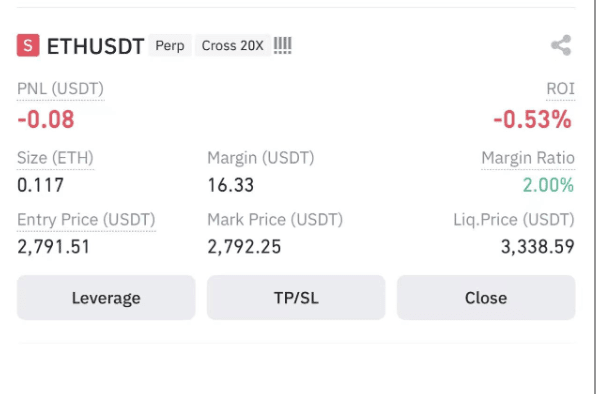
Funding or a dated contract: what changes for a multi-day hedge?
For a trade lasting a few minutes, execution costs may dominate. For a hedge carried through multiple settlements, funding becomes a separate reason to compare contracts. Binance can adjust funding intervals and caps, so “every eight hours” should describe an observed schedule rather than a permanent promise for every pair. The current countdown and funding history are more useful than assuming that all perpetuals use the same rhythm.
We collected all BTCUSDT, ETHUSDT and SOLUSDT funding records from 28 September through 4 October 2026 UTC. Each series contained 21 settlements. Applying those rates to an illustrative constant 25,000 USDT long position gives net funding costs of about 20.20 USDT for BTC, 22.83 USDT for ETH and 12.09 USDT for SOL. This is a historical rate comparison, not a forecast or an executed position’s statement.
The calculation holds notional constant to isolate the funding-rate difference. A real fixed-coin position changes in USDT value as the mark price moves, and its funding payments would be calculated on those changing values. The public funding-history endpoint and our downloadable record make the sample reproducible without implying that next week will cost the same.
| Contract | Settlements | Net long payment |
|---|---|---|
| BTCUSDT | 21 | 20.20 USDT |
| ETHUSDT | 21 | 22.83 USDT |
| SOLUSDT | 21 | 12.09 USDT |
When delivery futures are worth comparing
A dated hedge has an explicit end point. The reviewed COIN-M catalogue includes December 2026 and March 2027 BTC delivery contracts. A Bitcoin holder planning around one of those dates can compare the premium or discount of the dated contract with the uncertain stream of perpetual funding payments. The dated contract’s price already reflects the market’s pricing of time to settlement.
No perpetual funding payment does not mean no cost. The hedge may enter at an unfavorable basis, pay commission, and need to be rolled if the underlying holding remains after expiry. Rolling means closing or settling the old contract and establishing the new one, with a fresh spread and basis. A contract whose date poorly matches the holding period can complicate an otherwise simple hedge.
For example, a trader expecting to keep a hedge for ten days may prefer a perpetual even when a quarterly contract exists. Someone protecting a coin balance until the end of December has a stronger reason to inspect the December book. That is a decision about matching the instrument to the duration, not a blanket claim that perpetuals or delivery futures are cheaper.
The funding explanation also allows for changes in settlement conditions during stress. A strategy relying on collecting funding should remain viable if the rate shrinks, reverses or settles more frequently. Expected funding income is particularly fragile when it is being used to justify an otherwise unwanted directional position.
Collateral choices: when Multi-Assets Mode helps and when it complicates trading
For someone whose entire trading allocation is USDT, single-asset margin is usually the clearest starting point. There is little benefit in adding more collateral currencies solely because the interface offers the option. A multi-asset configuration becomes relevant when existing eligible balances would otherwise sit idle while another settlement balance needs support.
Binance’s mode-switching guide states that Multi-Assets Mode applies to USD-M and uses cross margin. It is not the same thing as COIN-M. It also cannot be treated as an isolated trade with a hard boundary around the small amount shown beside one position: supporting balances in the shared futures pool participate in the account’s risk.
The practical question is whether you want your collateral portfolio to support your futures positions collectively. Holding BTC as collateral while also taking a BTC long creates two exposures to a falling Bitcoin price: the position loses while the supporting collateral becomes less valuable in dollar terms. The margin benefit of reusing the coin can therefore come with a less forgiving account during a sell-off.
Auto-exchange changes what remains in the wallet
The Multi-Assets FAQ describes automatic conversion when a settlement balance falls below a threshold. That matters to someone whose goal is to keep particular coins untouched. Being able to post a coin as collateral does not guarantee that the same quantity will remain in the wallet after losses and conversion rules have operated.
Imagine a trader who wants to retain a long-term BTC holding while using its recognized value to support short-term altcoin trades. The setup may avoid an initial sale of BTC, but realized USDT losses can still create a settlement deficit. If preserving the coin count is essential, that possibility should be part of the choice before the collateral is committed.
Portfolio margin is a further account framework and should not be confused with simply switching on multiple collateral assets. Its value depends on the portfolio’s offsetting risks and eligibility. For the ordinary trader deciding between Binance, Bybit and OKX, it is sensible to settle the basic contract, settlement currency and execution method first. Advanced collateral treatment only improves the choice when it solves a constraint that actually exists.
Funding the account, withdrawing profits and handling a contract exit
The cleanest funding route is the one that delivers the collateral required by the selected product without an unnecessary conversion. A BTCUSDT plan needs the relevant stablecoin balance; a COIN-M hedge requires the supported coin collateral. Transferring an asset to the exchange is not the same action as allocating it to the futures wallet that will support the position.
For an on-chain transfer, the receiving network and asset must match what the sending wallet supports. A low withdrawal fee is irrelevant if the transfer is sent through an incompatible network. Binance’s deposit and withdrawal schedule should be consulted for the asset and network actually being used, rather than quoting one permanent “Binance withdrawal fee.”
After a profitable close, distinguish realized proceeds from collateral still supporting other positions. A futures balance can look larger because of unrealized gains, while the transferable amount remains lower. Moving money out of a shared margin pool also changes the resources supporting the positions left behind. For a trader using multiple contracts, the withdrawal decision should account for those remaining positions.
A delisting is an exit event, even for perpetuals
A perpetual has no scheduled expiry, but Binance can still discontinue the contract. A delisting notice may set a last trading time, restrict new positions, cancel open orders and specify settlement arrangements. Keeping a position open because the instrument was originally labeled perpetual does not override that notice. This is particularly relevant for less established altcoins whose listing status can change.
The practical response is to identify whether there is a viable voluntary exit before the deadline and compare its execution cost with the announced settlement process. A delisting is not an invitation to move automatically to another exchange: the alternative must support the same exposure, acceptable settlement and a usable market. Transfer time also creates a gap if one hedge is closed before its replacement is established.
An auto-deleveraging event is a different mechanism. It can reduce a profitable opposing position when the exchange’s liquidation process and insurance arrangements cannot absorb losses. Binance’s ADL explanation is relevant to traders using futures to hedge an external coin holding: if the short is reduced, the external holding may become less protected even though that short had been profitable.
Binance versus Bybit and OKX: which difference should decide?
For repeated manual USDT trades at standard fees, Binance’s 0.05% taker rate is slightly below Bybit’s reviewed 0.055% reference and equal to OKX’s reviewed 0.05%. On a 25,000 USDT taker execution, the difference from Bybit is 1.25 USDT. That can accumulate with turnover, but it is small enough for execution quality or an account-specific discount to reverse the comparison.
Bybit deserves a closer look when its unified-account workflow, exit controls or preferred contract interface better match daily use. OKX is especially relevant when collateral modes and portfolio treatment drive the decision. Compare the actual regional products: an EEA contract with a different leverage framework is not interchangeable with a global perpetual merely because both carry the same brand.
Our Binance–Bybit comparison and Binance–OKX comparison examine those choices in more detail. No brand wins every asset, size and holding period. A major BTC hedge, an altcoin scalp and a multi-currency portfolio can rationally end up at different venues without any contradiction in the review.
Binance futures: your questions
Can I trade Binance Futures through Binance.US?
No. Binance.US is a separate service, and a Binance.US account should not be treated as access to the global Binance Futures catalogue. For a US resident, use our United States guide to compare products actually offered under the relevant local framework. The international BTCUSDT contract described here is not a substitute for that eligibility check.
Does the BNB futures discount apply to COIN-M too?
The documented 10% BNB-payment discount discussed here applies to eligible USD-M futures commissions. Do not apply it automatically to COIN-M, funding or withdrawal fees. A COIN-M trade settles its charges in the relevant coin under that product’s fee schedule. The USD-M account also needs sufficient BNB for the discount to operate.
Why can a Binance reduce-only order be rejected even with enough balance?
The position may already be covered by other closing orders, or the proposed order may conflict with the current position. Inspect the remaining position and existing exits before resubmitting. Removing reduce-only solely to get an order accepted can create the opposite exposure after the original position has closed.
Can I hedge Bitcoin without selling the BTC holding?
A coin-margined short can offset some or all of a holding’s dollar-price exposure while settling gains and losses in BTC. The hedge must match the holding and remain adequately margined. Trading costs, the futures–spot price difference and possible ADL can leave a residual difference; the example in this review is an arithmetic illustration, not a guaranteed outcome.
Do Binance futures funding payments always occur every eight hours?
No. Our BTC, ETH and SOL historical sample contained three settlements per day, but Binance can alter the interval for a contract. The next settlement countdown and recent history identify the current cadence. A rate quoted per settlement should not be compared with another market’s rate until the settlement frequency is also known.
Does closing a Binance Futures Grid leave the underlying position open?
The published Trading Bots Account migration FAQ states that terminating a futures grid cancels its pending orders and closes its position. A grid should therefore be treated as a strategy with its own exit behavior, not simply a collection of manual orders that can always be detached while preserving the position. Review the termination confirmation before stopping it.
What happens to an altcoin futures position if Binance delists the contract?
The individual delisting notice sets the timetable and settlement treatment. A perpetual designation does not mean the exchange must list that market forever. Identify the last trading time, whether new orders are restricted and how any remaining position will be settled. If a replacement hedge is needed elsewhere, compare the new instrument before closing the old one.
Evidence behind this reviewSources and research
Sources and research
Reviewed against official product documentation and public contract data on 6 October 2026. Calculated examples are identified in the text. No funded account, authenticated fee tier, withdrawal or live order was tested. The dated record preserves the inputs and the limits of our observations.
- USD-M public contract information
- COIN-M contract sizes and dated markets
- Public leverage brackets
- Futures fee schedule
- Fees and eligible BNB payment
- Linear and inverse profit calculations
- June 2026 position-mode alignment
- Failed and reduce-only orders
- Price Protection
- Mobile detailed and brief position displays
- Funding rules
- Public funding history
- Switching collateral modes
- Multi-Assets auto-exchange and wallet scope
- Deposit and withdrawal network schedule
- Auto-deleveraging
- Trading Bots migration and grid termination
- USDC perpetual promotional fees, extended until further notice
- Binance Demo Trading capabilities and limits