
Where Hyperliquid earns a place on your shortlist
Hyperliquid brings the familiar crypto futures screen—chart, bids, asks, margin and conditional orders—into a wallet-based trading environment. You can inspect a market before connecting a wallet, and you can examine trading activity without relying solely on a centralized exchange's internal account statements. That makes it especially attractive to someone who already holds crypto onchain and wants to trade BTC, ETH or SOL without moving through a bank deposit and identity-verification workflow at a conventional venue.
Its weaknesses are equally concrete. A withdrawal must reach the correct chain and destination; a third-party market can introduce a separate operator and collateral asset; and some order-management features behave differently from the controls their names resemble on another exchange. Hyperliquid is therefore easier to recommend to a self-directed perpetual trader than to someone seeking a place to make a first card-funded crypto purchase.

BTC, ETH and SOL: what the current market data confirms
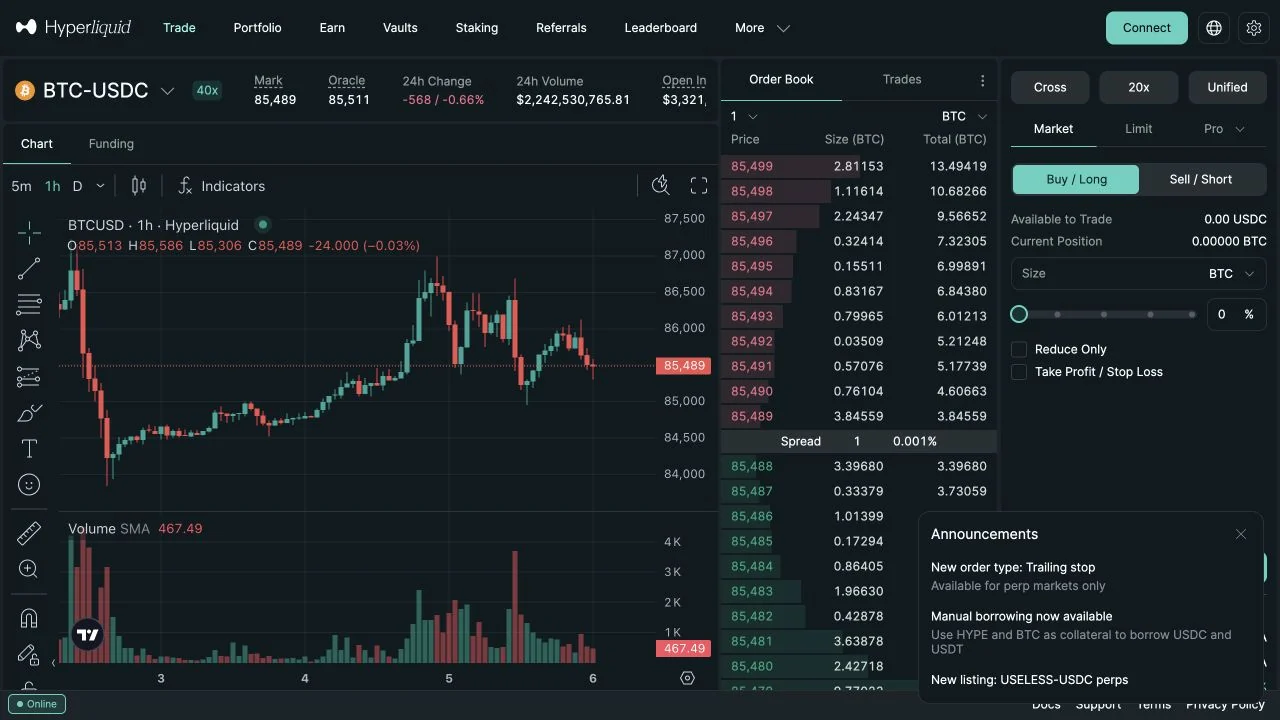
Our 6 October 2026 public-data capture returned active native BTC, ETH and SOL perpetual specifications with maximum leverage of 40x, 25x and 20x. These are instrument ceilings, not default settings: the disconnected BTC interface showed a 20x selection alongside a 40x market label. That distinction prevents a common misunderstanding when comparing screenshots. A selected leverage value is not necessarily the maximum the instrument permits.
The same capture recorded substantial trading activity in all three: approximately $2.24 billion in BTC, $1.08 billion in ETH and $196.7 million in SOL reported daily notional volume. These are the venue's point-in-time figures, not independently audited turnover or an assurance that a large order will receive the displayed price. We use them to establish that the markets are active, then inspect executable quotes separately.
The actual best BTC ask contained 0.7243 BTC at 85,490 USDC, or about 61,920 USDC of visible buying capacity at that single price. The best bid held 5.31552 BTC at 85,489 USDC. That asymmetry matters: a 100,000-USDC market buy could not all execute at the first ask in this observation, while an equivalent sale fit inside the displayed first bid. The side you trade changes the answer.
For SOL, the first ask contained 1,129.65 SOL at 120.05 USDC, approximately 135,614 USDC. A smaller asset by daily turnover nevertheless offered more notional at its first ask than BTC in this particular snapshot. Daily volume alone would have missed that difference. Neither book remains frozen while you decide; resting orders can be changed or canceled before your trade reaches them.
| Market | Published maximum | First high-leverage position band |
|---|---|---|
| BTC | 40x | Up to $150 million |
| ETH | 25x | Up to $100 million |
| SOL | 20x | Up to $70 million |
The public trade feed records completed matches rather than resting interest. The two records below are other participants’ executions, collected after our depth snapshot; they are not a before-and-after test. The smaller sell and larger buy both occurred within a second, at different prices. For a trader reviewing slippage, this illustrates why each execution needs its own timestamp, size and side instead of comparison with an unrelated earlier quote.
| Time | Aggressor side | Quantity | Price |
|---|---|---|---|
| 04:15:46 UTC | Buy | 0.03834 BTC | 85613.0 USDC |
| 04:15:45 UTC | Sell | 0.00699 BTC | 85612.0 USDC |
Native markets versus HIP-3: check who sets the contract rules
Native BTC, ETH and SOL belong to Hyperliquid's main perpetual venue. HIP-3 allows independent builders to deploy additional perpetual markets on the same infrastructure. Seeing both in the interface does not make their collateral, fee schedule or operating authority identical. For an ordinary BTC directional trade, the native market is the clearest baseline; a builder market needs a reason to justify its different terms.
Under the HIP-3 specification, the deployer is responsible for elements including the oracle, leverage settings and settlement operations. A deployer can halt trading and settle a market at its current mark price. That changes the question from “does Hyperliquid list this asset?” to “which contract am I selecting, and who can change its operation?” A familiar ticker alone does not answer it.
Collateral can differ too. A USDC balance is useful for native USDC contracts but is not automatically the correct balance for every market using another quote asset. The newer Unified account mode simplifies balances for markets sharing collateral; it does not turn all tokens into interchangeable dollars. If a builder market uses USDT, the collateral and the contract's fee settings need to be evaluated together.
Fees on builder markets are also configurable. The current schedule allows a deployer fee share from 0% to 300%, with protocol-fee changes when that share exceeds 100%. It is inaccurate to say every HIP-3 trade simply costs twice the native fee. Some markets can be cheaper; others more expensive. The final market-specific rate is the relevant comparison.
Growth Mode discounts are another place where a headline can mislead a crypto trader. The published eligibility excludes crypto assets, crypto indices, crypto wrappers and PAXG. A very low fee advertised for a non-crypto market should not be imported into a BTC cost estimate. For a trader using this site to choose crypto leverage, those non-crypto discounts do not establish a cheaper crypto venue.
How to fund Hyperliquid without putting USDC on the wrong route
The standard wallet route starts with a compatible wallet and USDC on Arbitrum, plus enough ETH on Arbitrum for the deposit transaction. Connecting the wallet and enabling trading is separate from depositing collateral. Your wallet may contain USDC on another network, but matching the ticker does not make that balance ready for the Arbitrum deposit flow.
The current onboarding guide also describes an email route using USDC from Arbitrum, Ethereum, Base or Polygon through Across. That is an important update to older reviews saying every user must first bridge manually to Arbitrum. Select the deposit method that matches the account you actually opened; the availability of additional email routes does not change the instructions for a different wallet deposit path.
Minimums deserve attention before a small trial transfer. The support documentation warns that wallet deposits below 5 USDC are not credited and are lost. Email deposits have different handling below their minimum. A test transfer should exceed the displayed minimum after any sending fee, rather than using a token amount simply because it feels safer. A tiny unsupported test can fail even when a correctly sized deposit would work.
Other assets can arrive through supported integrations such as Unit. Receiving BTC or ETH through such a route is not the same as receiving USDC trading margin. You may need to sell the asset in spot first, or qualify for a collateral arrangement that explicitly accepts it. This is a reason to decide the intended trading balance before transferring a coin you would otherwise prefer to keep.
A delayed credit should be investigated with the sending chain, token contract, receiving address and transaction status. The deposit transaction proves what left the wallet; the exchange balance proves what arrived for trading. Those are separate checkpoints. Do not send a second, larger transfer merely because the first is visible in an explorer but missing from the intended balance.
Unified, Standard or Portfolio: which balance supports your trade?
Hyperliquid now documents three account arrangements. Unified is the recommended mode for sharing a balance of the same asset across spot and eligible perpetual venues. Standard keeps separate balances and manual transfers. Portfolio introduces broader collateral and borrowing features for eligible accounts. A review describing only the old spot-to-perps transfer screen misses a meaningful improvement for someone using more than one market.
For a trader arriving with USDC and opening native crypto perpetuals, Unified reduces bookkeeping. Buying or selling spot and trading perpetuals can use the same asset balance within that account framework. Standard may still appeal if you deliberately prefer explicit separation and manual allocation. The relevant question is whether you want idle balances shared or intentionally compartmentalized.
Portfolio mode is a more substantial change than a convenience switch. The documentation lists eligibility conditions, collateral discounts, borrowing and account-size limits. BTC or HYPE recognized as collateral contributes less than its full market value, and borrowing creates obligations separate from the futures position. A trader who wants a simple stablecoin-funded BTC long does not need to enable it to make the platform useful.
Cross margin still shares losses
Cross is the default position-margin setting, while isolated margin is available where supported. A profitable cross position can help support another position; a losing one can consume the shared pool. Isolated margin assigns support to that position instead. The account mode controls balance organization, whereas cross or isolated controls how the trade uses margin. Confusing those two layers can create a larger shared risk pool than intended.
The transfer-out rule adds a useful constraint: collateral that looks idle may still be needed. Hyperliquid requires at least the greater of the initial-margin requirement and 10% of open notional for the relevant withdrawal calculation. With a hypothetical 20,000-USDC position, 3,000 USDC of equity and a 10x initial requirement, the 2,000-USDC floor leaves about 1,000 potentially transferable before other requirements. Raising the leverage selection does not necessarily release more cash because that 10% floor remains.
Hyperliquid fees: maker, taker, funding and front-end charges
The native perpetual entry tier charges 0.015% maker and 0.045% taker. Maker means an order adds liquidity and is subsequently filled; a limit order that immediately crosses the book can still pay taker fees. A trader comparing a passive-entry strategy with frequent market exits should budget each leg according to how it actually executes.
On an unchanged 24,000-USDC position, a maker entry costs 3.60 USDC and a taker exit 10.80 USDC, totaling 14.40. Taking liquidity on both legs totals 21.60 USDC. These are commission calculations before funding, spread or market impact. They also show why a screenshot advertising the lowest maker tier is a poor estimate for someone who predominantly presses market buy and market sell.
Discounts do not apply automatically
The fee schedule uses fourteen-day weighted volume, combining perpetual volume with twice spot volume. HYPE staking can reduce fees, while maker-share rebates require separate qualifying activity. An ordinary new account paying a positive maker fee should not assume that providing liquidity automatically earns a rebate. Nor should token purchase costs be ignored merely because a staking discount lowers commission.
For a trader already holding the required stake, the discount is relevant to an execution estimate. For someone considering acquiring HYPE only for lower fees, the decision includes capital tied up and token-price exposure. A monthly commission saving can be much smaller than a routine change in the value of the stake. We therefore show the unqualified base rate first.
Builder codes introduce another potential fee layer when you use a third-party front end. They require an approved maximum fee and can add a charge to executions; the documented perpetual ceiling is 0.1%. This is distinct from a HIP-3 deployer's market fee. An otherwise identical trade can consequently cost more through a particular application than the basic native fee table suggests. Review the approved builder and revoke permissions you no longer intend to use.
How hourly funding changes a Hyperliquid holding cost
Funding is paid hourly on Hyperliquid perpetuals. The calculation refers to an eight-hour rate framework, but the hourly payment uses one eighth of that computed rate. Readers moving from a venue with eight-hour settlement need to compare like periods. Multiplying an hourly figure by three because another exchange has three daily funding events produces the wrong estimate.
The public BTC, ETH and SOL capture returned an hourly funding rate of 0.00125%. At that rate, an unchanged 20,000-USDC long would pay 0.25 USDC for one settlement, or 6 USDC over twenty-four identical settlements. That daily figure is an illustration of a constant rate, not a forecast: the rate can change, reverse sign or behave differently for another asset.
The funding payment uses position size multiplied by the oracle price and the applicable rate. It does not use your initial margin as the charged amount. A position with 1,000 USDC of assigned margin and 20,000 USDC of exposure pays based on that exposure. Funding can therefore be modest as a percentage of notional and still meaningful relative to the cash supporting the trade.
Hyperliquid's published cap is unusually wide at 4% per hour. That ceiling is not a normal expected charge, but it makes a simple comparison of headline commission insufficient for a crowded speculative market. Native BTC funding behavior should not be extrapolated to every new listing, and HIP-3 deployers have additional funding parameters. For a multi-day trade, historical funding for that exact market is more informative than today's single favorable reading.
Stops and partial fills: the Hyperliquid detail that can leave a trade exposed
Hyperliquid's position-level take-profit and stop-loss controls can close the entire position or a chosen quantity. A whole-position exit follows the position's size; an explicitly sized exit remains tied to its specified amount. The practical difference appears after adding to or reducing a trade. A stop designed for the old size may no longer cover the exposure you now hold.
Attached exits on an entry order have more specific activation rules. The TP/SL documentation says the child orders activate when the parent fully fills, or when a partially filled parent is canceled because of insufficient margin. If you manually cancel a partially filled parent, its attached child orders are canceled too. The filled portion of the entry can remain as a position requiring a new exit instruction.
Imagine a limit buy intended for 1 BTC that fills only 0.3 BTC. You decide to cancel the remaining 0.7 BTC. It would be easy to think the original attached stop now protects the 0.3 BTC automatically. Under the documented manual-cancellation behavior, that assumption is wrong. Inspect the resulting position and add its required stop after the cancellation. This is more consequential than learning another label on the order menu.
A partially filled entry needs an exit check
Only 0.3 BTC fills
You manually cancel the remaining 0.7 BTC of the parent order.
Attached TP/SL children are canceledThe filled trade remains
Inspect the position and place its intended closing instruction.
Do not assume the old stop survivedMarket TP/SL orders trigger from the mark price, not necessarily the latest trade visible on the chart. They also have a documented 10% slippage tolerance. A trigger level is therefore not a promised execution price, and the tolerance should not be mistaken for an estimate that every stop will slip by that amount. A stop-limit adds a price boundary but can remain unfilled if the market passes beyond it.
Reduce-only is useful when the intention is strictly to exit. It prevents the closing instruction from opening reverse exposure after the existing position has gone. The combination you need is not “more order types”; it is an exit size, trigger reference and execution behavior that match the actual position. A trader scaling entries should revisit those settings after each material size change.
Chase, TWAP and trailing stops: useful controls with different dependencies
A Chase order repeatedly adjusts a resting order around the market. Hyperliquid runs this function in the browser tab, so it is unsuitable for a trader expecting the strategy to keep adapting after closing that tab. The documentation permits up to five simultaneous Chase orders. Leaving a page active is an operational dependency, not a minor cosmetic detail.
TWAP is designed for distributing an execution over time. The documented minimum total value is $100, with durations from five minutes to seven days and suborders no more frequent than every thirty seconds. This can be useful for a patient entry or exit whose entire size would otherwise hit the book at once. It is not a promise of receiving the average chart price over that period.
TWAP suborders use a slippage constraint and can fall behind the intended schedule when sufficient liquidity is unavailable. Catch-up behavior is bounded rather than unlimited. If a program finishes with less than the requested quantity, the unexecuted amount is not a mysterious missing position; the execution conditions prevented a full fill. A trader using it to close exposure should confirm the remaining position when the schedule ends.
Trailing stops answer a different need. They adjust the trigger as the mark price moves favorably, allowing a position to remain open while defining a reversal threshold. They are useful when you want a rule for giving back part of an unrealized gain, not when you require a fixed guaranteed closing value. A trailing trigger and a passive execution program solve different problems; combining features without that distinction can make a simple trade harder to supervise.
For manual trading on a phone, standard resting limits and exchange-held conditional exits are generally easier to supervise than a browser-dependent Chase session. This is a product-fit judgment, not a measured uptime claim. Our review inspected the public interface but did not run a funded strategy or compare execution speed across devices.
What liquidation, HLP and auto-deleveraging mean for an open position
Liquidation begins when the account or isolated position falls below maintenance requirements. Hyperliquid uses a mark-price framework intended to reduce dependence on a single local trade. Consequently, a chart wick and the liquidation calculation can differ. The account's displayed margin health is more useful than trying to reconstruct a precise liquidation point from the headline leverage multiplier alone.
The documented first response is order-book liquidation. For positions above $100,000, an initial liquidation can close 20% of the position, followed by a cooldown and further handling if necessary. Smaller positions should not be assumed to receive the same partial-treatment pattern. A partial liquidation can preserve some exposure, but it is an involuntary reduction governed by the protocol, not a user-selected stop.
If the account deteriorates sufficiently, backstop liquidation can transfer risk to HLP. Cross-margin handling can encompass the account's cross positions, whereas an isolated position is handled within its isolated framework. HLP is part of the market's loss-management mechanism. Depositing into HLP is a separate investment decision and does not insure your personal trading balance against losses.
Auto-deleveraging is the further case a profitable trader should understand. Under specified conditions, an opposing profitable leveraged position can be reduced to resolve insolvency. Your trade can therefore end for a reason other than your own stop, limit or liquidation. This possibility matters to a hedge: if the futures leg disappears while the spot asset remains, the exposure you intended to offset has returned.
None of these mechanisms makes the largest permitted multiplier an appropriate default. More usefully, they explain what can change your position without a fresh click from you. A futures venue should be judged partly by how clearly these paths are documented and visible, not by treating a liquidation fund as equivalent to a guaranteed reimbursement program.
The JELLY episode: why market resolution belongs in this review
In March 2025, Hyperliquid's official announcements reported a validator decision to delist JELLY perpetuals after suspicious market activity. The team also announced reimbursement arrangements for affected users, excluding identified flagged addresses. The relevant evidence is the official announcement record, rather than a claim that every later incident would receive the same treatment.
For a futures trader, the lesson is about contract continuity. A position in a stressed smaller market can be affected by an emergency resolution even when the trader did not choose to close. That is materially different from an ordinary liquidation caused only by their own insufficient margin. It also prevents us from describing all onchain markets as immune to discretionary intervention.
This history does not establish that native BTC trading behaves like the JELLY event. It does justify treating newly listed or easily concentrated markets differently from established major pairs. When comparing a speculative market with an alternative venue, examine its resolution rules and operator alongside trading fees. A low commission is of limited comfort if you misunderstand how the contract can be halted or settled.
Getting funds out: withdrawal, internal transfer and available balance
Hyperliquid distinguishes sending assets within its environment from withdrawing to an external chain. Selecting an internal send operation for an address belonging to an unsupported exchange deposit route can leave funds somewhere the recipient does not monitor. The destination must support the exact asset and network used; the fact that it displays a familiar hexadecimal wallet address is insufficient.
An open trade can also explain why the balance available to withdraw is lower than account equity. Initial-margin requirements, the transfer floor and outstanding obligations reserve funds. Unrealized profit shown beside a position is not automatically the amount you can remove while maintaining that position unchanged. Closing or reducing a trade changes those requirements, whereas merely changing the leverage selection may not free the expected amount.
After initiating a supported withdrawal, track its status before assuming a wallet display problem means a platform failure. A completed transfer can require selecting the correct network or adding the correct token view in the receiving wallet. The withdrawal support page separates processing from destination visibility. We did not perform a funded withdrawal and do not present an old fixed-fee claim as a verified quote for every current route.
This makes Hyperliquid a less convenient choice if your routine exit is directly to a bank account. A bank-funded exchange can combine trading and cash withdrawal in one account, while this route can require an additional conversion venue. Include that extra step in your decision before moving collateral, especially when the amount is small enough that network and transfer costs materially affect the result.
Can you use Hyperliquid from the US or Ontario?
The interface terms, updated 15 June 2026, exclude people and entities residing in, located in or established in the United States or Ontario, Canada, along with specified sanctions-related categories. Those exclusions apply even though the underlying chain is described as permissionless. The public page being reachable is not an exemption from its access conditions.
This is particularly important when reading a “no KYC” comparison. A wallet connection describes an account-access method; it does not establish worldwide legal availability, local authorization or immunity from later restrictions. Our country guides address local choices separately. We do not recommend a VPN or a different front end as a way to override the restrictions of a service you are prohibited from using.
For an eligible user, the distinction between the interface and underlying protocol still matters during a disruption. A browser problem, a chain problem and a withdrawal problem are different failure points. A useful incident record identifies the affected component, timestamps and transaction or order identifiers. Sending support a seed phrase never helps resolve any of them; it only gives away control of the wallet.
Hyperliquid versus Lighter and centralized futures exchanges
Choose Lighter for a clearer zero-commission ordinary-order starting point if its markets and documented timing conditions fit. Its Standard account does not charge maker or taker commission for ordinary orders, but specialized execution features can have separate fees. Our Lighter dossier separates those exceptions and the account tiers, so the comparison is not based on an unqualified “everything is free” statement.
A centralized futures exchange can be the better fit when you need direct local-currency funding, integrated identity-based account recovery, private account activity or a particular coin-margined product. Bybit and OKX offer extensive controls, while Kraken's eligible products provide different collateral and regional arrangements. Those benefits come with their own entity, custody and availability conditions; they are not interchangeable substitutes in every country.
Hyperliquid futures: your questions
Does Hyperliquid require HYPE to trade native BTC perpetuals?
The ordinary USDC-funded native BTC route does not require purchasing HYPE. A wallet deposit through Arbitrum needs the appropriate USDC and ETH for that deposit transaction. HYPE staking discounts and Portfolio collateral are separate optional features; neither should be confused with a mandatory trading subscription.
Why does Hyperliquid show 20x when BTC supports 40x?
The order ticket can display your selected leverage while the market label displays its maximum. Our public inspection showed that exact combination. Larger positions enter lower-leverage risk bands, and the amount available to trade also depends on account equity and other positions.
Will a Hyperliquid stop remain after I cancel a partly filled entry?
Not necessarily. Under the documented attached-order rules, manually canceling a partially filled parent also cancels its attached TP/SL children. The filled position can remain open. Inspect the position and place the intended exit for the quantity actually held; cancellation for insufficient margin has different child-order handling.
Can I close the browser while a Hyperliquid Chase order runs?
The Chase function operates in the browser tab and depends on that tab remaining active. It should not be treated as an independently running server-side strategy. This dependency is specific to Chase and should not be generalized to every resting order or conditional exit.
Are HIP-3 markets covered by the same collateral pool as native perps?
It depends on account mode and the market’s collateral asset. Unified mode can share balances across eligible markets using the same asset. Standard uses separated balances, while Portfolio has additional eligibility and collateral rules. A USDT builder contract does not simply consume a native USDC balance as though the assets were identical.
Does the 0.015% Hyperliquid maker rate include every third-party fee?
No. It is the native base perpetual maker commission. A third-party front end may have an approved builder fee, and HIP-3 deployers set market-specific fee parameters. Staking, volume and maker-share programs can also change qualified account rates; use the final rate for the selected interface and contract.
Does Hyperliquid guarantee repayment after an emergency delisting?
No general guarantee follows from a previous incident. The JELLY announcement described a particular delisting and reimbursement response. Future market resolutions depend on their own circumstances and rules. Native markets and independently deployed HIP-3 markets also have different operating responsibilities.
Evidence behind this reviewSources and research
Sources and research
Reviewed against current official product documentation and public market data on 6 October 2026. Interface observations are read-only; no funded trading, identity verification or withdrawal was performed. Product-specific qualifications and unresolved source conflicts are recorded below; no guarantees of access, fills or withdrawal speed are inferred from public pages.
- Hyperliquid: Fees
- Hyperliquid: Margining
- Hyperliquid: Margin Tiers
- Hyperliquid: Contract Specifications
- Hyperliquid: Hip 3 Builder Deployed Perpetuals
- Hyperliquid: Start
- Hyperliquid: Abstraction
- Hyperliquid: Portfolio Margin
- Hyperliquid: Deposited Usdc
- Hyperliquid: Funding
- Hyperliquid: Builder Codes
- Hyperliquid: Tpsl
- Hyperliquid: Order Types
- Hyperliquid: Liquidations
- Hyperliquid: Adl
- Hyperliquid: Robust Price Indices
- Hyperliquid: Withdrawal Has Not Arrived In My Wallet
- Hyperliquid_Announcements?Before=334
- Terms