
Who benefits most from trading perpetuals on Lighter?
The choice is which account you should use. Lighter now has Standard, Plus and Premium arrangements, with different fees, order timing and subaccount allowances. A paid tier is not a simple upgrade across every dimension. In the current documentation, Standard has no added maker latency, while Plus lists a 200-millisecond maker delay. Choosing Plus because its name sounds faster can therefore solve the wrong problem.
We favor Standard for a discretionary BTC or ETH trader placing a manageable number of ordinary orders. Plus is relevant when throughput and more subaccounts become constraints. Premium is the more logical paid comparison for a strategy that relies on rapid cancellation or taker response. Those recommendations follow the published differences; we did not run latency benchmarks or claim that a paid account produces better fills in every market.

Standard, Plus or Premium: choose the constraint you need to remove
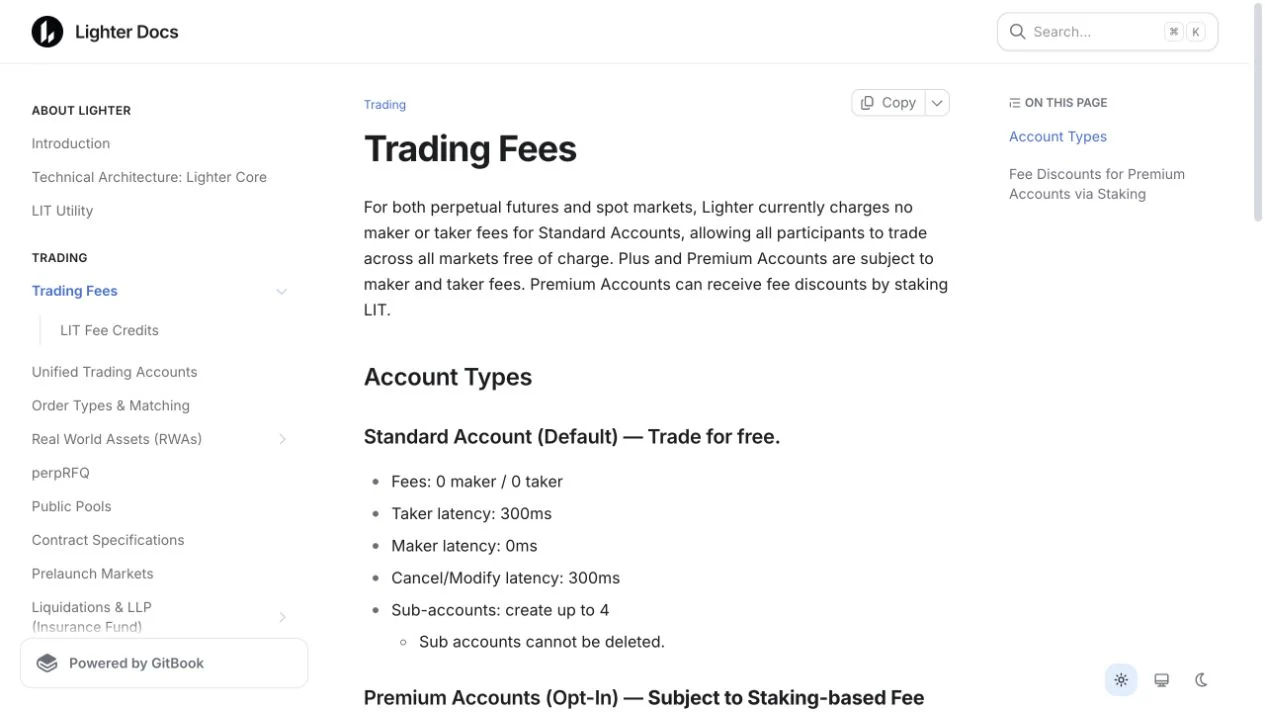
The official account documentation, updated 4 October 2026, lists three distinct arrangements. Standard has zero ordinary maker/taker fees, a 300-millisecond taker delay, a 300-millisecond cancel/modify delay and no added maker delay. It supports four subaccounts. For a trader who places a limit entry and manages a small number of positions, those conditions can be entirely adequate.
Plus charges 0.005% on both maker and taker executions. Its documented taker delay remains 300 milliseconds, while maker and cancel timing is 200 milliseconds. It increases transaction capacity and supports sixteen subaccounts. Its most defensible use case is an account needing more operational capacity while not relying on the fastest available reaction time.
Premium starts at 0.004% maker and 0.028% taker, with a 140-millisecond taker delay and no added delay for cancellations or post-only placement. Sixty-four subaccounts are available. This is a materially different cost profile from Plus: a passive maker can pay a slightly lower commission, but a taker pays more. Whether the timing change is worth that difference depends on how orders actually execute.
Published delay is not your measured end-to-end speed
These figures describe product rules. They do not include every aspect of internet connectivity, wallet interaction, device performance or the time until another trader matches an order. Zero added maker delay is not a promise of an instant fill. Similarly, a 140-millisecond taker setting does not establish that Premium beats another exchange by a measured number of milliseconds in your location.
The tier belongs to the L1 address and is shared across its subaccounts. A trader cannot assume that one subaccount will retain Standard fees while another uses Premium simply because their positions are separate. Account changes also have timing conditions: upgrades have no cooldown, while other switches generally require twenty-four hours since the last change. That makes the tier a considered trading configuration, rather than a free switch for every order.
| Account | Ordinary maker / taker | Timing and account capacity |
|---|---|---|
| Standard | 0% / 0% | 0 ms maker; 300 ms taker and cancel; 4 subaccounts |
| Plus | 0.005% / 0.005% | 200 ms maker/cancel; 300 ms taker; 16 subaccounts |
| Premium base | 0.004% / 0.028% | 0 added cancel/post-only delay; 140 ms taker; 64 subaccounts |
Is Lighter really free? Separate ordinary orders from TWAP and RFQ
The zero-fee claim is valid for ordinary Standard executions, but it is incomplete as a description of every trading operation. The account-types specification explicitly assigns a one-basis-point fee to Standard TWAP orders. One basis point is 0.01%, or $1 per $10,000 executed. That small exception matters if your normal way of entering and exiting is a time-sliced program.
The perpRFQ documentation separately lists a one-basis-point points fee for Standard accounts using that feature. This is another reason not to paste “0% all trades” into a recommendation card. RFQ and an ordinary market order can produce similar-looking positions while using different execution arrangements and fees.
For a stable $10,000 entry and $10,000 exit, Standard ordinary commission is $0; Plus commission is $1; Premium taker execution on both sides costs $5.60 at its base rate. Premium maker execution on both sides costs $0.80. A Standard TWAP totaling $10,000 incurs $1 for that executed amount; two such programs total $2 if both execute fully and the rate remains unchanged.
What happens after you decide to cancel a quote?
- Standard
- 300 ms configured delay
Ordinary maker/taker commission remains zero.
- Plus
- 200 ms configured delay
Paid capacity; 0.005% maker and taker.
- Premium
- No added cancellation delay
Base commission: 0.004% maker / 0.028% taker.
Commission is only one part of the comparison. A maker order can wait without filling, an urgent taker order can cross several levels, and an open perpetual can pay funding. The most useful cost record separates those components. Otherwise a trader can incorrectly attribute a poor execution to a fee or assume a zero-commission fill could not have been expensive.
We would not select Premium simply because it is the most advanced label. If your records show that cancellation timing is costing you fills, it becomes a relevant experiment. If your activity consists of occasional BTC market entries held for several days, the higher taker commission needs a more specific justification. Paying for a capability you do not use is not an execution improvement.
How much leverage is available on Lighter BTC, ETH and SOL?
The current public order-book specification returned a minimum initial-margin fraction of 2% for BTC and ETH, equivalent to 50x maximum leverage, and 4% for SOL, equivalent to 25x. BTC and ETH also had a 5% default initial-margin setting. That default corresponds to 20x and explains why an account can start below the market's maximum without any contradiction.
All three markets were active and not frozen in the 6 October capture. Reported daily quote volume was about $751.7 million for BTC, $290.6 million for ETH and $47.1 million for SOL. Volume shows recent activity; the order book determines the size available at a particular price.
Minimum order value can outweigh the minimum coin amount
BTC's captured minimum base quantity was 0.00007 BTC, alongside a $10 minimum quote amount. At an illustrative BTC price of $85,000, the minimum coin quantity is worth only $5.95. A trader must therefore satisfy the quote minimum as well; meeting one published minimum does not necessarily create an acceptable order. ETH and SOL also had $10 quote minimums in the capture.
A $10 minimum position is not a $10 maximum deposit or an invitation to exhaust the leverage slider. It specifies the smallest accepted exposure under the observed market settings. Tick size, quantity increments and available margin still constrain the final order. If a tiny order is rejected, check its position value before concluding that the deposit has failed.
The contract-specification article includes wording about a test network, so we used the active mainnet response to corroborate the markets above. This is a material research distinction: a static table can be useful for explaining margin fractions but should not by itself certify what is currently trading. New listings and account-specific restrictions can also change the set of instruments available to you.
Post-only, reduce-only and TWAP: three behaviors worth understanding
Lighter matches ordinary orders by price and time. A post-only instruction prevents a limit from taking immediate liquidity: if it would cross the book, it is canceled. That is useful for retaining maker behavior, but it can leave you with no entry. Someone expecting the system to automatically move the price away from the market should not assume that behavior here.
Reduce-only prevents an exit from increasing exposure or flipping the position. Once the position reaches zero, an ordinary excess reducing order is canceled. This is useful when more than one exit could act on the same position, because the second fill should not create a new trade in the opposite direction.
TWAP has a more specific lifecycle. A reduce-only TWAP can continue attempting its scheduled reductions after the position reaches zero, until its program ends. If you subsequently reopen a position in the relevant direction, the continuing program can start reducing that new exposure. Flattening the position is therefore not always equivalent to stopping the execution program.
Imagine selling out of a SOL position early while a longer reduce-only TWAP remains active. An hour later you open a fresh SOL long and wonder why it is being reduced. The program, rather than an unexplained account action, can be the reason. End or review the outstanding TWAP before beginning the new trade. This is a useful distinction for traders who frequently reuse the same market during a session.
Conditional orders use the mark price for triggers. The order-management page also explains that risk checks occur when fills execute, rather than allowing an order to turn a healthy account into an unhealthy one unchecked. A resting order can therefore fail to fill as originally expected if account circumstances change. Margin released by canceling another order can affect opening capacity without changing the market price.
When a large crypto trade deserves a perpRFQ quote
A large order can be awkward when the public book does not show enough size near the current price. Lighter's perpRFQ gives eligible whitelisted addresses a way to request liquidity from market makers for selected instruments, including BTC, ETH, SOL and several other crypto markets. This is an execution option for size, rather than a separate higher-leverage product.
The documentation says market makers see the requested size without the trade side, can respond within a ten-second window and may adjust pricing until you execute. The user then has a two-minute execution window. Those details matter because the initial indicative number is not a fixed price reserved unconditionally for the whole interval.
The practical choice is whether the offered execution improves on the public book for the amount you intend to trade. That comparison should include the applicable RFQ fee and the current quote at confirmation. A quote arriving quickly is not proof that it is cheaper, and an RFQ request does not commit a market maker to supply unlimited depth.
For small manual trades, this extra workflow is unlikely to be the main reason to choose Lighter. For a larger portfolio adjustment in a supported crypto asset, it is more relevant than increasing the leverage multiplier. Increasing leverage changes collateral required; it does not create counterparties for an order that exceeds available liquidity. RFQ addresses the latter problem.
Depositing to Lighter: the new unified address and minimums
The updated transfer documentation recommends the Unified Deposit Address route through Fun.xyz. It can accept supported assets from multiple networks and convert them to the chosen supported destination asset. That is different from a direct Ethereum deposit and from older instructions that describe only a CCTP bridge. The route shown in the app determines which instructions you should follow.
For a new account, the documented unified-address minimum is $5 on most supported networks; Bitcoin requires $10. Existing accounts can have a $3 minimum on supported EVM chains and Solana, while Tron remains $5 and Bitcoin $10. Direct Ethereum deposits have their own $1-equivalent minimum. Mixing those minimums is a straightforward way to create a transfer too small for the selected route.
A unified deposit may also involve asset conversion. The amount leaving your wallet is not necessarily numerically identical to the USDC credited after conversion and route costs. Compare the quoted destination amount with the amount you intend to use for futures margin. This matters particularly for smaller transfers, where a modest fixed cost becomes a noticeable percentage.
The app provides the deposit destination for the chosen account and route. An old address copied from a tutorial is not a substitute, and a contract address should not be treated as a general-purpose exchange deposit address. Keep the source-chain transaction reference and the route status so that you can distinguish a pending conversion from a missing trading credit.
There is no reason to fund every available account mode while testing the interface. A USDC futures balance provides the simplest basis for checking the ordinary trading workflow. Holding ETH as additional collateral is a separate choice discussed below; it should follow an understanding of the margin treatment, not happen accidentally because an ETH transfer was more convenient.
Can ETH back a Lighter futures position?
Yes, Lighter now documents Multi-Asset Margin for Unified Trading Accounts. Its current collateral table lists ETH and XAUT alongside the USDC base balance. ETH contributes 70% of its indexed value toward opening capacity, with a separate 85% liquidation-threshold treatment. The haircut means you cannot count a $1,000 ETH holding as $1,000 of spendable margin.
Suppose the ETH allocated as collateral is worth $2,000. At a 70% loan-to-value setting, it contributes $1,400 toward the account value used for opening checks. If ETH's price falls 20%, that contribution becomes $1,120, a $280 reduction before considering any futures PnL. Using the same coin as collateral and as the direction of a long trade can therefore make the two parts of the account weaken together.
ETH collateral changes with ETH’s price
Same allocated coins · documented 70% opening-value ratio
Recognized opening value
Recognized opening value
The distinction between the opening haircut and liquidation threshold is deliberate. Failing an opening-capacity check need not mean the account has already reached liquidation. The account can enter a stage where risk-increasing actions are restricted before positions are forcibly closed. A trader should respond to that change in account health instead of waiting for the interface to show a final liquidation event.
Allocation and supply caps limit the feature
Users can choose how much of a supported holding to allocate as margin. The documentation also publishes individual and global caps: ETH has a 2,000-ETH user cap and 10,000-ETH global cap, while XAUT has different limits. A supported asset is not an assurance that unlimited new collateral can be added at any moment.
The page contains broad examples of spot use, but its launch restriction says non-USDC collateral support is for perpetuals, with USDC spot use not included at launch. We therefore do not recommend a leveraged spot workflow merely because a generic example appears further down the document. For this futures review, the supported conclusion is narrower: eligible Unified accounts can use the specified assets under the current margin rules.
Multi-asset liquidation can involve both perpetual positions and collateral assets. Holding ETH in this pool is consequently different from leaving ETH untouched in an external wallet. It can be sold through the liquidation mechanism when account health deteriorates. If preserving the coin holding is more important than reducing stablecoin funding needs, separate collateral remains easier to reason about.
Funding, mark price and why the displayed balance moves
Lighter's crypto perpetuals use hourly funding in the documented framework. The eight-hour basis is divided into hourly payments, so a rate described over eight hours should not be charged again in full every hour. Funding history for the selected market is more useful for a multi-day trade than a single headline about Standard commission being zero.
The mark price combines internal market information with external references. Lighter documents a blend involving its order-book impact price, a smoothed premium relative to the index and external exchange marks. The objective is to avoid relying entirely on one last trade. The index itself uses oracle providers including Chainlink, Stork and Pyth.
For the reader, the important consequence is that the chart's latest executed price need not be the number used for margin health or a conditional trigger. A brief trade through a level may not produce the same result as the mark reaching that level. Conversely, an account can approach its margin threshold even if the particular chart view makes the movement seem smaller.
A futures account's value includes unrealized gains or losses, funding effects and relevant collateral valuation. A funding payment is not the exchange secretly adding maker or taker commission to a supposedly free order. Keeping those entries separate lets you determine whether your strategy is suffering from repeated execution cost, expensive holding periods or the direction of the market.
This is also why a high annualized funding reading should not be presented as a dependable return. A trader taking the receiving side still faces price, execution and liquidation exposure, and the rate can reverse. Lighter's fee advantage can improve the economics of a trade without turning the funding stream into a predictable income product.
What happens before and during a Lighter liquidation?
Lighter distinguishes initial, maintenance and close-out requirements. Initial margin governs opening capacity; maintenance governs whether exposure can remain supported; close-out governs more severe account deterioration. At the pre-liquidation stage, actions that increase risk can be restricted even before the liquidation engine begins closing positions. That is a useful early signal rather than a broken buy button.
The liquidation mechanism first cancels orders. If that does not restore sufficient account health, positions can be closed through the book. The documentation's partial-liquidation concept can mean closing individual positions until the overall account recovers, rather than necessarily selling an identical small percentage of every position. A multi-position trader should not assume each hedge leg survives proportionally.
For example, an account holding a directional BTC position and a separate ETH hedge may emerge with a changed mix of exposure after liquidation handling. The relevant follow-up is the remaining portfolio, not merely whether the account is still open. Liquidation fees can also be charged, with the documented maximum of 1% for the observed markets.
The Lighter Liquidity Pool serves a backstop role when ordinary liquidation is insufficient, with auto-deleveraging as a further mechanism. LLP protection is a system for managing bad debt; it is not a promise to reimburse every trader's loss. A profitable opposing position can be affected when the final mechanism is required, which matters when that position exists to offset coins held elsewhere.
There is also a narrower account-management nuance: the fee documentation says isolated-position fees can be supported by an automatic transfer from cross balance when needed. A user who treats the word isolated as an absolute promise that no other balance can ever move should account for that documented behavior. Isolation of position risk and payment of operational charges are not always the same boundary.
Secure versus Fast withdrawals: where the funds can go
Lighter's Secure withdrawal returns assets to the L1 address that owns the account and settles through Ethereum. The current documentation lists a minimum of $1 equivalent and supports eligible assets. This is the more constrained destination route: it is not a general instruction to send any token directly to any external exchange address.
Fast withdrawal is documented as USDC-only, with a 4-USDC minimum, and can target an Ethereum address other than the account owner's. It uses a liquidity pool and requires the relevant wallet authorization in addition to the account signing process. “Fast” describes that architecture, not a measured promise from our review about the number of seconds every withdrawal takes.
The route fee and available withdrawal limit are provided for the particular account and operation. We could not verify a universal current fixed fee without a funded account, so we do not import an old flat-fee figure from a previous review. The useful answer is the destination and asset distinction above; the final quote resolves the exact current cost.
An internal Lighter transfer is a third operation. Moving a balance to another Lighter account does not withdraw it to Ethereum, and an Ethereum transfer does not necessarily reach an exchange deposit route on another network. Choose the destination first, then the operation that actually reaches it. This avoids an apparently successful transfer ending somewhere different from the intended cash-out path.
If a Secure withdrawal is finalized but not yet reflected in a familiar wallet view, the documentation provides a claim path on the Ethereum contract. That is different from resubmitting an identical withdrawal because the interface seems delayed. Most readers should use the app's supported status and claim workflow rather than copying low-level transaction instructions from an unrelated account example.
When Plus, API quotas or LIT discounts become relevant
API-heavy strategies have a second capacity limit beyond requests per minute. Lighter's volume quota applies to Plus and Premium order-related transactions and grows with trading volume. The published program grants one unit of quota for every $2 traded, alongside a small free submission allowance. Subaccounts under the same L1 address share that quota.
This matters for a strategy that constantly replaces quotes but executes very little. A high nominal per-minute allowance does not necessarily permit unlimited unfilled order activity. The quota is designed around usage and executed volume, so a bot needs to monitor both. It is not useful to a manual trader merely because a review wants to list another advanced feature.
Premium staking discounts run from 2.5% to 30% across the published LIT bands. Fee credits also count toward the relevant stake treatment in the current account specification. A trader already holding qualifying value can apply the correct tier when comparing costs; someone buying LIT solely to save commission needs to compare the saving with the capital and token-price exposure.
At base Premium taker pricing, $1 million of executions costs $280. A 10% fee discount saves $28 on that same activity. That simple scale check is more useful than presenting a large percentage discount without the trading volume behind it. It does not establish that buying the required stake is a good investment.
For most readers, these are later decisions. Start with the order workflow and market you need, establish whether its execution is suitable, then consider paid throughput or staking where a real constraint appears. Creating extra accounts or chasing program benefits before proving the basic trading fit adds complexity without improving the underlying trade.
Where is Lighter unavailable?
The Lighter terms expressly exclude the United States, Canada, the United Kingdom, China, North Korea, Russia, Ukraine, Cuba, Iran, Venezuela, Sudan, Belarus, Myanmar and Syria, along with relevant sanctions categories. This is a service-access restriction, not merely a limitation on card deposits. The wallet interface does not establish an exception for residents of those locations.
That matters when selecting between onchain venues: their restricted-country lists are not identical. A trader eligible for one cannot infer eligibility for another from a shared wallet-login method. Use the service’s current terms and the local derivatives context; the absence of a conventional signup form does not itself authorize trading.
Lighter, Hyperliquid or a centralized exchange?
A maker that repeatedly cancels and replaces quotes faces a more specific comparison: Lighter Premium's cancellation conditions against the alternative venue's actual order behavior and fees. A patient discretionary trader faces a different comparison: Standard commission, the selected market's depth and the cost of funding an account. Those readers should not be given the same recommendation merely because both trade perpetuals.
A centralized exchange may suit someone needing a direct fiat withdrawal, account recovery through a verified identity or a contract not available on Lighter. Lighter's wallet and Ethereum-based settlement model removes some conventional account steps but introduces its own signing and chain responsibilities. Published smart-contract and circuit audits are useful evidence of review scope, not proof that any of those responsibilities disappear.
Lighter futures: your questions
Does a Standard Lighter TWAP also have zero commission?
No. The current account-types documentation assigns a one-basis-point fee to Standard TWAP executions. That is 0.01%, or $1 per $10,000 filled. Ordinary Standard maker and taker orders remain zero commission; perpRFQ has a separately documented one-basis-point points fee.
Is Lighter Plus faster than Standard for every order?
No. Plus lists 200-millisecond maker/cancel timing and a 300-millisecond taker delay. Standard lists no added maker delay, with 300 milliseconds for taker and cancel/modify. Plus primarily addresses greater operational capacity; Premium is the relevant tier for its lower published taker delay and cancellation conditions.
Can a Lighter TWAP affect a position I open later?
A reduce-only TWAP can continue until its scheduled end even after the original position is flat. If you reopen a relevant position while it remains active, later slices can reduce that position. Review or stop the remaining program when finishing the trade, rather than assuming a zero position automatically ends it.
Why did Lighter reject a BTC order above the minimum coin quantity?
The order must also satisfy the quote-value minimum and other market filters. Our mainnet capture listed 0.00007 BTC and $10 as separate minimums. At $85,000 per BTC, the minimum coin quantity is only $5.95, so it does not satisfy the $10 requirement.
Can Lighter Fast withdrawal send ETH to another wallet?
The current Fast route is documented for USDC only. Secure withdrawal supports eligible assets but returns them to the owning L1 address and settles through Ethereum. Select the route by asset and destination, then use its current fee and limit; a route’s name alone does not identify what it supports.
Do all Lighter subaccounts keep independent fee tiers?
No. The account type belongs to the L1 address and is shared across its subaccounts. Standard, Plus and Premium offer different subaccount allowances, and the relevant staking treatment and volume quota are also consolidated as documented. Separate strategy balances do not create independent tier eligibility.
Can residents of the UK or Canada use Lighter Standard?
Lighter’s current terms exclude both the United Kingdom and Canada, as well as the United States and other listed jurisdictions. The restriction is not lifted by selecting the zero-fee Standard tier or using a wallet instead of a conventional exchange login. Eligibility comes before choosing among its account types.
Evidence behind this reviewSources and research
Sources and research
Reviewed against current official product documentation and public market data on 6 October 2026. Interface observations are read-only; no funded trading, identity verification or withdrawal was performed. Product-specific qualifications and unresolved source conflicts are recorded below; no guarantees of access, fills or withdrawal speed are inferred from public pages.
- Lighter: Trading Fees
- Lighter: Types
- Lighter: Order Types And Matching
- Lighter: Perprfq
- Lighter: Transfers
- Lighter: Multi Asset Margin
- Lighter: Collateral Supply Limits
- Lighter: Unified Trading Accounts
- Lighter: Funding
- Lighter: Pnl And Total Account Value
- Lighter: Fair Price Marking
- Lighter: Liquidations And Llp Insurance Fund
- Lighter: Quota
- Lighter: Security Audits
- Lighter: Current Terms of Service