
Aster Pro, Shield or 1001x: which product should you actually use?
Aster is easiest to evaluate when you stop treating its trading modes as a single product. Pro is the order-book venue: it suits traders who care about order placement, maker execution, conditional exits and multi-asset collateral. Shield simplifies the trading workflow and offers a different choice of charging model. The product now documented as 1001x uses a liquidity pool and has its own leverage, fee and position-management rules.
Shield deserves consideration when you prefer its simplified execution and understand the selected flat-fee or profit-share arrangement. A smaller upfront commission can become a larger charge on a successful trade. The relevant comparison is the net result for your intended holding period and exit, not which mode displays the least imposing order panel.
The 1001x product is more specialized. BTC can reach the headline multiplier, while ETH and other crypto markets have lower documented maxima. At the highest BTC settings you cannot simply add margin after the trade is open, and net profit is capped. Those conditions are part of the product, not small-print exceptions to an otherwise unlimited leveraged position.
Three Aster workflows, three different cost questions
Pro matches orders through an order book. You can aim to provide liquidity with a limit order, take liquidity when urgency matters and use conditional instructions for exits. Its trading account must have the required supported collateral. Network support affects deposits and collateral choices, but it does not turn every asset on a supported chain into eligible margin.
Shield has separate funding and pricing documentation. Its fee overview still mentions a limited-time zero-fee launch event, while the detailed fee page describes profit-sharing and a flat-fee option. We use the specific current fee options for comparisons and do not present an undated promotional sentence as permanent free trading. The selected mode and quote must make the applicable charge explicit.
1001x opens positions through the supported onchain flow using the ALP liquidity pool on BNB Chain or Arbitrum. The documentation calls it deposit-free because it does not require the same preliminary Pro account deposit. It still uses wallet funds to support positions and charges applicable execution costs. “No deposit step” is not “no collateral required.”
Keeping those distinctions visible solves several misleading review claims at once. A Pro maker rate cannot price a pool-based entry. A 1001x maximum cannot label every Pro market. And Shield's profit-sharing option cannot be described as a fixed percentage of notional. The trade you choose determines which schedule matters.
| Product | Most useful feature | Cost to compare |
|---|---|---|
| Pro perpetuals | Order-book control and hidden limit orders | Maker/taker group, funding and collateral charges |
| Shield | Simpler execution with alternative pricing | Chosen profit share or flat fee, slippage and hourly funding |
| 1001x | Pool-based positions with market-specific high leverage | Product fees, execution charge, funding and profit cap |
Aster Pro fees: General pairs are not the whole market list
The detailed perpetual fee page lists 0% maker and 0.04% taker for General pairs. Group B crypto pairs have a separate 0% maker and 0.1% taker schedule. That difference is substantial for a taker-heavy strategy: the same notional costs two and a half times as much in commission on a Group B pair.
For a 20,000-USDT entry and exit at unchanged notional, two General taker fills cost 16 USDT. The same pair of Group B taker fills costs 40 USDT. A passive General entry followed by a taker exit costs 8 USDT, assuming the entry genuinely provides liquidity. A limit order that immediately crosses the book should not be budgeted at the maker rate.
The grouping matters particularly for altcoin traders. A single badge saying “Aster, 0.04%” can misprice a coin whose contract belongs to Group B. The current list includes named crypto contracts such as OKBUSDT and MEMEUSDT, rather than a simple rule that every smaller coin has the higher rate. Find the selected contract's group; do not infer it from market capitalization alone.
VIP qualification requires both rolling fourteen-day spot/perpetual volume and the relevant average ASTER holding balance. Volume alone is not enough to assume a discounted tier. The program also keeps Group B and RWA treatment separate, so the General VIP ladder should not silently price every contract. We use the unqualified rates in the examples rather than assuming the reader holds a platform token.
USD1 is no longer a blanket cheaper BTC fee
The current detailed schedule puts BTC, ETH and SOL USD1 perpetuals at 0% maker and 0.04% taker, matching the General rate. Older commentary promoting a 0.005% USD1 taker rate no longer describes that table. Switching settlement assets for a fee advantage that has expired adds conversion work without the assumed saving.
RWA perpetuals have a distinct 0.0125% taker schedule, effective from 7 September 2026 in the source. We mention it only to prevent that lower figure being applied to crypto trades. Our recommendation concerns crypto leverage; a stock or commodity fee does not establish the commission on a BTC perpetual.
The introductory Perpetuals page still contains an older 0.01%/0.035% feature bullet. The dedicated fees and specifications page is the more precise source for the current market groups. This review follows that schedule instead of quietly mixing favorable numbers from different versions of the documentation.
Choose the control you actually need
- Set a resting price
- Pro order book
Limit and hidden orders; maker/taker market groups.
- Choose how success is charged
- Shield
Compare the selected profit share with flat-fee pricing.
- Use the specialized BTC multiplier
- 1001x product
Pool-based execution; high settings restrict added margin and cap net ROI.
What Aster’s 1001x claim does—and does not—tell a futures trader
The 1001x documentation assigns the maximum to BTC/USD. ETH/USD supports up to 250x, while other crypto perpetuals in that product support up to 75x. Those are specific product rules. They should not be presented as the maximum on every Aster order-book contract or used to rank every Aster market ahead of another venue.
At 500x, 750x and 1001x, the highest-leverage BTC arrangements use a dynamic closing charge instead of the ordinary opening charge. Adding margin to an open position is not supported at those settings. The published maximum net profit ROI is approximately 500% for 500x and 750x, and 300% for 1001x. The combination changes both sides of the trade: the remaining margin flexibility and the upside are constrained.
For perspective, a 0.1% adverse price movement on a 1001x position is approximately equal to its initial margin before fees and the product's liquidation threshold are considered. This is arithmetic showing the scale of the exposure, not a precise liquidation-price formula. The actual threshold can be reached earlier because the product reserves costs and applies its own loss parameters.
Below 500x, the product documents the ability to add margin and ordinary opening/closing fees. That is still not the same workflow as Pro cross margin. If your plan relies on moving collateral between several positions, the simplified high-leverage product may remove exactly the controls you need.
Pro maximums require the selected contract’s risk bracket
Our Pro public response confirmed BTCUSDT, ETHUSDT and SOLUSDT as trading contracts and exposed their order filters. It did not supply a complete account-specific leverage bracket sufficient to certify one universal maximum. We therefore do not infer “20x maximum” from the generic required-margin field or apply the 1001x product ceiling to Pro. The relevant Pro bracket and selected size must resolve the final limit.
Aster Pro order size, slippage controls and incomplete market fills
The public BTCUSDT specification recorded a 0.001-BTC quantity step and a 5-USDT minimum notional. At a hypothetical BTC price of 85,000 USDT, the smallest quantity is worth 85 USDT, so the coin-size rule is more restrictive than the five-dollar notional floor. A page advertising five-dollar BTC orders without checking the size step would give the wrong practical expectation.
ETHUSDT used a 0.001-ETH step, while SOLUSDT used a 0.01-SOL step in the same capture. Price increments also differ. Those filters describe acceptable order inputs, not how much leverage a verified account is allowed to use. They explain a rejected quantity more directly than assuming the exchange has no liquidity or the wallet connection is broken.
Aster's market-order slippage control converts the instruction into an immediate-or-cancel limit with a price boundary derived from the best bid or ask. The order takes available liquidity within that boundary and cancels the unfilled remainder. That gives you price protection at the cost of potentially executing less than the requested quantity.
Suppose you intend to buy 2 ETH, but only 1.3 ETH is available inside the chosen boundary when the instruction reaches the market. A partial fill is a valid possible outcome. The remaining 0.7 ETH should not be treated as an invisible pending market order. Reconcile the executed quantity before attaching a fixed-size exit or placing another entry.
A wide tolerance prioritizes completion but permits a worse price. A narrow one prioritizes the boundary but increases the chance of an incomplete fill. The useful setting depends on the urgency and depth of that specific contract. The control does not establish that every trade will execute at the edge of the tolerance, and it does not create liquidity that is absent from the order book.
USDT, USD1 and coin collateral: what actually backs an Aster position?
Aster's Single-Asset and Multi-Asset settings define the collateral arrangement. The published single-asset description lists USDT and USD1. Multi-Asset accepts a broader range of supported holdings and operates with cross margin. The important practical choice is whether you want a relatively simple stablecoin-funded trade or a shared pool whose recognized value can move with several assets.
Current collateral tables are chain-specific. On BNB Chain, BTC, ETH, BNB and asBNB are listed at 95% collateral value, ASTER at 80%, and several other assets at different ratios. On Solana, SOL and JLP are listed at 90%. Supported USDC appears in specified network tables; it should not be assumed from the fact that another chain supports a token with the same symbol.
A 95% ratio gives 950 dollars of recognized collateral for a holding valued at 1,000 dollars. That haircut is separate from the token's future price change. If the coin loses value while the futures position also loses money, the collateral support and trading result can deteriorate together. A restaked or yield-bearing asset adds its own exposure beyond the perpetual being traded.
A positive portfolio can still contain a negative settlement balance
Futures losses, funding or fees can create a negative USDT or USD1 balance while other collateral keeps the total account positive. From 9 April 2026, the documented Multi-Asset rules charge interest on the portion exceeding the separate 1,000-dollar negative-balance allowance for each of those assets. The current source describes an annualized rate of 4%, with hourly accrual.
At the source's example hourly rate of 0.000457%, a negative 2,000-USDT balance incurs 0.00457 USDT per hour on the 1,000 above the allowance. The amount is small in that example, but the distinction matters: funding and borrowing interest are different charges, and a positive aggregate balance does not prove that neither is accruing.
Automatic conversion can occur when specified negative-balance or liquidation conditions are reached. Conversion ratios can differ from collateral-value ratios, so a 95% recognized collateral value is not a universal conversion quote. A trader can rebalance the owed settlement asset before hitting an automatic-exchange condition rather than assuming other coins will remain untouched indefinitely.
Cross or isolated: decide before opening the Aster Pro position
Pro documents cross margin as the default and permits isolated arrangements where supported. Changing between those settings can be unavailable while a position or open order exists. The time to make the choice is before entering, not after a price move reveals that the account is sharing more collateral than intended.
For a self-contained directional trade, a supported isolated setup makes the assigned position buffer easier to monitor. For offsetting positions deliberately sharing collateral, cross can use the portfolio more efficiently. Multi-Asset mode is explicitly cross-only, so choosing it for collateral flexibility also means accepting the shared account-health calculation.
The transfer-out calculation depends on unrealized PnL, position requirements and outstanding orders. A wallet balance is not a promise that the entire amount is withdrawable while trades remain open. Removing collateral changes the buffer even when the number of contracts does not change, and an open isolated order can reserve funds that otherwise appear unused.
Aster's documentation gives different cross-transfer expressions depending on whether unrealized PnL is present, with additional assumptions about gift balances and cross collateral. The amount available to transfer can be lower than the wallet balance because open orders, unsettled costs and collateral requirements still tie up funds.
This is a stronger use case for a clear account view than for another high maximum-leverage badge. Someone managing several positions needs to know what can be removed, which losses are shared and whether a collateral conversion is approaching. Those operating details determine whether the chosen Aster product fits the trading plan.
Shield profit share versus a flat fee: compare the successful trade too
Shield offers a published profit-share range of 15% to 20%, with BTCUSDT and ETHUSDT given as 15% examples. Alternatively, the detailed page lets the trader select a 0.03% flat fee based on position notional. The fee overview states that the flat rate applies to opening and closing. Those models reward different patterns of results and should not be condensed into “Shield is free.”
Take an illustrative 10,000-dollar position whose notional is unchanged at exit. Two 0.03% flat charges total $6. Under a 15% profit share, a $20 profit produces a $3 share, while a $100 profit produces a $15 share. At $40 of profit, the share equals $6. This comparison excludes funding and slippage and assumes the quoted fee option applies without a separate promotion.
Shield: a successful trade can favor the flat fee
$10,000 at entry and exit · 15% profit-share example
At $40 profit, a 15% share equals $6.
A profit-share choice can appear attractive when the trade loses because no profit share is charged on a loss. That does not make the loss smaller than zero, eliminate funding or guarantee a favorable execution price. A trader should compare a plausible range of winning and losing outcomes instead of choosing the model solely from the cost of an unsuccessful position.
The documentation's zero-fee launch language and detailed pricing options are not fully harmonized. We have therefore not assumed that an undated promotional sentence overrides the fee shown at entry. This is a material limitation in the public evidence, and a reason our recommendation is more confident for the clearly specified Pro General schedule than for a universal claim about Shield pricing.
Shield also has its own hourly funding mechanism and dynamic slippage. Those costs belong to the Shield quote, not the Pro market's familiar funding display. Even if the underlying crypto asset is the same, switching products changes the economics that need to be compared.
1001x mode: fees, profit caps and why the quote needs its own calculation
Below the special high-leverage BTC settings, 1001x mode charges 0.08% to open and 0.08% to close crypto positions. A constant 5,000-dollar notional therefore incurs $8 in those two charges before execution cost and funding. The documentation separately lists an opening execution fee of $0.50 on BNB Chain and $0.20 on Arbitrum.
At BTC leverage of 500x, 750x or 1001x, the ordinary opening fee is replaced by the documented dynamic closing arrangement, with a minimum closing rate of 0.03%. That is not equivalent to an unconditional 0.03% maximum fee. A profitable trade can encounter the PnL-based component, and the net ROI cap still applies.
There is an arithmetic inconsistency in the official example. It states $100 of profit, a 15% share and $600 notional, then labels the result 0.03%. The expression $100 × 15% ÷ $600 equals 2.5%, not 0.03%. We do not repeat the printed result or treat it as an executable quote. The discrepancy is a reason to inspect the actual close estimate for this specialized product rather than derive a confident all-in charge from that example.
The product's funding accumulates per block and includes a borrowing component. Depending on the balance of positions and borrowing rate, the simplistic idea that one side must always receive the other side's payment does not adequately describe it. A Pro eight-hour funding assumption cannot be transferred to this pool-based position.
BTC and ETH use the documented fixed-slippage framework, while other crypto pairs can use dynamic slippage linked to position size, open interest and underlying liquidity. Fixed describes the mechanism, not a promise of zero slippage. The resulting entry and exit estimates, funding, costs and profit cap together determine whether the trade has acceptable economics.
Pro funding and liquidation: the market-specific details that matter
Pro perpetuals use funding intervals that can vary by contract and can be adjusted during volatility. The source gives an ASTERUSDT example using four hours and describes eight hours as a default that should not be assumed universally. Use the selected market's current interval and history, particularly when moving between major coins and smaller listings.
The documentation also warns of a possible fifteen-second deviation around collection. A trader entering a few seconds after a nominal funding timestamp should not treat that timing as a dependable way to avoid the charge. This is relevant to short holding periods where one funding event can exceed the planned gross price gain.
Funding is deducted from the perpetual account balance and can affect position margin if the available balance is insufficient. It can therefore move the liquidation buffer even without a large change in the underlying coin price. Multi-Asset interest is an additional possibility, which is why the earlier collateral section distinguishes settlement debt from the perpetual's funding payment.
Liquidation uses the relevant mark and maintenance requirements rather than a simple “price moved one divided by leverage” formula. Risk tiers and account mode affect the result. A cross account can involve several positions, whereas the 1001x product uses its separate documented loss and funding parameters. The two products should not share one universal liquidation explanation.
For an exit instruction, decide whether the trade needs execution priority or a price boundary. A stop-market can close at a worse price than its trigger in a fast market, while a stop-limit can fail to complete. The practical aim is to understand which position remains after the instruction, not to claim that a stop guarantees a fixed maximum loss.
Funding and withdrawing Aster: use the product’s actual asset and network
Aster Pro supports multiple networks with distinct collateral lists. Selecting a supported chain is only the first part of a deposit instruction; the exact token must also be supported on that route. For instance, a collateral table listing USDC on Ethereum or Arbitrum does not prove an arbitrary representation of USDC is acceptable on every other chain.
The Pro guide explains that futures results and fees can leave settlement balances requiring rebalancing before withdrawal. The newer USD1 contracts and collateral documentation add another settlement asset to consider. A reader should identify whether the position is a USDT contract or a USD1 contract rather than treating either ticker as a cosmetic display preference.
When sending funds back to a centralized exchange, the receiving deposit route must match the withdrawal asset and network. A familiar exchange logo or a valid-looking address does not establish that the selected chain is supported there. The useful comparison is the amount that will reach a usable balance after conversion and withdrawal costs, not only the amount shown as portfolio equity.
1001x follows a different wallet-funded position flow on BNB Chain and Arbitrum. Instructions for withdrawing a Pro account balance should not be used to explain closing a pool-based 1001x position. Likewise, the execution fee paid to open the latter is not the network fee for every Pro withdrawal.
We inspected documentation and public market information without moving funds. Route-specific fees and processing times are therefore not presented as measured outcomes. For a trader choosing between Aster and a centralized venue, the supported onchain route is an advantage when funds already live on that network; it can be extra work when the intended destination is a bank account.
Aster availability: wallet access still has geographic restrictions
Aster's terms dated 25 February 2026 list prohibited jurisdictions including the United States, Canada, the United Kingdom, China, North Korea, Russia, Ukraine, Cuba, Iran, Venezuela and Syria, alongside sanctions-related restrictions. We do not describe Aster as a worldwide route simply because it can be accessed through a wallet.
The terms also reserve the possibility of identity checks. Hidden orders concern public market visibility; they are not an exemption from account-access requirements. A reader evaluating privacy should distinguish those two points instead of treating the trading feature as a guarantee about every future verification request.
This limitation materially changes the shortlist for readers in the excluded locations. The presence of Aster in an international comparison is not a recommendation to bypass local or platform restrictions. Our country pages provide the relevant regional context, while this dossier evaluates how the products work for eligible users.
When Aster is preferable to Hyperliquid or Lighter
Lighter Standard is the stronger starting comparison for a manual trader whose priority is zero ordinary maker/taker commission. Aster's zero General maker rate does not reproduce zero taker pricing, and Group B makes the difference larger. On the other hand, fee savings alone do not reproduce Aster's hidden-position behavior or particular collateral options.
Hyperliquid is a useful comparison for a trader prioritizing a publicly observable order book and native-market activity. Aster's hidden liquidity means public depth cannot be interpreted in precisely the same way. That is a difference in market visibility, not evidence that either book must always execute better.
Aster futures: your questions
Is 1001x available on every Aster crypto market?
No. The dedicated 1001x product lists BTC/USD up to 1001x, ETH/USD up to 250x and other crypto perpetuals up to 75x. Those limits do not automatically describe Pro order-book contracts. Pro leverage depends on its selected market, position bracket and account conditions.
Does an Aster USD1 BTC trade still get a 0.005% taker fee?
The current detailed perpetual schedule lists 0.04% taker and 0% maker for BTC, ETH and SOL USD1 pairs. Older reduced-rate commentary should not price a current trade. USD1 and USDT also remain different settlement assets, so conversion can matter even when the advertised commission matches.
Can I add collateral after opening a 1001x BTC position?
The documented BTC settings of 500x, 750x and 1001x do not support adding margin to an open position. Below 500x, the product permits adding margin under its rules. This is separate from Pro cross-margin behavior and is one reason the extreme-leverage product may not fit a strategy requiring later collateral adjustments.
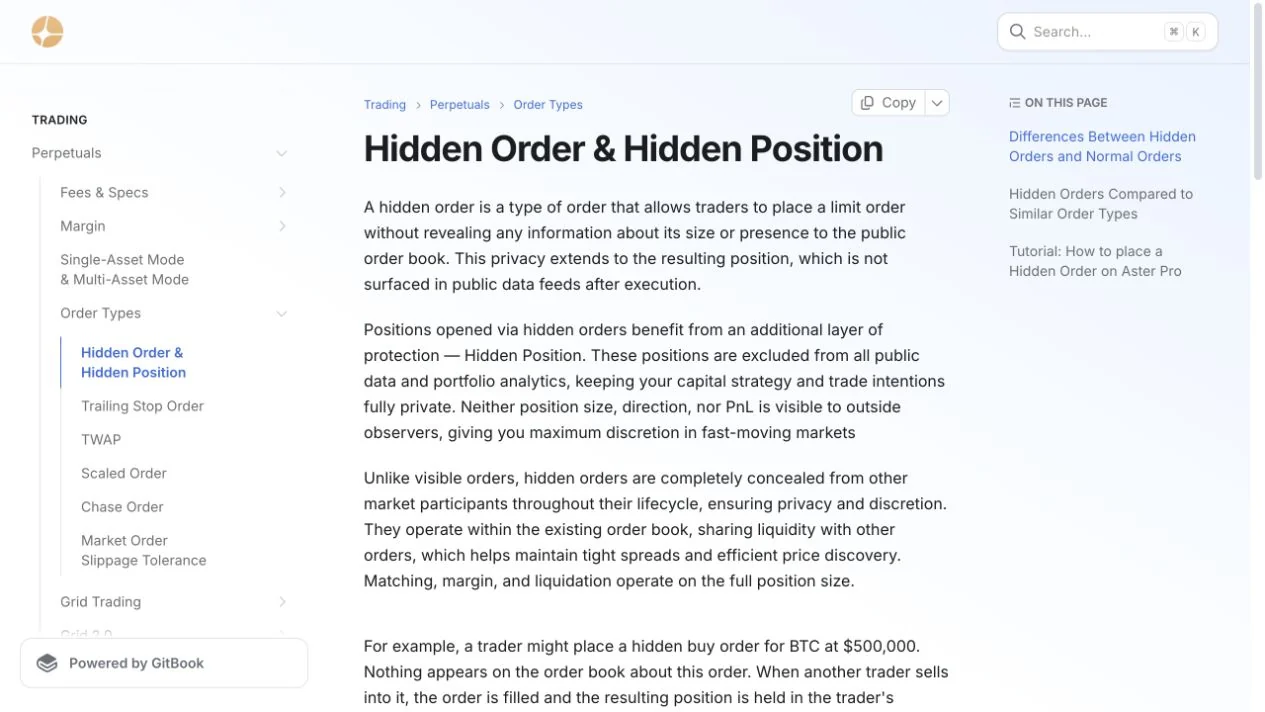
What does Aster hide when I place a hidden limit order?
The documentation says the order’s presence and size are omitted from the public book, and the resulting position is excluded from public feeds and portfolio analytics. The owner still sees it in the account. Full size continues to determine matching, margin and liquidation; this is not a guarantee of wallet anonymity or invisible transfers.
Why can a market order on Aster fill only part of my requested size?
The slippage-tolerance function uses an immediate-or-cancel limit boundary. Available liquidity inside that boundary can fill while the remainder is canceled. Check the executed position before placing the next order or a fixed-size exit; a market instruction with price protection is not a guarantee of full completion.
Can Aster charge interest while my overall account is profitable?
Yes, under Multi-Asset Mode a negative USDT or USD1 balance can coexist with positive collateral elsewhere. The documented separate allowance is $1,000 for each asset; interest accrues on the negative amount beyond it. This borrowing charge is distinct from perpetual funding and can apply despite positive total equity.
Is Shield profit sharing always cheaper than the flat fee?
No. Using the documented 15% BTC/ETH profit-share example, a $100 profit costs $15. A stable $10,000 position charged 0.03% at entry and exit costs $6 before funding and slippage. The comparison reverses for smaller profits. The chosen live quote matters because the documentation also retains undated promotional wording.
What is the difference between Aster collateral value and withdrawal value?
Collateral ratios determine how much of a holding supports margin; they are not a promise of a conversion or withdrawal rate. Open positions, reserved orders, negative settlement balances and conversion haircuts can reduce what is available to withdraw. A supported token’s full market value should not be treated as immediately transferable cash.
Evidence behind this reviewSources and research
Sources and research
Reviewed against current official product documentation and public market data on 6 October 2026. Interface observations are read-only; no funded trading, identity verification or withdrawal was performed. Product-specific qualifications and unresolved source conflicts are recorded below; no guarantees of access, fills or withdrawal speed are inferred from public pages.
- Aster: Fees
- Aster: Perps
- Aster: Vip Program
- Aster: 1001X
- Aster: Leverage
- Aster: Fees And Slippage
- Aster: Managing Positions
- Aster: Hidden Order And Hidden Position
- Aster: Market Order Slippage Tolerance
- Aster: Collateral
- Aster: Margin
- Aster: Calculating Maximum Transfers In Cross And Isolated Margin
- Aster: Shield Profit Share And Flat Fee
- Aster: Shield Fees And Specs
- Aster: Shield Funding Fee Rate
- Aster: Funding Rate
- Aster: Liquidations
- Aster: Deposit And Withdrawal Guide
- Aster: Terms And Conditions