
Who should use Gate for crypto futures?
Gate makes the most sense when your trading shortlist extends beyond the largest coins. Its public USDT perpetual catalogue contains majors and a much longer tail of markets, while the contract feed exposes useful differences in leverage, funding frequency and order units. That combination lets you reject an unsuitable market before transferring money just to discover its limitations.
We would not select Gate solely because a review quotes a large number of coins. A spot listing does not establish a futures listing; the public futures catalogue also includes non-crypto instruments. Counting every record as a crypto trading opportunity overstates the relevant choice. This review stays with crypto USDT perpetuals, using BTC, SOL and HYPE to show decisions that a total market count cannot resolve.

BTC, SOL and HYPE: three different Gate markets
On 6 October 2026, Gate’s public contract records returned maximum leverage of 200x for BTC_USDT, 100x for SOL_USDT and 75x for HYPE_USDT. These are market parameters, not a promise that every account can select those values. Position size, pending orders and account restrictions can reduce the available setting. The named contracts were marked as trading in the retrieved responses.
| Contract | Published maximum | First risk-limit band | Funding interval |
|---|---|---|---|
| BTC_USDT | 200x | 500,000 USDT | 8 hours |
| SOL_USDT | 100x | 200,000 USDT | 8 hours |
| HYPE_USDT | 75x | 20,000 USDT | 4 hours |
HYPE is the clearest reason not to copy BTC assumptions. Its first risk band is one twenty-fifth of BTC’s in this sample, and its funding events occur twice as often. A strategy with small entries may fit comfortably, while the same strategy scaled into a larger position could need lower leverage and a different carrying-cost budget. The decision changes before any forecast about HYPE’s price.
SOL sits between the two in this comparison: it has a larger first-band allowance than HYPE but a lower published leverage maximum than BTC. A SOL trader should therefore compare SOL across exchanges, rather than treating the BTC ceiling as a platform-wide benefit. Our measurements do not rank the investment quality of these assets or suggest that the higher available multiplier is the better setting.
Order units can make a small trade look larger
The BTC feed uses a 0.0001 BTC contract multiplier. At the captured mark price of 85,682.2 USDT, one such contract represents about 8.57 USDT of exposure. HYPE uses 0.1 HYPE per contract, approximately 9.34 USDT at the separate metadata snapshot. These are position values, not the complete amount of cash needed to open: margin, fees and order restrictions still apply.
SOL’s record enables decimal quantities and returns zero in its integer minimum-size field. We therefore do not translate that field into a claim that the minimum order is zero or one SOL. The displayed amount step and minimum on the order ticket are the useful controls for a manual trade. This is also why a comparison built from raw contract counts can give a misleading answer about affordability.
Current Gate leverage limits: one consistent BTC schedule
The current BTC risk-tier endpoint differs substantially from the worked example in Gate’s explanatory help article. The help page remains useful for understanding how the system works, but its older numerical ladder should not be presented as the current BTC schedule. We use the dated API table below for current figures and retain the complete returned schedule in the downloadable research record.
| Position value up to | Maximum leverage | Initial margin rate | Maintenance rate |
|---|---|---|---|
| 500,000 USDT | 200x | 0.50% | 0.30% |
| 1,000,000 USDT | 150.01x | 0.6666% | 0.35% |
| 1,500,000 USDT | 125x | 0.80% | 0.40% |
| 3,000,000 USDT | 100x | 1.00% | 0.50% |
| 5,000,000 USDT | 80x | 1.25% | 0.70% |
Suppose you want 750,000 USDT of BTC exposure. That amount belongs above the first 500,000 band, so quoting 200x for that position would be wrong even though 200x is a valid BTC market maximum. The next band permits approximately 150x. You can choose much less leverage, but you cannot combine the largest position allowance with the smallest-band margin requirement.
Maintenance margin also needs the tier deduction. At 750,000 USDT, multiplying everything by 0.35% produces 2,625 USDT. The captured second tier includes a 250 USDT maintenance deduction, giving 2,375 USDT instead. That corresponds to 1,500 USDT on the first 500,000 and 875 USDT on the next 250,000. This is a maintenance requirement before additional account conditions, not an exact liquidation-price forecast.
Adding BTC size changes the permitted setting
First captured BTC_USDT risk band
The second band extends to 1 million USDT
The important retail takeaway is simpler than the arithmetic: adding size can change the required margin even if the asset and direction stay the same. Keep room for the next order rather than building a plan around a headline multiplier. Gate’s risk-limit explanation also notes that existing positions can temporarily retain earlier settings when parameters change; the position details then matter more than a newly published generic table.
Why an unfilled order can reduce your available size
Gate counts opening orders as well as existing positions when assessing effective exposure. In hedge mode, its explanation compares the combined long side with the combined short side and uses the larger result. This prevents a trader from placing a large extra order while assuming that only the already filled position consumes the risk allowance.
Consider a deliberately simplified BTC example: a long position of 1,000 contracts with 500 additional long contracts waiting, against a short position of 2,000 with 500 short contracts waiting. At 99,000 USDT and the 0.0001 BTC multiplier, the larger side is 2,500 contracts, representing 24,750 USDT. Adding both directions would overstate this particular effective-value calculation; ignoring the waiting orders would understate it.
This can explain an apparently inconsistent rejection. You may have enough uncommitted USDT for the margin on a proposed order, yet still exceed the allowed contract exposure once the resting orders are included. Canceling an obsolete entry can release capacity without adding collateral. Lowering the selected leverage may allow a larger position band, but it also requires more initial margin for the same size.
Separate an order cap from a position cap
A position limit describes the exposure the account can hold under the relevant rules. A market-order cap describes how much one instruction can attempt to execute. These are different constraints. Splitting a large instruction can address an order-size ceiling; it cannot remove the account’s exposure limit or create liquidity that is absent from the book.
For someone scaling into an altcoin, the practical workflow is to inspect existing orders before assuming that a failed addition means the exchange has stopped supporting the coin. Check the size unit, available margin, position allowance and market-order maximum together. Gate publishes these controls at contract level, which is helpful, but a single snapshot cannot settle a live account-specific rejection.
Gate futures fees: the rate that actually applies
The ordinary reference used in our comparison tools is 0.02% maker and 0.05% taker for crypto USDT perpetuals. Gate’s April 2026 fee announcement explicitly retains the 0.05% VIP 0 taker rate across the listed contract groups. Maker qualification and the account’s own fee panel should be checked before treating an estimated commission as an executable quote. Market-maker rebates, Points and special programmes are separate cases.
There is a trap in the public contract response: the BTC payload contains a negative maker fee and a 0.075% taker field. Those fields are not sufficient evidence that an ordinary new user receives a maker rebate or pays that taker rate. Gate’s fee help describes account tiers and a separate Points deduction method. We do not replace the retail schedule with the raw adapter values.
| Execution assumption | Opening fee | Closing fee | Total commission |
|---|---|---|---|
| Maker 0.02%, maker 0.02% | 4 USDT | 4 USDT | 8 USDT |
| Maker 0.02%, taker 0.05% | 4 USDT | 10 USDT | 14 USDT |
| Taker 0.05%, taker 0.05% | 10 USDT | 10 USDT | 20 USDT |
A 20,000 USDT position backed by 1,000 USDT at 20x still generates fees on the 20,000 exposure. Raising leverage does not reduce the commission for that unchanged position. This is especially relevant when comparing a low-margin entry with a fee rebate: a rebate on one side does not make repeated taker exits free.
What a discount must prove
Gate’s September 2026 update introduced a taker programme requiring registration through an account manager and a share of total platform taker volume. Its advertised discount tiers are 9%, 16% and 20%, subject to qualification; they are not automatic benefits of opening a referral link. The same announcement separates TradFi perpetual fees, which should not be imported into a crypto comparison.
Points can also change the calculation. The help page describes a fixed 0.075% deduction basis with possible effective discounts, so “pay with Points” is not enough to prove savings. Compare what the Points cost you and the final charged rate against your normal VIP rate. A promotion is useful only if its eligible markets, duration and execution role match the way you actually trade.
Gate funding: why HYPE needs a different holding-cost check
The retrieved BTC and SOL contracts used eight-hour funding intervals; HYPE used four hours. The number of settlements matters when a position remains open across several days. An identical percentage displayed on two markets does not imply an identical daily carrying cost if one market settles twice as often.
For a transparent example, assume an unchanged 15,000 USDT position and a positive 0.01% funding rate throughout a full day. Three eight-hour settlements total 4.50 USDT paid by the long; six four-hour settlements total 9 USDT. This is a timing illustration, not a forecast for BTC or HYPE. Actual rates can change at each settlement, and shorts pay instead when the rate is negative.
Count settlements, then compare the carrying cost
Assumed constant 15,000 USDT long · 0.01% paid per event
- Every eight hours3 payments × 1.50 USDT = 4.50 USDT in a full day
- Every four hours6 payments × 1.50 USDT = 9 USDT in a full day
The distinction becomes commercially relevant when comparing where to hold the same HYPE trade. A cheaper entry fee can disappear into higher accumulated funding. For a brief intraday trade, execution may dominate; for a multiday position, record the actual funding history over a period matching your likely holding time. Looking only at the next estimated rate is too narrow to judge a carry-heavy strategy.
Gate can adjust funding intervals and caps for individual contracts. The contract countdown therefore belongs beside the rate when evaluating the cost. A settlement advertised as eight-hour in an old listing notice should not overrule a current four-hour or one-hour contract setting. The funding explanation describes the transfer separately from the commission paid for opening or closing.
Receiving funding is not a guaranteed positive return. The payment can reverse while you hold the position, and a price move can overwhelm many funding credits. For an existing position, examine how the payment changes available margin as well as the PnL history. A credit and a trading profit are different entries, particularly when a trade spans a change in funding direction.
What the sampled order books show—and what they cannot
We retrieved public BTC, SOL and HYPE order books and converted every level with its contract multiplier. The exercise asks how much displayed price impact a fixed order would have had in those saved books. It does not simulate latency, other traders canceling orders, account checks or a real fill, and the snapshots were collected minutes apart rather than at the same instant.
| Market | Buy: average beyond best ask | Sell: average below best bid | Displayed levels used |
|---|---|---|---|
| BTC_USDT | 0.000% | 0.000% | 1 buy / 1 sell |
| SOL_USDT | 0.0044% | 0.0079% | 2 buy / 3 sell |
| HYPE_USDT | 0.0357% | 0.0452% | 27 buy / 29 sell |
In this sample, the BTC top quote contained enough displayed quantity for the chosen order, whereas HYPE required walking through many levels. The HYPE sell estimate was around 22.59 USDT below selling all 50,000 at its best bid, before commission. That difference is material beside a 25 USDT taker fee at a 0.05% reference rate. A fee-only comparison would miss about half of that combined effect.
An exit is a separate liquidity question
For a long position, the bid side is the relevant side for an immediate sale. A busy ask side may make the chart look active while offering little help to your exit. Gate’s order book can display the underlying coin amount; the API reports contract quantities. Our calculations convert those quantities rather than mistaking 500 contracts for 500 BTC or HYPE.
The useful conclusion is limited: Gate offered observable depth in all three sampled markets, but the cost of consuming it differed considerably. Before scaling an uncommon contract, repeat the comparison at your own expected closing size and across more than one market condition. There is no basis here to declare Gate uniformly deeper than KuCoin, MEXC or another exchange; that would need matched observations on those venues.
Can a 50,000 USDT HYPE trade still use 75x?
No: the same HYPE trade used in the book comparison falls into a different size band. The captured risk schedule allows 75x through 20,000 USDT, 60x through 50,000 and 50x through 100,000. A book can contain enough offers to execute an order while the requested leverage is unavailable. This is a concrete reason to read the HYPE schedule before copying the market’s largest multiplier into a trading plan.
At exactly 50,000 USDT, the published second-band initial margin rate is 1.6666%, or approximately 833.30 USDT before fees and other account requirements. Selecting a lower 20x setting would instead require about 2,500 USDT of initial margin. Neither amount is a recommended deposit: operating at a band boundary leaves little room for a higher mark price or another opening order to change the effective exposure.
Consider a separate example with 50,000 USDT already open and another 5,000 USDT same-direction entry waiting to fill. Under the documented effective-exposure calculation, the combined 55,000 USDT belongs in the next HYPE band, whose maximum is 50x. The extra order has changed the capacity decision even before becoming a filled trade. A genuine reducing order serves a different purpose; it should not be confused with adding another entry.
The maintenance deduction also changes with the band. At 50,000 USDT, the second-band calculation is 1% of exposure less 33.34 USDT, giving 466.66 USDT. At 55,000, the third band uses 1.2% less 133.34, giving 526.66 USDT. These amounts illustrate the maintenance component only. They are not liquidation prices or a guarantee that a position can be safely carried with that much account equity.
This resolves the practical choice better than a single maximum-leverage headline. A 10,000 USDT HYPE entry and a 50,000 USDT HYPE entry differ in both allowed leverage and the depth consumed in our sample. If the larger trade requires more collateral than you intended to allocate, either reduce its size or compare the same exposure elsewhere. Splitting an opening order into smaller pieces does not erase the risk band of the resulting combined position.
Gate order controls for entries and partial exits
The public HYPE ticket displayed Limit, Market and Conditional orders, with TP/SL, Iceberg and Reduce-Only controls. We inspected the signed-out interface; no order was submitted. The meaningful detail is the ability to distinguish an instruction that reduces exposure from an instruction that could open a new position after the original trade has already closed.
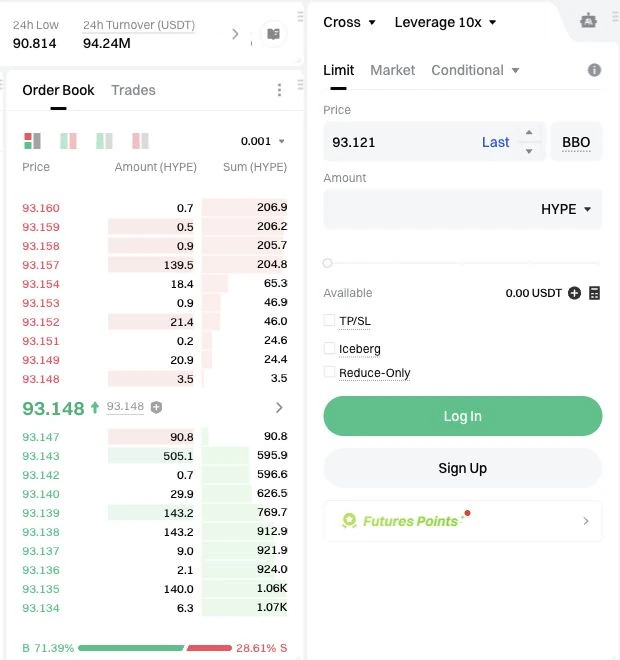
For a partial exit, the quantity should describe the portion to remove, with Reduce-Only used where supported. If you hold 1,000 contracts and want to close 400, a reducing instruction targets the smaller portion. A plain sell instruction has different implications if another exit fills first or if you are using hedge mode. The label matters more than simply pressing the opposite directional button.
Gate’s TP/SL help notes that a trigger can fail to produce the expected result because of market depth, trading interruptions or order conditions. A stop-limit order can trigger and remain unfilled beyond its limit. A market-style exit sacrifices price certainty to seek an available fill. Those distinctions should determine the exit instruction, rather than assuming that a green “set” label has guaranteed the final execution price.
Post-only is useful when maker execution is essential: an instruction that would immediately consume liquidity is prevented from doing so. The cost is that you can miss the entry. Immediate-or-cancel permits a partial fill and cancels the remainder; fill-or-kill requires the full requested size to be available under its conditions. These controls solve different problems and should not be stacked merely because they are available.
On a narrow screen, verify the amount unit and selected order type before reviewing the confirmation. Gate’s help places risk limits under the Futures menu on the app; on the web they appear in Coin Overview and Leverage and Margin. The screen capture illustrates desktop controls only. It does not establish that every control is available on every app version or regional account.
Collateral, withdrawals and the right Gate account
This article’s contract examples settle in USDT. Holding the underlying coin in a separate spot balance does not by itself establish that it will collateralize the chosen futures position. Gate has multiple account modes, including unified margin, and its BTC-margined products are distinct from the USDT contracts compared here. Select the settlement asset intentionally instead of relying on a similar ticker.
For a straightforward directional trade, keeping the intended futures collateral in USDT makes the position’s cash requirement easier to read. A mode that recognizes several assets can use capital more efficiently, but it also makes the supporting collateral change in value. If your collateral falls at the same time as the futures trade loses, the buffer may shrink from two directions. That is a reason to select the account structure deliberately, not an argument that every trader should switch.
The cash available to withdraw is not necessarily the total balance shown at the top of the account. Margin supporting a position and funds reserved for orders can limit transfers. Closing a trade may release collateral, but settlement, compliance review or a network suspension can still affect the next withdrawal. Gate’s public contract feed cannot verify the withdrawal status of your particular account.
A Gate account offered through a local entity should also be evaluated on that entity’s product menu. A local spot service, licence or app listing does not prove access to the global futures contracts in this review. Complete the relevant identity and product checks before sending futures collateral, using accurate residence details. Our country guides help separate those access questions from the trading mechanics discussed here.
Gate’s withdrawal charge depends on the asset and network. Compare the minimum and net amount received, and check that both ends support the same network. This review does not contain a timed deposit or withdrawal.
Gate versus KuCoin and MEXC: when would we switch?
KuCoin is the more relevant alternative when account organization is the unresolved issue. Its Classic and Unified systems have distinct balance and risk behavior, and our KuCoin futures review explains the current migration rules. A trader already using those balances and controls may gain little by duplicating a BTC-only workflow on Gate, even if Gate’s maximum BTC leverage is higher in the captured data.
MEXC deserves a contract-specific cost check when trading commissions dominate a high-turnover strategy. Promotional or account-based rates need to be compared with Gate’s actual account quote, not with a fee headline taken from a different market. The MEXC review separates those conditions. If the proposed saving is smaller than the difference in spread or available exit depth, the advertised rate is not decisive.
Gate futures: your questions
Why can BTC offer 200x on Gate while HYPE offers 75x?
Gate sets leverage and risk bands per contract. Our 6 October capture showed those maxima for BTC_USDT and HYPE_USDT, with different first-band position limits. Your permitted setting can be lower because of position size, open orders or account conditions. Use the named contract’s controls rather than a platform-wide maximum.
Do unfilled Gate futures orders use my position allowance?
Opening orders enter the effective-exposure calculation alongside positions. In hedge mode, Gate compares the combined long and short sides and uses the larger side under the documented formula. An obsolete entry order can therefore consume capacity even though it has not yet created an executed position.
Does the Gate API maker rebate apply to a normal retail account?
Not automatically. A negative maker field in the public contract response is not proof of your account fee. VIP qualification, market-maker arrangements and product settings matter. Check the account quote; our ordinary fee examples use stated reference assumptions rather than awarding everyone the API rebate.
Can I close only part of a Gate futures position?
A reducing order can target a smaller quantity than the position. Select the correct contract amount and the supported close or Reduce-Only control. Check remaining position size after execution; a partially filled limit order does not necessarily remove the full amount you intended.
Are Gate futures Points always cheaper than normal fees?
No universal saving follows from the label. Gate describes a 0.075% taker deduction basis with possible discounts for Points, while ordinary account rates depend on VIP status. Compare the effective cost of acquiring and using Points with the fee your account would otherwise pay.
Can a 50,000 USDT HYPE position use Gate’s 75x headline?
The captured HYPE second band permits 60x through 50,000 USDT. The 75x maximum belongs to the first 20,000 USDT band, and opening orders count toward effective exposure.
Evidence behind this reviewSources and research
Sources and research
Official contract and order-book responses were collected on 6 October 2026. Current market tiers take precedence over historical numerical examples in help pages. Interface observations were signed out; book calculations are static estimates, not executed trades. Fee assumptions and unresolved account-level conditions are recorded separately.
- BTC contract parameters
- SOL contract parameters
- HYPE contract parameters
- Current BTC risk tiers
- Risk-limit mechanics
- Trading-fee calculation
- April fee structure
- September fee update
- Fee overview
- Funding rules
- HYPE trading interface
- TP/SL controls
- Futures API and order controls
- HYPE risk tiers