













Where can Canadians trade crypto with leverage?
If you want a BTC short, an ETH long or a leveraged altcoin trade, start with the product available to your Canadian account. A familiar exchange logo or a Canadian-dollar deposit button does not answer that question. Some crypto exchanges accept Canadian spot customers while withholding futures; DEX interfaces have their own country and provincial restrictions.
| Your goal | Where to look | What changes the decision |
|---|---|---|
| Perpetuals from your own wallet | GMX or Jupiter; Hyperliquid outside Ontario requires a separate eligibility check | Interface terms differ. None is presented here as a Canadian-licensed retail futures venue. |
| Buy or sell crypto with CAD | Kraken Pro, with Ndax as the fee comparison | Useful for spot and supported wallet transfers; neither a spot balance nor Pro branding unlocks Kraken leverage. |
| Futures inside a Coinbase account | Coinbase Financial Markets for qualifying Canadian clients | This has an asset/registration test; it is not included with an ordinary Coinbase Canada account. |
| Bybit, MEXC, Bitget or OKX perpetuals | Do not use their global leverage adverts as a Canadian shortlist | Their current geographic policies restrict Canadian customers. |
“Best” also depends on the trade. A broad order book is useful for rotating between altcoins; a Solana-native interface may fit a wallet already holding SOL; a pool-based venue charges differently from a maker/taker exchange. Those are meaningful differences even when two apps both show a Long button.
Which perpetual DEXs can Canadians use?
Canada is not one uniform DEX access rule. The clearest provincial distinction in the sources checked on 28 September 2026 is Hyperliquid: its interface terms name Ontario as restricted. dYdX’s perpetuals terms name Canada as a whole. GMX and Jupiter do not name Canada in their published geographic exclusions, but both make use conditional on applicable law.
That leaves different answers, not a blanket “all DEXs work” or “Canada has no DEXs.” GMX and Jupiter are relevant products to investigate; absence from their exclusion lists is not confirmation of Canadian regulatory approval. Their product comparison follows immediately, so you can see whether either would actually fit your trading needs.
| DEX | Canadian restriction found | Practical reading |
|---|---|---|
| Hyperliquid | Ontario is explicitly named | Not an Ontario option. Other provinces are not named by that clause; local legal eligibility still applies. |
| GMX | Canada is not explicitly named | Conditional interface access; no verified Canadian retail derivatives authorisation in this review. |
| Jupiter Perps | Canada is not explicitly named | Conditional interface access. A Solana wallet does not itself establish eligibility. |
| dYdX perpetuals | Canada-wide exclusion | Exclude it from a Canadian perpetuals shortlist, even if other dYdX products differ. |
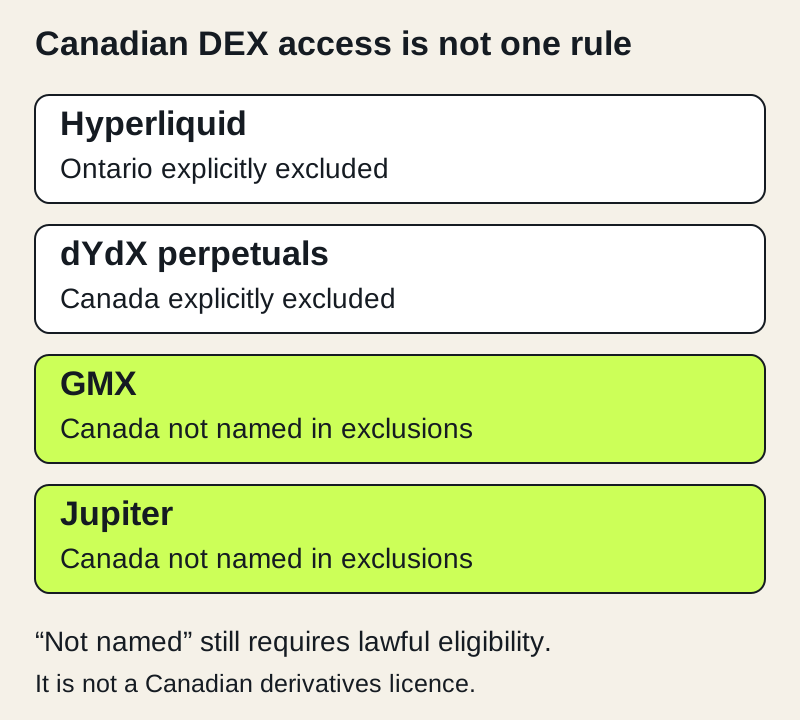
Ontario versus the rest of Canada
A Toronto resident should not treat a Vancouver tutorial as proof of Hyperliquid access. Conversely, Hyperliquid’s Ontario clause should not be rewritten as a provider-imposed ban on all Canadians. We retain that distinction rather than inventing a simpler national rule.
An interface may also restrict a person temporarily located in a named region, not only somebody with a permanent address there. Read residence and location literally. A VPN changes the connection you present; it does not change your eligibility. The cited terms prohibit concealing location to bypass their restrictions.
What does “non-custodial” change?
You authorise transactions with your wallet instead of handing a centralised exchange complete control of an account balance. Once collateral enters a trading protocol, however, it is exposed to that protocol’s contracts, pricing and liquidation rules. “My keys” does not mean a leveraged position cannot be liquidated or a contract cannot fail.
The decision is therefore partly about control and partly about what can go wrong. A CEX may freeze an account or withdrawal. A DEX can have contract, network or interface failures. A wallet connection removes some account friction, but it is not a replacement for checking the product you are about to fund.
GMX or Jupiter: which better fits your crypto trading?
For a trader already using Solana, Jupiter deserves attention because it keeps the trading interaction in that ecosystem. GMX is the stronger comparison when you want to examine different collateral choices and crypto markets across its supported networks. The right choice starts with the assets you already hold and the market you actually intend to trade, not the largest leverage badge.
Jupiter: separate the core perpetuals from Beta markets
Jupiter’s core JLP markets cover SOL, ETH and wrapped Bitcoin, with published leverage up to 250x. Long positions use the corresponding asset as collateral, while shorts use USDC. An input-token conversion may happen before the position opens, so paying with one token does not necessarily mean the position keeps that token as its collateral.
This is useful for someone trading a specific SOL or BTC view from a Solana wallet. It is less helpful if the real aim is to rotate across a long list of smaller altcoins. Jupiter’s spot token catalogue is much broader than its core perpetuals catalogue; finding a coin in Swap does not establish a leveraged market for it.
Jupiter also documents separate Beta markets, including JUP, HYPE and ZEC. Those use USDC collateral and an order-book engine, with funding and leverage limits specific to each market. Do not apply the JLP 250x headline or its borrow-fee model to every Beta market. The market tab is part of the product choice.
GMX: compare the actual pool and collateral
GMX lets you choose among supported crypto markets and collateral arrangements. A dollar profit calculation does not mean your collateral itself is a stablecoin. If you support a position with a volatile token, that token’s changing value can affect the account alongside the trade.
For example, a trader who wants a clean BTC price bet may prefer supported stablecoin collateral to holding ETH as margin while shorting BTC. The latter combines a Bitcoin view with exposure to Ether. It can be deliberate, but it should not happen accidentally because an existing wallet balance was the easiest token to click.
GMX’s network offering now extends beyond the older “Arbitrum and Avalanche only” descriptions: its site also names MegaETH and Solana and describes multichain funding. Market availability, collateral and fees still depend on the selected deployment. Compare the same crypto market on the interface you intend to use rather than borrowing a specification from another network.
Which one wins for your use?
Jupiter fits a Solana wallet used for its core BTC, ETH or SOL markets. GMX offers a different choice of collateral and crypto markets. These are product differences; this country guide does not contain a live execution comparison.
What does a leveraged DEX trade actually cost?
Compare fees on the position you open, not merely the money deposited. Suppose an eligible trader uses US$200 of collateral for a US$2,000 position. The following figures assume the same position value on entry and exit, no discounts and no price movement. They isolate the basic trading fee; they are not an all-in quote.
| Venue / order | Entry fee | Entry + exit |
|---|---|---|
| Hyperliquid base-tier taker, where eligible | 0.045% = US$0.90 | US$1.80 |
| Hyperliquid base-tier maker, if both orders rest and fill | 0.015% = US$0.30 | US$0.60 |
| GMX standard crypto position fee | 0.04%–0.06% = US$0.80–1.20 | US$1.60–2.40 if the two rates stay within that range |
| Jupiter core JLP base fee | 0.06% = US$1.20 | US$2.40 |
On this narrow taker comparison, Hyperliquid’s base trading charge is below Jupiter’s core base fee. That does not make it an Ontario option, and it does not establish the cheapest overall execution. GMX’s rate depends on whether the trade improves or worsens the balance between longs and shorts; the opening and closing rates can differ.
The same US$2.40 is 1.2% of the US$200 collateral. At higher leverage, a modest-looking position fee consumes a larger share of the money supporting the trade. That is why an app advertising high leverage can feel expensive even if the percentage beside the fee looks small.
The cost that keeps running after entry
Hyperliquid perpetuals use funding payments between traders. Jupiter’s core JLP positions incur an hourly borrowing charge; its Beta markets use funding instead. GMX can include both borrowing and funding, alongside price impact and network costs. These are different mechanisms, so a flat “no overnight fee” claim would be misleading.
For a short trade lasting minutes, entry/exit charges and execution may dominate. For a multi-day trade, the cost of carrying the position can outweigh a small fee advantage. Use the current rate for the market and direction you want. A funding rate paid to longs today can change later; it is not fixed income.
An example shows the scale without pretending to forecast rates: a carrying cost of US$1 per day would consume US$7 over a week. Against US$200 collateral that is 3.5%, before trading costs or market movement. If your expected move is small, a supposedly successful trade can still produce a disappointing net result.
Why the final number may differ from the headline fee
Jupiter adds price-impact charges and, where needed, token conversion and Solana transaction costs. GMX has its own price-impact and network/execution charges. On an order book, a market order may fill at several prices. Those differences matter most when your order is large relative to available liquidity.
For a fair comparison, enter the same intended size on each eligible venue and read the preview before signing. Compare the amount you would receive on closing as well as the amount required to open. The cheapest logo on a fee table is not necessarily the cheapest trade in a moving market.
Can you get 100x or 250x crypto leverage in Canada?
There is no single Canadian maximum that unlocks the same leverage on every exchange. The first limit is access to the product; the second is the particular market and position size. Kraken’s Canadian spot account has no leverage, regardless of what its international futures pages advertise.
Jupiter publishes up to 250x for its core JLP perpetuals. Hyperliquid’s published native-asset range is 3x–40x, and GMX’s opening limit varies with the market and its current configuration. Those product figures describe what the platforms can offer; they do not override the Canadian access distinctions above.
More leverage does not make the same trade more profitable
If two traders each open a US$2,000 BTC position, a 1% move changes its value by about US$20 before costs. Setting one account to 10x and another to 20x does not double that position’s dollar gain. It changes how much collateral is committed and how little adverse movement the position can withstand.
The gain becomes larger only if you use the higher setting to open a larger position. That also enlarges the loss. Separate those two decisions: how big the trade should be, and how much money supports it. Treating the leverage slider as a profit slider hides the first decision.
At 100x, collateral starts at roughly 1% of position value before fees and other requirements. At 250x it is roughly 0.4%. Liquidation can happen before a move of that full size because the platform must retain a maintenance buffer and costs reduce the available margin. A high maximum is a product feature, not evidence of a forgiving trading experience.

BTC, ETH, SOL or smaller altcoins?
For BTC and ETH, you can compare a specific perpetual across more venues. For smaller altcoins, confirm that the exchange has a perpetual contract, not just a spot token or a similarly named synthetic market. A price page, Swap result or token listing is not enough.
The useful test for a fast-moving altcoin is whether you can enter and exit the amount you want without moving through a thin market. A large advertised leverage limit does not provide liquidity. A smaller position on a deeper market may give more predictable execution than a higher-leverage trade in a newly listed token.
Also check whether the venue combines purchases into one position. Adding to an existing long changes its average entry and exposure; it may not create a separate trade with its own stop. That matters if you plan to hold a longer-term BTC position and scalp the same contract on the same account.
What about Binance, Bybit, MEXC, Bitget and Crypto.com?
These are reasonable brands to search for. The problem is that international reviews often attach their global features to Canadian readers without checking the product restrictions. Here is the current evidence behind their exclusion or limitation in this guide.
| Platform | Current finding | What not to assume |
|---|---|---|
| Binance | Exited the Canadian market; documented by the Nova Scotia regulator | An old Canadian account or global referral link does not establish current service. |
| Bybit | Canada is on its excluded-jurisdiction list | A local payment method elsewhere is not Canadian futures eligibility. |
| MEXC | Canada is named as prohibited in its terms | A no-KYC advertisement does not remove the country restriction. |
| Bitget | Canada is named in the prohibited-country terms | Copy trading and leverage figures from global pages do not apply automatically. |
| OKX | Canada appears in its restricted-location disclosure | A regional webpage does not change the account’s residence. |
| Crypto.com | Canada is listed for derivatives restrictions | A Canadian app, card or spot account is a different product. |
The answer is therefore not to choose whichever site still loads. A platform can let you read market data before applying its account or trading restrictions. You could otherwise spend time buying crypto and transferring it to an account that cannot open the position you wanted.
If you already have an account with one of these services, read the specific notice addressed to it before acting. Existing-position closure and withdrawal handling can differ from new-account access. This guide does not infer that a restricted customer’s assets disappear, nor that an old successful trade guarantees continued access.
Does FINTRAC registration mean an exchange can offer futures?
No. FINTRAC says it registers money-services businesses for compliance purposes and does not license or endorse them. That registration alone does not establish securities or derivatives permission. A site advertising an MSB number can still be the wrong answer to “Can I trade perpetuals here as a Canadian?”
Canadian crypto-platform rules and the provider’s actual product agreement are more relevant. This distinction is worth one clear explanation because it prevents a familiar mistake: confusing a genuine registration number with approval for every feature on the global platform.
What is Kraken useful for if Canadian futures are unavailable?
Kraken remains useful for trading supported crypto against Canadian dollars and moving supported assets to a personal wallet. The account can serve a Canadian spot trader without pretending to solve the separate perpetuals question. Its Canadian registration and international derivatives business are different things.
Use Kraken Pro when you want its order-book interface. Switching from the basic app to Pro does not unlock Canadian margin or futures. The CTA here is explicitly labelled spot trading, so the destination is consistent with the product being discussed.
Kraken or Ndax for the CAD purchase?
Kraken’s checked entry-level spot-crypto schedule lists 0.40% maker and 0.80% taker; Ndax lists 0.20%. On a C$1,000 purchase, those commissions are C$4, C$8 and C$2 respectively. Special pairs and higher account tiers have different rates.
Ndax wins that narrow entry-level commission comparison. Kraken may still fit someone who values a particular supported asset, order interface or existing account. Those advantages must matter to your use; they are not a reason to call it universally cheapest.
Compare the actual crypto received after execution, not just the commission. A limit order that immediately matches can pay the taker fee. A lower-fee resting order may not fill. Neither exchange’s spot trading fee should be replaced in a comparison by its international futures fee.
Keep the bank purchase separate from the leveraged trade
A CAD purchase is one transaction; a later wallet transfer and leveraged position are others. You do not need to enlarge the CAD purchase merely because the destination supports a high leverage number. Transfer only the balance needed for the intended setup after checking destination eligibility and the supported network.
For active traders, leaving a separate amount outside the trading protocol also makes results easier to understand. Otherwise a single total balance can mix long-term holdings, spending money and margin for short-term positions. That is an account-organisation choice, not a new trading strategy.
How do Interac, USDC and wallet transfers fit together?
Kraken’s Interac instructions require a verified Canadian resident, a Canadian phone number and matching sender/account names. If your bank profile uses a nickname, resolve it before transferring. A debit at the bank does not always mean the exchange has already credited the payment.
For an onchain destination you are eligible to use, plan the receiving network before buying the token. “USDC” alone is not a complete transfer instruction: the token exists on multiple networks. The exchange withdrawal network and the wallet’s receiving network must match the destination’s supported version.
Why do Canadian guides use USDC instead of USDT?
Kraken restricts USDT for Canadian clients. A global tutorial telling you to deposit Tether into Kraken can therefore be wrong for your account. This does not mean every stablecoin is interchangeable or that a Tether balance can be sent to a USDC address and credited as dollars.
If you already hold USDT elsewhere, first establish which asset and network your Canadian receiving account supports. Converting on an eligible service may be necessary. Allow for the conversion price and network charge; do not send an unsupported token hoping the receiving platform will sort it out.
| Balance or destination | What the route needs |
|---|---|
| CAD through Interac | Verified Canadian account and matching sender name. |
| USDT held elsewhere | A supported asset conversion; Kraken restricts USDT for Canadian clients. |
| USDC to your wallet | The exact supported network, plus its transaction-fee token. |
| Crypto withdrawal worth C$1,000 or more | Recipient information; Kraken disallows third-party wallet withdrawals. |
For Solana-based trading, leave enough SOL for the necessary transactions instead of spending the entire wallet balance on collateral. For another network, retain its required network-fee token. A wallet can show a valuable stablecoin balance while lacking the small native-token amount needed to submit a transaction.
Can you withdraw straight from an exchange to any wallet?
Kraken’s Canadian withdrawal guidance requires extra recipient information for crypto transfers worth C$1,000 or more and says it does not allow withdrawals to third-party wallets. Use a wallet you own and follow the withdrawal form; a recipient who sends you an address is not necessarily an eligible destination.
That makes the ownership question more important than the address format alone. A transfer to your own wallet is different from paying another person or sending directly to an address a service assigns. If the form asks for information you cannot truthfully supply, do not guess to get past it.
A small test can reveal an address or network mistake, but it does not certify every future withdrawal or the safety of a protocol. Save the transaction hash and check where the first transfer arrived before repeating it at a larger size. Never share a seed phrase with someone offering to “validate” a missing deposit.
How do you turn a closed crypto trade back into CAD?
Closing a perpetual releases the remaining collateral and settles the trade under the venue’s rules. It does not automatically sell the result for Canadian dollars or send an Interac payment. Start by checking which token you actually receive; a profitable trade settled in a volatile asset can change value before you cash out.
For a supported transfer back to a Canadian exchange, create the deposit instructions in that account and match both token and network. Once credited, sell through the appropriate CAD market or conversion service, then request the bank withdrawal. Each conversion and transfer can have its own cost.
Small withdrawals can be expensive even after a good trade
| Method | Charge | Share of C$200 |
|---|---|---|
| Kraken Interac | C$10 | 5% |
| Ndax Interac | C$1.50 | 0.75% |
| Ndax EFT | C$4.99 | 2.495% |
Do not compare those bank charges as if they include the blockchain transfer or crypto sale. An apparently cheaper bank exit can lose its advantage if it requires an extra conversion or an expensive network withdrawal. Use the net CAD arriving at the bank as the final comparison.
Why can funds be tradable but not withdrawable?
Kraken documents temporary holds linked to certain purchase methods and security changes. Some card or digital-wallet purchases can trigger a 72-hour withdrawal hold; that is not a universal rule for every Interac deposit. A recent password change can also affect withdrawals to new addresses.
Check the specific hold shown by the account before funding a trade that needs an immediate exit. A screen showing available trading balance may include money that cannot yet leave the platform. Opening a position does not remove a payment-method hold.
For onchain withdrawals, a submitted transaction and a completed transfer are different states. If an action remains pending, inspect its status before submitting the same action again. Duplicate attempts can create multiple transactions or orders without solving the original problem.
Which Canadian rules actually change the trading decision?
The important Canadian distinction is product permission, not whether crypto itself exists in the country. The CSA’s crypto-platform framework restricts leverage and margin for clients of the covered platforms. That helps explain why a Canadian spot service can be available while the same brand’s international perpetuals are not.
Provincial rules can also affect spot purchase limits and eligibility tests. Coinbase’s published guidance lists a C$30,000 rolling annual net-purchase limit for certain assets in some provinces and territories, with named asset exemptions. Other provinces do not use that same general cap. It is not a universal C$30,000 limit on every coin or a permission to trade derivatives.
For choosing a DEX, the province matters where the interface expressly names it, as with Ontario and Hyperliquid. For choosing Kraken derivatives, the restriction is Canada-wide. Those two cases should not be collapsed into the same answer.
Coinbase futures: a real crypto product with a narrow audience
Coinbase Financial Markets publishes a Canadian qualifying-client route. Its criteria include at least $5 million in net financial assets excluding real estate, or registered investment-adviser/dealer status, under the applicable qualification rules. Ordinary Coinbase spot verification is not enough.
For somebody who meets that test, the offering deserves consideration because it is an actual crypto derivatives service. For most readers seeking a small-account perpetual platform, it is not a practical substitute for the missing Futures tab. We do not rank it as a universal Canadian retail choice.
The service uses USD collateral and describes CAD-to-USDC-to-USD funding. The useful question is how much USD reaches the derivatives account after conversion, not the currency selected for displaying balances. Provincial moves also have onboarding consequences, so existing access should be rechecked when residence changes.
Do traditional Bitcoin futures add anything to this choice?
Only if you specifically want crypto price exposure through an approved Canadian brokerage account. Listed Bitcoin futures can provide leverage or a short position, but they do not recreate a wallet-based perpetual exchange with a broad altcoin menu. They are a secondary alternative here.
Listed futures, TFSA and RRSP: the short version
Interactive Brokers Canada publishes a listed crypto-futures service, subject to account and product approval. A contract has a defined size and expiry, so it is not interchangeable with a perpetual that stays open until you close it or it is liquidated. The broker’s margin requirement determines the cash needed; there is no reason to compare it using an offshore exchange’s advertised 100x badge.
IBKR’s published account comparison excludes direct futures from its TFSA, RRSP, RRIF and FHSA accounts. Holding a crypto fund in a registered account is a different product. A fund unit neither gives you a crypto wallet balance nor unlocks exchange perpetuals.
If you specifically need that brokerage structure, review its permissions and costs separately. If your aim is to trade crypto-native perpetuals, the DEX and exchange comparisons above are the relevant starting point.
What should an active crypto trader keep for Canadian taxes?
Keep the trading history, funding or borrowing charges, fees and wallet transfers, rather than only the amount withdrawn to your bank. The CRA distinguishes business income from capital gains according to the circumstances. A platform calling a payment “profit” does not decide its Canadian tax treatment.
Crypto-to-crypto conversions can be dispositions, while transfers between wallets you own generally have a different character. An export that counts both as sales can misstate the result. Connect the withdrawal and deposit records when you move between your own accounts.
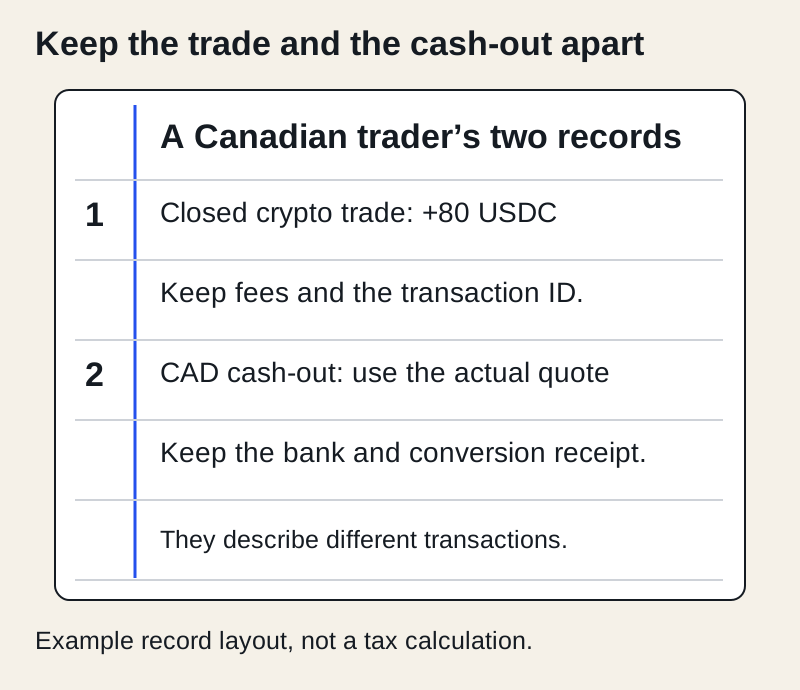
For perpetuals, retain the realised results and collateral movements as well as the spot purchases used to fund them. A screenshot of unrealised PnL is not a complete record of closed trades. Keep CAD valuations and the conversion method alongside the original token or dollar figures.
This is especially relevant when moving between a Canadian exchange and a DEX: one export may show the crypto purchase, another the trading activity, and the wallet history the transfers between them. None alone necessarily describes the full year. Download records while the accounts and interfaces remain accessible.