










Pick the exchange for the way you want to trade
Binance: make your own trades
DOP P2P plus crypto futures makes it the practical starting point for a peso-funded account.
Read the verdictBingX: follow a futures trader
Dedicated copy settings matter more here than a leaderboard’s headline return.
Read the verdictKraken: an independent trading account
An alternative for existing crypto without making copy trading part of the decision.
Read the verdictFor a Dominican resident starting with pesos and placing their own BTC or ETH trades, Binance is the most practical option in this comparison. Its published P2P notice explicitly includes DOP. That makes the local purchase side concrete, while its futures product lets an eligible account keep the trading workflow on the same platform.
If you are specifically looking for someone to follow, compare BingX’s copy controls before choosing Binance purely for funding convenience. If you already own crypto and want a separate venue for manual trading, Kraken belongs on the shortlist. These are conditional overseas account choices: a working app or a peso payment does not by itself establish futures approval for your verified account.
Why Binance makes sense for a DOP-funded futures account
The most useful reason to stay on Binance after buying USDT is avoiding an unnecessary transfer for the trade you already want to make. That advantage disappears if your approved account lacks the coin, exit controls or execution quality you need. Buying with pesos is the starting point; completing the intended futures trade is the test.
The local currency in the P2P filter should be DOP. This is not the same as a token with the ticker DOP, and it is not Dominica’s XCD. Look at the amount of USDT delivered, the seller’s payment instructions, order limits and completion history. The payment method offered on an individual advertisement can change; we have not verified a permanent integration with every Dominican bank.
Check Futures before buying the collateral
Complete the account checks and confirm that the intended futures market is available before buying a trading balance. Being able to use spot or P2P answers a different question. If the account cannot open the required futures product, there is no benefit in discovering that only after a large peso purchase.
For a straightforward USDT-settled trade, select the corresponding perpetual rather than a spot pair or a coin-margined contract. The BTC price chart can look similar on all three screens. What changes is whether you own coins, hold a leveraged position, or use a coin balance whose value moves alongside the market.
A practical reason to avoid unnecessary transfers
Suppose your local purchase leaves 200 USDT. Moving it elsewhere for a feature you will never use creates another withdrawal charge, another network choice and another account to manage. Remaining on Binance can be sensible if the desired contract and controls are already enabled. Moving becomes worthwhile when the other venue offers something you will actually use, such as a particular copy model or a preferable market for your order size.
This is why we do not rank exchanges only by their advertised maximum leverage. A higher ceiling does not improve a 5x BTC trade by itself. For that trader, the useful comparison is the completed order, the settlement asset, the controls for closing it and the cost of returning to pesos.
Where does Kraken fit if you do not want copy trading?
Kraken is worth comparing for eligible Dominican residents who already have a crypto balance and intend to trade independently. Its international derivatives page requires full verification and does not name the Dominican Republic in its excluded-residence list. That is more relevant to this product than looking at the availability of its US exchange-traded futures service.
BingX also supports manual trading, so the absence of a copy relationship is not an exclusive Kraken advantage. Compare Kraken when you want its own market and account setup, not because the alternatives supposedly force you to follow a trader. For an independently chosen BTC order, the relevant result is the actual fill and total cost.
Kraken’s published entry-level derivatives rates are 0.02% maker and 0.05% taker. Binance’s fee explainer uses the same percentages in its regular-user examples, but directs readers to their current account schedule for the applicable rate. On those example rates alone there is no basis to declare a universal fee winner. Spread, funding and any account-specific discount can change the total.
| Starting point | Service to compare | Decision |
|---|---|---|
| DOP at a Dominican bank | Binance funding route | Compare the actual DOP/USDT quote and bank cash-out. |
| Crypto already in your own account | Kraken international derivatives | Compare the intended perpetual and total fill cost. |
| A lead trader you want to follow | BingX supported copy account | Confirm the market is copyable and how the follower can exit. |
For a reader with USDT already ready to trade, this makes Kraken a useful independent alternative. For someone beginning and ending in DOP, adding another venue needs a concrete benefit. We do not suggest an extra account merely to make the list look longer, and we do not call a bank transfer cheap without an actual payment quote.
How do you compare a Dominican peso USDT quote?
Start with the total RD$ debit and the net USDT delivered. The BCRD reference exchange rate is a useful benchmark for the US dollar, but a P2P offer for a crypto token is a separate quote. The seller may build a margin into the price; a marketplace fee can then be added or deducted at checkout.
Binance’s September 2025 notice names DOP among P2P Zone markets moving to a flat taker fee of 0.06–0.08 USDT per USDT order. Its scope is that product and notice, not every purchase screen. Use the charge displayed on your actual order; do not apply an old “zero fees” statement or a fee from Express automatically.
The seller’s price often matters more than a tiny flat fee
At an illustrative RD$60 per USDT, RD$6,000 buys 100 USDT before fees. At RD$61 it buys about 98.36 USDT. The difference is about 1.64 USDT before any marketplace charge, far larger than a difference of a few cents in a flat fee. These are example quotes, not the current peso rate.
For a 10-USDT purchase, a 0.08-USDT charge alone is 0.8% of the amount. On 100 USDT it is 0.08%. This is why the same fixed charge can matter much more to a very small account. Check minimum orders and final delivery before deciding whether a tiny purchase is worth making.
Does a bank name in an advertisement mean a partnership?
No. If an advertisement names Banreservas, Popular or BHD, that describes the payment arrangement shown by that seller. It does not establish that the bank endorses the exchange or guarantees the crypto trade. Use the exact instructions within the live order and a payment account that meets its name requirements.
A seller moving the deal to a private message, asking for payment to a different person, or promising to settle “after the futures trade wins” is changing the transaction. Do not let urgency about entering the market replace the original payment agreement. The decision to buy collateral and the decision to open a leveraged position can be made separately.
What should you check on a small-screen futures ticket?
A crowded phone screen makes some errors easier to miss. Before confirming, identify the settlement asset, the size of the position and whether the action opens or closes exposure. The big leverage number is only one setting. A token balance of 100 USDT does not mean an order showing 1,000 USDT is a cash purchase you can withdraw afterwards.
Size first, leverage second
Suppose you decide on a 500-USDT position. At 5x it uses roughly 100 USDT of initial margin; at 10x it uses roughly 50 USDT, before the platform’s additional requirements. A 1% underlying move still changes the position’s value by about 5 USDT in either case. The higher leverage reduces backing, not the dollar effect of that same market move.
This is a useful check for someone budgeting in pesos because the affordable loss should be decided before the slider makes the position appear cheap. If you increase the position itself from 500 to 1,000 USDT, the same 1% move becomes about 10 USDT. That second change is what doubles the exposure.
A stop trigger is not the final fill
A stop-market order is intended to act when the chosen trigger is reached, but the final execution can be worse in a fast market. A stop-limit adds a price limit but may remain unfilled. Pick the behaviour that matches your plan and check that the order reduces the position you meant to exit. A low commission cannot compensate for misunderstanding this control.
These controls matter more than whether a platform uses a more dramatic maximum-leverage headline. You can rehearse the sequence in a supported demo environment before sending a live order. Demo practice shows the controls; it cannot prove that a real Dominican bank payout or a stressed live market will behave identically.
Can you copy an onchain trader through the same account?
Not merely because you can see that trader’s wallet. BingX’s copy service follows supported lead accounts and markets within its own product. A wallet leaderboard from another platform is a separate record. Sending crypto to BingX does not create a link that automatically reproduces transactions made elsewhere.
For a Dominican reader comparing a copy-trading advertisement with an onchain performance screenshot, first identify where the proposed orders would actually be placed. Are you subscribing to a supported trader, manually following signals, or granting another service permission to operate a wallet? Those are different arrangements even if every advertisement calls itself copy trading.
The important comparison is the position you would receive, not just the return displayed. BingX documents that unsupported markets and execution differences can prevent a follower’s result from matching the lead account. An unrelated wallet history provides even less assurance that a CEX account can reproduce it. Use the supported copy product’s allocation and exit rules to judge the offer.
How do you withdraw profits to a Dominican bank?
First close the position and identify the amount that is actually available for withdrawal. With copy trading, stopping new copies and closing existing positions can be separate actions. Check what the selected stop option does before assuming the whole balance is free to move.
If selling through DOP P2P, select a suitable buyer and check the net peso proceeds. On the sell side, the critical action is releasing crypto only after the payment has genuinely arrived according to the marketplace rules. A receipt image or a message saying the transfer is pending is not the same as money in your account.
| Stage | Amount to record |
|---|---|
| Close the position | Settlement balance after fees and funding. |
| Convert or sell the balance | The DOP amount quoted by the permitted conversion route. |
| Receive the bank transfer | Net pesos after payout charges; reconcile to the trading statement. |
For a crypto transfer from another exchange, check the receiving deposit network and minimum before sending. Moving USDT on the wrong network does not become correct because both applications show the same ticker. Use the details generated by the receiving account, and include the withdrawal charge when comparing the eventual DOP result.
Keep the completed trade or copy-account statement, the crypto movement and the peso receipt together. They explain how the amount arose if the bank asks. An honest description of your own trading is more useful than describing every incoming amount as a gift or remittance when that is not what happened.
A “regulator release fee” is a separate warning sign
SIMV explicitly warns that it does not request or hold money to release funds to an individual. If someone claiming to represent the regulator demands another deposit before you can withdraw, do not treat that as a normal exchange charge. Verify through the official institution rather than the contact that supplied the demand.
Is crypto futures trading locally regulated or tax-free?
The exchanges above are not presented as Dominican-licensed futures businesses. DGII’s official 2026 response repeats that crypto is not state-issued legal tender and does not have the local protections described for recognised money. That does not support calling every offshore futures account locally regulated, and it is not a substitute for checking the specific customer’s eligibility.
The same DGII response says income arising when crypto is converted into recognised money is taxable under the tax code. It answers a question about a company’s own-account P2P activity. We do not extend it into a universal tax percentage or a personal perpetual-futures ruling, and it is not evidence that keeping all gains on an exchange makes them tax-free.
Use the local warnings for the right purpose
SIMV’s April 2026 notices say KRONOX CRYPTO and CashFX are not registered to perform the relevant securities-market functions in the country. These notices concern the named businesses. They should not be reused as evidence that an unrelated exchange is fraudulent or that a Spanish-speaking sales agent is automatically authorised.
For your own records, preserve deposits separately from realised trading gains, charges and withdrawals. A year-end wallet balance alone does not show which part is original capital. If activity becomes regular or substantial, ask for advice based on the actual futures and P2P history rather than borrowing an answer about a different business model.
BingX copying: the follower’s costs and controls
Is BingX copy trading worth choosing over manual futures?
BingX deserves a separate comparison when your actual question is “Can I follow a trader instead of placing every order myself?” Its copy products let you choose how an account follows another trader. That is a meaningful service difference from simply reading a signal in a chat and trying to place the same trade afterwards.
It does not remove the decision about whom to follow. A trader can show an attractive closed-trade history while carrying a large open loss. Check both the ongoing positions and the longer record. A short run of profitable closes cannot tell you how that account behaves during a sharp market move.
Fixed amount versus a share of the trader’s positions
A fixed amount assigns your chosen margin to each copied order. A position-ratio approach follows the relative allocation more closely. These can produce very different exposure from the same person. BingX’s documentation distinguishes the modes; the appropriate choice depends on whether you want a per-order budget or to follow the lead account’s proportions.
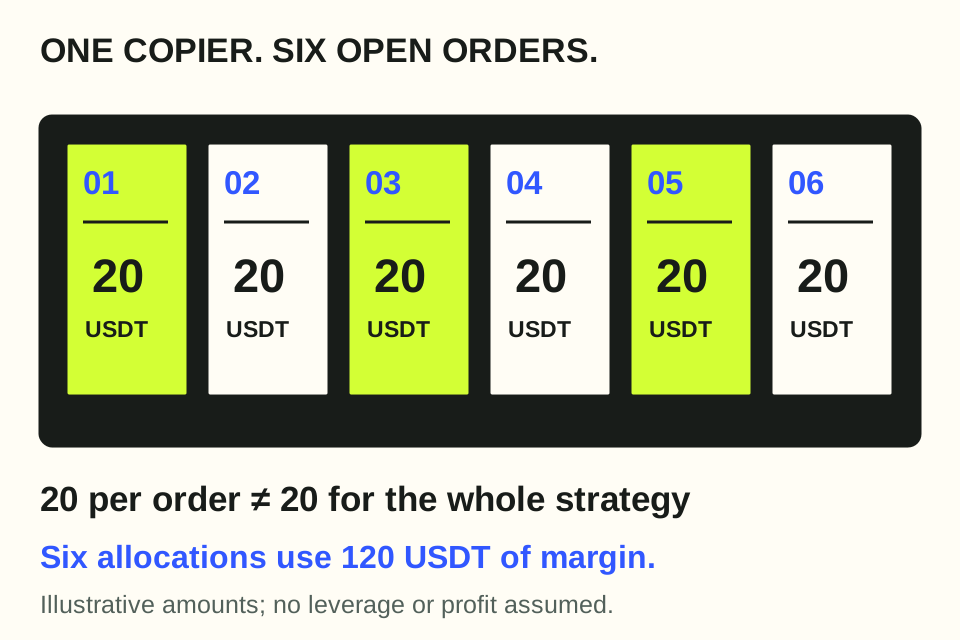
For example, allocating 20 USDT to each of six simultaneous orders puts 120 USDT of margin to work, not 20 USDT across the whole strategy. If those positions all depend on a rising crypto market, six coin names do not necessarily give six independent bets. This example is about the allocation you choose, not a forecast of how any listed trader will behave.
Choose copy trading when the monitoring and allocation model solves a need you have. Choose manual trading when you want full control over the entry, position size and exit. Opening a copy account only because a leaderboard shows a spectacular percentage leaves the most important choice unexamined.
Why a copied profit can differ from the money you keep
A copied return is not guaranteed to match the lead trader’s. BingX identifies entry timing, execution prices, profit sharing and unsupported pairs as possible causes of different results. A follower can also have a different liquidation outcome. You are opening trades in your account, not buying the exact historical return shown on someone else’s profile.
The fee that a profit screenshot can miss
BingX’s “Copy With 0 Slippage” documentation says its Guaranteed Price fee is excluded from the copy-trading profit-and-loss statistics. It also says the fee rate changes and describes situations where a copy may fail or the closing order may execute at market. That makes “0 slippage” a feature to examine, not a promise that every copy is cost-free or identical.
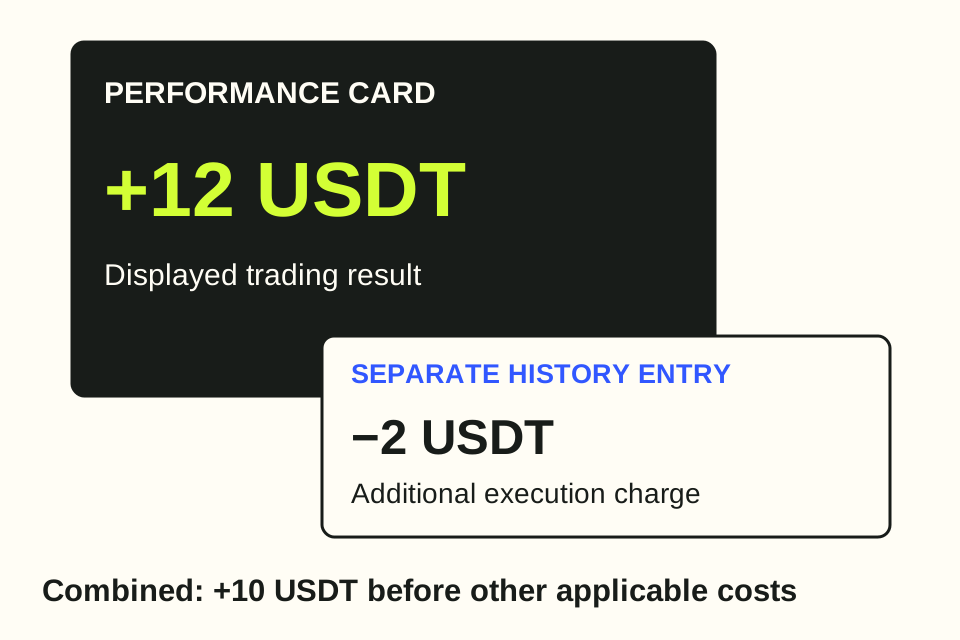
Imagine the displayed trading result is +12 USDT and separate transaction history shows 2 USDT of Guaranteed Price charges. The combined result is +10 USDT before any further charges not already included. Do not subtract a profit share twice if it has already been deducted; identify exactly what the displayed number includes.
Compare the same money over the same dates
For a Dominican peso-funded account, keep two records: the copy account’s net token change and the DOP paid or received at the edges. Depositing more money can raise the balance without producing a trading gain. Withdrawing money can lower it without proving a loss. Include both flows when checking a strategy’s result.
A simple account check is ending balance plus withdrawals, minus starting balance and new deposits. Then check whether separate charges have already entered that balance. Use matching dates and currency. This does not calculate a time-weighted investment return, but it answers the more immediate question: did this account gain money after the amounts I added and removed?