














OKX or Bybit for crypto futures in Guyana?
Thirty cents is a narrow advantage on the illustrated $3,000 entry and exit. A worse fill or one additional carrying charge can reverse it. The comparison therefore keeps the permitted funding route and position’s actual holding time alongside commission.
Bybit is a credible second quote, especially if you already trade there or the exact coin you want has a better market there. Both platforms offer perpetuals; neither becomes the winner simply by displaying a larger leverage number. For a position held over several days, the payments charged while it stays open can outweigh a small difference in trading commission.
| Your plan | Starting point | What can change the answer |
|---|---|---|
| Practise a BTC or ETH perpetual before depositing | OKX demo | The intended live product must also be available to your verified account. |
| Enter and close a liquid market quickly | Compare the two order previews | Your fee tier, spread and order size matter more than a generic score. |
| Keep the position for several days | Compare funding on the exact pair | A lower entry fee can be overtaken by repeated holding payments. |
Use OKX when its account quote preserves that commission advantage and the desired market trades well. Keep Bybit ahead for a particular trade if its execution and holding costs more than make up the thirty-cent gap. The worked three-day example below shows exactly how that can happen.
The full exchange catalogue remains available below. A platform being listed as accessible is an access finding, not proof of a Guyanese licence or confirmation that a particular GYD payment will succeed. This article narrows the trading decision without deleting those other choices.
Which exchange is cheaper for the trade you actually want?
Start with the size of the position, not the deposit. A 300-USDT balance can support different position sizes, and commission is normally calculated on the amount traded. The cost of buying and selling 3,000 USDT of exposure is not calculated on only the 300 USDT used to back it.
A short trade: the fee difference is small
Using the published standard taker examples of 0.05% at OKX and 0.055% at Bybit, entering and closing an unchanged 3,000-USDT position costs 3 USDT and 3.30 USDT respectively. This assumes the same entry and exit value, no discount, no special product schedule and immediate execution on both sides.
Thirty cents is a real difference, but it is not a strong reason to move money between exchanges by itself. One additional transfer charge, a worse execution price or a token conversion can erase it. Check the rate displayed on your own account: published base examples are not a promise that every regional account receives that rate.
A longer trade: holding payments can reverse the result
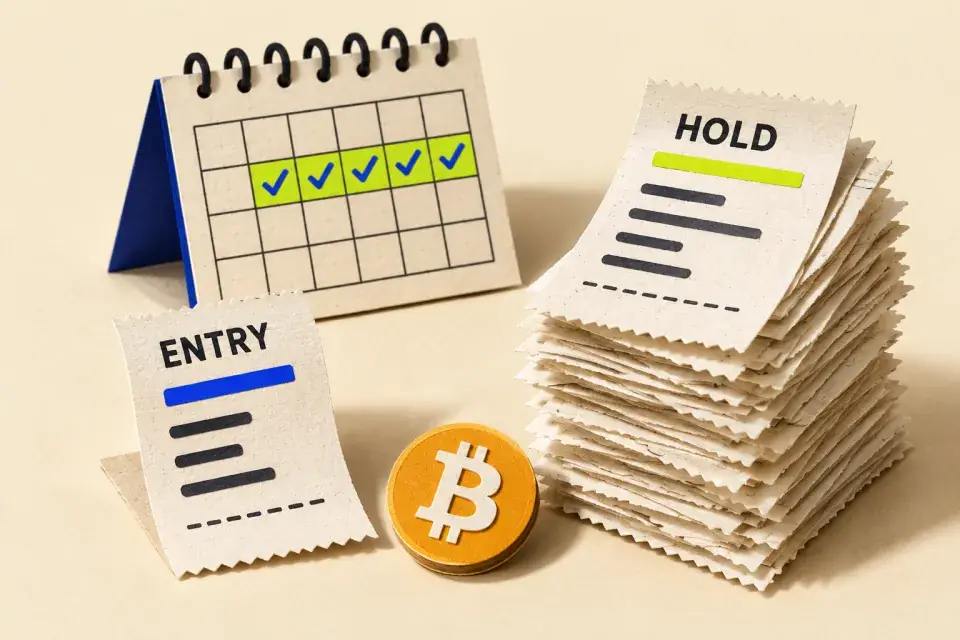
Now imagine the same position stays open for three days. In a simplified eight-hour schedule there are nine payments. At a constant 0.01% each time, 3,000 USDT of exposure costs 2.70 USDT; at 0.03%, it costs 8.10 USDT. Those are hypothetical rates used to explain the difference, not today’s quotes or a prediction.
If the first exchange charged 3 USDT in commission plus 8.10 in holding payments, the total would be 11.10. If the second charged 3.30 plus 2.70, it would total 6. The exchange with the slightly higher trading fee would be cheaper in that example. The conclusion follows from the trade you plan, rather than the logo above a fee table.
Real funding rates and position values change, and not every pair uses eight-hour intervals. The payment can also go the other way: a trader may receive rather than pay. Compare the exact market, direction and next payment time before opening. A funding receipt is not a guaranteed income stream; an adverse price move can be much larger.
BTC, ETH or a smaller coin: choose the contract before the leverage
An exchange can list a coin for ordinary buying without offering a perpetual on it. Search inside the futures area, confirm the pair and look at the settlement asset. For a USDT-settled position, you are calculating the result in USDT, not receiving a payout in Guyana dollars.
Why the maximum multiplier is a weak ranking criterion
Suppose two exchanges both let you open the same 2,000-USDT Bitcoin position. Selecting a higher multiplier on one reduces the initial backing required; it does not make a 1% Bitcoin move worth more on that unchanged position. The approximate move is 20 USDT on either, before costs.
The important questions are whether your intended order can fill cleanly, how much room the position has before liquidation, and whether the exit control behaves as expected. A very high maximum on an illiquid coin can be less useful than an ordinary multiplier on a market with enough buying and selling interest.
Use a limit order for a price decision, not a fee assumption
A limit order sets the worst price you are willing to accept. It does not always qualify for the lower maker fee: an order that immediately matches an existing offer can still take liquidity. A post-only instruction is useful when you specifically want the order to rest, but it can leave you without a fill.
For a small altcoin, inspect the difference between the best buy and sell prices and the orders near them. If a quick entry and exit already loses several dollars to that gap, arguing over fractions of a dollar in advertised commission misses the main cost. This is where Bybit can beat an OKX shortlist, or vice versa, for a particular market.
The practical verdict is market-specific: use the platform with the permitted contract, a sensible quote for your order and controls you understand. The article’s lead recommendation helps you start that check; it cannot replace the live price comparison.
Can you deposit Guyana dollars or use a local bank card?
Do not read a global list of payment logos as confirmation of GYD deposits. We have not verified a direct GYD bank-deposit product for either shortlisted futures account. That leaves a clear distinction between an exchange accepting an eligible resident and a bank or payment provider supporting the desired purchase.
For someone who already owns transferable crypto, the immediate task is to match the exchange’s accepted asset and network. For someone starting entirely in GYD, obtain an actual purchase quote and an accepted payment method before choosing a live trading balance. A rate copied from a currency website does not tell you how many usable tokens will arrive.
Compare the final tokens, not a seller’s headline rate
Consider a purely illustrative budget of GYD 69,000. One quote promises 300 USDT delivered. Another advertises GYD 225 per USDT but subtracts a 7-USDT transfer charge: 69,000 divided by 225 is about 306.67, leaving 299.67 USDT. The apparently better exchange rate delivers slightly less collateral.
That calculation does not endorse either seller or assume the payment is allowed. It shows the question to ask: how much will arrive in my own receiving account after every deduction? Keep GYD, USD and USDT written out in the quote. A dollar symbol by itself is not precise enough for this purchase.

Republic Bank Guyana’s banking code explains that foreign-exchange transactions have a disclosed rate or a method for setting it, alongside applicable charges. That supports asking for the bank’s actual conversion terms. It does not say the bank accepts crypto transfers, and we do not treat it as evidence that a card purchase will work.
If a local intermediary collects money for multiple customers, that introduces a separate service business and counterparty. Do not assume the person is licensed because a global exchange operates elsewhere. Guyana’s service-licensing rules, discussed below, make that distinction especially important.
How to test an OKX futures setup before transferring money
The useful first test is a complete practice trade: enter, attach the intended exit, reduce or close, then read the final result. Opening a demo position without closing it leaves the most important part untested. OKX’s own guide provides a futures simulation workflow using virtual balances.
Choose a familiar liquid contract for this exercise. Change the position size and watch how the required backing changes. Then keep the size fixed and change the leverage. Seeing those two actions separately is a better introduction than treating a large multiplier as a way to create a large return from nothing.
What should the practice trade teach you?
- Where the position’s actual size appears, rather than just its margin.
- Which asset the contract uses for its result.
- How an exit order is attached, changed and cancelled.
- Where the closed trade and its charges can be reviewed.
A demo fill cannot prove the price you will receive with real money, especially in a thin market. Its purpose is to catch mistakes with direction, units and controls. Once the real account is verified, repeat the product check there before sending a permitted deposit.
With live funds, calculate the intended loss in USDT and then its GYD replacement cost. If a 15-USDT trading loss would take an uncomfortable share of the local budget to replace, increasing the multiplier does not fix that. Reduce the position or skip it; changing the screen’s percentage cannot change the household cost.
Keep any unrelated crypto outside the amount you intend to expose to the trade. Shared-margin settings can make other eligible balances support a losing position. The relevant setting is the one on the actual account, not the one shown in a tutorial from a different product version.
Is crypto futures trading legal in Guyana?
There is no sound basis here for either “everything is banned” or “2026 made every exchange licensed.” Section 72 of the Guyana Compliance Commission Act addresses specified virtual-asset services carried on as a business for other people. It requires a licence for activities such as exchanging, transferring or safeguarding their assets.
The same section set a pause on issuing the relevant licences on or before 31 December 2025, or another date fixed by ministerial order. Reaching a calendar date is not the same as finding a licence issued to OKX, Bybit or a local USDT dealer. The earlier FIU risk assessment describes the restrictive position at that earlier stage; it is not a new approval for 2026.
What changed in the government’s 2026 announcement?
The February legislative agenda included a proposed Virtual Assets Bill. The official announcement reviewed for this article describes a bill to be brought forward, not a completed licensing register or an authorisation for retail perpetuals. We did not establish a later approval of the named exchanges from the sources reviewed.
For a reader, the actionable difference is between trading their own funds and someone running a crypto service for customers. The statute’s business wording does not by itself settle every legal question about personal offshore trading. It also does not permit a person to sell managed trading accounts locally merely by calling the activity personal investing.
Our exchange comparison is therefore based on published provider access conditions, not a claim of Guyanese regulatory protection. If a service markets itself as locally authorised, ask for the named licence and verify its scope. A company registration, foreign licence or screenshot of the 2025 deadline is not the same evidence.
Would a decentralised perpetual exchange be better?
Wallet-based trading is relevant for an experienced reader who already keeps crypto outside a centralised exchange. It changes who holds the wallet keys and how trades are submitted. It does not remove the need for a compatible asset, sufficient fees on the network or compliance with the service’s terms.
GMX is one example in the wider catalogue, but its cost model should not be compared with a centralised exchange using a single maker/taker percentage. Its documentation separates position fees, possible price impact, borrowing and funding costs, plus execution costs. For a short, small position, fixed execution costs can matter disproportionately.
That makes the DEX choice more compelling when wallet custody is itself important and the actual trade quote is competitive. It is less compelling when the only reason is to avoid learning a centralised exchange’s fee screen. You would be taking on different things to understand, not eliminating the work.
For a GYD-funded newcomer, we would finish the straightforward verified-account and funding checks first. For an existing on-chain trader, compare the desired market and all-in opening and closing quote. Neither path should be sold as a way around local service-licensing requirements.
Measure the result in money you can actually use
A profitable closed position is only one part of the outcome. Write down the original GYD spent, the collateral delivered, the closed trading result and the final amount received after withdrawal or sale. This prevents a gain on the futures screen from hiding a poor conversion on either side.
If 300 USDT becomes 318 after trading costs, that is an 18-USDT account gain. It does not establish a GYD profit until you price the exit. A sale quote, network charge and local receipt may reduce the amount; the GYD exchange rate may also have changed since entry.
For an overseas exchange, test the withdrawal to a destination you control before committing a larger trading balance. A successful deposit proves only that money entered the platform. It does not prove that the planned recipient, network or local conversion is available when you want to leave.
The completed choice is therefore conditional but concrete: start with OKX for a documented perpetual workflow, compare Bybit’s actual market quote, and let position duration and delivered collateral decide the cost winner. Do not let a tiny commission difference distract from a much larger holding or conversion bill.