
















Kraken or OKX for a Kiribati futures account?
Kraken is the more useful starting account for a Kiribati resident who already holds supported crypto and wants a choice of derivatives collateral. Its published international derivatives exclusions do not name Kiribati. This supports considering an application; it does not certify a local licence or guarantee approval of every identity document.
OKX is a second candidate for someone specifically wanting its USDT perpetual markets. Kiribati is not named in its reviewed international restricted-location disclosure. The choice between these accounts should turn on the contract and the balance available to fund it, rather than on an assumption that using Australian dollars gives access to Australian banking facilities.
| Candidate | Reason to consider it | What remains account-specific |
|---|---|---|
| Kraken international derivatives | Several supported collateral currencies, including crypto and AUD | Verified residence, derivatives approval and an accepted funding method |
| OKX international perpetuals | USDT-based contracts for a trader who already has the required balance | International-account allocation, approved products and token transfer support |
A first-time reader starting entirely with cash in a Kiribati bank has an extra problem to solve before either comparison becomes actionable: how the money will reach an accepted exchange account. We do not advertise a verified ANZ-to-exchange pipeline because the public material reviewed does not establish one. Someone with an existing supported digital-asset balance has a more direct starting position.
Why Kraken's collateral choice matters here
Kraken's international multi-collateral wallet includes AUD, USD and supported cryptocurrencies. That can be useful for an AUD-based reader, but the collateral list is not a list of bank-deposit methods. A currency may be usable once it is in the account even when a particular overseas bank cannot send it through the advertised domestic channel.
For a resident who already owns supported Bitcoin or another eligible asset, compare using that balance with first selling it for USDT. The former can avoid an unnecessary conversion, while the latter changes the collateral's price behaviour. Crypto collateral can lose value at the same time as a position moves against the account; the asset's collateral discount also affects the usable balance.
Kraken's contract families include perpetual and fixed-maturity products. A fixed-maturity contract has an expiry; a perpetual uses recurring funding. For a trade intended to last several weeks, that is a meaningful choice, even if the immediate entry prices look close. The fixed contract can trade above or below spot, so the absence of perpetual funding is not proof that it is cheaper.
Choose from the contracts actually enabled after the Kiribati account review. The international product comparison here is not an instruction to apply under Australian residence. The two countries share a currency, not an identical exchange-account agreement.
When an OKX USDT account is the better fit
A reader already holding USDT may prefer to compare the relevant OKX perpetual directly, without adding an AUD conversion merely because local living expenses are in dollars. Its international contract guide documents long and short perpetual positions and the funding mechanism. The particular market's size limits and available leverage still need to be read from the verified account.
For a BTC or ETH order, compare the expected execution at the intended size with Kraken's corresponding product. For a less widely traded token, first establish that the exact perpetual exists and is enabled. A spot listing, a token price page and a tradable derivative are three different things; only the last answers this site's question.
The useful decision is therefore specific. Kraken has an advantage when its collateral flexibility avoids moving or selling a balance unnecessarily. OKX may suit an existing USDT trader whose preferred contract and trading workflow are available there. Neither advantage proves that a Kiribati-issued card can buy the starting balance through an external payment provider.
A small island market does not justify inventing a local winner based on untested payment claims. These are international candidates selected from their product documentation and restrictions, with the bank-funding gap stated plainly.
Why an AUD account in Kiribati is not an Australian PayID account
Kiribati uses AUD, but Kraken's funding schedule marks its domestic PayID and Osko deposit facilities as Australia-only. A Kiribati bank account must not be described as eligible for that channel just because its balance is denominated in the same currency. The receiving account's permitted origin and the sender's bank details both matter.
ANZ Kiribati offers international-payment services through its local banking arrangements. Its app guide provides an overseas-transfer workflow, but a general transfer facility is not an endorsement of every exchange beneficiary. The bank's terms permit checks on the customer, destination and supporting information.
The actual local charges
The linked ANZ Kiribati customer tariff lists A$7 for an international transfer through internet banking or the Pacific App and A$30 at a branch. It also lists a 2.5% cross-border card transaction fee where the transaction is processed overseas. These are bank-side prices; exchange charges, conversion and intermediaries can add more.
For an illustrative A$500 transfer, the A$7 charge equals 1.4% of the amount, while A$30 equals 6%. The difference is A$23 before any receiving or currency costs. This calculation compares published banking channels only. It does not assert that either channel has approved a particular crypto-exchange deposit.
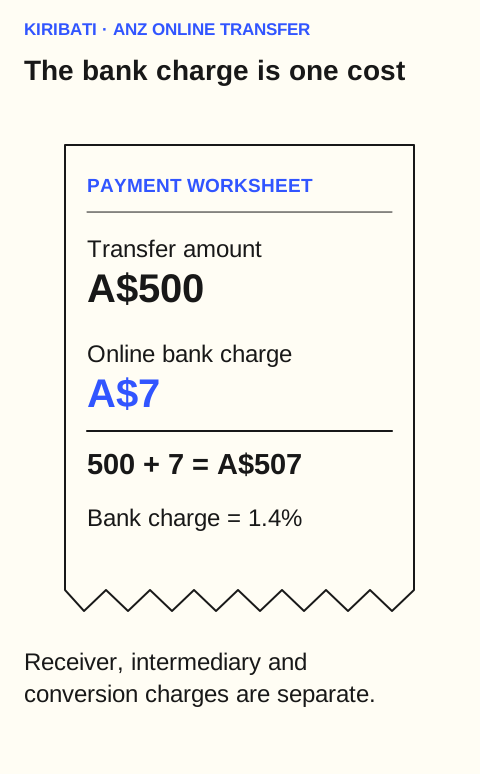
For a small trading balance, that starting cost can matter more than a tiny difference in futures commission. An exchange comparison that ignores it can select the cheaper trade while leaving the reader with the more expensive funded account.
How much leverage can a resident actually use?
We found no verified Kiribati-specific retail leverage ceiling in the official local material examined. That is not proof of an unlimited legal entitlement. The exchange's approved account, the particular contract and its position-size bracket determine what the platform will permit, while local obligations remain separate.
Do not import Australia's 2x retail CFD ceiling merely from the currency. Equally, a global exchange advertisement showing a much larger multiplier does not prove that a Kiribati applicant will receive it on every market. Use the approved contract specification instead of assigning one country's number to another.
For a reader whose starting balance is A$500-equivalent, a 10x position would represent A$5,000-equivalent exposure before charges. It would not create A$5,000 that can be withdrawn to an ANZ account. This example is sizing arithmetic, not a claimed Kiribati product limit or a recommendation to use that amount.
The more relevant comparison between the shortlisted accounts is how much of the deposited balance actually counts as collateral, what the selected market permits, and what charges accumulate while it remains open. The currency used to budget a trade and the currency in which its result settles need to stay visible as separate amounts.
Tarawa and Kiritimati: the same country, different address records
ANZ's current contact page identifies branches in Banraeaba, Tarawa, and Kiritimati. It also specifies the information used for inward international payments: the account number, full account name, residential address and bank identification. That is useful for a trader preparing to receive a return of funds, rather than assuming an Australian branch's banking instructions apply.
Kiritimati is also known as Christmas Island. In an exchange application it belongs under Kiribati, not under the Australian Christmas Island territory. This is an unusually consequential naming mistake: Kraken explicitly treats Australian territories under its Australian derivatives restriction, whereas Kiribati is absent from that list.
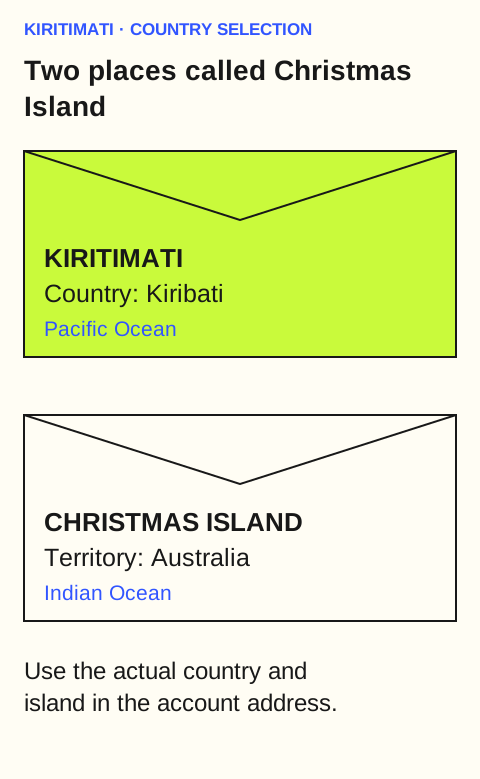
We found no evidence that the two reviewed international platforms assign a different national leverage limit to Tarawa and Kiritimati. The local difference established here concerns accurate address and banking information, not a special high-leverage zone. Outer-island residents should similarly retain the real island and residence details rather than replace them with a more familiar capital-city address.
Can trading proceeds return to an ANZ Kiribati account?
An exchange balance and an accepted outward bank withdrawal are separate parts of the service. For an AUD-based household, a USDT trading result eventually needs a supported conversion and payout if it is to become spendable bank money. A crypto withdrawal alone does not establish that final bank step.
ANZ's reviewed schedule lists A$15 for an inward AUD telegraphic transfer in the first band, up to A$50,000, and A$15 for funds received in foreign currency. Other exchange or intermediary deductions can occur before the amount arrives. The tariff describes the charge if the payment is accepted; it is not a promise that every exchange-origin transfer will be processed.
This makes frequent small cash-outs relatively expensive. For example, A$15 is 7.5% of A$200 before other deductions. The point is to include a withdrawal budget when comparing accounts, not to encourage leaving funds exposed merely to save a transfer fee. The preferred amount to retain depends on the person's actual trading needs and access to the account.
Keep the exchange statement linking the withdrawal to the original funding and realised trades. A matching account name and coherent transaction history make the return understandable without disguising it as salary or family assistance.
Local reporting and I-Kiribati residents abroad
Kiribati's Tax Division publishes individual income-tax returns and instructions through its official site. We did not locate an official derivative-specific ruling that justifies labelling every offshore crypto-futures gain tax-free or applying a single advertised crypto rate. The sensible record is the actual realised result, fees and supporting AUD values, retained separately from your own deposits.
The official return material identifies tax-office assistance in Bairiki and London, Kiritimati. Where a classification is needed, present the derivative's actual settlement and the activity records, rather than asking only whether “crypto” is taxable. The classification of regular trading may differ from the treatment of an unrelated receipt.
For an I-Kiribati citizen genuinely resident in Australia, the Australian account rules replace the assumption of a Kiribati international account. A return to Kiribati is also a residence change to disclose. Sending money home and moving the trading account are different decisions; an ANZ account remaining open in Kiribati does not determine where the person currently lives.