













Kraken or Bybit for crypto futures in Montenegro?
For a Montenegro resident, Kraken is the more rounded starting point for a crypto-futures account, particularly when euros are the source of trading capital. Bybit becomes more attractive when an already funded crypto trader wants a particular USDT perpetual or a higher published market ceiling. Neither choice should be based on the mistaken idea that Montenegro's use of the euro gives residents the same account as customers in the European Union.
The international Kraken derivatives policy does not name Montenegro among its excluded locations. Its account-verification requirements still apply. Bybit's general service exclusions also omit Montenegro, but its payment table explicitly restricts the country's EUR SEPA and USD SWIFT methods. The second fact is a meaningful disadvantage for a reader starting with money at a Montenegrin bank, even though it does not amount to a ban on the entire trading platform.
| Your starting point | Candidate | Reason to consider it |
|---|---|---|
| Euros in a Montenegro bank account | Kraken international derivatives | Relevant crypto products and euro funding infrastructure, with the SEPA documentation issue explained below |
| Eligible crypto already held in your own wallet | Bybit international | A contract-focused alternative whose fiat restrictions need not describe the existing crypto balance |
| An international OKX account already approved for your residence | OKX international | Compare the specific contract and withdrawal route; its EEA SEPA offer is not a Montenegro deposit promise |
| Cash offered to a local crypto dealer | Check the local provider first | Registration, transaction ownership and proof of origin matter before choosing a futures market |
The order is an editorial choice, not a claim that these exchanges hold Montenegro derivatives licences. We favour the option that can support the complete trade and return of funds. If your approved Kraken account does not offer a usable cash method, the recommendation has to be reconsidered for your circumstances rather than rescued with a transfer to an unrelated person's account.
What leverage and contracts are available?
Montenegro is outside the EEA. An eligible resident applying to an international exchange should therefore examine its non-EEA crypto contracts, while someone from Montenegro living in Croatia or Germany needs the service for that actual residence. This is a product difference with immediate consequences: the same brand may offer different markets, collateral and limits to those two people.
Kraken publishes international limits up to 50× on selected contracts; Bybit’s reviewed announcement lists up to 150× on selected BTCUSDT and ETHUSDT contracts. These are exchange limits, not national allowances from Montenegro. Smaller limits may apply to other coins, larger positions or a new account.
For a trader paid in euros, Kraken's ability to offer different collateral structures is worth investigating before choosing a dollar-settled perpetual. The displayed contract currency and the asset supporting the position need not be the same. If the plan is to keep a euro balance, choose the approved account's supported cash/collateral arrangement; do not buy USDT merely because a generic overseas tutorial begins with it.
Bybit is a better candidate when the intended USDT contract is available there and your crypto acquisition and withdrawal route is already permitted. Its standard derivatives execution charges start at 0.02% maker and 0.055% taker, while Kraken's starting schedule is 0.02% and 0.05%. The small commission gap is unlikely to outweigh an unusable local funding method. Funding payments and conversion charges are separate from these execution rates.
Montenegro joined SEPA. What changed for deposits?
Montenegro became operational in SEPA on 6 October 2025. The Central Bank also imposed caps on relevant transfer charges. That is a substantial improvement for a resident moving euros to an eligible European recipient. It removes the justification for treating every international euro payment as an expensive traditional wire, but it does not force a crypto exchange or its banking partner to accept the transfer.

Kraken's documentation contains a mismatch worth making explicit. Its July 2026 general SEPA country table still marks Montenegro as outside the network. Its cash-deposit page says customers with a bank account inside SEPA may use the relevant methods. The central bank's dated operational confirmation establishes Montenegro's actual network status. The stale country table should not be presented as evidence that the country never joined.
What we cannot establish from those conflicting pages is that every Montenegro-resident Kraken account now displays every SEPA method. Our conclusion is narrower and useful: Kraken is a derivatives candidate; Montenegro's bank network is connected; the specific Kraken beneficiary must be available for the verified account before money is sent. Until that last condition is met, we do not label a Montenegro-to-Kraken SEPA transfer as tested or guaranteed.
Bybit is less ambiguous on the named methods. Its September 2026 list includes Montenegro under EUR SEPA and USD SWIFT restrictions. Switching the intended transfer from euros to dollars therefore does not solve those particular exclusions. OKX's reviewed EUR SEPA instructions require EEA residence. An ME bank account or a euro-denominated salary does not satisfy that different residence condition.
How much should a permitted euro transfer cost?
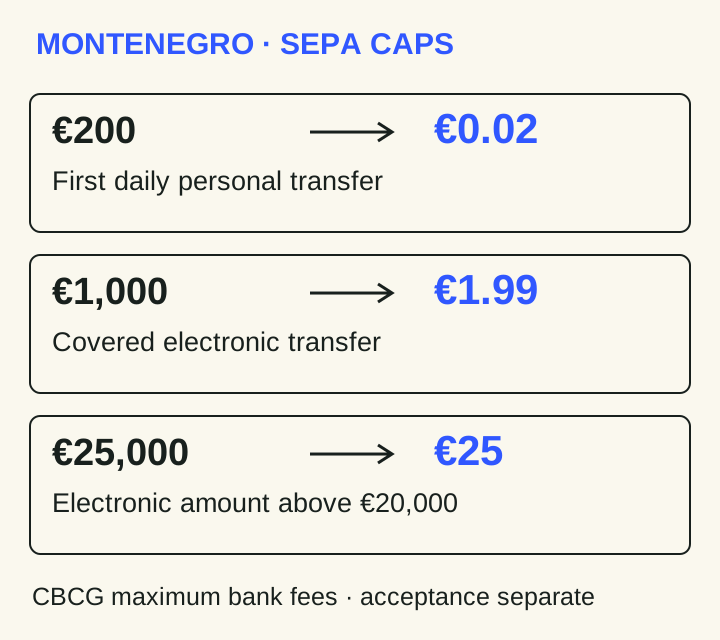
The CBCG caps give a usable benchmark for eligible SEPA payments. The first daily transfer by an individual of up to €200 may cost at most €0.02. Electronic transfers up to €20,000 are capped at €1.99; the equivalent branch transaction at €3.99. For electronic amounts above €20,000 the cap rises to €25. A bank can charge less, and the rules do not establish whether a particular crypto recipient will be accepted.
| Covered transfer | Maximum bank fee | Effect on the example amount |
|---|---|---|
| First daily personal transfer of €200 | €0.02 | 0.01% of €200 |
| Electronic transfer of €1,000 | €1.99 | 0.199% of €1,000 |
| Branch transfer of €1,000 | €3.99 | 0.399% of €1,000 |
| Electronic transfer of €25,000 | €25 | 0.10% of €25,000 |
These examples show why the payment channel matters more than a slogan about free deposits. On a €1,000 payment, using a branch rather than the covered electronic method can add €2 at the caps. That difference may be larger than the execution-fee difference on a modest futures position. Compare the actual invoice or displayed banking quote, since these are legal ceilings rather than the price charged by every bank.
Incoming SEPA transfers also have a cap: up to €1.99 for amounts of €20,000 or less, rising to €25 above that. The exchange may have its own withdrawal fee, so include both sides when planning a cash-out. There can also be a currency-conversion cost if trading gains arrive in a different currency. Keep those separate instead of presenting the recipient bank's capped charge as an all-inclusive withdrawal price.
What does Montenegro's new crypto register prove?
Montenegro's Capital Market Commission introduced the rules for its crypto-service provider register in December 2025. On 31 July 2026 it announced the first registration: Artenx d.o.o. Podgorica, under the anti-money-laundering law. This is a concrete development that older descriptions of a completely unregistered local market can miss. The Commission's register, not a dealer's social-media profile, is the starting point for checking a claimed registration.
The announcement does not establish that Artenx offers a crypto-futures exchange, a particular leverage limit or an order book comparable with the international platforms above. We therefore do not place it in the futures shortlist simply to add a local name. Registration for a crypto service and documented permission for the leveraged product are different findings. The same distinction applies if another company enters the register after this review.
For a local cash purchase, identify the legal seller, the service being supplied and the transaction record. A receipt should let you connect the original euros to the crypto later used as collateral. This becomes especially valuable when a Montenegrin bank receives proceeds from an exchange months later. A message showing only a wallet address and a nickname leaves the bank with less to verify than a transaction with a named, appropriately registered provider.
Budva, Tivat and Podgorica do not become separate exchange jurisdictions because different intermediaries advertise there. The verified difference is between the providers and services, not a town-specific leverage allowance. We found no basis in the reviewed national materials for promising residents of a particular coastal municipality a special crypto-futures exemption. The bank, documents and actual account terms determine the usable route.
Foreign residents, seasonal stays and existing accounts
Montenegro's international community includes people who have relocated permanently and people making a short stay. An apartment rental for a season is not, by itself, permission to move an exchange account to Montenegro. A genuine resident can document their local address and legal status; a visitor may still belong under their existing residence country's product rules. This is particularly important when the original country restricts derivatives more heavily.
Kraken's current international derivatives exclusions name Russia and Belarus. That is a residence-policy fact, not proof that every person with a Russian or Belarusian passport is automatically treated the same after a genuine move. Nationality, sanctions status, documents and the provider's onboarding decisions can still affect the application. Do not advertise a Montenegrin residence permit as guaranteed acceptance for everybody who could not trade from a previous country.
For an existing customer who moves, update the real address through the provider's account process. The change can affect the contracting entity, payment methods and positions that can remain open. Someone who continues living in an EEA country cannot use a Montenegrin bank account as a replacement for that residence. Conversely, a Montenegro resident should not retain an obsolete EEA address just because an old SEPA button is still visible.
Does a digital-nomad permit make trading profits tax-free?
Montenegro's official investment material describes relief for qualifying digital nomads earning employment or self-employment income from an employer not registered in Montenegro. That is not the same description as profits from trading your own crypto futures. A foreign exchange is the place where the trade occurs; it is not necessarily your employer. The permit should therefore not be used as a blanket exemption for all money arriving from abroad.
Keep remote-work receipts and personal trading results distinct. A developer receiving a salary from a foreign company and making separate perpetual trades has two activities, even if both are managed from the same rented apartment. The employment relief cannot simply be applied to the futures ledger because the person qualifies for it on their salary. This is one of the more consequential local errors in broad relocation guides.
How should a Montenegro resident treat futures profits?
Montenegro taxes resident individuals on worldwide income, while non-residents are generally taxed on income sourced in Montenegro. Residence can arise through domicile or the centre of personal and economic interests, as well as the statutory day-count rule. Opening an offshore exchange does not turn a resident's profits into income that can simply be ignored. The applicable income category still needs to match the actual activity.
The Tax Administration's June 2026 guidance confirms an annual 15% rate for capital gains in the context of transfers of company interests. That establishes a real rate in the tax system; it does not specifically classify every USDT-settled perpetual as a company-share capital gain. We do not present the rate as a definitive ruling for all crypto derivatives. A claim that Montenegro has a universal 9% crypto tax is equally unsuitable without checking the income category and current law.
The January 2026 consolidation of the personal-income law helps explain the limit of the evidence. Article 37a describes capital gains on real estate, interests in a legal entity and securities. It does not expressly name a retail crypto perpetual. Whether a particular contract belongs in that category must be established, rather than assumed from an article discussing the sale of company shares. This is a classification gap, not evidence that the profit is exempt.
For tax residence, the law includes a person with domicile or the centre of business and vital interests in Montenegro, as well as someone present for more than 183 days in the tax year. The day count is therefore not the only test. A genuine relocation with local family and economic ties needs a fuller assessment than simply counting nights, while a short visitor should not automatically be described as a Montenegro tax resident.
The useful record for a futures account separates realised trading results, funding, execution fees and collateral disposals. A withdrawal can contain original capital and gains together, while an account that has made no bank withdrawal can still have realised trades. Provide those components when establishing the treatment with the Tax Administration or a local tax preparer. Asking about a described perpetual contract is more precise than asking whether crypto is taxed.
For an example of the accounting issue, suppose you deposited €3,000 and later withdrew €3,600 after closing the account. The extra €600 may be the starting point for reconciling the activity, but the bank transfer alone cannot show whether there were other deposits, fees, coin disposals or still-open positions. It is not a calculation of €3,600 of taxable profit. Keep the trading export so the classification can be applied to the correct amount.
Taking futures proceeds back to Montenegro
For a euro-funded resident, a supported exchange withdrawal to an own-name bank account is the cleanest route to compare first. The CBCG incoming-transfer cap helps estimate the bank side if the payment is genuinely a covered SEPA transfer. It does not compel a bank to accept an unexplained transaction or remove checks on the exchange recipient and source of funds.
A trader using Bybit should account for its named fiat restrictions before describing the balance as ready for a direct bank withdrawal. Moving eligible crypto to a separately verified cash-out provider may involve another transaction, another service relationship and another fee. That can be a legitimate route where permitted, but it should be costed explicitly rather than hidden behind a statement that withdrawals are easy everywhere.
This is why our Montenegro shortlist is not ordered solely by maximum leverage. Kraken deserves the first investigation for a resident seeking a euro-connected relationship; Bybit can suit a crypto-funded contract choice. The documented SEPA inconsistency is the main unresolved practical limitation in the former route. A completed, approved account showing the intended deposit and withdrawal method is stronger evidence than either an outdated country table or a generic claim made by a ranking site.