










Binance or Bybit: which fits a Senegal account?
Binance: start from an XOF balance
A documented Wave purchase and sale flow, plus manual futures and optional copy trading.
Read the verdictBybit: compare the trader you will copy
Worth considering when a particular Classic trader and their terms suit you better.
Read the verdict| Your starting point | Preferred choice | What decides it |
|---|---|---|
| You have XOF in Wave | Binance, if the account offers the documented method | The purchase and sale instructions cover that wallet; no need to assume a P2P advert is the only route. |
| You already hold transferable USDT and trade manually | Binance on the base execution-fee comparison | Its standard taker example is slightly cheaper; transfer costs can erase a small saving. |
| You want to follow someone else’s futures trades | Compare the specific Binance portfolio with the Bybit Classic trader | Profit share, open losses and the ability to leave matter more than a leaderboard badge. |
This personal-account shortlist assumes genuine Senegalese residency. A working payment method does not settle the local rules for funding an offshore investment; the final section explains the UEMOA requirement that matters before a live deposit.
Why Binance is our first choice for Senegal
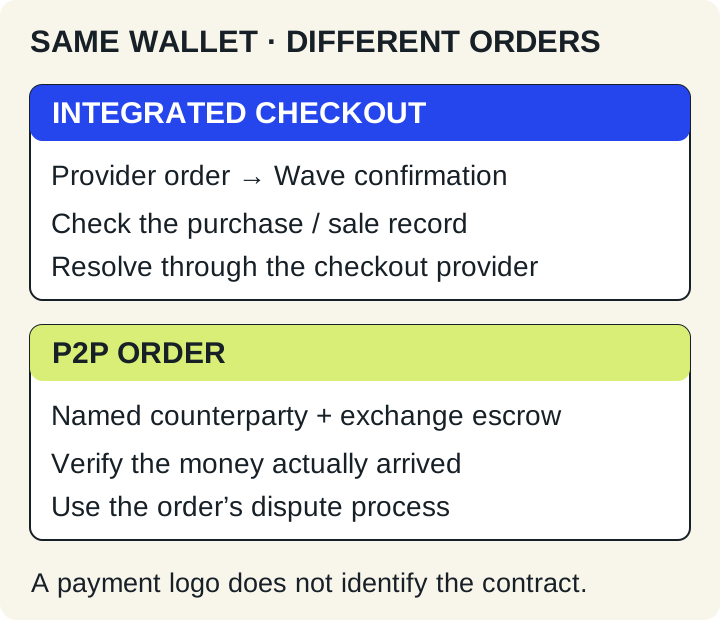
For someone starting with francs CFA, Binance has a concrete advantage: it publishes an XOF checkout that hands the payment over to Wave, then returns you to Binance to see the completed purchase. Its separate selling guide also describes a Wave payout. This is more useful than a vague claim that an exchange is “Africa friendly”.
The instructions show identity verification, a payment preview and confirmation inside the Wave app. They do not give every Senegal account an unconditional right to use every product. Confirm that the method appears in your own verified account and that the quoted crypto amount is acceptable before authorising anything. We reviewed the published flow; we did not complete a Senegalese resident’s transaction.
Buying a coin and opening a leveraged trade are separate decisions. If you only want to hold Bitcoin, stop at the purchase. For a futures position, you need the correct settlement balance and approved Futures access. Do not turn a simple purchase into a leveraged position merely because the next screen makes that possible.
When staying on one platform actually helps
It can avoid an additional crypto withdrawal between exchanges. That removes one network choice, one destination address and one transfer charge from the process. It does not remove the conversion spread or make futures suitable for money you expect to spend soon. For an existing Bybit user with USDT already in place, moving everything just to save a fraction of a percent is a different calculation.
Is Binance cheaper for a manual futures trade?
For the regular-user examples reviewed, Binance quotes 0.02% for an order that adds liquidity and 0.05% for an order that takes it. Bybit’s standard non-VIP perpetual/futures schedule is 0.02% and 0.055%. These are execution charges, not total ownership costs; promotional markets and individual account rates can differ.
| How the trade fills | Binance | Bybit |
|---|---|---|
| Immediate entry and immediate exit | 2.00 USDT | 2.20 USDT |
| Resting entry and immediate exit | 1.40 USDT | 1.50 USDT |
The illustration keeps entry and exit value equal so the fee comparison stays clean. At actual prices the two sides may have different values. Funding, slippage, purchase costs and withdrawals are excluded. “Resting” means the order really adds liquidity; typing a limit price does not automatically earn the lower rate.
On that immediate round trip, Binance saves 0.20 USDT. Ten identical round trips save 2 USDT. A hypothetical 3 USDT transfer would take fifteen such round trips to recover, before any other difference. That is why our recommendation is stronger for a new XOF-funded account than for someone already established elsewhere.
Changing the leverage setting does not shrink the trading fee on the same exposure. With 200 USDT supporting a 2,000 USDT position, a 2% adverse move means roughly 40 USDT lost before charges. With 400 USDT supporting the same position, that price loss is still about 40 USDT. More collateral changes the cushion, not the underlying exposure.
Is copy trading an easier way to trade from Senegal?
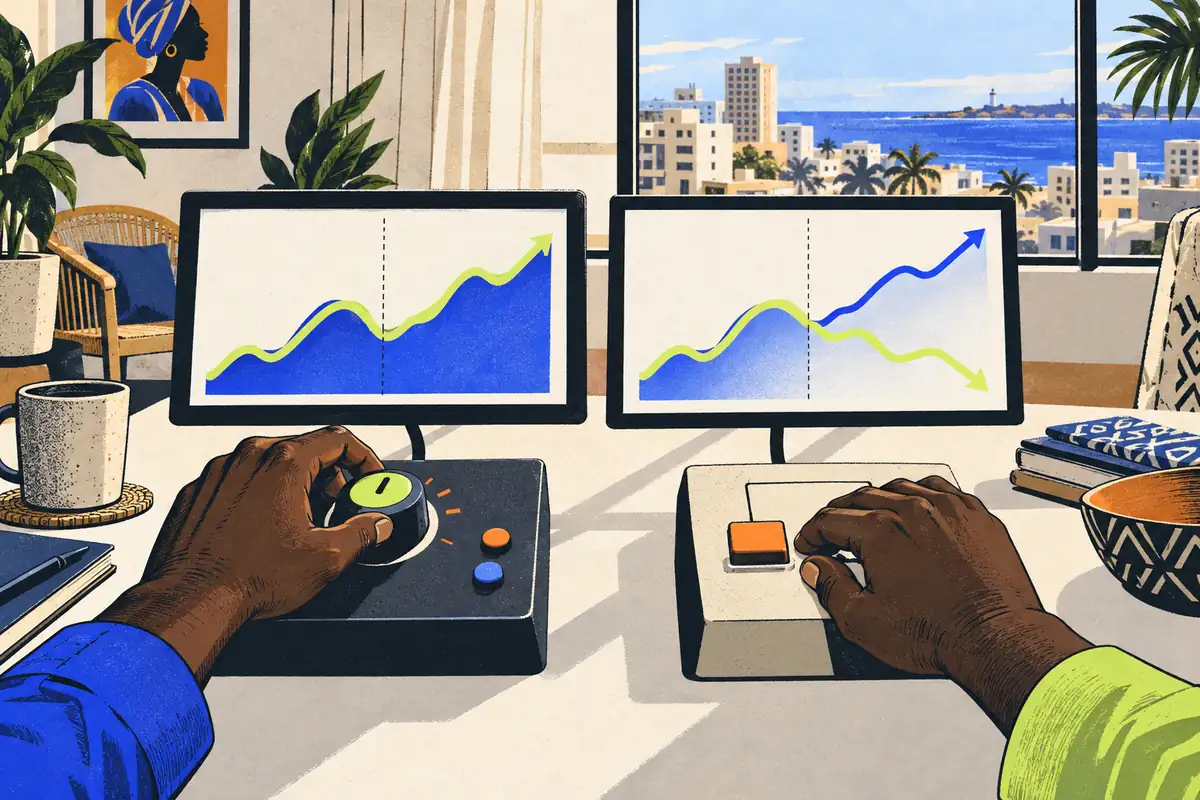
It removes some button-pressing, not the need to choose a strategy. Before following anyone, look at how much of their result comes from closed trades and how much risk remains in open positions. A portfolio can show many small wins while carrying one large losing position. A high win rate alone does not answer how much you could lose.
Binance supports allocation methods that follow a proportion of the lead portfolio or use a fixed amount. The first can scale exposure with the leader; the second can make each copied order larger or smaller relative to your own balance. Neither tells you whether that trader’s strategy is sensible for your money. Set an allocation you can afford to lose rather than copying the size of somebody else’s account.
A practical comparison is to put two candidate profiles side by side and ask: how long is the visible history, what was the largest fall, how much remains open, and can I leave without a lock-up? A short winning streak should not outweigh a longer record that shows losses as well. Those are questions about the chosen trader, not a reason to declare every account on one exchange superior.
The leader’s share changes what you keep
Bybit Classic publishes tiered shares of 10%, 10%, 12% and 15%. Binance’s lead-trader programme spans a regular 10% share and higher-tier allowances reaching 30%. Those are not the same product as Bybit Copy Trading Pro or TradFi copy trading. Read the percentage on the exact portfolio rather than borrowing a rate from a different programme.
| Selected portfolio share | Paid to the leader | You keep |
|---|---|---|
| 10% | 8 USDT | 72 USDT |
| 15% | 12 USDT | 68 USDT |
| 30% | 24 USDT | 56 USDT |
These are comparisons at equal profit, not forecasts. A 10% trader with poorer performance may leave you less than a 15% trader; a 30% fee is not justified merely by a higher badge. Losses also remain yours. The useful question is the result after the share and the risk taken to earn it, not the percentage printed in a promotion.
When would we choose Bybit instead?
Choose Bybit for a specific Classic trader you have assessed, or because your existing account and balance already fit your workflow. Its documentation makes clear that copying still attracts the ordinary derivatives trading and funding charges. The profit share is an additional component, not a replacement for those charges.
For a beginner comparing two otherwise similar copy portfolios, the lower applicable share and clearer exit terms favour that particular portfolio. For a manual trader, the base-fee example above favours Binance slightly. This leaves Bybit with a real use case without inventing a universal winner for copy trading.
Your result can differ from a leader’s because the copied trade starts later, gets a different fill or cannot open at the requested size. A small follower balance may also miss orders. Look at the actual copied-position history after a trial allocation, rather than treating the leader’s published percentage as the return on your own money.
Bybit’s published restrictions do not list Senegal as an excluded country, but residency is only one condition. Use your real identity and check product approval. A French-language interface is convenient for reading an order; it does not override account eligibility or a bank’s rules for sending funds.
Wave costs and limits that can change the plan
Binance’s published mobile-money FAQ lists XOF purchase and sale charges of 2.2% and 1.5%. Treat them as listed service rates and confirm the checkout: the conversion quote can also affect how many coins or francs you receive. These rates are separate from the optional bank–Wave link discussed below.
Wave’s Senegal terms distinguish an unidentified wallet, an identified balance limit and monthly loading. They state a 200,000 XOF monthly ceiling for an unidentified account, a 2,000,000 XOF maximum holding for an identified user, and 10,000,000 XOF in cumulative monthly loading, subject to the applicable rules. These are wallet constraints, not the maximum size of a Bitcoin trade.
That distinction matters if a planned cash-out arrives while your wallet already holds money. An identified wallet with 1,850,000 XOF has 150,000 XOF of room under a 2,000,000 XOF holding ceiling. A proposed 200,000 XOF receipt exceeds that room even if your monthly loading total is low. Resolve the wallet limit through the provider’s normal process rather than splitting payments to evade it.
Do not attach the same 1% to every Wave operation
The reviewed Wave–Banque Atlantique Senegal agreement charges 1% for transfers between the linked bank account and Wave. That is a named bank-wallet service. It is not proof that every Binance checkout, P2P payment or Wave cash withdrawal costs 1%.
For a 150,000 XOF transfer covered by that agreement, the fee is 1,500 XOF. If you later make an equal transfer back through the same service, another 1,500 XOF applies. Those two operations cost 3,000 XOF before any crypto conversion; a plan that does not use the bank link should not include them. Compare the payment preview for the method you will actually use.
A good checkout comparison asks how many USDT the same spend buys after displayed charges. For example, hypothetical offers of 150 USDT and 146 USDT for 90,000 XOF differ by four USDT. The higher amount is preferable only if the recipient, processing terms and permitted payment method also match your needs. These numbers illustrate the comparison; they are not current Senegal market quotes.
How do you turn a futures balance back into XOF?
First close the exposure you intend to cash out and identify the balance available to transfer from the derivatives account. A green profit figure on an open position is not automatically money available to withdraw. Pending orders or other positions can still use the balance.
Binance’s selling guide shows a Wave payout in XOF and asks for the receiving wallet details. Its detailed steps allow up to two days, while a general FAQ on the same page says instant receipt. Plan for the longer stated window and the live order estimate, rather than promising money immediately after closing a trade.
If you use P2P instead, the payment is with a counterparty under the order’s terms. Keep the exchange’s order record and check the actual wallet credit before releasing crypto. A screenshot sent by the buyer does not establish receipt. If the name or amount does not match, use the order’s dispute process rather than an off-platform promise to settle later.
Is crypto futures trading approved in Senegal?
The material reviewed does not establish a Senegalese licence for these offshore futures accounts. Senegal is part of UEMOA, where the 2024 foreign-financial-relations regulation includes prior authorisation for investments abroad in Article 12. Whether a particular transfer or account arrangement falls within those requirements needs an answer tied to that transaction, not a guess based on the app loading.
For an outward investment payment, state its real purpose to the bank and obtain the applicable procedure before committing funds. A local wallet’s payment feature does not settle the treatment of an offshore investment. Equally, this rule is not a reason to erase every provider from the country catalogue or claim that merely researching a platform is prohibited.
BCEAO’s 2026 crypto-assets conference in Dakar discussed the subject at central-bank level. It was not a product licence. The practical result for this guide is a conditional shortlist with a documented payment feature, rather than an unsupported promise of fully regulated Senegalese futures access.