How Auto-Deleveraging (ADL) Works in Crypto Futures
Jump to sectionsShort answer
Auto-deleveraging can close part of a profitable futures trade when the platform needs to resolve losses elsewhere. It can happen even with enough margin in your own account. If the trade was hedging another investment, the reduction leaves part of that investment unprotected.
Binance Futures shows ADL priority and offers a separate eligibility-based Delta Neutral Account feature. Those are relevant controls for a hedged strategy whose profitable leg must remain open; they do not remove the possibility of forced reduction.
Why was my profitable crypto futures position closed automatically?
A trader sees a healthy short, a green profit figure and plenty of margin. Part of the short then disappears without a stop firing. That can be ADL: the platform uses an opposing position to resolve distressed exposure. The trader selected for reduction is not necessarily the trader whose margin problem started the event.
A forced close also needs to be distinguished from a voluntary take-profit order, contract expiry or delisting settlement. The event label, affected quantity and settlement price identify what occurred. A profit figure alone cannot distinguish these mechanisms. Before diagnosing an unexplained reduction, locate the transaction record rather than assuming every automatic close was liquidation.
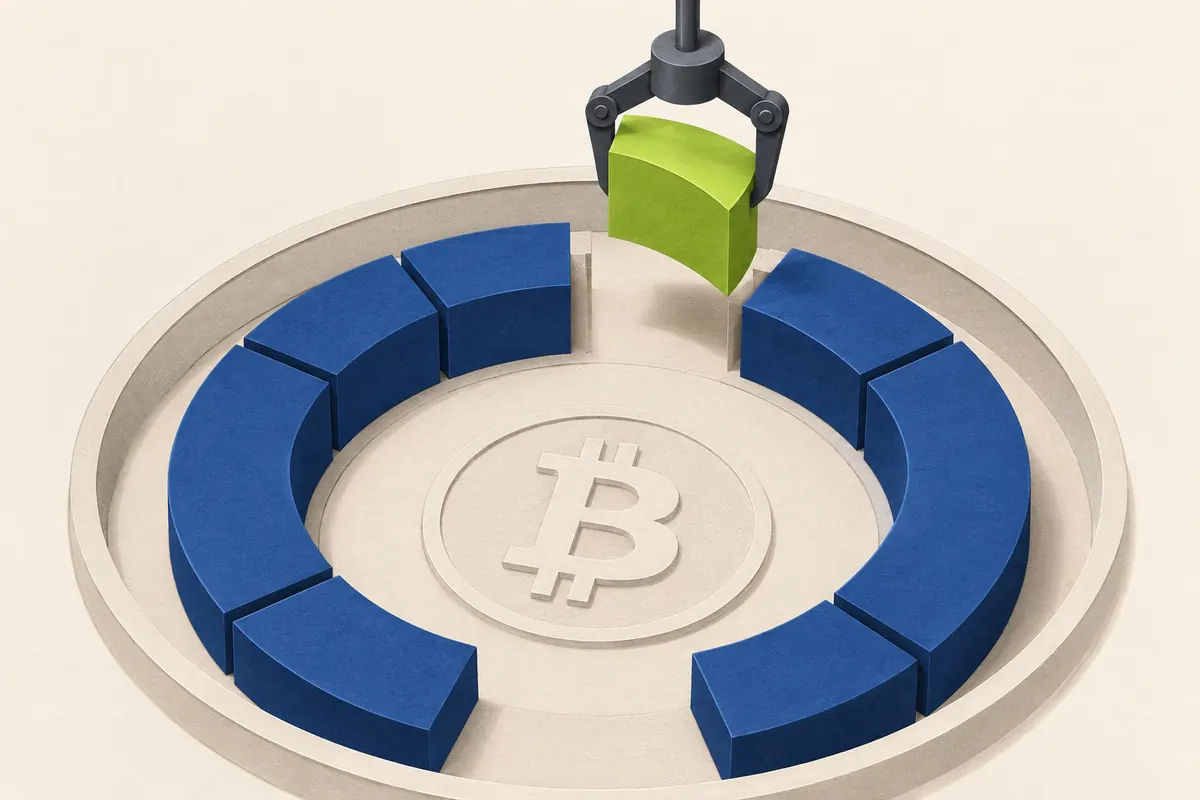
What do the ADL lights or queue indicators actually tell you?
They place a position within a priority system. Being near the front matters if that system needs to reduce opposing exposure. It does not tell you that a particular amount of bankrupt exposure exists, how much can be handled by other safeguards or when a reduction will happen. Rank and event probability are different quantities.
Four lights identify a relative priority band, not an 80% probability. That band can exist with no ADL event at all; a large event can consume several bands.
Profit in dollars is not enough to reconstruct priority
Binance’s published positive-P&L ranking combines profit as a fraction of position notional with effective leverage. The simplified numbers below apply that stated relationship; they do not estimate any real account’s place among other users. Both positions are on the same relevant side, with positive equity and no special priority treatment.
| Input | Position A | Position B |
|---|---|---|
| Notional exposure | 20,000 USDT | 60,000 USDT |
| Unrealized profit | 2,000 USDT | 6,000 USDT |
| Equity used in denominator | 4,000 USDT | 20,000 USDT |
| Profit / notional | 10% | 10% |
| Effective leverage | 5x | 3x |
| Illustrative score | 0.50 | 0.30 |
B earns three times as much in absolute terms, yet A has the larger score because its exposure uses less supporting equity. Ranking by the biggest green P&L number would reverse the useful interpretation. Even these two scores cannot reveal a percentile without the other eligible positions in the queue.
A displayed leverage setting is not always effective leverage. Changing a slider without changing the equity actually supporting exposure may leave the relevant ratio unchanged. The same distinction applies when profit, collateral value or another cross position changes the denominator. The indicator should be read as a current account output, not a permanent characteristic of the original trade.
Why queue formulas cannot be copied between platforms
Hyperliquid’s documentation prints its sorting index as (mark_price / entry_price) × (notional_position / account_value), and describes ranking by unrealized P&L and leverage. We retain that published expression rather than replacing it with Binance’s profit-percentage formula or inventing a long/short normalization. A public expression alone is insufficient to reproduce a live queue without its conventions and account state.
Binance Portfolio Margin’s documented CM ADL-quantile endpoint returns discrete values and states that values update every 30 seconds. Polling faster does not make the underlying estimate continuous. Account mode also affects returned fields. This article does not request private account data or offer a live ADL predictor.
ADL triggers and settlement prices differ across exchanges
Read the trigger, selection rule and execution-price rule separately. A remaining insurance balance or a chart price alone cannot explain whether this product’s ADL event followed its rules.
| Platform | Distinctive rule | Price / fee detail |
|---|---|---|
| Binance Futures | Insurance takeover can reach a capacity limit before the displayed fund is empty. | Educational FAQ describes the distressed position’s bankruptcy price and no trading fee for the ADL-selected winner. |
| Bybit | Triggers include an eight-hour drawdown condition with pair-specific parameters. | Uses the fund-defined bankruptcy price; its help page states a maker fee for the reduced trader. |
| Hyperliquid | ADL addresses negative account or isolated-position value. | Opposing positions close against the underwater account at the previous mark price. |
| Deribit | Eligible positions can reach ADL after liquidity-support capacity is exhausted. | Transfer uses mark adjusted in the receiving member’s favor; a reward may also apply. |
The price distinction can materially change realized P&L. A forced close at a specified bankruptcy reference is not an ordinary market order walking the book. A previous mark is not necessarily the mark visible after the event. Compare the recorded settlement reference with the rule in force, rather than using a later candlestick as the sole benchmark.
Bybit: do not substitute a generic “fund reaches zero” trigger
Bybit’s current mechanism describes both an eight-hour drawdown test and a combined-balance condition for independent pools. It directs readers to pair-specific trigger and stop parameters. A positive balance for one pair alone cannot establish that neither condition applies. The same document also says opposing losing positions can be selected, with profitable ones prioritized.
Deribit: first establish whether the instrument is eligible
Deribit limits ADL to perpetuals without an option series in the same currency pair; its page lists current exclusions. It allocates eligible opposing reductions pro rata using unrealized profit within the daily window. That is not the same mechanism as selecting the largest Binance-style score first. Checking the instrument’s eligibility avoids applying an ADL explanation to a contract governed by a different fallback.
A favorable ADL price adjustment can still interrupt a strategy. Include the cost of replacing the removed exposure when assessing the outcome, even where the forced reduction itself has no trading fee.
A BTC hedge after ADL: what exposure is left?
Assume a trader owns 1 BTC spot and holds a linear 1 BTC short perpetual. Both were established at 110,000 USDT for this exercise. At 100,000, spot has lost 10,000 while the short has gained 10,000 before costs. Now suppose ADL closes 0.4 BTC of the short at exactly 100,000. The spot holding is untouched.
Net: +0.4 BTC · A further 2,000 USDT fall produces an 800 USDT combined price loss.
The closed 0.4 BTC realizes a 4,000 USDT gain. The remaining 0.6 BTC short has an unrealized gain of 6,000 at the unchanged mark. Together those still equal the original short’s 10,000 gain. ADL has not magically erased all profit in this example. It has changed the protection against the next move.
The portfolio now has 1 BTC spot minus 0.6 BTC of short exposure: a net 0.4 BTC long. If both relevant prices then fall by 2,000, the spot loses another 2,000 while the short gains only 1,200. The combined next-move loss is 800. That new directional exposure is the practical damage a hedge monitor needs to detect.
Rebuilding the short is only one possible response
The trader could seek another 0.4 BTC short, reduce spot by 0.4 BTC or accept the changed exposure. Each choice has a different execution cost and operational requirement. Reopening immediately on the same stressed contract may recreate the exposure to ADL; moving elsewhere introduces another venue and potentially another collateral requirement.
A spot-perp hedge is also not always a perfect one-for-one offset in practice. Spot and perpetual prices can diverge, fees and funding accumulate, and inverse contracts have different exposure mechanics. The fixed linear quantities here isolate the effect of ADL itself. They are not a promise that a real hedge had zero risk before the reduction.
For a basis or funding strategy, record the remaining pair of exposures before evaluating the attractive funding rate still displayed on screen. That rate applies only to the surviving futures quantity. A strategy can retain a positive funding payment while carrying an unintended directional position much larger than the expected next payment.
Can adding margin or lowering leverage prevent auto-deleveraging?
Additional eligible equity can reduce effective leverage in systems that use it for priority. It can therefore change ranking, but it does not switch off ADL or control how much distressed exposure arrives. A useful distinction is between lowering a score and guaranteeing that a position survives. Only the first follows from that arithmetic.
In the earlier positive-P&L example, raising A’s relevant equity from 4,000 to 8,000 while holding notional and P&L fixed reduces effective leverage from 5x to 2.5x and the score from 0.50 to 0.25. Other accounts can change simultaneously, so that still does not tell you A’s new queue position. It also commits more capital to the venue.
Reducing size lowers the quantity exposed to ADL, but its rank changes under the platform’s profit and margin formula. Reopening incurs a new spread, fee and market price.
A real hedge does not automatically qualify for special treatment
Binance’s Delta Neutral Account feature requires eligible PM or PM Pro status, VIP 4 or above to enable it, activation and a qualifying relative difference below 0.05. Its documentation excludes ordinary Spot Account assets and options from the eligible hedge calculation. Having BTC in a separate spot wallet therefore does not by itself activate that lower-priority treatment.
Bybit’s separate Delta Neutral Mode has account and VIP eligibility criteria. A hedge receives that treatment only when the mode is enabled and the positions qualify.
What should you do with an ADL notification?
If ADL removes part of a profitable hedge, recalculate the remaining coin exposure before a bot restores its target. In the BTC example, the short reduction leaves more of the spot holding exposed to a fall.
Use the ADL quantity and the venue’s settlement-price rule to explain the realized result. Then inspect surviving orders: an automatic replacement order can reopen the exposure just removed, at a new price and cost.
Resize or unwind the remaining hedgeADL questions beyond the warning lights
Can auto-deleveraging affect a position that is losing money?
It can under some rules. Bybit’s current documentation explicitly allows selection of opposing losing positions after prioritizing profitable ones. “ADL only closes winners” is therefore too broad. Eligibility, direction and priority depend on the platform’s mechanism.
Does isolated margin make my position immune to ADL?
No. Isolated margin defines which collateral supports a position. It does not automatically remove that position from an opposing ADL queue. Your own collateral can be adequate while another account’s distress triggers a reduction under the platform’s rules.
Do I lose all my unrealized profit when ADL happens?
Not automatically. The affected quantity is settled at the applicable ADL price, which determines realized P&L. A remaining quantity can still carry unrealized profit. The worked BTC example realizes part of the gain without erasing the rest, while showing why the surviving hedge can nevertheless become inadequate.
Can a stop-loss order keep a profitable short out of the ADL queue?
An untriggered stop is not a completed close and does not remove existing exposure from the queue. If an exit executes beforehand, the exposure changes. But a stop is not an instruction overriding the platform’s ADL process, and its presence alone provides no exemption.
Is an ADL close guaranteed to use the latest market price?
No. Platforms use different settlement references, such as a bankruptcy price, a previous mark or an adjusted mark. Those can differ from the chart shown after the event. Evaluate the recorded price under that platform’s rule rather than assuming the trade was an ordinary market order.
Can I move my open perpetual position to another exchange to escape ADL?
An open contract normally belongs to the venue where it was created; transferring collateral does not transfer the position. Replacing exposure elsewhere involves closing or reducing one position and opening another, with execution and funding requirements on both sides. A withdrawal alone may also reduce the equity supporting the original position.
Can a partial ADL reduction change my next funding payment?
Yes. A smaller qualifying position produces a smaller funding transfer at the same rate and mark. If ADL closes the entire leg before the assessment time, that leg no longer earns or pays the scheduled transfer under the ordinary snapshot model.
Sources and research 8 source references
Current official ADL, account-feature and API documentation checked on 7 October 2026. The ranking and BTC hedge cases are constructed examples with explicit assumptions. No private account queue was queried and no trade was executed. Hyperliquid’s published index is retained as written, not silently normalized. Deribit instrument exclusions and Bybit trigger conditions are scoped to their own current documents. Binance’s educational FAQ is not a substitute for applicable clearing rules and contract terms.
Evidence by section
- Why was my profitable crypto futures position closed automatically?
- What do the ADL lights or queue indicators actually tell you?
- ADL triggers and settlement prices differ across exchanges
- Binance: Auto-deleveraging: ranking, execution and notifications
- Binance: Futures insurance funds: allocation and takeover capacity
- Bybit: ADL mechanism: drawdown triggers, prices, fees and queue
- Hyperliquid: Auto-deleveraging: negative equity and previous mark execution
- Deribit: ADL after liquidity support; instrument eligibility
- Can adding margin or lowering leverage prevent auto-deleveraging?
- What should you do with an ADL notification?
Source register and access
- Binance: Auto-deleveraging: ranking, execution and notificationsLink checked · Reviewed 7 Oct 2026 · Product rule · next editorial check due 2027-01-05
- Binance: Futures insurance funds: allocation and takeover capacityLink checked · Reviewed 7 Oct 2026 · Product rule · next editorial check due 2027-01-05
- Bybit: ADL mechanism: drawdown triggers, prices, fees and queueLink checked · Reviewed 7 Oct 2026 · Product rule · next editorial check due 2027-01-05
- Hyperliquid: Auto-deleveraging: negative equity and previous mark executionLink checked · Reviewed 7 Oct 2026 · Product rule · next editorial check due 2027-01-05
- Deribit: ADL after liquidity support; instrument eligibilityPublic link · automated check limited · Reviewed 7 Oct 2026 · Product rule · next editorial check due 2027-01-05
- Binance Developers: Portfolio Margin CM and UM ADL quantile estimationLink checked · Reviewed 7 Oct 2026 · Product rule · next editorial check due 2027-01-05
- Binance: Delta Neutral Account eligibility and ADL ranking treatmentLink checked · Reviewed 7 Oct 2026 · Product rule · next editorial check due 2027-01-05
- Bybit: Delta Neutral Mode: eligibility and priorityLink checked · Reviewed 7 Oct 2026 · Product rule · next editorial check due 2027-01-05