Funding Rate Arbitrage: Costs, Capital and Exit Risk
Jump to sectionsShort answer
Funding rate arbitrage pairs opposing exposures to collect a funding difference. A common version buys spot Bitcoin and shorts the same BTC quantity in a perpetual contract. It earns money only when funding plus the change in the spot-perp spread exceed trading, borrowing and transfer costs. Measure the result against all capital committed, including the spot purchase and cash supporting the short. A hedge can reduce directional exposure without protecting either account from liquidation.
Binance’s spot-perpetual arbitrage bot includes entry and exit spread conditions and coordinated closure of both legs. Those functions are relevant when managing carry as one strategy; the return still depends on actual funding and the eventual exit basis.
Start with the Bitcoin quantity, not the advertised APR
Suppose you buy 0.2 BTC at 50,000 USDT and sell a linear perpetual for 0.2 BTC at the same price. The spot purchase costs 10,000 USDT. The short also has an initial value of 10,000 USDT, but that is exposure, not another purchase of Bitcoin. Separately, you allocate cash to support its margin requirements. Those three numbers must not be mixed.
If both prices rise to 55,000, the spot gains 1,000 USDT and the short loses 1,000 USDT before costs. If both fall to 45,000, the signs reverse. Keeping equal BTC quantities is what offsets this common price movement. A spot balance worth $10,000 and a short worth $10,000 at different prices need not contain exactly the same BTC exposure.
That matters when an exchange charges a spot purchase fee in Bitcoin. An order for 0.2 BTC might leave less than 0.2 BTC in the wallet after the fee. Hedge the net quantity actually held, or explicitly account for the small remaining short. Order requests, executed quantities and delivered balances answer different questions.
Funding is the separate cash flow. For a positive funding rate, a short normally receives and a long pays; a negative rate reverses the direction. The strategy does not require Bitcoin to rise. It requires the receiving side to earn enough, for long enough, while the paired positions remain manageable.
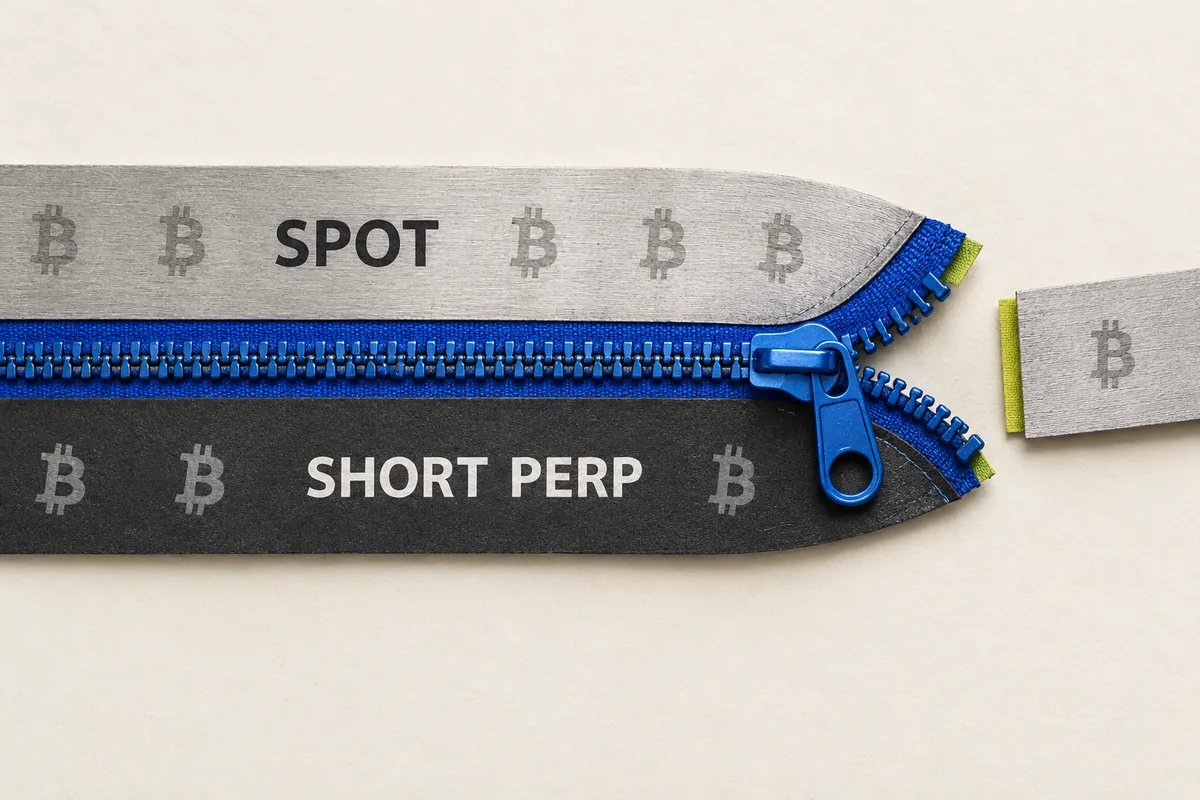
Do not add a second trade every time the dollar value of both legs changes. If each remains 0.2 BTC, a shared price move changes both notionals together. Unnecessary rebalancing can create fees and accidentally change a matched hedge. Reconcile quantities after partial fills, withdrawals, fees paid in the asset or changes to one position.
A $20,000 allocation can support only a $10,000 funding leg
Use an intentionally simple starting budget: 10,000 USDT buys spot, and 10,000 USDT supports the short in a separate derivatives account. Total starting capital is 20,000 USDT. The short earns funding on its position value, not on the sum of the two account balances. At a 0.01% event rate and unchanged 10,000 USDT notional, it receives 1 USDT.
Ten such receipts produce 10 USDT gross: 0.05% of the 20,000 committed. Reporting 0.1% by dividing by only 10,000 ignores half the capital. Funding divided by a much smaller initial-margin allocation makes the headline larger again, but does not describe the return on the whole strategy. Include cash you deliberately reserve to sustain it.
| Execution | Calculation | Cost |
|---|---|---|
| Buy spot | 10,000 × 0.10% | 10 USDT |
| Open short | 10,000 × 0.05% | 5 USDT |
| Sell spot | 10,000 × 0.10% | 10 USDT |
| Close short | 10,000 × 0.05% | 5 USDT |
| Complete cycle | Two spot and two perpetual executions | 30 USDT |
At 1 USDT per event, 30 payments merely recover these 30 USDT of commissions. The thirty-first produces the first 1 USDT above commissions, assuming the same rate and notional persist. A positive daily funding receipt is not automatically daily profit. Entry and exit costs are paid for the cycle, not charged again every day in the calculation.
The arithmetic changes when prices or execution types change. A 0.2 BTC spot sale at 55,000 has an 11,000 USDT fee base. A limit order that crosses the book can still be a taker. Use each completed fill’s value and charged rate when reconciling the result instead of applying an opening-price estimate to every later trade.
Capital efficiency also needs a location. Reducing the short allocation from 10,000 to 2,000 leaves total deployed capital at 12,000, before any reserve. It increases the strategy’s return percentage for the same funding receipts, but leaves less cash on the losing short during a rally. The spot gain may sit in another wallet or venue and arrive too late to help.
Six actual BTC funding settlements: receipts did not stay positive
The following public Binance BTCUSDT history was retrieved on 8 October 2026. Assume a constant 0.1 BTC short was present at all six settlements. Each payment uses that record’s mark price and settled rate. This is a calculation from public observations, not a trade we placed or a claim about a customer account.
| UTC settlement | Rate | Mark price, USDT | Short cash, USDT |
|---|---|---|---|
| 6 Oct 08:00 | −0.001592% | 85,514.00 | −0.136138 |
| 6 Oct 16:00 | +0.002245% | 85,675.20 | +0.192341 |
| 7 Oct 00:00 | −0.000743% | 85,516.50 | −0.063539 |
| 7 Oct 08:00 | −0.003657% | 84,102.71 | −0.307564 |
| 7 Oct 16:00 | +0.001152% | 83,412.01 | +0.096091 |
| 8 Oct 00:00 | −0.000992% | 83,282.00 | −0.082616 |
The unrounded sum is approximately −0.301425 USDT. Four payments were negative for the short and two positive. Selecting the largest positive observation and projecting it across all six events would describe a different, invented cash flow. This small sample proves neither that funding arbitrage always loses nor that the opposite position would be profitable after costs.
The position quantity is constant here, but its notional is not. As the mark changes, the cash charged for the same percentage also changes. Multiplying one opening notional by a sum of rates is an approximation; multiplying each settlement’s notional by its own rate reconstructs the assumed position more faithfully.
The record contains funding, not executed spot prices, bid-ask spreads, commissions or the price of closing the short. It therefore supports a funding subtotal, not a complete strategy return. A backtest that fills those missing fields with convenient prices can look far more profitable than an executable trade.
Inspect the six public funding recordsA widening spot-perp gap can erase the funding collected
Define the basis here as perpetual price minus spot price. For equal quantities, the gross price result of long spot plus short perpetual is quantity × (entry basis − exit basis). A smaller basis at exit helps this position; a larger one hurts. This sign is easy to reverse when a screen instead quotes spot minus perpetual.
Return to 0.2 BTC bought and shorted at 50,000, so the entry basis is zero. Later spot is 55,000 and the perpetual costs 55,300 to buy back. Spot gains 1,000, but the short loses 1,060. The combined price result is −60 USDT. With 36 USDT of funding and a fixed illustrative 30 USDT cost budget, the complete result is −54 USDT.
- Combined spot + short price result
- -60.00 USDT
- Funding − fixed 30 USDT cost budget
- 6.00 USDT
- Net strategy result
- -54.00 USDT
- Return on 20,000 USDT committed
- -0.270%
Constructed closing scenarios, not a forecast. Fixed costs isolate the spread effect; real fees depend on fill values. No borrowing, transfers or liquidation simulation.
If the perpetual instead closes 100 USDT below spot, the paired price result is +20 USDT. A discount at exit helps the short-perpetual/long-spot setup relative to the same entry basis; it does not automatically hurt it. Always establish which instrument is being bought back before interpreting the sign of the spread.
A perpetual has no scheduled maturity forcing its price to meet spot on your chosen exit date. You can wait for a more favorable spread, but waiting adds new funding exposure and keeps capital committed. Entry spread is an observed starting advantage or disadvantage; it is not a locked profit unless the remaining execution and exit conditions support it.
For a live close estimate, use the spot bid you can sell into and the perpetual ask you can buy back, including depth for your quantity. Comparing two last-trade prices omits the cost of crossing both markets. If one quoted price disappears before the other leg fills, the difference belongs in realized execution, not in the funding subtotal.
Cross-exchange funding arbitrage needs two funding ledgers
A long on one exchange and a short on another can offset coin exposure while collecting a difference in funding. Each account still needs its own collateral. Profit on the receiving venue cannot automatically prevent liquidation of the paying or losing leg.
Compare the two settled payments over matching periods, then deduct both entry and exit costs. A divergence between the venues’ futures prices also changes the result when the pair closes. The funding spread is only one component.
If one leg is reduced or a venue restricts exits, the surviving leg becomes directional. Decide how much unmatched quantity the strategy can tolerate before treating a quoted annual rate as an opportunity.
Negative funding: selling owned spot is not the same as borrowing it
When a long perpetual receives negative funding, the opposite exposure can come from selling spot. There are two economically different starting points. Someone who already owns 0.2 BTC can sell that inventory and use a long perpetual to retain similar price exposure. Someone starting with only USDT needs a way to borrow and short BTC, or a different derivatives hedge.
For the existing BTC holder, judge the strategy against continuing to hold 0.2 BTC. The objective may be to finish with the same coin quantity plus or minus the carry result. Calling the spot-sale proceeds free investment capital would erase the asset that was given up at the start. Buying it back is part of restoring the original portfolio.
A borrowed-spot version adds interest, collateral requirements and the possibility that borrowing capacity changes. A long receiving 4 USDT of funding per day and a borrowed asset costing 3 USDT per day leave only 1 USDT before execution costs. If borrow cost rises to 5, the apparent funding opportunity becomes negative without any change to the funding rate.
Do not assume an arbitrage product will arrange that loan. Binance’s documented bot supports a reverse-carry investment in the base asset and states that margin borrowing is not supported for these strategies. Its workflow therefore should not be presented as an automatic way for a USDT-only account to borrow any coin for negative-funding trades.
Should you close when the funding rate reverses?
Separate the record of what happened from the choice that remains. If entry fees have already been paid, they are a sunk cost. They belong in the strategy’s lifetime result, but they should not make you keep an unfavorable position open until it “earns them back.” The next decision compares closing now with the additional cash flows and risks of waiting.
Imagine the current close would realize a 12 USDT loss after all costs. Waiting one more event is expected, under a stated scenario, to receive 4 USDT of funding. If the exit spread worsens by an amount costing 9 USDT and no other cost changes, waiting makes the result 5 USDT worse. The earlier loss is not repaired merely because another payment arrived.
A single negative forecast does not mechanically imply an immediate exit either. Forecasts can change, closing has a price, and an existing favorable spread may dominate one small payment. Write down the additional funding you might receive or pay, any borrowing during the wait, the spread move you can tolerate and the time at which you will reassess. That is more useful than a universal “hold for three days” rule.
Execution needs a plan for mismatched fills. If you sell all spot while only half the short closes, the remainder is an unhedged short. If the short closes first and spot remains, you hold unhedged spot. Size the next action from actual remaining positions. A stale bot status or two submitted orders are not confirmation that exposure has disappeared.
Bybit spread orders can fill both legs in equal quantities or neither. This matched-execution feature addresses entry risk within that product; two independent orders on different venues still leave a gap between fills. Each completed leg then follows its ordinary margin rules.
What the Binance bot automates—and what remains your decision
Binance’s guide documents entry and exit spread controls, a buffer in its allocation, a funding-direction alert and full or partial closure of both legs. A pending close can be waiting for the selected spread condition. Skipping that condition allows a market exit, trading price control for immediacy. The interface’s minimum-holding estimate uses past funding assumptions.
The bot’s allocation differs from the fully funded two-account example above. Do not import that example’s 20,000 USDT denominator into a bot that reserves and recognizes assets differently. Use the capital allocated to the actual strategy, its recorded spot and futures quantities, and any additional funds you subsequently commit.
Model a funding payment separately from the whole strategyA pending spread-controlled close may leave the pair open while carry deteriorates. Compare the cost of waiting with the executable cost of closing now; use the bot’s actual committed capital as the denominator.
Practical funding-arbitrage questions
Does 1x on the short make spot-perpetual arbitrage impossible to liquidate?
No. A separate short account can lose margin as the price rises even when spot gains elsewhere. Shared-margin products have their own collateral and maintenance treatment. A terminal hedge calculation does not establish that both positions survive the path.
Can I count the same spot Bitcoin as both free savings and strategy capital?
Not without disclosing the overlap. If the BTC is needed to offset the short, it is economically committed to the hedge. If it is also collateral, its recognized margin value and price exposure must be accounted for together.
Is entering a few seconds before funding enough to capture a profitable event?
The payment alone does not answer that. Two entry fills and two later exits can cost more than the receipt, and eligibility depends on when the position exists under the venue’s settlement process. The public next rate is not a guaranteed cash amount.
Should staking rewards be added to the spot leg’s expected return?
Only if the asset and arrangement actually preserve the hedge and permit the access you need. A staked or wrapped asset may have a different price, redemption delay or borrowing treatment. Do not add an advertised yield while continuing to assume immediately saleable spot.
What if the exchange delists one contract in my funding trade?
The hedge needs to be reconciled around the forced close or settlement. An independent spot position can remain after the perpetual ends. Binance’s bot documentation says relevant delistings can trigger automatic closure and settlement of the associated strategy; that behavior does not apply to every manually assembled hedge.
Does a profitable funding history prove that the bot’s APR is achievable?
No. History records past settlements. Your size, entry and exit prices, fees, capital allocation and periods actually held determine your result. The six-event example above deliberately reports only the funding subtotal because the remaining trade data was not observed.
Sources and research 6 source references
Official documentation reviewed 8 October 2026. Six public Binance BTCUSDT funding records are saved with retrieval time, exact rates and mark prices; payments assume a constant 0.1 BTC short and are not an account backtest. Other amounts, fees and exit spreads are constructed examples. We placed no trades and verified no individual eligibility or live execution. Payoff signs and capital arithmetic were checked independently. Competitor coverage was used to identify omissions, not as evidence for product terms. The Binance bot description was rechecked against the international English FAQ on 8 October 2026; its stablecoin and account restrictions still apply, including the stated EEA qualification.
Evidence by section
- Start with the Bitcoin quantity, not the advertised APR
- Six actual BTC funding settlements: receipts did not stay positive
- Cross-exchange funding arbitrage needs two funding ledgers
- Negative funding: selling owned spot is not the same as borrowing it
- Should you close when the funding rate reverses?
- What the Binance bot automates—and what remains your decision
Source register and access
- Binance: Funding arbitrage data and capital assumptionsLink checked · Reviewed 8 Oct 2026 · Product rule · next editorial check due 2027-01-06
- Binance: Funding Rate Arbitrage Bot: spread controls and closureLink checked · Reviewed 8 Oct 2026 · Product rule · next editorial check due 2027-01-06
- Bybit: Funding fee calculation and account recordsLink checked · Reviewed 8 Oct 2026 · Variable parameter · next editorial check due 2026-10-22
- Binance Developers: Public funding history endpoint and mark-price fieldsLink checked · Reviewed 8 Oct 2026 · Product rule · next editorial check due 2027-01-06
- Binance public API · captured by Crypto Leverage Hub: Six BTCUSDT settled funding records, retrieved 8 October 2026Historical snapshot · observation date retained · Reviewed 8 Oct 2026 · Dated example · original values preserved
- Bybit: Spread trading and matched executionLink checked · Reviewed 8 Oct 2026 · Product rule · next editorial check due 2027-01-06