USDT vs USDC vs Coin-Margined Perps: Choosing Settlement
Jump to sectionsShort answer
Use the settlement currency of the contract you actually intend to trade, not whichever token happens to be in your wallet. USDT and USDC perpetuals can leave similar price exposure but different balances and product rules. Coin-settled contracts leave a volatile-asset result. On a unified account, another asset may support the margin without changing the settlement currency; that mismatch can also create borrowing.
Bybit offers USDT, USDC and inverse contract families, including USDC session settlement. This helps you compare the currency in which profit becomes available and whether a session reset changes the displayed entry reference.
You own USDC. Does that make a USDC perpetual the best choice?
Imagine that your trading funds are already in USDC, but the particular altcoin perpetual you want is listed in USDT. There are several possible account outcomes: the venue may require a conversion, permit USDC as shared collateral, or offer a separate USDC contract. These are not equivalent ways to hold the same balance. The settlement asset determines which currency receives trading results.
A USDT contract does not become a USDC contract just because USDC helped satisfy its margin requirement. Under a multi-asset account, the platform can recognize one asset as collateral while booking a loss in another. That is the situation to resolve before selecting a leverage level: can the account pay the result in the currency the contract uses?
Bybit’s UTA documentation distinguishes single-asset isolated margin from multi-asset cross and portfolio margin. In the documented isolated setup, each asset supports its corresponding contract family. In cross or portfolio mode, supported collateral is valued at the account level. This is a rule of that account system, not a property built into USDC or USDT themselves.
| Field | Example | What it does not establish |
|---|---|---|
| Deposited asset | You transferred USDC into the exchange | That your next contract settles in USDC |
| Eligible collateral | USDC contributes to shared margin | That a USDT loss is paid without borrowing or conversion |
| Contract settlement | BTCUSDT books its result in USDT | That a positive total USD balance means you hold enough USDT |
| Withdrawable asset | The account permits a USDC withdrawal | That all displayed margin equity can be withdrawn now |
The settlement choice should therefore begin with the market you need and the balance you want after closing. If both contract families offer suitable execution, staying in the currency you already use may save conversion friction. If one family lacks the required contract or has poor execution for your size, keeping the same token merely for convenience may be a false economy.
USDT, USDC and coin settlement: what changes in the trade?
Bybit documents BTCUSDT as USDT-settled and BTCUSDC as USDC-settled linear contracts. Binance’s captured BTCUSD_PERP specification identifies a $100 contract size with BTC margin. These examples provide a concrete comparison without treating all exchanges’ account systems as identical.
| Contract example | Price result arrives in | Distinctive accounting point | Useful when |
|---|---|---|---|
| Bybit BTCUSDT | USDT | No USDC-style session reset in the documented comparison | Your trading budget and intended cash balance are in USDT |
| Bybit BTCUSDC | USDC | Session settlement realizes P&L and resets the reference entry | You want USDC results and can reconcile session entries |
| Binance BTCUSD_PERP | BTC | Inverse contract count has a $100 face multiplier | A BTC result fits your intended holdings and accounting |
Do not conclude from the table that every USDT book is deeper than every USDC book. Liquidity belongs to a particular venue, symbol, size and moment. A global stablecoin market-cap ranking cannot tell you the executable price of a $20,000 order on a specific perpetual contract. The appropriate comparison is the trade you can actually fill.
In a hypothetical $20,000 trade, an entry that is 8 basis points worse costs $16, exceeding a 2-basis-point commission saving of $4. Compare execution and fees together for the intended quantity, including the exit.
Position settings may also differ by product or change over time. If you require hedge mode, a particular order instruction or a specific size increment, use that contract’s current rules. The stablecoin issuer does not determine those exchange features. Choosing a token first and only later discovering an incompatible product puts the decision in the wrong order.
Why a USDC entry price can change without a new trade
Bybit’s USDC perpetuals use session settlement: open P&L is booked into the wallet and the settlement-time mark becomes the new reference entry. The position remains open. The current FAQ says the session follows the contract’s funding interval, which can vary; it should not be presented as a universal eight-hour rule.
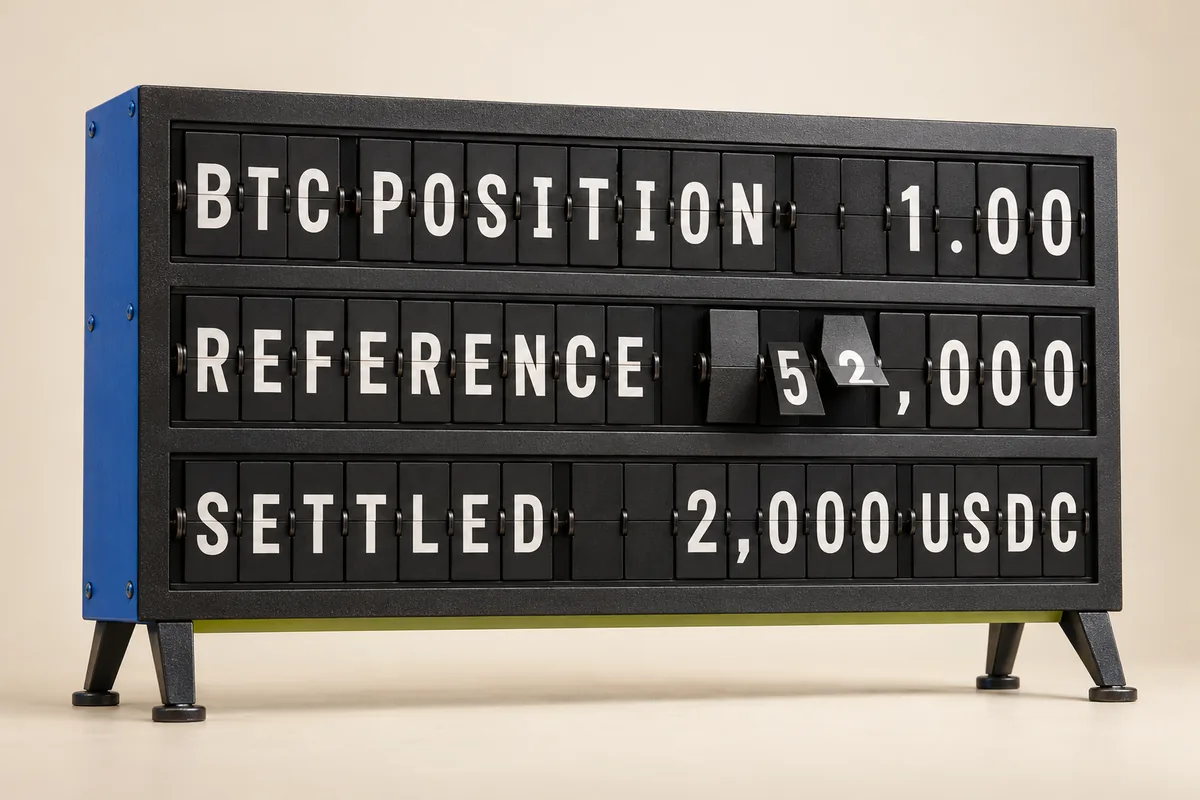
Consider a 1 BTC long entered at 50,000 USDC, with a starting wallet balance of 3,000 USDC. At the session boundary the mark is 52,000. For clarity, the example excludes trading fees, funding and other positions; it describes accounting entries, not the maximum withdrawable balance or a margin recommendation.
Before the session settles
- Reference entry
- 50,000 USDC
- Wallet balance
- 3,000 USDC
- Open P&L
- +2,000 USDC
- Equity
- 5,000 USDC
Mark: 52,000 · gain remains unrealized
Immediately after settlement
- Reference entry
- 52,000 USDC
- Wallet balance
- 5,000 USDC
- Open P&L
- 0 USDC
- Equity
- 5,000 USDC
Same mark, same position, unchanged equity
Later, at a 51,000 mark
- Reference entry
- 52,000 USDC
- Wallet balance
- 5,000 USDC
- Open P&L
- −1,000 USDC
- Equity
- 4,000 USDC
Lifetime price gain: +1,000 USDC
Immediately before settlement, the wallet contains 3,000 USDC and the position has 2,000 USDC of unrealized profit. Immediately afterward, the wallet contains 5,000 USDC and the position’s new unrealized P&L is zero. Equity is 5,000 USDC on both sides of the boundary. The reset has not created another 2,000 USDC of wealth.
Now let the mark fall to 51,000 without another trade. The position shows a 1,000 USDC unrealized loss relative to the new 52,000 reference. Combined with the 2,000 USDC already settled, the position is still up 1,000 USDC from the original entry. Reading only the current session’s red number would miss that earlier gain.
If the trade closes at 51,000, the current session contributes a 1,000 USDC realized loss. The full price result is the prior 2,000 gain plus that 1,000 loss, for a net 1,000 USDC gain before charges. A history export needs both sessions to explain the whole trade.
The records that reconcile the apparent mismatch
Session settlement changes the accounting reference while the position can remain open. Use fills for traded quantity, settlement entries for cash transfers and the cumulative result for the full trade; a reset is not another market purchase.
This is especially important when importing records into a portfolio tracker. If a tracker treats every session credit as new external income while also using the final close’s lifetime P&L, it may double-count the same gain. Reconcile the exchange’s fields before combining them. Tax treatment of those records depends on the jurisdiction; this guide explains the trading ledger rather than assigning a tax category.
The example also shows why you should not move a stop simply because the reference entry changed. The market has not granted a new original entry. A planned exit level should be considered against your actual total exposure and cumulative result, not automatically rebuilt around a cosmetic zero in the current-session P&L field.
What a stablecoin depeg changes—and what it does not
Holding a dollar-linked token is not the same as holding bank dollars. If 10,000 tokens trade at $0.98, their market value is $9,800. The $200 difference is 2% of $10,000, not 20%. The token count has not changed; the dollar valuation has.
A 100% collateral ratio recognizes the full indexed value of the asset. It does not fix the asset’s market price at $1. Both the index price and the recognition ratio enter the account’s margin calculation.
A depeg affects single-currency and multi-asset accounts differently. The quoted contract price may change as well as collateral value, so use that product’s valuation rules to estimate the effect on margin.
A higher BTCUSDT price might partly reflect a cheaper USDT
Assume Bitcoin stays worth $50,000, while USDT moves from $1 to $0.98. Ignoring basis and trading friction, a dollar-consistent BTC price would be about 51,020.41 USDT because 51,020.41 × $0.98 is approximately $50,000. A chart expressed in USDT can rise without an equivalent rise in Bitcoin’s dollar value.
This does not predict how any venue’s mark will move during an actual incident. It explains why comparing BTCUSDT and BTCUSDC prices as if both quote assets always equal one dollar can misidentify a stablecoin conversion difference as a futures opportunity. Convert both prices to the same unit before drawing that conclusion.
If you also hold a perpetual position, its mark, index construction and settlement rules determine the account effect. Avoid adding a hypothetical stablecoin loss to a hypothetical derivative gain unless their prices use compatible currencies and timestamps. During a depeg, those assumptions are precisely what become less reliable.
Issuer reserves help assess the token, not the exchange account
An issuer’s reserve report concerns the token’s backing. Your futures venue separately decides whether that token is eligible collateral, how it values it and whether withdrawals are available. Neither policy establishes the other.
| Question | Relevant evidence |
|---|---|
| Can this token be redeemed? | Issuer eligibility and redemption terms |
| How much margin does it provide? | Venue collateral ratios and account mode |
| Can I move it out on this network? | Receiving address, token contract and venue withdrawal support |
A positive account value can still hide a settlement-currency debt
Bybit’s unified-account documentation describes automatic borrowing when an asset’s equity becomes negative, subject to the account’s borrowing rules. That means a positive total dollar-equivalent balance does not necessarily prove that every individual asset balance is positive. This is a consequence of multi-asset accounting that matters when the deposit and settlement currencies differ.
Suppose you hold 1,000 USDC and a USDT-settled trade books a 200 USDT loss, with no USDT balance available. In an account that handles this through borrowing, you could have positive USDC assets and a USDT liability. The total may still look positive in dollar terms, yet the liability needs repayment and can carry its own conditions. This is a constructed account example, not a statement that every such trade always creates the same loan.
The practical alternative may be to convert part of the collateral into the settlement currency in advance. That conversion has a spread or fee, so it should be compared with the expected borrowing exposure rather than treated as automatically better. What matters is making the currency mismatch visible before it becomes an unexpected charge.
After closing all positions, examine individual currency balances as well as total equity. “No open trade” is not identical to “no outstanding liability.” A profitable position in one currency does not necessarily extinguish a loss or loan in another through the method you assumed. Use the account’s repayment record to confirm the debt has actually been resolved.
Understand eligible collateral and the value the account recognizesIs converting USDT to USDC worth it for a lower futures fee?
Compare the conversion cost with the savings on the trading activity you expect, using the same units. Imagine a hypothetical conversion costs $12 in spread and fees, and the other contract offers a 0.01-percentage-point saving per execution on a $10,000 position. That is $1 on entry and about $1 on an equal-value exit. Six such round trips would recover the $12, before any other differences.
$10,000 × 0.0001 = $1 saving per execution
$1 entry + $1 exit ≈ $2 per round trip
$12 conversion cost / $2 saving ≈ 6 round trips
Hypothetical fee difference, equal entry and exit notionals, no change in funding or fills. If you must convert back at another $12, the estimate becomes 12 round trips.The estimate becomes less favorable if the other market has worse fills or more expensive funding. It becomes more favorable if the conversion also matches the asset you already want to retain. That is why a permanent trading balance and a one-off trade can lead to different choices, even with the same posted fee schedule.
Do not use a promotional maker rate as the saving if your strategy executes as taker. Do not count rebates you are not eligible to receive. And avoid projecting a current funding advantage through a month of trading as though it were fixed: a funding estimate is not a contractual discount on every future position.
A price-neutral transfer between stablecoins can still consume part of the trading budget. If the main reason for switching is a tiny fee reduction on one small trade, the calculation may show there is no saving. If the target contract is substantially better for your required execution, that execution benefit may justify the conversion even when the posted fee itself is higher.
When a coin-settled result fits better than a stablecoin balance
A trader who keeps records and obligations in BTC may prefer a contract that pays BTC. That choice can simplify the asset they retain, but it does not make the result stable in dollars. Someone planning to pay dollar-denominated expenses after closing may prefer a stablecoin result instead, while still evaluating the stablecoin and venue separately.
For a BTC holder, using coin collateral can avoid an immediate sale into a stablecoin. The trade then needs to be evaluated alongside the existing coin holding. This is especially important for a long position: a falling BTC price can affect both the derivative and the dollar value of the collateral. It is a balance-sheet consequence, not a reason to assume every coin-settled trade is unsuitable.
A hedge can produce a different outcome from an additional directional bet. Shorting to offset an existing coin holding and going long on top of that holding are not equivalent uses of the same contract. Our inverse-contract guide works through a fixed-BTC receipt and shows the separate effect of collateral; repeating those calculations here would obscure the currency decision.
Calculate coin-settled P&L and a Bitcoin receipt hedgeAlso distinguish the coin you deposit from the actual payoff family. A product can accept volatile collateral while using a linear calculation. A unified account can accept other eligible assets while retaining inverse settlement. The “coin-margined” label alone is not enough to choose a formula or predict the final wallet currency.
The withdrawal network can matter more than a small fee discount
Match the receiving venue’s supported network and token contract to the balance you intend to transfer. Native USDC and a bridged representation may not share deposit support. A bridge or conversion changes the total cost of funding the futures account.
| Balance | A fixed $5 transfer consumes |
|---|---|
| $200 | 2.5% |
| $10,000 | 0.05% |
Prefer the settlement and withdrawal combination that fits the currency you want to retain. A small commission saving may disappear if reaching that account and returning funds requires extra conversions.
Compare stablecoin backing and collateral risksQuestions about stablecoin and coin-settled perpetual balances
Does a USDC session reset charge me for a second opening trade?
A session reset is an accounting settlement, not another opening fill. Keep actual trading fees and funding entries separate from the realized session P&L. A later genuine closing execution has its own trading fee.
Can I withdraw all USDC profit as soon as a session settles?
Not necessarily. A realized wallet credit can still support an open position or shared account margin. Withdrawable balance depends on the remaining obligations; the session credit alone does not determine it.
Are USDT and USDC perpetual funding rates interchangeable?
No. Separate contracts can have different funding rates and intervals, even on the same underlying coin and venue. Compare the charge for the holding period you intend, not just the displayed percentage.
Can I swap the settlement asset of an existing perpetual without closing it?
Do not assume a wallet conversion changes an open contract. Changing collateral is different from moving exposure to a separate USDT or USDC symbol. A migration may require closing and reopening, with new fills and costs.
Does holding two stablecoins diversify the risk of the exchange?
It changes your issuer exposure, but both balances can still depend on the same custodial exchange. Splitting token types inside one account does not remove that shared venue exposure.
Why does my balance show a gain while my USDC position shows a loss?
A previous session may already have realized a gain. The current position P&L then measures movement from the reset reference price. Add the relevant settled sessions and current result, without counting any fee twice.
Sources and research 11 source references
Official product, issuer and token-network sources reviewed 8 October 2026. USDC session treatment is specifically attributed to Bybit; it is not a universal property of USDC perpetuals. The ledger, depeg, conversion and borrowing examples are constructed and independently recalculated. We did not execute transfers or trades, verify a reader’s borrowing eligibility, or compare live order books. Issuer reporting is not an audit of an exchange or a guarantee of redemption access. Sources and scope are retained in the batch research record.
Evidence by section
- You own USDC. Does that make a USDC perpetual the best choice?
- USDT, USDC and coin settlement: what changes in the trade?
- Why a USDC entry price can change without a new trade
- What a stablecoin depeg changes—and what it does not
- Issuer reserves help assess the token, not the exchange account
- A positive account value can still hide a settlement-currency debt
- When a coin-settled result fits better than a stablecoin balance
- The withdrawal network can matter more than a small fee discount
Source register and access
- Bybit: Unified account margin, collateral and borrowingLink checked · Reviewed 8 Oct 2026 · Product rule · next editorial check due 2027-01-06
- Bybit: USDT perpetual settlement FAQLink checked · Reviewed 8 Oct 2026 · Product rule · next editorial check due 2027-01-06
- Bybit: USDC perpetual FAQ and session intervalLink checked · Reviewed 8 Oct 2026 · Product rule · next editorial check due 2027-01-06
- Bybit: BTCUSDC contract specificationsLink checked · Reviewed 8 Oct 2026 · Product rule · next editorial check due 2027-01-06
- Bybit: USDC session settlement and reference-entry resetLink checked · Reviewed 8 Oct 2026 · Product rule · next editorial check due 2027-01-06
- Circle: USDC reserves and assurance reportingLink checked · Reviewed 8 Oct 2026 · Product rule · next editorial check due 2027-01-06
- Tether: Reserve transparencyLink checked · Reviewed 8 Oct 2026 · Product rule · next editorial check due 2027-01-06
- Tether: Issuance and redemption mechanicsLink checked · Reviewed 8 Oct 2026 · Product rule · next editorial check due 2027-01-06
- Circle: Native USDC contract addresses by networkLink checked · Reviewed 8 Oct 2026 · Product rule · next editorial check due 2027-01-06
- Binance public API / Crypto Leverage Hub: BTCUSD_PERP instrument specification captured 8 October 2026Historical snapshot · observation date retained · Reviewed 8 Oct 2026 · Dated example · original values preserved
- Bybit: Inverse contracts and UTA collateralLink checked · Reviewed 8 Oct 2026 · Product rule · next editorial check due 2027-01-06