
Manual SOL orders
The collected Retail quotes and zero commission support this specific recommendation.
Why this fitsStandard API SOL execution
The observed book was stronger than Paradex’s separate ordinary API feed.
Why this fitsdYdX vs Paradex: a SOL trade gives the comparison a concrete answer
Paradex’s Retail and ordinary API feeds did not show the same SOL prices in the captured books. A manual order could use liquidity that was absent from the standard API comparison. That difference matters when moving from browser trading to a bot or third-party terminal.
The comparison is not “dYdX has fees, Paradex is free.” On Paradex, the ordinary API book differed substantially from the Retail book. On dYdX, discounts and rebates can reduce the published gross charge. The amount required to open a trade can also change for reasons unrelated to commission: dYdX documents market-wide open-interest thresholds, while Paradex reserves margin for the largest position your pending orders could create.
| Requirement | dYdX | Paradex |
|---|---|---|
| Active contract checked | SOL-USD | SOL-USD-PERP |
| Captured base opening fraction | 5% | 2% before account provisions |
| Manual two-taker reference | 0.05% per side gross; rebates separate | Zero Retail commission |
| Ordinary API execution in sample | Stronger than the collected Paradex Pro book | Retail findings do not transfer to Pro |
| Capital pressure examined | Market-wide open-interest thresholds | Largest position created by pending orders |
We use SOL for the worked comparison rather than recycling a BTC result from another article. Both venues returned an active SOL perpetual. The saved dYdX record specified 5% initial margin and 3% maintenance margin, while Paradex’s SOL record exposed a 2% base initial fraction. Those numbers help explain capital requirements; they are not recommendations to trade at the maximum available leverage.
Paradex is the suggested starting point for this manual SOL use case. Someone running a bot should go directly to the execution section before applying that recommendation. The evidence from an interactive Retail feed does not describe every route by which an order can reach the platform.
Which perpetual markets are still active on dYdX?
The dYdX catalogue returned 296 market records on 5 October 2026, but only 73 were marked ACTIVE. The other 223 were in FINAL_SETTLEMENT. Counting the entire response as currently tradable markets would substantially exaggerate the selection. A delisted contract can remain in an API because its settlement and historical records still matter to existing users.
All 73 active records in that collection were classified as CROSS. This does not mean the frontend cannot isolate a position; the market’s classification and the account arrangement are different concepts. It does mean that an old description of a large active isolated-market catalogue would not match the response we actually inspected.
The public market records included active BTC, ETH, SOL, LINK, WIF and HYPE contracts. Their base initial-margin fractions were not uniform: BTC and ETH showed 2%, SOL 5%, LINK and WIF 10%, and HYPE 20%. The maximum opening ratio implied by those fractions ranges from 50x to 5x before other requirements. A headline advertising the highest BTC leverage tells a HYPE trader very little.
| Market | Initial fraction | Maintenance fraction |
|---|---|---|
| BTC / ETH | 2% | 1.2% |
| SOL | 5% | 3% |
| LINK / WIF | 10% | 5% |
| HYPE | 20% | 10% |
Paradex’s larger catalogue also needs filtering
Paradex’s market endpoint contains options as well as perpetuals. It would be equally misleading to count every option expiry and strike as another coin available for leveraged perpetual trading. We matched SOL-USD-PERP to dYdX’s SOL-USD and inspected its trading mode, size increments and margin fields.
The distinction matters for smaller coins. A contract name can remain visible while trading is restricted, while a new listing may have little usable depth. We do not recommend the platform with the longest raw response. For a specific altcoin, an active contract, a compatible minimum size and quotes covering the intended position are the relevant combination.
Size increments can change a partial close
The captured SOL size step was 0.1 SOL on dYdX and 0.01 SOL on Paradex. At an illustrative $120 SOL price, those increments represent $12 and $1.20 of exposure respectively. Minimum-notional rules are additional constraints, so the smaller step does not mean a $1.20 opening trade is necessarily valid.
For a 100 SOL position, this difference is unlikely to decide the exchange. For a small position managed through repeated partial exits, it can leave a different residual quantity. That is a practical product distinction: a trader cannot assume a percentage-based close button will round identically on the two venues or that the remainder can always be closed with the same ordinary order.
Why can dYdX require more margin when my own position has not grown?
Some dYdX markets increase their initial-margin fraction as total market open interest passes published thresholds. Open interest measures outstanding positions across the market, not just your wallet. If more capital crowds into that market, the amount needed to add exposure can increase even though your existing position is unchanged.
The margin documentation distinguishes this initial requirement from maintenance margin. Initial margin governs opening or increasing risk and contributes to free-collateral calculations. Maintenance is the threshold relevant to retaining a position. An increase in the initial fraction is not, by itself, an identical increase in the liquidation threshold.
For SOL, the collected lower and upper open-interest caps were $40 million and $100 million, with a 5% base initial fraction. Below the lower cap, the base fraction applies. Between the caps, the documented calculation scales toward 100%. The reported SOL open interest in our collection was comfortably below the lower cap, so the stressed examples below are scenarios, not a claim that SOL was already subject to those higher requirements.
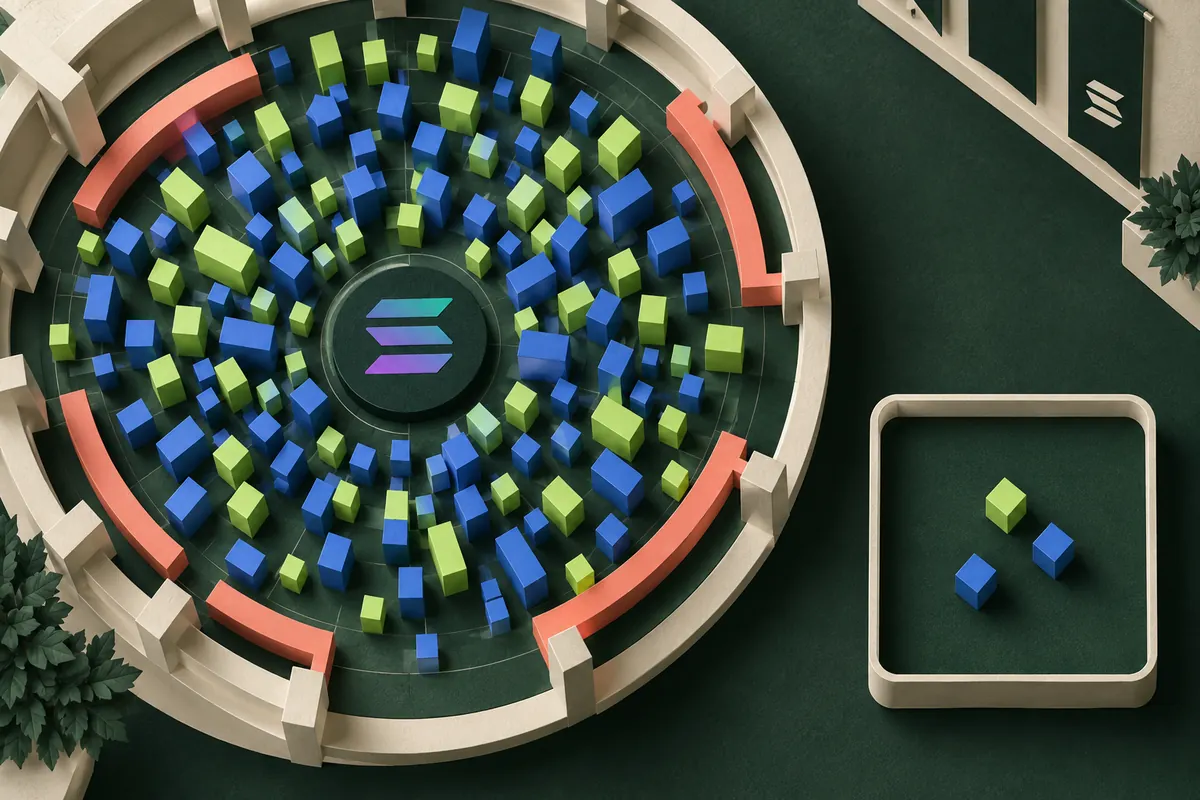
One unchanged $10,000 SOL position, three market conditions
At or below $40 million of market open interest, the simplified base requirement is $500. At $55 million, the documented scaling produces 28.75%, or $2,875. At $70 million it produces 52.5%, or $5,250. The trader’s own $10,000 position has not changed in this comparison; the surrounding market condition has.
Same $10,000 SOL position. Different market-wide activity.
The modeled maintenance requirement stays at $300. A higher opening requirement is not the same as immediate liquidation.
These figures isolate the open-interest mechanism at constant position value. A real SOL price move also changes dollar exposure and account equity. With those effects held constant, the 3% maintenance fraction in the saved SOL record would still imply $300 in each scenario. Confusing the higher initial requirement with immediate liquidation would give the reader the wrong operational conclusion.
A trader with $2,000 of equity could initially have capacity to add exposure under the $500 example. Under the $2,875 initial requirement, that same account would no longer have positive free collateral in this simplified calculation. It may need to reduce exposure or add funds before increasing the position, despite remaining above the separate maintenance requirement.
Do not apply this example blindly to BTC and ETH
The collected BTC and ETH records had zero values in both open-interest cap fields. We do not divide by the difference between two zero caps or import SOL’s thresholds into those markets. This is why a market-specific comparison is more informative than declaring that every dYdX trade automatically becomes more expensive whenever exchange activity rises.
The practical implication is most relevant to a trader expanding an altcoin position during a crowded move. A leverage setting remembered from a quiet market is not a durable promise of future capacity. The published current market configuration is more useful than the maximum multiplier on an older review page.
Paradex reserves capital for orders that have not filled yet
Paradex’s cross-margin calculation considers the largest position that could result if orders on one side fill. This can explain a rejected order or a smaller withdrawal allowance when the visible filled position looks modest. An unused ladder of opening orders is still a commitment to possible additional exposure.
Take an illustrative account already long 100 SOL, with another 50 SOL of buy orders and 80 SOL of ordinary sell orders. The buy side could grow the long to 150 SOL. The sell side would only reduce the current long to 20 SOL. At a $120 mark and the captured 2% base fraction, the simplified net initial requirement follows 150 SOL: $360, before any fee provision or expected loss from aggressive orders.
Canceling the unused 50 SOL buy ladder reduces that simplified figure to $240 for the existing 100 SOL position. The account has not made a trading profit; it has removed a possible future obligation. This is different from the dYdX market-wide scaling example, where the relevant change came from aggregate activity outside the trader’s own order list.
The official cross-margin rules add fee provisions and potential opening losses to the net requirement. For this reason, “position divided by 50” is not a complete reconstruction of the ticket’s required balance. It is a base comparison that becomes more useful once pending orders and account settings are included.
Cross margin does not mean every offset is recognized
A long SOL perpetual and a short ETH perpetual can offset some broad market movement, but they are not the same asset and can diverge sharply. Ordinary cross margin shares account resources; it does not prove that the risk engine treats the two positions as a low-risk spread. Keeping a profit from one position available to support another is different from reducing their combined opening requirement.
Paradex’s portfolio-margin beta evaluates a portfolio through stress scenarios and is restricted to whitelisted users. Its requirements include funding and fee provisions. That may be relevant to an established multi-position strategy, but it is not needed to explain the manual SOL recommendation in this article. We do not give a new account an assumed portfolio offset it has not been approved to use.
dYdX vs Paradex fees: separate the gross charge from rewards
The dYdX documentation’s basic fee table starts at 0.01% maker and 0.05% taker below $1 million of 30-day volume. Its rewards page also describes a 50% trading rebate after governance changes to earlier token-emission rewards. The gross commission and a rebate should remain visible as separate amounts; otherwise an old token-reward description can be mistaken for today’s cash economics.
On $12,000 of exposure at both entry and exit, two base taker fills cost $12 gross. Applying a 50% rebate to those fees would produce a $6 net commission illustration. We show the latter as a conditional rebate scenario rather than a verified receipt for a funded account. Market promotions, staking discounts and routing arrangements can create a different effective result.
| Case | Gross commission | After the stated assumption |
|---|---|---|
| dYdX base two-taker reference | $12.00 | $12.00 before any rebate |
| dYdX with 50% rebate applied | $12.00 | $6.00 conditional illustration |
| Paradex Retail | Zero | Zero trading commission |
| Paradex ordinary API | Different published Pro schedule | Not assigned an authenticated net rate here |
The current dYdX rewards and fee documentation should be read alongside the fee-location guide, which identifies the account’s Fees page. Old v3 fee tables and old DYDX reward emissions are not substitutes for the present chain and interface. In particular, a dated BTC fee holiday does not establish a current SOL exemption.
Paradex’s trading schedule publishes zero commission for Retail orders, including its qualifying interactive route. Ordinary API access belongs to a different category. The dedicated schedule and the raw market fee fields did not agree on the starting Pro taker charge in our research, so we do not calculate an authoritative Pro net total from the lower field. That limitation does not affect the zero Retail figure used here.
A rebate cannot repair an unsuitable order book
A trader repeatedly crossing a thin book may lose more to execution than a rebate returns. The opposite also happens: a venue with commission can still be cheaper if the competing quote is sufficiently worse. That question is most useful at the quantity you intend to trade, rather than at an arbitrary exchange-wide volume total.
For 100 SOL near $120, even a $6 commission saving represents only five cents per SOL across the combined entry and exit. An average execution difference larger than that can reverse the fee-only ranking. This is why the next comparison uses both sides of the book and keeps the same SOL quantity on each venue.
What the SOL books showed in our collection
We collected three short public request rounds on 5 October 2026, retrieving dYdX, Paradex Retail and Paradex ordinary API books separately. For each observation, we modeled buying and immediately selling the same 10 SOL or 100 SOL against displayed levels. This measures spread and visible depth, without a holding period, funding, network delay or actual order submission.
| Feed | Quantity each way | Book only |
|---|---|---|
| dYdX | 10 SOL | $0.90 |
| dYdX | 100 SOL | $9.00 |
| Paradex Retail | 10 SOL | $0.42 |
| Paradex Retail | 100 SOL | $4.20 |
| Paradex Pro feed | 10 SOL | $29.90 |
| Paradex Pro feed | 100 SOL | $567.26 |
For 100 SOL, the median modeled book-only cost was $9 on dYdX and $4.20 on Paradex Retail. Adding the $12 dYdX base two-taker illustration gives about $21, or $15 under the separate 50% rebate scenario. Paradex Retail remains $4.20 because its compared commission is zero. The result supports Paradex for the sampled manual trade; it is not a prediction of tomorrow’s execution.
The ordinary Paradex API result was a different market experience
The collected Pro feed produced a much wider simulated round-trip cost at the same quantities. Its 100 SOL book walk reached about $567 before commission. We do not present that as an executable trade: the market’s price protections could prevent an order from consuming such distant levels. It demonstrates why substituting the ordinary feed for the Retail feed, or vice versa, can badly distort a comparison.
That Pro book was unchanged across the three requests. Repeating the request therefore did not create three independent observations of changing Pro liquidity. The raw records preserve timestamps and sequence data so this limitation remains visible. The sample is useful for identifying the channel difference, but too short for claims about average daily liquidity or reliability during liquidation cascades.
For a standard API strategy, dYdX had the stronger visible SOL execution in this collection. For an interactive Retail trade, Paradex had the stronger total under the stated assumptions. A broad “best DEX” verdict would conceal that reversal. Our short answer recommends the supported manual use case while keeping the API distinction available before a trader commits capital.
Holding SOL overnight: how to compare funding without the wrong time unit
Both platforms quote SOL against a dollar reference and use USDC for the compared trading balance, but funding displays can use different reference periods. dYdX’s chain documentation describes hourly funding. Paradex’s SOL configuration listed an eight-hour funding reference, while its mechanism accrues through the funding index. Two percentages shown next to SOL should not be ranked until their time bases match.
The saved dYdX SOL record showed a next funding rate of zero at collection. That is one point in time, not evidence that holding SOL is permanently free. A rate can change after the position opens. If the purpose is to keep a trade for several days, the useful comparison is the actual accrued or settled series over the intended interval, with the sign appropriate to a long or a short.
For illustration, a $12,000 long paying an effective 0.008% over eight hours incurs $0.96 for that period. Three identical periods would cost $2.88 over a day. An hourly figure of 0.001% produces the same total if exposure and the rate remain constant. This simple normalization avoids calling one venue eight times more expensive because one screen expresses the same rate over a longer interval.
The dYdX funding rules and Paradex funding mechanism support different implementation details. For a trade opened partway through a reference interval, use the accrued payment shown for that position. Multiplying a full eight-hour headline rate by every brief visit to the market overstates the cost where funding accrues continuously; comparing an anticipated rate with a settled payment mixes two different observations.
Isolated positions and keeping a second strategy separate
A trader may want one SOL idea separated from another strategy’s collateral. dYdX’s frontend supports isolated positions through separate subaccounts. This is distinct from a market being labeled ISOLATED in the protocol catalogue. The active SOL market can be a cross market while the frontend uses a separate subaccount to contain that position’s resources.
The isolated-position documentation also explains why the headline wallet total is not always the balance supporting the individual position. Funds allocated elsewhere do not become usable simply because the wallet owner controls both subaccounts. A trader moving between cross and isolated workflows needs to inspect the position’s own equity and pending orders.
Paradex also documents cross and isolated modes in its margin system. The relevant reason to choose isolation is deliberate separation of the trade’s allocated capital, not an assumption that it changes the market’s price behavior. Cross mode may be more convenient for several related positions, but it lets their gains and losses interact through the shared account.
For a single manual SOL position, adding a complicated portfolio setup is unnecessary. For a separate altcoin experiment, allocating a defined balance can make the account easier to manage. The comparison should follow how you intend to operate the positions, rather than awarding a point for the largest number of margin-mode labels.
Deposits and withdrawals: where your USDC needs to arrive
dYdX offers several documented funding paths, including supported bridge routes and Coinbase-related transfers through Noble. The chosen path determines which transaction stages the deposit must complete before it reaches the trading subaccount. A completed source-chain transaction is not always the same event as a usable trading balance.
Its deposit overview distinguishes regular and faster routes. Its withdrawal guide describes moving funds from the trading subaccount before the onward bridge. That separation is useful when the portfolio shows value but the withdrawal flow offers less than expected: some resources may still support a position or reside in a different account stage.
Paradex’s compared perpetuals require USDC. A dollar-valued non-USDC holding does not automatically provide the same free collateral. Its native Ethereum withdrawal process includes settlement stages; third-party transfer routes have their own quotes and conditions. The route should be chosen for the intended destination, rather than on a blanket promise that every withdrawal is instant.
Moving a live trade is more involved than moving a balance
If you intend to switch from dYdX to Paradex while keeping SOL exposure, the position itself does not transfer with the USDC. Closing, transferring and reopening creates a period with different exposure; opening at the new venue first temporarily creates two positions and requires extra capital. Each sequence has its own execution and funding consequences.
A smaller initial transfer can establish the new account while the existing position is managed normally. That is an operating choice, not a recommendation to duplicate leverage. The meaningful migration cost includes the close on one venue, the new entry on the other and any transfer charge. The fee difference on future trades must be large enough to justify those one-off costs.
Mobile trading, access and the final choice
For these markets, a phone view should make the position quantity, free collateral and outstanding opening orders easy to inspect together. On Paradex, the pending ladder can be the reason the next order is rejected. On dYdX, the market’s effective initial requirement can change independently of that ladder. Those two explanations are more useful than repeatedly telling the reader to “check margin.”
For a ladder managed on a phone, count the orders still capable of increasing exposure before placing a replacement. An interface that shows the position above one tab and the unfilled orders behind another can make the reserve harder to reconcile. We have not performed an authenticated mobile order or wallet-signing test, so the public-data findings are not presented as a measured usability score.
Eligibility is also interface-specific. The dYdX access policy restrict access in jurisdictions including the United States and Canada. Paradex has its own terms and restricted locations. A decentralized settlement design does not override those access rules. Readers comparing permitted local products should start with the relevant country guide, rather than interpreting a public API response as account approval.
The conclusion is strongest for the trade we actually examined: manual SOL perpetuals favor Paradex’s Retail offering on the sampled costs and base capital requirement. dYdX is more attractive for the ordinary API execution observed here and for a trader deliberately choosing its chain and subaccount workflow. For another coin or another order route, repeat the contract-level comparison instead of importing the SOL outcome unchanged.
dYdX vs Paradex: frequently asked questions
Why does the dYdX API list a coin that I cannot open anymore?
The market catalogue also retains contracts in FINAL_SETTLEMENT. Our collection contained 296 records but only 73 ACTIVE markets. A retained ticker is not evidence that a new position can be opened. Use status alongside the instrument name when checking coverage. This is especially relevant to older reviews that counted isolated listings without revisiting their current state. Historical trades and settlement records still need those identifiers after ordinary trading has ended.
Can dYdX SOL opening margin rise without an increase in my SOL quantity?
Yes, under the documented open-interest scaling for that market. The captured SOL thresholds were $40 million and $100 million, with a 5% base initial fraction. Aggregate market activity above the lower threshold can raise the requirement. SOL price changes can independently alter your position value and equity. The article holds those effects constant to isolate the threshold mechanism. This is an opening-capacity issue and must not be confused with an identical rise in maintenance margin.
Does canceling a Paradex buy ladder release collateral?
It can, because the cross-margin calculation considers the largest position that the remaining orders could create. In our example, canceling 50 SOL of unused buys leaves the existing 100 SOL long unchanged but reduces its possible future size. That can lower reserved initial margin. It does not refund a trading loss or change the price of the filled position. Fee provisions, other orders and other positions still affect the actual amount available to withdraw or reuse.
Are the dYdX isolated-position controls the same as isolated-market listings?
No. A market’s protocol category and the frontend’s use of a separate subaccount describe different arrangements. The collected active markets were classified CROSS, while the frontend documentation still describes isolated positions. Funds in another subaccount do not automatically support the isolated trade. This distinction is useful when a market is available but the displayed balance for a particular position is smaller than the wallet’s overall value.
Is Paradex’s zero-fee SOL result also valid through every trading bot?
No. Our recommendation uses the interactive Retail feed and Retail commission treatment. Ordinary API access has a different classification and the collected SOL book was much wider. Some interactive API use can qualify as Retail under the platform’s rules, but the label API alone does not establish that status. An automated or third-party interface must identify its actual route before the Retail calculation is used to price the strategy.
Does the 50% dYdX rebate make the SOL example free?
No. With $12,000 on each side and a 0.05% gross taker rate, the reference commission is $12. A 50% rebate would reduce that component to $6, not zero. Book cost and funding are separate. The current docs describe the rebate, but we did not verify a funded account receipt, so the net figure is shown conditionally. A past fee holiday on a different ticker is not used as evidence that SOL currently has no charge.
Which venue gives finer control over a small SOL partial exit?
The captured quantity steps were 0.1 SOL on dYdX and 0.01 SOL on Paradex. Paradex therefore allowed finer quantity increments in those records. Minimum-notional and closing-order rules still apply, so the step alone does not guarantee that every tiny residual can be traded as an ordinary opening order. For a larger position this difference is minor; for repeated partial reductions of a small balance it can affect rounding and the remaining exposure.
Can I move my open SOL position from dYdX to Paradex?
A USDC transfer moves funds, not the derivatives position. Maintaining similar exposure involves a close on one venue and a new position on the other, with execution costs and timing between them. Opening the replacement first requires extra capital and temporarily changes total exposure. Closing first creates a gap without the position. The relevant migration estimate includes both trades and the transfer route; it is not just the difference between the two advertised commission rates.
Open the evidenceSources and research
Sources and research
Checked 5 October 2026. Three SOL request rounds, separate Paradex interactive and ordinary feeds; the Pro book repeated the same state. Models walk visible levels and exclude latency and account price protections. dYdX net-rebate amounts are conditional illustrations. OI scenarios use collected SOL caps but hypothetical future market sizes. No authenticated trade or transfer was performed.
- public market records
- market endpoint
- margin documentation
- cross-margin rules
- portfolio-margin beta
- dYdX rewards and fee documentation
- fee-location guide
- trading schedule
- dYdX funding rules
- Paradex funding mechanism
- isolated-position documentation
- margin system
- deposit overview
- withdrawal guide
- dYdX access policy