

A dated option belongs in the position
A verified BTC put provides a concrete way to price protection alongside the perpetual.
Why this fitsThe trade only needs a perpetual
Lower published native-perp base commission without paying an unnecessary option premium.
Why this fitsHyperliquid or Aevo: what are you trying to keep open?
Buying a dated put alongside a BTC long changes what the trade can do after a sharp fall. Aevo supplies that options leg; Hyperliquid’s lower perpetual commission addresses only the futures leg. The worked example prices the protection separately and shows why it does not automatically prevent liquidation.
Aevo’s advantage is specific. Its active catalogue included BTC-30OCT26-85000-P when we checked on 5 October 2026. That contract pays according to BTC’s value below an $85,000 strike at the stated expiry. The public order book also returned a bid and ask. This is a stronger reason to consider Aevo than a general statement that its documentation mentions options. It still does not establish that every strike has a useful quote or that a large order will fill at the first displayed price.
| Intended trade | Starting point | What supports the choice |
|---|---|---|
| BTC perpetual without an option | Hyperliquid | 0.015% maker / 0.045% taker base commission |
| BTC perpetual with a dated put | Aevo | Active matching option catalogue and a captured two-sided quote |
| Hedge split between platforms | Evaluate both accounts | Option gains do not automatically support the other account’s margin |
| Small options account | Price the funding route too | Published Ethereum USDC withdrawal charge is material at small balances |
For someone closing a BTC long after a small intraday move, paying an option premium may solve no actual problem. Hyperliquid’s native perpetual, order controls and lower reference commission fit that task more directly. For someone who specifically wants a position to survive a temporary fall without relying solely on a stop order, Aevo deserves a closer examination of premium, expiry and margin together.
The sections below compare these two jobs separately. We use one observed option book to show what buying and reselling protection could cost, then a deliberately simplified payoff model to show what the purchased contract changes. Neither example is presented as a funded trade or a guaranteed account outcome.
Aevo options versus Hyperliquid perpetuals: start with the actual contract
A BTC perpetual on either platform offers continuing BTC price exposure without a scheduled expiry. An Aevo put is different: it has a strike, an expiry and a premium. Those three details determine whether it is useful for your planned holding period. Buying an option that expires before the event you are trading leaves the position exposed when the protection was supposed to matter.
In the saved Aevo market catalogue, BTC-PERP was active, quoted in USDC and configured with 0.001 BTC size increments. Its maximum leverage field was 20x. The same response listed the $85,000 BTC puts across multiple expiries, including 9 October, 30 October and 25 December 2026. Those dates describe the catalogue at the research time; they are not permanent product recommendations.
Hyperliquid’s native BTC perpetual used a 40x maximum in its collected market configuration. That does not make 40x a useful target for a hedged position. Leverage describes the opening ratio permitted under the relevant tier; it does not price an option, make a stop reliable or say how much breathing room an account needs. The margin tiers also change the maximum as position size increases.
The expiry should cover the trade, not merely be the cheapest
A cheaper near-expiry put can be appropriate for a genuinely short event window. It is a poor substitute for a month of protection if you intend to keep the perpetual open for that month. Extending the hedge later means buying a new option at the price then available. The replacement may be more expensive precisely because volatility has increased.
The strike creates a different trade-off. A lower strike generally leaves more initial downside with the trader before the expiry payoff becomes useful. A higher strike covers more of that decline but normally costs more, with the exact premium set by the market. Choosing the cheapest ticket without relating its strike to the planned loss tolerance defeats the purpose of comparing options in the first place.
Product count is less helpful than the expiry you can actually trade
Aevo returned 2,776 active option instruments and 102 active perpetual instruments, including non-crypto markets. Each strike, expiry and option direction creates a separate instrument; these counts do not mean thousands of different cryptocurrencies or a broader crypto selection than Hyperliquid.
The useful shortlist is smaller: the underlying you want, the expiry that covers your trade, the strike that addresses your downside and the quantity you can buy or sell. Hyperliquid’s native perpetual catalogue and Aevo’s option chain answer different questions. For a leveraged altcoin trade without a matching option, Aevo’s BTC options are not a reason to ignore the actual altcoin book.
How much does buying the Aevo put cost?
At 18:41:22 UTC on 5 October, the public BTC-30OCT26-85000-P book showed a best ask of 2,612.50 USDC and a best bid of 2,375 USDC per BTC of option exposure. Both top levels displayed 1.6 BTC of quantity. The difference between those two prices matters if the hedge is closed early rather than held to expiry.
For 0.1 BTC of protection, the displayed ask implied a premium of 261.25 USDC. Selling that same quantity immediately against the displayed bid would recover 237.50 USDC, before trading fees: a 23.75 USDC spread cost. This small example fitted within both captured top levels. It is arithmetic on a single public snapshot, not a promise that those quotes remained available while an order was sent.
| Item | Per BTC of option exposure | For 0.1 BTC |
|---|---|---|
| Best ask | 2,612.50 USDC | 261.25 USDC premium |
| Best bid | 2,375.00 USDC | 237.50 USDC resale |
| Immediate spread before fees | 237.50 USDC | 23.75 USDC |
| Quantity shown at either top level | 1.6 BTC | 0.1 BTC fits within the displayed size |
The mark price is not the price you can buy
An option’s mark price helps the exchange value positions and calculate risk. It is not necessarily an offer to sell the quantity you want. Our example uses the ask for a purchase and the bid for a sale, rather than applying the mark to both operations and hiding the spread. The difference becomes particularly important for a short-lived hedge that you plan to remove after an announcement.
The quote also cannot be scaled indefinitely. The next ask in the snapshot was 2,800 USDC with 1.5 BTC displayed. An order larger than the first level could therefore pay a higher average premium. If the requested quantity exceeds the collected depth, the right result is incomplete coverage, not an invented execution price for the rest.
Count option commission separately from its premium
Aevo’s options fee schedule lists 0.03% maker and 0.05% taker, with a cap based on 12.5% of the option premium. At an illustrative BTC index of $85,000, buying 0.1 BTC of exposure as taker gives a notional-based fee of $4.25. The premium cap is $32.66 for the observed 261.25 premium, so the lower $4.25 applies in that calculation.
We calculate those amounts from the published percentages. Some old worked examples on the source page do not multiply their own percentages correctly. Copying the example result would reproduce the error. The percentage, quantity, index and cap need to agree in the comparison rather than being accepted simply because the example appears on an official page.
The premium is money paid for the option; it is not exchange commission. That distinction matters when deciding whether the protection was expensive. A 261.25 premium plus a 4.25 entry fee is a very different proposition from describing the hedge as a $4.25 add-on. Funding on the perpetual and any eventual closing or settlement charge are additional items.
A stop loss and a put solve different problems
A stop instruction attempts to close the perpetual after a trigger. A put gives a contractual payoff at expiry, subject to the venue’s settlement rules. With a stop, you can be taken out during a temporary drop and miss a subsequent rebound. With a purchased put, you pay for the option even if BTC never falls far enough for its expiry payoff to become positive.
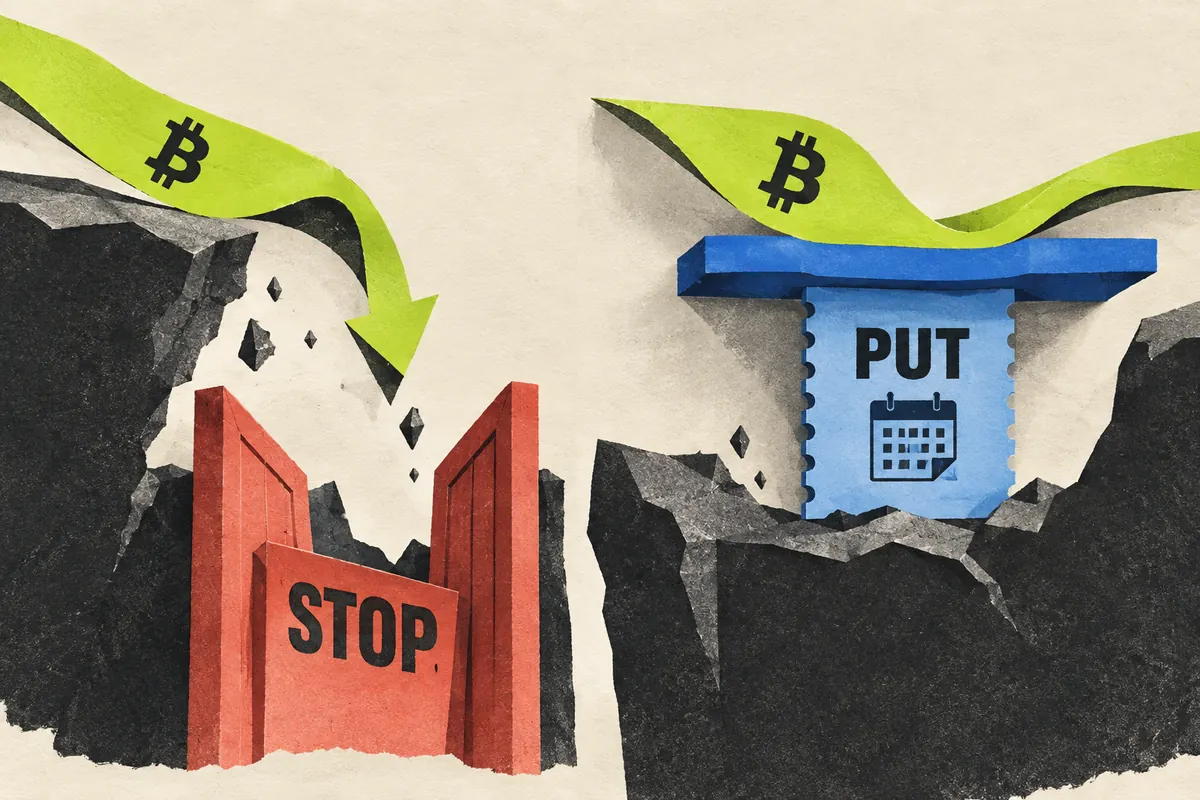
Neither tool removes execution and account risk. A stop-market order can fill below its trigger in a fast fall. A stop-limit can remain unfilled. A put held on a separate account does not automatically replenish the perpetual account when its equity falls. Even when both positions are on Aevo, the selected margin system and available equity determine whether the perpetual can remain open until the option expires.
Consider a planned 0.1 BTC long through an event. If your intention is to exit as soon as the original trade thesis fails, a stop may be closer to the requirement. If your intention is to retain upside exposure through price swings until a particular date, paying for a put may be more consistent. That is a choice about the position you want to own, not an assertion that one product is universally safer.
Hyperliquid’s order types include stop and take-profit instructions. These support management of its perpetual but do not reproduce the expiry payoff of a dated BTC put. An order that triggers when price reaches a level and a contract that pays below a strike should not appear as equivalent ticks in a comparison table.
Worked BTC example: the protection has a price and an end date
Use round numbers to make the decision visible: buy 0.1 BTC of perpetual exposure at $85,000 and buy a put covering the same quantity at an $85,000 strike. Use the observed option premium of 261.25 USDC as the model input. The $85,000 perpetual entry is illustrative, not the concurrent observed BTC entry quote. Assume the perpetual can remain open until expiry and the relevant prices converge for settlement.
Without the put, a finish at $75,000 produces a $1,000 loss on the perpetual. The put’s expiry payoff is $1,000, offsetting that price loss; after its premium the combined price result is minus $261.25. At $95,000, the perpetual gains $1,000 and the put expires without intrinsic value, leaving $738.75 after premium. Fees and funding still have to be deducted.
The expiry payoff changes; the account still needs margin
BTC price at expiry
- BTC at $75,000.00
- -$261.25
- BTC at $85,000.00
- -$261.25
- BTC at $95,000.00
- $738.75
The flat downside shown in this model is an expiry result under its assumptions. It is not a liquidation guarantee. Before expiry, the option’s value responds to remaining time and expected volatility as well as BTC’s price. The perpetual has its own mark and margin checks. An account can run out of usable collateral before the final payoff in the diagram becomes available.
What changes if the protection covers less than the position?
Suppose the perpetual remains 0.1 BTC but the put covers only 0.05 BTC. At a $10,000 fall, the perpetual still loses $1,000 while the put pays only $500 before premium. Half the position remains economically exposed below the strike. That may be intentional, but it cannot be described as the same protected trade at half the cost.
The reverse mismatch also has consequences. If the perpetual is partially closed and the full put stays open, the remaining combination becomes more sensitive to a further decline than the original balanced structure. The option does not automatically resize because the perpetual changed. This is one of the practical reasons to compare both positions in BTC exposure instead of comparing their two cash prices.
Closing before expiry produces a different result
If you remove the hedge after the event, the option is sold at the available bid. It may retain time value, or its value may have fallen because expected volatility declined. The expiry diagram cannot predict that resale price. Our observed bid/ask example helps estimate the immediate spread burden, while the actual later exit requires a new quote.
There is also a sequencing choice. Buying the protection first means paying the premium before the perpetual fills; opening the perpetual first creates an unprotected interval. A trader placing two independent orders should decide what to do if only one fills. We did not verify an atomic two-leg execution route for this exact combination and do not imply one exists merely because both products share a platform.
Hyperliquid vs Aevo fees for a perpetual-only trade
At the ordinary published starting rates, Hyperliquid lists 0.015% maker and 0.045% taker for native perpetuals. Aevo’s perpetual schedule lists 0.05% maker and 0.08% taker. Aevo’s page also mentions a planned fee reduction; a promise of a future reduction is not the current charge used in our calculations. Personalized volume or staking tiers can change the comparison.
| Fill combination | Hyperliquid base | Aevo standard |
|---|---|---|
| Maker entry + maker exit | 2.55 USDC | 8.50 USDC |
| Maker entry + taker exit | 5.10 USDC | 11.05 USDC |
| Taker entry + taker exit | 7.65 USDC | 13.60 USDC |
For 8,500 USDC of exposure at both entry and exit, two taker fills produce reference commission of 7.65 on Hyperliquid and 13.60 on Aevo. The 5.95 difference is meaningful for frequent trading, but much smaller than the 261.25 premium in our separate option example. These costs should not be mixed into a single percentage that conceals what was purchased.
A resting entry with an urgent taker exit changes the reference totals to 5.10 and 11.05 respectively. A limit price by itself does not establish a maker fill: an immediately marketable order can take liquidity. Fee estimates should reflect the fills a strategy realistically produces, particularly if the exit normally uses a stop rather than a patient resting order.
The Hyperliquid fee page and Aevo perpetual fee page support this base-rate comparison. It is not a liquidity ranking. We did not collect a synchronized multi-size execution study for both perpetual books in this article, so we do not claim that the commission difference equals the final difference in trading cost.
Funding can outlast the reason for buying the option
Aevo documents hourly funding payments. Hyperliquid also settles native perpetual funding hourly. The actual signed rates can differ between venues and over time. A protective option does not cancel that funding bill: it addresses price exposure under its payoff, while the perpetual continues to incur or receive funding during the holding period.
At a hypothetical constant 0.001% hourly rate paid by the long, 8,500 of constant exposure costs 0.085 per hour, or 2.04 over 24 hours. A week at that unchanged assumption costs 14.28. This is a sensitivity calculation, not a forecast of either exchange’s funding. The Aevo funding rules distinguish the quoted reference interval from the actual hourly payment.
Will Aevo recognize the hedge in its margin calculation?
Under Aevo’s default Standard Margin, positions are evaluated separately. A long option requires its premium; buying it should not be assumed to reduce the perpetual’s margin requirement dollar for dollar. The combined economic payoff and the cash needed to keep the account operating are different calculations.
Aevo’s Portfolio Margin evaluates combined positions through price and volatility scenarios, with a floor requirement as well. That makes it relevant to portfolios containing actual offsets. The documentation includes early examples with historical parameters, so we do not reuse an old ETH example to promise a current BTC margin saving.
For this comparison, the useful question is whether the exact proposed BTC positions reduce the requirement in the account’s currently enabled mode. If the account preview still requires the original perpetual margin plus the option premium, the trade must be funded on that basis. A theoretical hedge is not permission to spend collateral that the platform still requires.
This can decide whether Aevo’s integrated products are useful at your balance size. Someone with enough capital to pay the premium and maintain the perpetual buffer may value keeping both positions together. Someone whose entire balance only just supports the unhedged perpetual cannot assume that buying protection makes the position affordable. The option purchase itself consumes resources.
WBTC collateral does not mean the premium is paid in BTC
Aevo settles these products in USDC. Its collateral framework lists other supported assets with valuation ratios; WBTC and ETH are listed at 90% and USDT at 99% in the reviewed table. It also describes conversion of collateral to cover a negative USDC balance once the stated threshold is reached. Buying an option is one event that can create that deficit.
A trader depositing WBTC specifically to avoid selling any BTC should therefore examine the settlement balance before buying the put. Eligibility as collateral does not mean every premium or realized loss stays unpaid in another currency. Holding adequate USDC for planned option purchases makes the cash movement easier to understand and avoids treating total account value as freely spendable USDC.
Depositing, managing and withdrawing a two-product account
The most convenient funding route depends on where your USDC already is. Aevo’s withdrawal documentation distinguishes Ethereum mainnet from Arbitrum, Optimism and Base, with different processing expectations. Its separate fee page lists 25 USDC for Ethereum USDC withdrawals and no exchange withdrawal charge for the listed Arbitrum and Optimism routes. Network availability and the actual displayed withdrawal quote remain the relevant check at the time of transfer.
That fixed mainnet amount is material for a small options account. On a planned 100 USDC withdrawal, 25 USDC is a quarter of the balance; on 5,000 it is 0.5%. This does not make an unrelated chain an acceptable destination: the receiving wallet or exchange must support the selected token and network. We do not assign a fee to Base simply because the timing page names it; the reviewed fee table did not provide the same detail for that route.
The official withdrawal timing page describes additional checks for flagged transfers. The deposit and withdrawal fee page describes charges rather than measured speed. These are separate considerations, especially if you expect option expiry proceeds to be immediately available elsewhere.
What should remain visible on a phone?
A perpetual view alone is insufficient for managing the example trade. You need to see the BTC quantity still open, the put’s quantity and expiry, available USDC and current margin usage. Switching between the option chain and the perpetual ticket can make an unmatched quantity easy to overlook. The important comparison is whether you can maintain those two positions correctly, not whether a mobile screen displays the longest list of markets.
Before closing the account, resolve both instruments. Selling the perpetual does not sell the put; withdrawing available cash does not cancel an unused opening order. If the option still has market value, decide explicitly whether to sell it or retain it until expiry. We reviewed public product information and quotes, but did not perform an authenticated mobile order or withdrawal test on either exchange.
Which platform fits the finished trade?
For a standalone BTC perpetual, Hyperliquid has the stronger documented base-commission proposition in this pair. There is no reason to buy an option merely to justify choosing Aevo. A trader who expects to manage the position with entries, partial exits and stops can compare Hyperliquid’s actual book with their required size and leave the option premium out of the budget entirely.
Aevo is the more relevant destination when a dated BTC or ETH option is part of the trade you intend to hold. Its verified option catalogue, quoted BTC put and combined product environment provide a concrete basis for that recommendation. The decision then turns on a usable strike and expiry, the premium you are willing to pay and an account balance capable of supporting the complete position.
A wallet connection alone does not establish eligibility for either interface. Use the country guidance for your residence and the platform’s applicable terms before funding. This comparison concerns the documented global products, not permission to access restricted derivatives from every jurisdiction. The narrower product conclusion remains useful: choose the market that can execute the intended position, then evaluate its full cost and margin needs.
Hyperliquid vs Aevo: frequently asked questions
Can I buy an Aevo put for a Hyperliquid BTC position?
The two positions can coexist, but they remain on separate accounts. The option’s gain is not automatically available to meet Hyperliquid’s margin requirement. A falling BTC price could force the perpetual to close before the put expires, even if the combined expiry payoff looked protected. Match the BTC quantity and expiry, then fund the perpetual account to withstand the intended holding period independently. Our payoff example assumes that the perpetual survives; it does not model instant transfers between exchanges.
How much would 0.1 BTC of the quoted Aevo protection cost?
The saved 30 October 2026 $85,000 put ask was 2,612.50 USDC per BTC of exposure, making the premium 261.25 for 0.1 BTC. At an illustrative $85,000 BTC index, the published taker percentage adds 4.25, below the premium-based fee cap. That gives 265.50 before the perpetual’s own costs. The quote is a dated observation, not a live offer. A different strike, expiry, index or available quantity changes the result.
Does a put still help if I close the perpetual early?
It can still have resale value, but it is no longer protecting the original full position once that position is closed. Selling the option realizes its available bid, which reflects remaining time and expected volatility as well as BTC price. Keeping it creates a separate position with its own expiry outcome. If you close only part of the perpetual, decide whether to resize the put too; the exchange does not infer the intended relationship between two independent instruments.
Is Aevo’s 20x BTC limit lower than Hyperliquid’s?
The collected native BTC configurations showed 20x on Aevo and 40x on Hyperliquid. Those are market maximums subject to size, mode and account conditions, not recommended settings. The meaningful trade size can be the same with a larger reserve at the lower multiplier. For an option-protected trade, the premium and margin buffer also need funding. Choosing the larger advertised multiplier alone would ignore why Aevo is being considered: its dated option product, not a higher BTC leverage ceiling.
Will holding an Aevo option to expiry avoid a closing spread?
It avoids selling that option back into the order book, but it replaces the early-sale result with the expiry settlement result. An option can finish without intrinsic value, while an in-the-money option can incur the applicable settlement charge. Aevo’s fee page exempts daily options from that settlement charge; the exemption should not be applied to every expiry. The perpetual remains a separate position and can still incur funding or closing costs.
Can WBTC pay for my Aevo option without a sale?
WBTC can be recognized as collateral under the documented ratio, but the option premium is settled in USDC. Aevo’s collateral framework describes auto-conversion when a negative USDC balance reaches its stated threshold. A WBTC-funded account therefore should not assume that purchasing options leaves every satoshi untouched. Holding the intended premium amount in USDC makes the settlement requirement explicit. The recognized collateral value and the actual token balance available to spend are separate figures.
Why not use the cheapest far-out-of-the-money put?
Its lower premium can leave a much larger loss between the perpetual entry and the option strike. If a 0.1 BTC long starts at $85,000 and protection begins at $75,000, the first $1,000 of price decline is outside the put’s expiry payoff, before premium and costs. That may fit a deliberately limited hedge, but it is not equivalent to an $85,000 strike. Choose the loss range the contract addresses before comparing its price.
Is a small Aevo options account practical with Ethereum withdrawals?
The reviewed fee page lists a 25 USDC Ethereum USDC withdrawal charge, which is material for a small balance. It lists different treatment for supported layer-two routes, so the destination network can change the economics substantially. Use the route supported by the receiving account and its current quote; do not select an incompatible network just to avoid a fee. The published timings were not independently tested with a funded transfer in this comparison.
Open the evidenceSources and research
Sources and research
Reviewed 5 October 2026. Aevo public BTC option and perpetual books collected at 18:41:22 UTC; contract catalogues retained separately. The payoff model uses an illustrative $85,000 entry and the observed option ask, not a simultaneous executed combination. No funded trade, authenticated margin approval or withdrawal test. Old Aevo fee-example arithmetic was recalculated from its stated rates.