











Which exchange fits an Antiguan trading account?
Kraken: trade and plan a USD exit
A useful first choice when a dollar bank withdrawal matters as much as the futures trade.
Read the verdictOKX: keep a USDT trading setup
The alternative for an existing crypto-funded account that needs separate long and short positions.
Read the verdict| Decision | Kraken Pro Derivatives | OKX futures |
|---|---|---|
| Best suited to | A trader who wants a possible USD bank withdrawal | Someone already using USDT who needs separate buy and sell positions |
| Basic trading cost | Same standard futures rates as OKX in this comparison | Same standard futures rates as Kraken Pro |
| What a sell order does | Reduces an existing bet on a rising price | Can start a separate bet on a falling price when hedge mode is selected |
| Bank withdrawal | Published USD international-transfer option, subject to approval | No direct EC-dollar bank withdrawal confirmed here |
When is Kraken the better choice?
Kraken Pro separates the futures price from the cost of getting your money home. Start with those two amounts: the commission for the trade, then the withdrawal charge for your intended cash-out. ECAB documents international wires in USD, but your bank and Kraken must both accept the specific transfer.
Use Kraken Pro pricing for this comparison
Kraken Pro charges 0.05% at the starting rate for buying or selling immediately. Its simpler app Perps product lists 0.25%. Opening and closing a $2,000 trade at an unchanged value therefore costs $2 on Pro versus $10 in the app, before other charges. The cheaper 0.02% Pro maker rate applies when your order waits on the market and another trader takes it. The product you choose within Kraken can matter more than the exchange name.
A published bank option is useful, but inspect its total cost
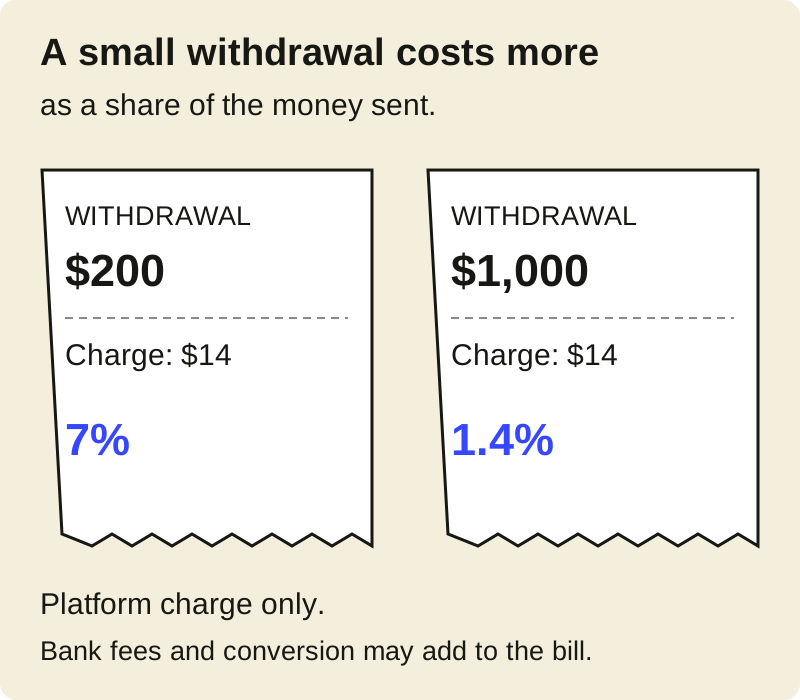
Kraken’s withdrawal table lists a Bank Frick USD SWIFT method with a $100 minimum, a $14 withdrawal charge and a one-to-five-business-day estimate, subject to regional availability. Additional receiving or correspondent charges can apply. This is a documented payment option, not an Antiguan bank acceptance test or a promise that every local customer sees it.
For a $200 withdrawal, the $14 platform charge alone consumes 7% of the amount. At $1,000 it is 1.4%. That makes repeated small international withdrawals a poor fit for this particular method, even when futures commissions look inexpensive. Check the full cash-out amount rather than using a low trading fee to judge the whole service.
Keeping a larger balance on an exchange solely to spread out a withdrawal fee is not a free saving: it increases the amount exposed to that provider. Decide the cash amount and timing you actually need, then choose the payment method. For a small account without an economical bank exit, a documented crypto transfer to an existing cash-out service may be more practical; price both legs before relying on it.
When would I choose OKX instead?
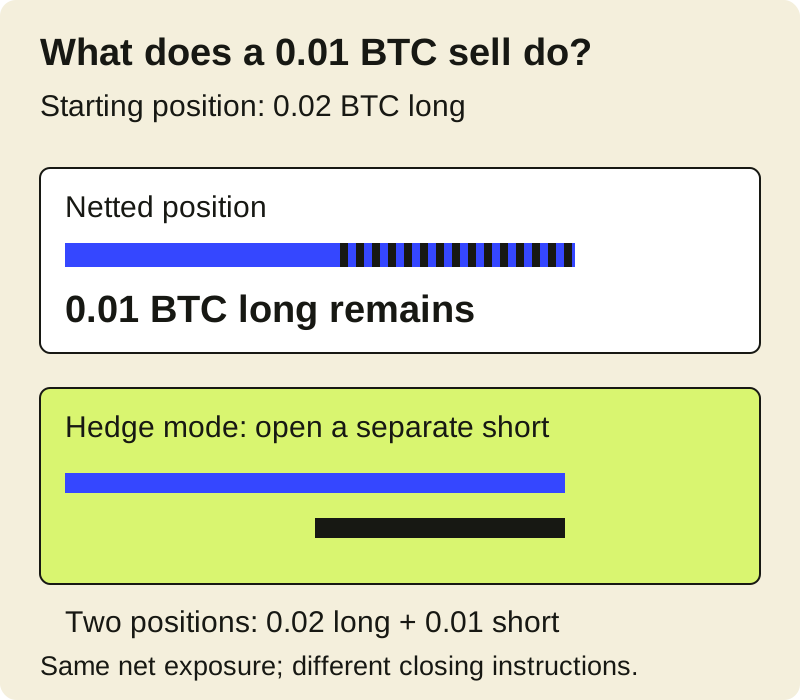
OKX offers a setting called hedge mode: you can keep a trade that benefits from a rise and another that benefits from a fall open on the same market. On Kraken, selling the same contract instead reduces or closes the existing position. If you only want to cut your current trade in half, you do not need the extra OKX setting.
Suppose your first trade follows 0.02 Bitcoin and benefits when the price rises. Selling 0.01 Bitcoin on Kraken leaves that first trade half as large. With the right OKX hedge-mode instruction, you can instead keep the original trade and open a separate 0.01 Bitcoin trade that benefits from a fall. You now have two trades to manage. That is useful for separate plans, but it is not a shortcut to a risk-free profit.
Does an Antiguan passport qualify me for these exchanges?
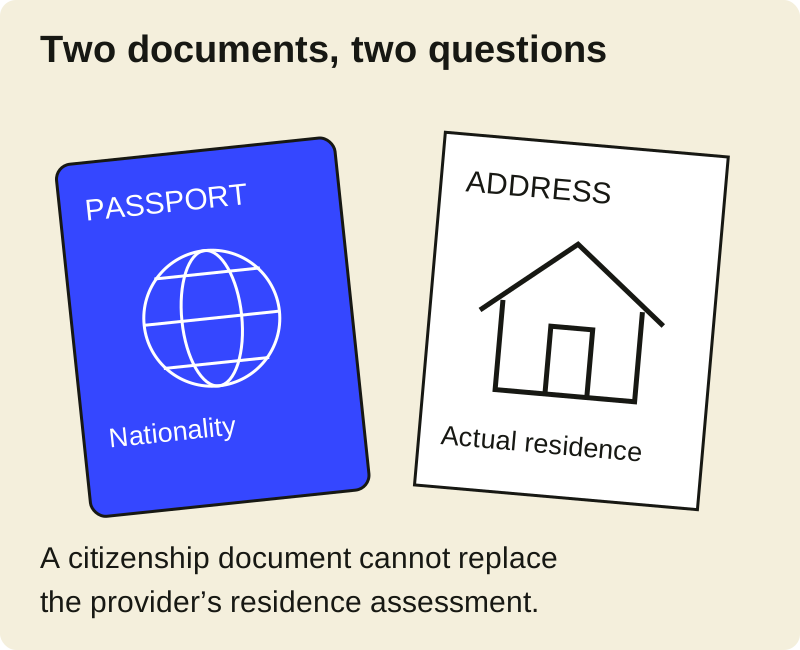
An Antiguan passport alone does not establish that your trading account belongs under Antigua and Barbuda’s resident rules. This matters more here than a generic identity checklist suggests: the citizenship-by-investment programme describes a five-day presence condition over the first five calendar years. That is quite different from actually living in the country.
A person holding that passport while residing in Canada, the United Kingdom or the United States must use the provider’s rules for their real situation. The citizenship document can establish nationality, but it cannot erase an address, an applicable restricted-person definition or a different contracting entity. Moving temporarily for a holiday does not settle that question either.
For someone genuinely relocating to Antigua or Barbuda, the useful step is to update the account and obtain approval for the products attached to the new residence before transferring a trading balance. Keep the provider’s answer with the residence documents. An existing foreign account should not be relabelled locally simply because the national passport changed.
Is Barbuda treated as a different trading jurisdiction?
The provider policies reviewed do not establish a separate retail futures category for Barbuda. Use your actual address on the island and the country Antigua and Barbuda. A postal-format problem or a requested supporting document is an account-verification issue; it is not evidence that the island has a different leverage limit.
The same care applies to businesses. An Antiguan company certificate does not turn a personal account into a corporate account or make every owner eligible. Company onboarding can examine directors and beneficial owners as well as incorporation. Choose the account type that reflects whose funds are being traded.
Which local crypto licences are actually documented?
The FSRC directory consulted names RockWallet Limited for specified custody, wallet and exchange activities, and RockWallet Custody Limited for custody. Its filename refers to 2023, so we treat it as the published directory encountered in this review, not as proof that it is a complete real-time register of every licence.
RockWallet’s own service description focuses on buying, selling, swapping and holding crypto. Those services can be useful, but the record does not establish a local leveraged-futures account. Choosing a business because it appears in a local digital-asset directory is not enough when the specific product you want is a perpetual contract.
| Claim on a website | What it establishes | What remains to check |
|---|---|---|
| An Antigua company address | The business identifies an address or incorporation connection | The company actually holding your account and its authorised activity |
| A matching FSRC directory entry | The named business and activities in that record | Whether your exact trading product falls within those activities |
| A crypto buying or wallet app | A way to transact or hold supported assets | Whether it offers any leveraged product at all |
A concrete warning shows why this distinction matters. In August 2025, the FSRC said Digital Cryptocurrency Bank, also calling itself DCB, had never been licensed by it for international banking. That is a specific warning about that named business, not a reason to classify all crypto trading as prohibited.
If a provider invokes local protection, compare its exact company name with the regulator’s record before relying on that protection. If it is an offshore exchange, evaluate it as such. Neither an island address nor familiar local imagery tells you how a claim would be handled if the platform failed.
How should I budget a trade in EC dollars?
The ECCB’s 2026 communication confirms the EC-dollar peg of EC$2.70 to US$1. That makes the reference conversion easy: EC$1,350 corresponds to US$500 before charges. It does not guarantee that a card payment or bank transfer will place exactly $500 in the trading account.
Separate three decisions: how much local money you commit, how much collateral reaches the account and how large a position you open. With $480 credited after a hypothetical $20 funding cost, a $2,000 position is still $2,000 of market exposure. A 2% adverse move would be a $40 gross loss on that exposure, before fees and funding; the original EC$ budget does not change the contract’s arithmetic.
That example is not a recommended trade size. It shows why the bank outlay and the order amount should be visible together. If your spending limit is EC$1,350, do not interpret a platform’s permitted leverage as permission to use the whole account repeatedly across several correlated trades.
Do I need a local P2P seller?
Not necessarily. If you already have acceptable crypto funding or an approved international bank method, an extra person-to-person purchase can add another spread and another transfer. Conversely, the mere existence of a global P2P tab does not demonstrate an executable XCD offer for your amount. This review does not invent an Antiguan seller or quote that was not observed.