













Which exchange fits a trader in Dominica?
Kraken for a straightforward futures account
Lower published base taker commission in this comparison, plus several collateral choices.
Read the verdictBybit for separate long and short positions
Its USDT hedge mode matters when you deliberately need both directions on the same contract.
Read the verdictStart with Kraken for a single directional BTC or ETH trade. Choose Bybit instead when you specifically need an independent long and short on the same USDT contract. The comparison below explains that distinction with positions you might actually place, then checks how much the commission difference is worth.
Both choices require verification and the relevant account permission. Neither is presented here as a locally licensed FSU futures provider or a confirmed direct XCD bank connection. The sections below compare what happens inside the trading account and what an EC-dollar budget costs to fund.
Kraken or Bybit: which fits the position you want?
For a single BTC or ETH position, Kraken’s published base taker rate is 0.05%, compared with Bybit’s 0.055% standard tier. That is a modest, identifiable advantage, not a claim of universally lower total costs. The worked comparison below shows when the ten-cent gap on a $2,000 fill is too small to justify moving funds.
Kraken’s multi-collateral wallet lets eligible assets support positions whose value is measured in US dollars. This can suit someone who already holds several assets. It also requires more care than keeping only a stablecoin balance: a falling collateral asset can reduce the funds supporting an otherwise unchanged trade.
Keep the trade idea separate from the coins backing it
Imagine a reader in Roseau holding Bitcoin who wants to take a leveraged view on Ether. Using BTC as backing creates two moving parts: the Ether position and the dollar value of the Bitcoin. If both move against the account, the loss of backing compounds the trading loss. Moving to supported dollar-linked collateral removes that particular BTC price exposure, although stablecoins bring their own issuer and price risks.
That is the real choice here. Retaining existing coins avoids selling them simply to fund a position; using a more stable settlement balance makes the trade result easier to follow. Neither choice increases how much money you can afford to lose. Kraken’s cross and isolated modes also deserve attention: cross margin shares backing across positions, while isolated margin assigns it to a selected position. Account-wide collateral problems can still matter.
When would we choose something else?
Bybit’s documented hedge mode can hold a long and a short on the same USDT contract. Kraken’s derivatives FAQ says opposite orders on the same contract offset the existing position instead. Choose Bybit if maintaining the two directions separately is an intentional requirement; for one directional position, that extra mode is not inherently an advantage.
When is Bybit’s hedge mode useful?
Bybit offers a specific option for a trader managing different views over different time frames: a long and a short can coexist on the same USDT contract in hedge mode. USDT settlement itself is not an exclusive reason to choose Bybit; the important distinction in this comparison is how those opposing positions are handled.
For a simple directional trade, use the contract and margin settings deliberately. The platform documents both isolated and cross margin, and USDT perpetuals support hedge mode, which can hold a long and a short at the same time. Hedge mode is a feature for managing separate positions, not a free method of cancelling all costs or guaranteeing a profit.
One position or two opposite positions?
Suppose you bought a BTC perpetual and now want to take half the exposure off. Closing half the original position accomplishes that directly. Opening a new short instead can leave two positions running, with separate fills and charges. For a reader operating from a phone, the practical advantage comes from seeing which position is being reduced before pressing the final button.
Bybit’s public service restriction list does not name Dominica as a general excluded location. Its fiat-service table is more specific: Dominica appears in the SEPA restriction column. That does not turn into a ban on all crypto trading, but it does mean an article should not casually recommend a euro bank deposit to a Dominica-verified account.
For example, an account could retain a longer-running BTC long while opening a separate short for a temporary bearish view. You then have to manage both exits and their costs. If the intention was simply to reduce the original long, closing part of it is clearer. Two tickets are useful only when the separate management serves an actual strategy.
Does Dominica’s TRON connection change your exchange access?
Not automatically. The association is real: Huobi’s 2023 announcement describes work with TRON and DMC Labs on a Dominica digital identity programme. It discusses potential account and digital-service benefits. It does not establish that every exchange accepts the identity, that every derivative is approved, or that the holder has moved their home to Dominica.

Do you need DMC or TRX to trade BTC futures?
No DMC purchase is part of the Kraken or Bybit account path discussed here. The required balance comes from the specific contract’s accepted collateral. A marketing article about Dominica Coin cannot substitute for that list. Buying an unrelated token first can add a trade and another price risk without helping open the BTC position.
TRON also names a blockchain network, whereas TRX is its native token and USDT is a different asset that can exist on that network. A futures account can accept a particular USDT transfer network without making TRX the collateral for the position. Read the asset and network as two separate labels when moving funds.
Are old Dominica promotions still a reason to sign up?
The HTX DMC campaign found during this review ran in December 2022. Its token awards and temporary fee privileges were tied to that event. We do not carry those figures into a current welcome offer or use them to move HTX above the exchanges compared here. Historical involvement explains the search interest; it does not prove a current trading benefit.
If you live abroad and hold a Dominica-linked digital credential, use your actual residence and the documents the exchange requests. Someone living in a restricted market does not gain a permitted futures account simply by selecting Dominica in a menu. The same applies to a company address: a business account requires its own assessment rather than borrowing the personal account rules.
How much crypto does an EC-dollar budget actually buy?
Dominica uses the Eastern Caribbean dollar, XCD, not the Dominican Republic’s peso. The ECCB maintains the official peg of EC$2.70 per US$1. That is a useful reference for checking a quote. It is not a promise that a card, bank or crypto seller will deliver one USDT for exactly EC$2.70.
Take EC$810 as an example. At the peg, it corresponds to US$300 before costs. If a provider’s final quote delivers 290 USDT, your effective purchase price is about EC$2.793 per token. If a different quote delivers 295 USDT for the same total debit, it leaves five additional USDT for the same budget. These are comparison figures, not current local offers.
Where can the difference go?
A card conversion, a seller’s price margin, an exchange purchase charge and the crypto withdrawal can each reduce the amount that arrives. Ask for the final debit and the delivered asset quantity. A provider saying “no trading fee” has answered only one part of that question.
There is also a distinctly local charge worth checking. The FSU publishes a 2% stamp duty on outbound money transfers in its money-services fee information, effective from January 2024. Ask the provider whether it applies to the particular transfer you are arranging. Do not assume every onchain transfer attracts it, or that a payment avoids it merely because crypto is involved.
For an outbound amount of EC$810, 2% would be EC$16.20 where the duty applies. A quote that charges it on top has a different total debit from a quote where all charges are already included. Comparing only the EC$810 headline hides that difference. Keep the quotation rather than trying to reconstruct it after the trade.
What if no XCD option appears?
Do not select another country or send EC dollars to bank details intended for another currency. Check an actual supported purchase method or fund from crypto you already own. This guide has not verified a live XCD bank deposit into either featured exchange, so it does not label a hypothetical payment route as a local integration.
Would a cheaper futures fee change the decision?
For a new account, the published base derivatives rates are 0.02% maker and 0.05% taker at Kraken, versus 0.02% and 0.055% for Bybit’s standard perpetual/futures tier. A maker order waits on the order book; a taker order matches available liquidity. The rate shown in your account and the relevant market tier take precedence.
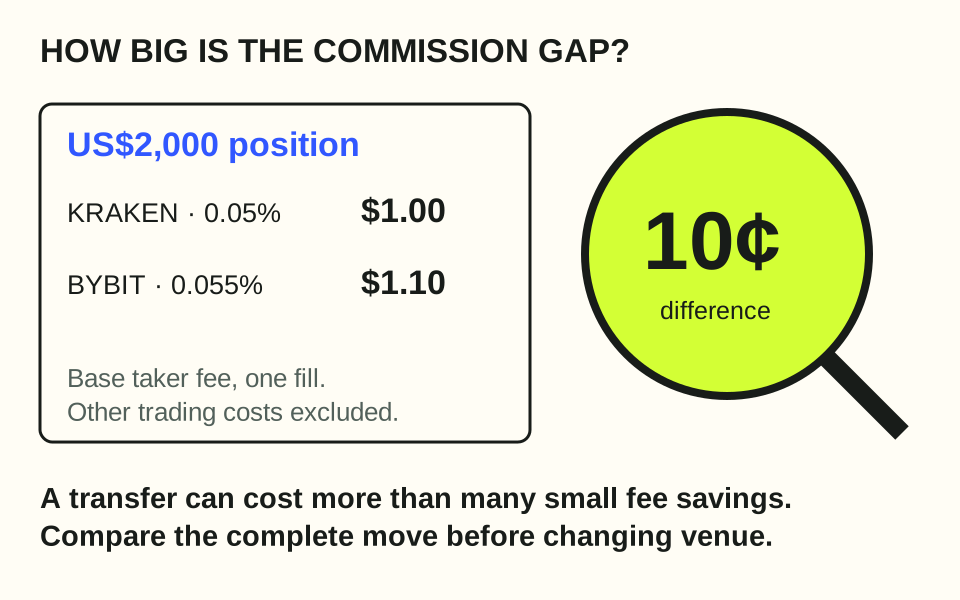
On a US$2,000 position, those taker rates give US$1 and US$1.10 per fill. If entry and exit had the same value, the gap across both fills would be US$0.20. A US$4 extra transfer cost would require twenty such round trips to offset. This does not predict profits or encourage extra trades; it shows why moving a small balance for a headline fee can be pointless.
Keeping a perpetual open can also involve funding payments between traders. The amount and direction vary. A lower execution fee is not a complete answer for a position held for several days, so inspect the funding information for the exact market rather than copying an example rate into your budget.
The decision changes with turnover. A trader already funded on both venues can place more weight on execution costs and the order book. A reader moving a few hundred EC dollars into their first account should avoid letting a ten-cent difference drive an expensive transfer. Those are different starting positions, not conflicting rankings.
Can a wallet-based perpetual exchange replace the CEX?
It can serve a different account preference. A perpetual DEX lets a supported wallet interact with a trading protocol, rather than relying only on a centralised exchange login. For a Dominica reader already holding onchain assets, that can be relevant. A wallet connection does not itself create an XCD withdrawal or prove that local rules do not apply.
GMX illustrates a difference worth understanding before comparing it with Kraken or Bybit. Its documented execution separates the request to trade from the transaction that executes it. The interface includes a network fee and may return an unused portion of the amount reserved for execution. You therefore cannot compare the whole transaction with a CEX commission percentage alone.
For a small position, inspect the complete opening and closing estimate and the supported collateral. For a position held longer, add its continuing costs. If the available asset or network requires another conversion first, include that step. The DEX is worth considering when the wallet model is the reason you want it, not because a high leverage number makes the rest of the workflow disappear.
What does a Dominica registration actually protect?
Dominica’s Virtual Asset Business Act requires registration for businesses offering or operating virtual-asset services in or from the country. The FSU maintains the relevant register and warns that unlisted entities are not authorised to do business in Dominica. An overseas exchange accepting an application must not be described as locally licensed solely for that reason.
Use the register to check a claim about the named business. Then check the service: custody, coin purchases and a leveraged derivatives account are not interchangeable. A website that displays an incorporation address or a “crypto bank” slogan has not, through that wording alone, shown permission for the product you want.
This distinction leaves the practical exchange comparison intact while stating its limit: the featured choices are overseas crypto products assessed from their published terms. We have not established a local FSU retail-futures authorisation for them. Anyone whose requirement is a specifically locally authorised provider should verify that product with the FSU before depositing.