















Which crypto futures exchange should you choose in Argentina?
Bybit: start and finish in pesos
Its peso payment instructions explain both adding money and withdrawing it.
Read the verdictBinance: check your account rate
Worth comparing if you place frequent orders, once you include the currency conversion.
Read the verdictOKX: an existing USDT balance
Useful when you already have crypto and do not need a new peso payment arrangement.
Read the verdict| Option | Choose it for | The trade-off |
|---|---|---|
| Bybit USDT perpetuals | A futures account with instructions for adding and withdrawing pesos | 0.055% standard immediate-order fee; payment charges depend on the method shown |
| Binance USD-M futures | Frequent orders if your account confirms the illustrated 0.05% taker rate | ARS funding limits and the actual conversion price still affect the outcome |
| OKX USDT futures | An existing USDT balance or a suitable local P2P offer | A P2P seller and their quote are separate from an exchange bank-withdrawal service |
| GMX perpetuals | An existing compatible wallet balance and a preference for on-chain trading | No ARS payout service; pool costs and network execution matter. |
Bybit is the most convenient starting comparison when the full ARS deposit-and-withdrawal cycle matters. Binance or OKX can win on frequent-trading commission. GMX becomes relevant when the money is already on-chain and you want wallet-based trading, rather than when you simply need an easier peso transfer.
How do Bybit deposits and withdrawals in pesos work?
Bybit’s peso instructions are more useful than a general “supports ARS” badge because they describe both directions of the payment. On the deposit side, its guide distinguishes a reusable fixed CVU from dynamically generated transfer instructions that are for one use. On withdrawal, it describes linking an account using local identifiers such as CBU, CVU or an alias, with CUIT/CUIL information.
Use the destination generated for your own account
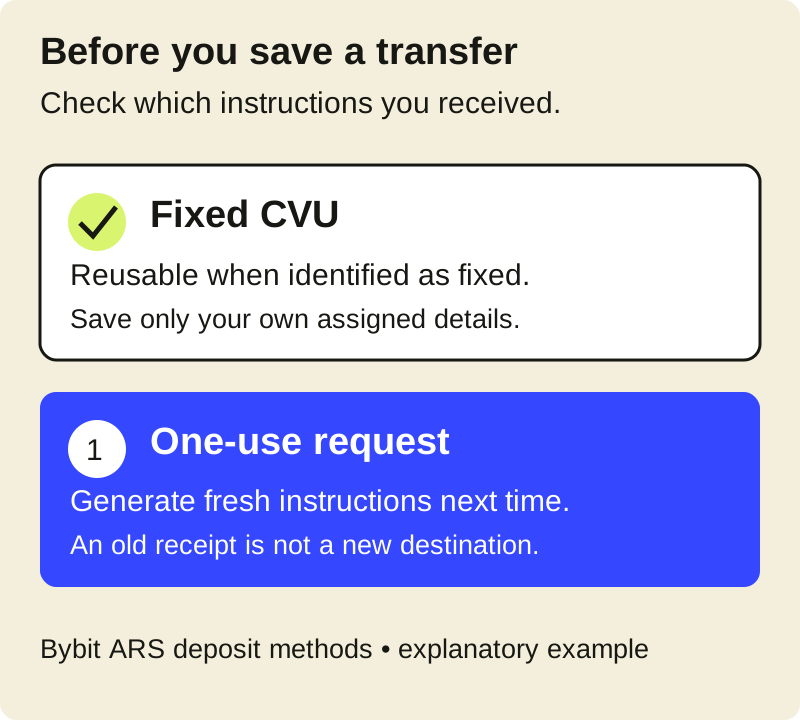
A fixed CVU can be saved when the platform identifies it as reusable. A one-use destination should not become a permanent favourite in your banking app. Start a new request when instructed, match the amount and account holder, and keep the bank receipt until the credit is visible. This avoids a very ordinary Argentine payment mistake: sending a second transfer to details copied from an old order.
The local payment terms identify Luzpay S.A. and SG Financial Technology S.A. in the processing arrangement. They explain that the credited payment balance is not itself a bank deposit or a crypto token. That matters when locating a delayed payment: a bank receipt, the local payment credit and USDT bought afterwards are different records, even if the app makes them feel like one transaction.
Test the return path before building a trading balance
For ARS withdrawals, use your own verified receiving account. Bybit may request evidence linking the account to the holder; its instructions do not make another person’s CVU a substitute. Once a recipient is approved, it can be reused. Fees and processing estimates belong to the selected method, so record the amount the withdrawal screen says you will receive rather than assuming all peso transfers are free.
Before you commit a larger amount, a small deposit, conversion and permitted withdrawal can answer a practical question: does this particular account complete the full cycle? Check the platform’s minimums first so the test does not strand an amount below the withdrawal threshold. A completed local test is better evidence for your situation than somebody else’s successful transfer from another bank.
Why can the credited pesos differ from the amount expected?
Bybit’s Argentina tax terms authorise Luzpay to make applicable tax deductions and withholdings from processed or credited amounts. The terms do not provide one universal percentage for every user. If a payment differs from your expectation, identify the actual deduction on the record rather than assuming every gap is an exchange spread.
For a useful comparison, put the net ARS credited beside the net USDT purchased. On exit, use the final ARS amount received. A “free transfer” label can describe the service fee while leaving a tax withholding or conversion difference elsewhere in the transaction. That distinction is specific to the local payment arrangement and can matter more than a small futures commission saving.
When are Binance or OKX the better fit?
Binance for repeated orders and a usable ARS deposit limit
Binance’s local-fiat guide has an Argentina-specific section. It requires identity checks and an account in the customer’s own name, and describes monthly deposit tiers expressed as USD-equivalent amounts: up to $10,000, up to $30,000 and a higher tier subject to further information. These are funding limits, not leverage limits or a permission to open a position of that size.
For a person making a few modest deposits, the lowest tier may already cover the intended funding. For someone moving a larger balance, extra documentation can become the deciding issue before the trading fee matters. Read the ARS section specifically: a multi-country help article can also discuss Colombian or Polish payment arrangements that have no bearing on your Argentine account.
OKX when you already have USDT, or a better local quote
OKX’s Argentina guide describes buying from other users through its P2P market, using local payment accounts. For someone paid in pesos, that adds a seller’s price and payment terms to compare. It is different from Bybit’s documented ARS deposit and withdrawal process, so do not read the two “supports pesos” claims as the same service.
If you already hold USDT on a supported network, moving it directly may avoid an unnecessary sell-to-pesos-and-buy-again cycle. Compare the actual network withdrawal fee with the amount being moved. A token ticker matching on both screens is insufficient if the sending and receiving networks differ; use the deposit network shown for that particular token.
Should you think in pesos, dollars or USDT?
Use pesos to plan what you can afford and what you need to withdraw for local expenses. Use the trade’s own currency to judge whether the trade made money. Starting with pesos does not mean you have to trade a peso-priced Bitcoin contract. Bybit’s peso payment service and a USDT futures trade are two different steps.
A dollar-linked balance can be easier to follow when you are comparing international exchanges, but USDT is a token designed to track the dollar, not a dollar bank deposit. Converting every balance to dollars is not automatically the best choice: conversion has a cost, and your next bill may be in pesos. The useful question is what you plan to do with the money.

An Argentine result can reflect two moving prices: Bitcoin against dollars and dollars or stablecoins against pesos. A peso conversion of Bitcoin can therefore rise while a BTCUSDT position loses, or fall while that position wins. Use the contract result and the actual ARS conversion as separate entries.
| Scenario | Bitcoin in USD | ARS per USD equivalent | Implied BTC value in ARS |
|---|---|---|---|
| Starting point | $100,000 | 1,000 | 100,000,000 |
| BTC falls 10%; peso quote rises 20% | $90,000 | 1,200 | 108,000,000 |
| BTC rises 10%; peso quote falls 15% | $110,000 | 850 | 93,500,000 |
In the first example, Bitcoin loses 10% in dollars but is worth 8% more pesos because each dollar buys more pesos. In the second, Bitcoin gains 10% in dollars but is worth 6.5% fewer pesos. Real buying and selling prices add their own differences. Neither result is a forecast; the examples explain why your peso balance and the Bitcoin chart can tell different stories.
Keep saving and speculation separate in your decision. Someone accumulating stablecoins for a future expense may not need any Bitcoin exposure. Someone trading a short-term Bitcoin move should judge that trade on the chosen contract. Combining those intentions inside one leveraged position makes it difficult to see whether the exchange, the trade or the exchange rate produced the outcome.
Bybit vs Binance vs OKX: what does a futures trade cost?
Bybit’s standard non-VIP futures table lists 0.055% for immediate fills and 0.02% for resting fills; the OKX basic-tier example uses 0.05% and 0.02%. Binance’s linked FAQ uses 0.05% and 0.02% as calculation examples, not a verified quote for every Argentine account. The Binance column below applies only if your own USD-M fee screen confirms those rates. All rates were reviewed on 29 September 2026; discounts, regional tiers and special contracts can differ.
| Order pattern | Bybit | OKX / Binance example |
|---|---|---|
| $2,000, taker both ways | $2.20 | $2.00 |
| $5,000, taker both ways | $5.50 | $5.00 |
| $5,000, maker entry and taker exit | $3.75 | $3.50 |
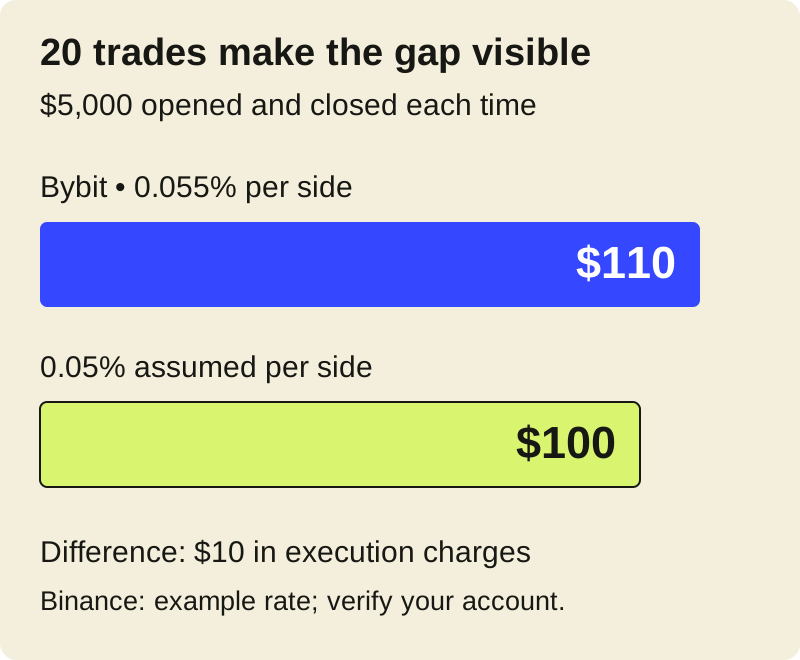
| 20 round trips of $5,000, all taker | $110.00 | $100.00 |
For one $5,000 trade, the difference is fifty cents. A better ARS conversion can easily outweigh that. Across twenty such round trips, the difference is $10, and across still more turnover it grows. OKX, or Binance if the example rates match your account, wins this narrow fee comparison; Bybit can still be the more practical overall account when its local payment arrangement is worth more to you than the commission saving.
A limit order is not automatically a maker order. If it immediately matches a resting order, it can be charged as a taker. Post-only instructions are designed to avoid that outcome, but an order that does not fill is not a completed cheap trade. When closing a fast-moving position, execution certainty may matter more than a small fee reduction.
Compare spread and depth on the actual contract as well. A worse execution price by 0.02% on $5,000 costs $1, twice the fifty-cent difference in the simple round-trip example. We have not measured comparative order-book execution, so these commission results are not a liquidity ranking. They tell you what the published fee component contributes, not which platform will always deliver the best fill.
Which crypto balance backs your futures trade?
The same app can hold spending money, spot coins and leveraged positions. That convenience can conceal how much of the balance is supporting a trade. Bybit’s Unified Trading Account supports several margin modes; review which assets are enabled as collateral rather than assuming the spot tab is always separate from futures risk.
For an Argentine trader who uses stablecoins between peso payments, this is a more important question than whether the app stays open at night. A USDT balance intended for next month’s expenses can become part of the trading support if the account settings allow it. Separate the amount you want to speculate with from the money you intend to convert back to ARS.
Spot margin and a perpetual have different bills
Borrowing to buy or sell coins on spot margin is not the same product as opening a perpetual. Bybit describes borrowing interest for spot margin; the perpetual has execution charges and funding. A low-looking futures fee does not price the borrowing on a different screen.
If you want a short BTC position without borrowing spot coins yourself, compare the perpetual product. If your strategy specifically requires borrowed coins, compare the spot-margin borrowing terms and repayment mechanics. Do not switch between them solely because both menus use the word margin.
Use the amount exposed, not the leverage headline
A 1,000 USDT position changes by roughly 10 USDT on a 1% move, before costs. That price effect is the same whether you assigned 100 or 200 USDT to support it. The smaller support amount gives the account less room for an adverse move; it does not create a cheaper Bitcoin price.
On a phone, check the position value and settlement asset before confirming. Then inspect the actual filled quantity and remaining exits. A partial take-profit can leave a smaller trade open, while a stop-limit may wait unfilled after it triggers. Those are concrete operating differences worth learning before increasing the position.
How much does holding a perpetual overnight cost?
A perpetual has no scheduled expiry, but holding it can produce funding payments. Bybit’s documentation states that intervals vary by contract and can change. Positive funding normally means longs pay shorts; negative funding reverses the direction. Compare the rate and the next settlement time on the contract you intend to trade, rather than transferring a rate from another coin.
For an eight-hour schedule at 00:00, 08:00 and 16:00 UTC, Argentine time is 21:00 on the preceding calendar day, 05:00 and 13:00. That detail matters if you call a position “overnight”: a trade held from late evening to lunchtime may cross a different number of funding events than you first expect. Check the displayed countdown; not every market uses those three times.
Suppose a $5,000 long pays 0.01% at each of three settlements while its value stays unchanged. The daily funding cost is $1.50. Seven identical days would cost $10.50, more than either platform’s one-time execution charge in the preceding example. This is a fixed-rate illustration, not a forecast: rates and position value change, and some settlements may pay you instead.
Decide from the holding period, not the advertised leverage
For an intraday position, entry and exit execution may dominate the cost. For a multi-day position, repeated funding can become more important. For someone trying to hold a long-term Bitcoin investment, outright spot ownership may better match the intention than continually paying to maintain leveraged exposure. The page ranks futures accounts for people who need them; it does not assume every Argentine crypto buyer should use a derivative.
Should an Argentine trader use a DEX instead?
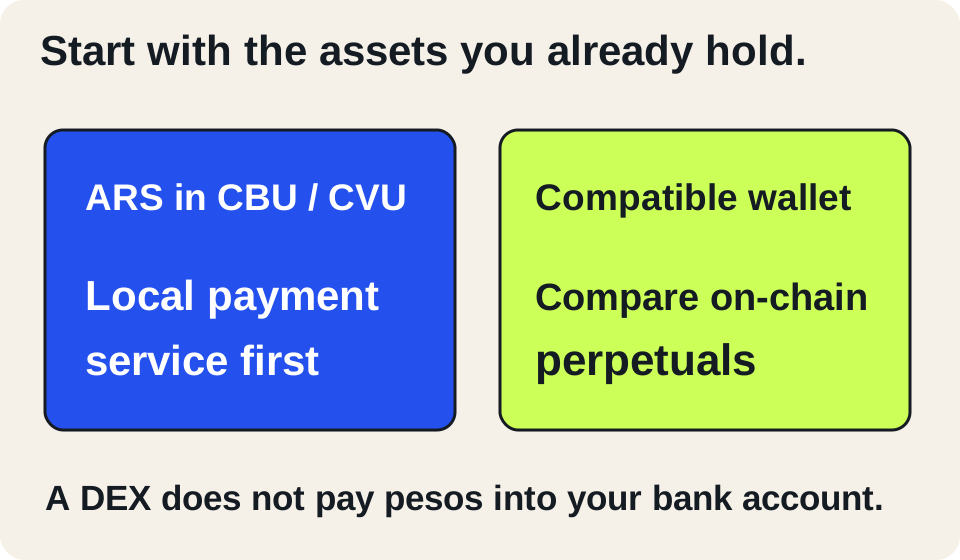
A DEX deserves a serious comparison when you already use a compatible wallet and want to manage positions on-chain. It is less compelling if your main problem is turning pesos into trading funds and back into a CBU or CVU. You still need a separate service for that local payment leg.
GMX is our wallet-based alternative to examine here. Its interface terms checked for this update exclude US persons and restricted or sanctioned users and require compliance with applicable law; they do not provide an Argentine licence. The recommendation is for an eligible user comparing the documented crypto product, not a claim that a wallet bypasses residence rules.
GMX versus an exchange order book
GMX’s trading cost is tied partly to the balance of positions in its pools. Its standard crypto position fee is 0.04% or 0.06%, depending on whether the action improves or worsens the long/short imbalance. It also has funding, borrowing, possible swap costs, price impact and network execution costs. A single headline percentage cannot represent the entire trade.
On a hypothetical unchanged 5,000-dollar position, a 0.04% opening and 0.04% closing component total $4; two 0.06% components total $6. Mixed rates give $5. Those figures isolate one fee component. They do not establish that GMX beats the CEX costs above after holding and execution costs are included.
The useful advantage is the wallet-based workflow and a different liquidity model. The disadvantage for an ARS-funded reader is that the peso on-ramp and final payout remain outside it. If the funds are already on a supported chain, that additional journey may be smaller. If they begin and end in a local bank, Bybit’s payment service can be the more practical starting point.
What about Hyperliquid?
Hyperliquid offers a different on-chain model built around an order book. Its core perpetual specification uses USDC collateral, and its margin documentation distinguishes shared cross margin from isolated positions. That makes it a product comparison with GMX, not simply another logo offering identical wallet futures.
If your current holding is USDT, first establish the supported deposit asset and route; a BTC market label does not make every stablecoin acceptable collateral. The current deposit interface may offer several routes, each with its own costs. Do not apply an old flat-fee bridge tutorial indiscriminately to a different route.
Compare the complete preview for the same crypto position and intended holding period. With an order book, execution depends on the available orders; with GMX, pool conditions and its pricing rules affect the result. This review has not run matched live trades, so it does not award either venue an invented liquidity victory.
Keep the peso exit in the comparison
Closing a wallet-based trade leaves assets under that product’s rules, not pesos in your bank. Before starting, identify which service would accept the resulting token and network and what it would pay to your verified local account. A bridge, a swap and an ARS payout are separate operations with separate costs.
For a trader already comfortable with on-chain assets, the extra control can justify those steps. For someone who wants a single account for a modest peso deposit, a few BTC trades and a peso withdrawal, it may not. That is the actual CEX-versus-DEX decision for this page, rather than a contest over the biggest leverage number.
What do CNV registration and Argentine tax records actually cover?
Argentina has a PSAV framework for virtual-asset service providers. CNV’s 2025 rules address matters including custody, segregation, security and conduct. The register should be checked using the exact legal company behind the service, not only the app’s brand. A registration for a local payment or virtual-asset activity should not be described as approval of every offshore derivatives contract offered elsewhere in the group.
For a local payment issue, identify the payment company named in the ARS terms. For a derivatives dispute, identify the company named in the trading agreement. Those may differ within the same app. Keep both records so a failed peso credit is not confused with a disputed futures fill, and so a local registration claim can be checked against the correct service.
Save records that explain both the trade and the conversion
Keep the ARS payment receipt, crypto conversion record, closed-position report, funding ledger and withdrawal receipt. Together they explain the difference between cash paid in, collateral moved between wallets, realised trading profit and money returned to your bank. An internal wallet transfer should not be mistaken for a new trading gain simply because it appears in a transaction export.
ARCA discusses derivative income within capital income and treats cryptoasset disposal under its own income-tax guidance. It also lists virtual currencies among assets relevant to Bienes Personales. Those distinctions are why a generic claim that every crypto future pays one flat tax rate would be unreliable: residence, instrument, source, taxpayer status and the applicable year matter.
Export records before closing an account or losing access to an old email address. Give the accountant the original reports and conversion dates, rather than only a peso total reconstructed from today’s quote. This section identifies the records and official guidance relevant to the decision; it does not calculate a personal tax liability or assume that a balance below an unspecified threshold is exempt.