















Which option fits the way you will fund it?
Already have crypto? Start with the trading account
Kraken Pro is worth considering when you already hold a supported cryptoasset and want perpetuals. You can fund the derivatives account without buying another coin from pesos first. Its ordinary starting taker commission is slightly lower than Bybit’s, although that small difference does not settle the whole comparison.
Starting with CuentaRUT? Resolve the peso payment first
Bybit documents CLP in its P2P marketplace. That can put the initial purchase and subsequent futures trading in one platform, if a seller accepts your bank and amount. CuentaRUT’s restrictions on new recipients can interrupt that purchase; the bank-limit example below shows when.
Alternatively, Buda can handle the local coin purchase before a supported transfer to a derivatives exchange. It adds a separate purchase and withdrawal, but its Chilean bank instructions may be more familiar. Use the local exchange to obtain the supported asset, then choose the futures market separately.
The comparisons below use published Chilean bank rules and provider terms. We have not opened resident accounts or tested bank withdrawals, so quoted charges and eligibility are distinguished from measured execution quality.
Kraken versus Bybit: what actually changes for a Chilean trader?
Chile is outside Kraken’s published non-US derivatives exclusions and Bybit’s listed excluded jurisdictions. Each provider still verifies the account and can apply product restrictions. Neither finding establishes that the international derivatives service has Chilean CMF authorisation.
Kraken Pro is the more natural fit when your priority is the trading account itself and you already have an accepted funding asset. Bybit deserves preference when a suitable CLP P2P offer solves the funding problem for you. That advantage comes from the marketplace arrangement, not proof that Bybit provides a domestic bank account in pesos.
A fee advantage, but not a decisive one by itself
The published starting perpetual/futures rates are 0.02% maker and 0.05% taker for Kraken Pro, compared with 0.02% and 0.055% for Bybit’s ordinary base tier. Account region, special markets and promotions can change the applicable rate, so these are the standard schedules checked for this comparison.
At US$10,000 of unchanged position value, entering and exiting as a taker costs US$10 at 0.05% each way, versus US$11 at 0.055%. Kraken Pro saves US$1 in that example. A worse funding quote or a more expensive withdrawal can easily exceed that saving.
The conclusion is therefore limited but useful: Kraken Pro has the lower published ordinary starting taker commission in this pair of schedules. That does not demonstrate a lower total CLP cost for every Chilean customer. A trader already funded in crypto can give the fee difference more weight than someone who must first obtain it from pesos.
Use the right Kraken product
Kraken’s simpler Perps product has a separate published fee of 0.25% to open and 0.25% to close. It should not be confused with Kraken Pro’s futures table. A review that uses the cheaper Pro figure while showing the simpler order screen can give the reader the wrong expectation.
Before choosing an order type, look at the confirmation rather than assuming every limit order earns the maker rate. An order that executes immediately against an existing offer can be a taker. For a position held over time, also inspect the funding payment shown for the specific perpetual; that cost is separate from opening and closing commission.
How do you fund the account with Chilean pesos?
The two main crypto funding arrangements are a local exchange that receives pesos and sells you crypto, and a P2P marketplace that connects you with a crypto seller. The cheapest-looking label does not tell you which arrangement you are using.
With Buda, the local purchase and onward crypto withdrawal are separate actions. Its current Chilean transfer guide says automatic BCI deposits normally take around 15 minutes, while deposits through the listed Itaú route can take up to three business hours because they are processed manually. Use the current receiving instructions, not bank details saved from a previous transfer.
Buda supports stablecoin purchases and documents Ethereum and Solana network options for USDT and USDC. Before buying specifically to transfer elsewhere, confirm that the receiving platform supports the same token on the same network. A cheap outgoing network is no advantage if the destination cannot credit it.
When CLP P2P is useful
Bybit’s published P2P table includes CLP. The actual usable offer depends on the advertiser’s payment method, amount range and requirements. A platform-level currency listing is not a guarantee that someone is offering the amount you need at a good price right now.
Compare the total pesos paid with the crypto released into your account. If an offer gives 500 USDT for CLP 475,000, the effective quote is CLP 950 per USDT. Another offer requiring CLP 485,000 for the same amount is CLP 970. Those are hypothetical quotes, but the CLP 10,000 difference is real arithmetic and should not disappear behind a zero-fee badge.
Keep the payment within the order process and the names consistent with the verified accounts. Do not send money to a replacement account supplied in an unrelated message. When selling, confirm the credited bank funds yourself rather than releasing crypto on the strength of a screenshot.
Can CuentaRUT stop an otherwise valid deposit?
Yes. The exchange can accept the amount while your bank limits the transfer to the recipient. BancoEstado’s published CuentaRUT rules give a newly added destination a maximum single daily transfer of CLP 200,000, with a combined CLP 600,000 daily allowance for transfers to new destinations during the first 24 hours.
That creates a practical problem for a first P2P order above CLP 200,000 to a new seller. The order’s timer may start even though the bank will not send the full amount. Read the bank limit before opening the order, rather than discovering it after promising payment.
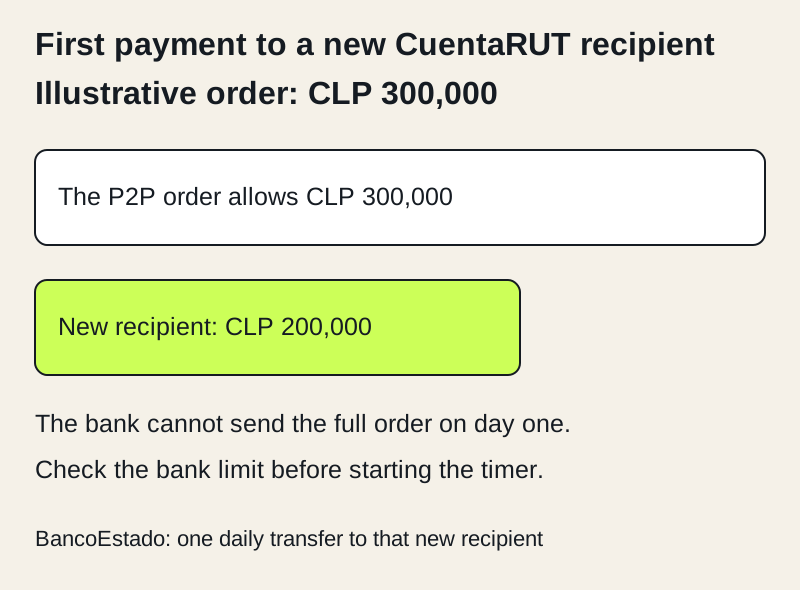
The solution is to choose an order amount your bank can actually send under the applicable rules, or arrange the payment after the bank’s waiting period. Do not split payments outside the seller’s agreed order or mark the order paid before the required money has arrived. That can turn a simple limit into a payment dispute.
A pre-existing beneficiary may have a different allowance, but the details must still match the current payment instructions. Exchanges and payment providers can change receiving accounts. A beneficiary you used months ago is not proof that the same account should receive today’s deposit.
Does a card solve the problem?
A supported card deposit may be faster, but it can cost more. Buda’s guide quotes approximate Chilean charges of 1.49% for debit cards and 2.92% for credit cards, subject to the confirmation screen. For CLP 300,000, those percentages are CLP 4,470 and CLP 8,760 respectively, before the subsequent crypto trade.
For someone making a small urgent purchase, paying a stated card charge may be acceptable. For a trader making repeated deposits, it can become more expensive than the difference between exchange trading commissions. The appropriate comparison is the whole funding step, not just how quickly the balance appears.
Can you short Bitcoin without selling the BTC you hold?
Yes, an eligible futures account can hold a short position while your BTC stays in a separate spot account or wallet. That reduces your combined exposure to a Bitcoin fall, but it adds margin, fees and the possibility of liquidation. Selling part of the spot holding is the simpler alternative when keeping those coins is not important to you.
Suppose you own 0.03 BTC and want to reduce half of that price exposure temporarily. A short sized to 0.015 BTC would approximately offset the price movement on half the holding. The contract price can differ from spot, and the actual order must fit the platform’s quantity rules. The 0.015 BTC is the exposure being offset, not a proposed deposit amount.
The short can lose while the coins gain
If Bitcoin rises, the BTC in your wallet gains value while the short loses. The separate wallet does not automatically send those gains to the futures account. A short can therefore be liquidated even though the combined idea looked roughly balanced on paper. Supporting the trade with accessible collateral is a different job from owning coins somewhere else.
For a Chilean reader whose immediate concern is paying a CLP expense, converting the required amount to pesos may meet that need more directly. A hedge keeps the trading and collateral tasks alive; it does not reserve a guaranteed peso payment. Use it for a deliberate reason to retain the BTC, rather than adding leverage simply because the exchange permits a short.
A partial exit needs the correct order
Kraken’s reduce-only instruction prevents a closing order from increasing or reversing the position. It is relevant when reducing the hedge in stages as you decide to sell some of the coins. An ordinary buy order with the wrong quantity can instead leave an unwanted long after the short has been closed. Check the remaining short against the BTC still held after each change.
USDT or USDC from Buda: which should you transfer?
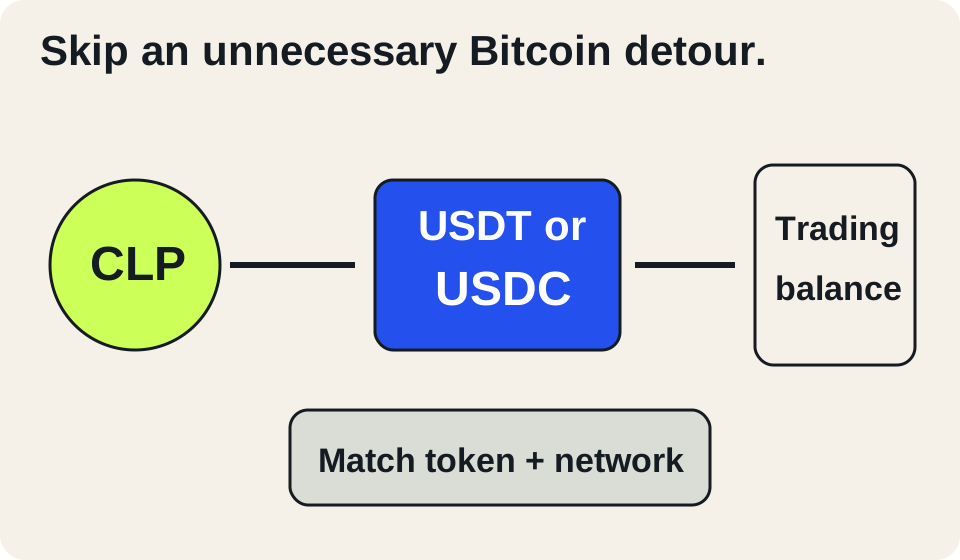
Choose from the destination contract backwards. If the intended market uses USDT as collateral, buying and transferring supported USDT can avoid a second asset conversion after arrival. If your exchange supports the USDC balance you want to keep, USDC may fit instead. Buda offers both stablecoins, but availability of a token does not establish that every network is supported at both ends.
Read the receiving exchange’s deposit screen before confirming Buda’s withdrawal. Match the token and blockchain, then compare the credited amount after the outgoing charge. Buda’s stablecoin page illustrates Ethereum and Solana routes; the live token-specific instructions decide which combination is available for your transfer. Do not send one version merely because its fee is lower.
You do not need a Bitcoin detour
Someone starting with CLP and planning a USDT-backed altcoin perpetual does not need to buy BTC, send BTC, sell BTC and then obtain USDT. Every extra conversion creates another price and fee. Compare a direct stablecoin purchase with that longer route using the actual destination support, rather than assuming Bitcoin is the universal transfer asset.
That matters during a fast market move. Bitcoin bought only as a transfer asset can fall between purchase and arrival, before the intended futures trade has even begun. A dollar-linked token removes that particular BTC-price movement from the funding step, although it retains issuer, network and depegging risks. It also remains exposed to the CLP exchange rate until you convert back.
What does Buda’s transfer estimate actually cover?
Its July 2026 guide lists approximate stablecoin crediting and sending times separately: around ten minutes for deposits and 45 minutes for withdrawals, operating around the clock subject to network conditions. These are provider estimates, not measured guarantees for your transaction. The later futures exchange credit can add another stage.
A crypto transfer still pending on Buda is different from one broadcast to the blockchain but waiting for the receiver’s confirmations. Look for the transaction ID before asking the destination to trace a payment. Once it is credited, check whether an internal move into the trading account is required. An asset visible in a funding wallet is not necessarily ready as margin for the order you want.
What does the Orionx closure mean for choosing an exchange?
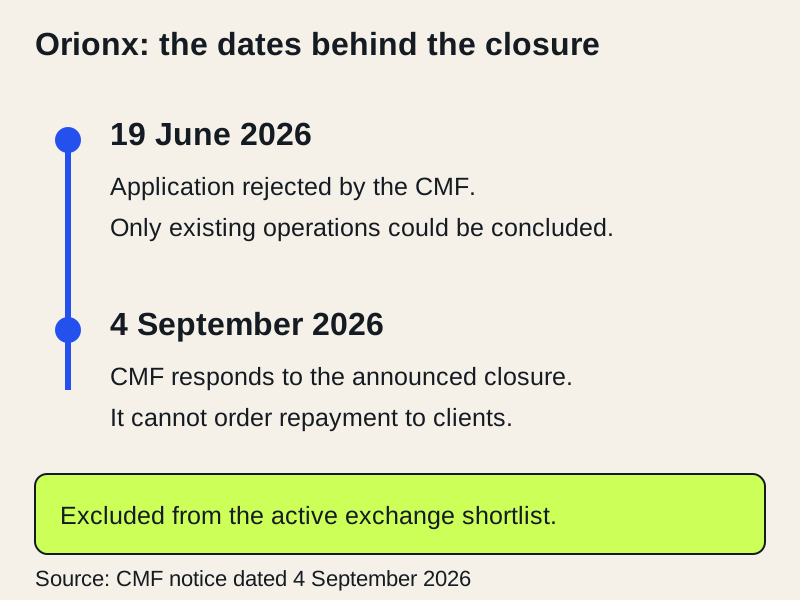
Orionx should not be treated as an active alternative in this comparison. On 4 September 2026, the CMF addressed its announced closure and stated that Orionx was neither registered nor authorised for the services covered by the Fintec law. Its application had been rejected on 19 June 2026.
The CMF also said it was not administering the closure and could not order the return of client assets. A pending application, a Chilean office or local payment support should therefore not be presented as if it guarantees supervision or repayment.
This case does not establish that every international exchange is unavailable to Chileans. It shows why the legal entity and authorisation status need to match the service being recommended. The relevant question is not simply whether a company has ever mentioned the CMF on its website.
Affected Orionx customers should retain balance statements, transfer records and the closure notice. The CMF directs recovery requests to the company and describes court action as a separate possibility. Opening a different exchange account will not recover that old balance.
How do you turn a trading result back into pesos?
Closing a futures position ends that trade; it does not necessarily produce CLP ready for your Chilean bank. At a crypto exchange, the result is held in the product’s settlement asset. The withdrawal step has its own currency, limits and settlement conditions.
One local exchange route is to transfer supported crypto to Buda, sell it for pesos and withdraw by bank transfer. Buda’s Chilean withdrawal guidance gives a normal transfer estimate of around 30 minutes, but the incoming crypto still needs its network confirmations first. Do not add the two stages together as if both were instant.
With P2P, the person buying your crypto sends the peso payment. Their bank transfer is part of a marketplace transaction, not a direct exchange bank withdrawal. Keep the order and bank evidence together so the credit can be explained if the bank asks about it.
Do not accidentally keep the wrong currency exposure
If a trade earns US$100 equivalent and you leave it in a dollar-linked asset, its peso value still changes with the exchange rate. At an illustrative CLP 900 per dollar it is CLP 90,000; at CLP 950 it is CLP 95,000. The trading result has not changed in dollars, but the amount available for a peso expense has.
That may be acceptable if you intend to keep dollar exposure. If the purpose is to pay a peso bill, the relevant result is what reaches the bank after conversion and costs. The account’s green profit figure is only an intermediate number.
A stop order is not a cash-out guarantee
Buda Pro’s stop-order explanation distinguishes a triggered market order from a stop with a limit price. A stop-limit can leave part or all of the order waiting if the market moves past the limit. That can matter when you intend to sell crypto arriving from another exchange and need a definite peso amount.
If execution is the priority, understand the price uncertainty of a market order. If a minimum sale price is the priority, accept that a limit may not complete. These are different instructions, not two names for a guaranteed sale.
What should you save for Chilean tax reporting?
An overseas investment can create reporting duties even in a year without a cash withdrawal. The SII’s current DJ 1929 guidance says foreign investments are reported regardless of whether they generated income. Its separate account guidance addresses foreign investment-account reporting. Do not use “I left the money abroad” as the test for whether records are needed.
Keep the institution’s identity, account statements, transaction history and year-end balance. For a crypto trading account, keep the conversion history too. A final peso bank credit may combine original capital, trading gains, losses and exchange-rate movement; it does not explain them separately.
Buda’s 2026 tax-report project can help with activity recorded on Buda, but the company explains limits to what it can know about external transfers. It cannot identify every later trade on another exchange or every use of withdrawn coins. A local report is therefore one input to the complete record, not a complete account of your international activity.
For a CLP-funded foreign account, retain the original peso payment and the amount actually credited. For a coin transfer, retain the asset, quantity, date and destination record. Those details let an accountant reconcile the history without guessing from a collection of bank deposits.
This guide does not apply one blanket tax percentage to every Chilean futures strategy. Product, account and taxpayer circumstances matter. The practical improvement is to gather the evidence while it is available, rather than trying to rebuild the history after a provider changes its exports or closes.