














Binance or Bybit for crypto futures in Peru?
Binance is the starting recommendation for a Peru-based reader who wants a conventional USDT perpetual account, local-currency funding options and documented controls for entering and closing their own trades. The useful comparison is Bybit, which also combines USDT perpetuals with a visible PEN marketplace. Neither recommendation relies on copying another trader or replacing crypto with a traditional brokerage account.
These exchanges are closer competitors than some Peru rankings suggest. Both document ways to spend supported crypto through local payment features, and both have futures-specific settings to learn. The decision should turn on the contract, the total quote and the exit controls you will actually use, not on a claim that only one app understands Yape.
| Question | Binance | Bybit |
|---|---|---|
| Can I build a USDT perpetual workflow? | USDⓈ-M contracts with supported account modes. | USDT perpetuals with documented order controls. |
| Is there a PEN funding route to inspect? | PEN is included in the published P2P fee-market list. | The public PEN market displays local payment adverts. |
| Can local QR payments alone choose the winner? | No: Binance Pay documents Peru QR support. | No: Bybit Pay also documents local payment support. |
| Which is cheaper for my trade? | Use the account’s live futures fee and fill quote. | Compare the same contract, size and holding period. |
We would start with Binance for a new, straightforward USDT trading setup, then use Bybit’s actual quote as a check before committing the balance. If Bybit already offers the required market and a better usable PEN purchase, that is a good reason to choose it. There is no value in forcing a reader to move an otherwise suitable account just to obey a ranking.
Kraken remains a useful alternative for existing eligible crypto collateral. Jupiter is the more relevant wallet-based comparison for readers already using Solana. Those are distinct needs; neither a longer coin list nor a local payments logo proves that one service is superior for every Peruvian futures trader.
The provider checks in this review support a product comparison, not a claim that we opened every account from Peru and measured execution. Identity checks, actual residence and derivatives access still apply. We preserve the broader country catalogue so the shortlist does not hide other documented choices.
Which balance should back a BTC or ETH perpetual?
For someone buying USDT with soles, a USDT-backed perpetual is an understandable starting point: the trading balance, position costs and realised result can be followed in the same token. You still need to check the chosen contract. A price displayed in dollars does not mean the exchange is holding soles or US dollars in a Peruvian bank for you.
Keep the initial setup as simple as the trade
Binance’s Single-Asset Mode uses the corresponding USDT or USDC margin balance. Its Multi-Assets Mode can share eligible collateral across supported USDⓈ-M positions. The second option can help an experienced trader with several assets, but it is not a necessary upgrade for a single USDT-funded BTC position.
A useful rule for the first account setup is to be able to explain which balance will absorb a loss. If the answer is unclear because several coins and positions share backing, simplify the arrangement before increasing size. More collateral choices can improve flexibility, but they can also make the account harder to read.
Choose the position in money terms before choosing a multiplier
Imagine a 200 USDT trading balance and a planned 600 USDT BTC position. That is three times the total balance, although the margin actually assigned to the position depends on the mode. A 1% BTC move changes the position by roughly 6 USDT before costs. If you instead open 6,000 USDT, the same move changes it by about 60 USDT.
Those are different trades. Setting a larger multiplier without noticing the increased order value can transform a modest idea into one that consumes much of the balance on an ordinary market move. The confirmation should make the full position value visible, not just the amount initially required to open it.
For a short, the gross direction reverses: a fall helps and a rise hurts. You do not need to own the coin to express that view through a supported perpetual. But you do need adequate backing, and a short can be liquidated during a rise before your longer-term prediction has any chance to play out.
The account’s maximum leverage is not a country-wide entitlement. It varies with the market, size and account rules. We do not label a platform the best for Peru just because an advertisement shows 100x or more on a particular contract.
Can you buy futures margin with Yape or Plin?
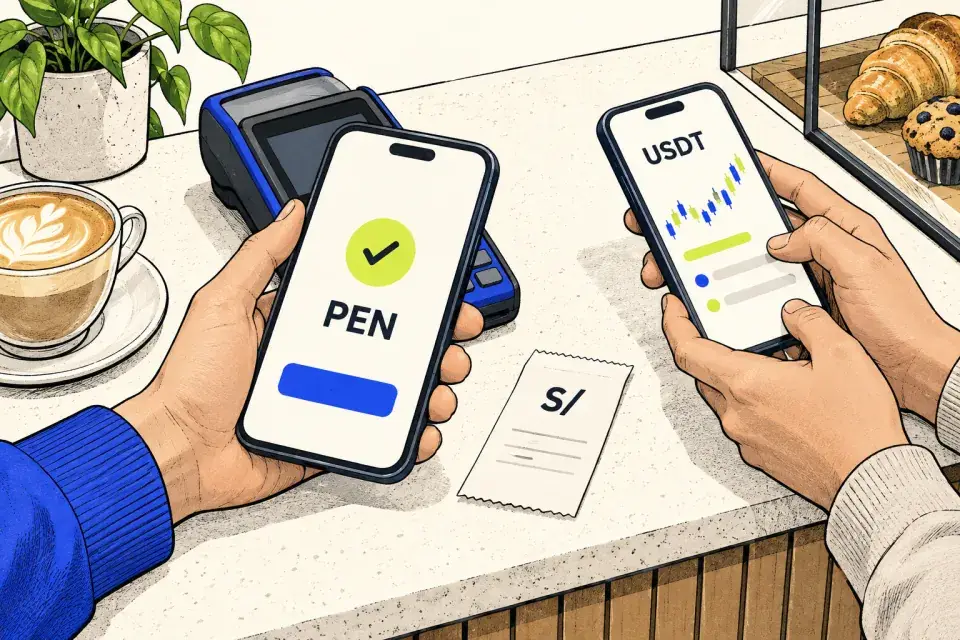
A supported P2P order can let you buy USDT using a local payment method, after which the token can be moved to the appropriate trading balance. That is different from Yape directly offering a leveraged position. The exchange order, the local payment and the futures trade are separate actions even when you complete them on the same phone.
Bybit’s public PEN purchase page returned adverts showing BCP, BBVA, Interbank, Yape and Plin during this review. That is evidence of listed payment methods at the time checked, not a promise of the same sellers, prices or limits when you visit. Select an offer that accepts your bank or wallet and the actual amount.
The S/500 limit is useful before you choose an advert
Yape’s help page sets a S/500 maximum per transfer and describes selectable daily limits of S/500, S/950 or S/2,000. Your current setting matters. An advert whose minimum is S/800 cannot automatically be completed with one S/500 Yape transfer just because the daily total looks large enough.
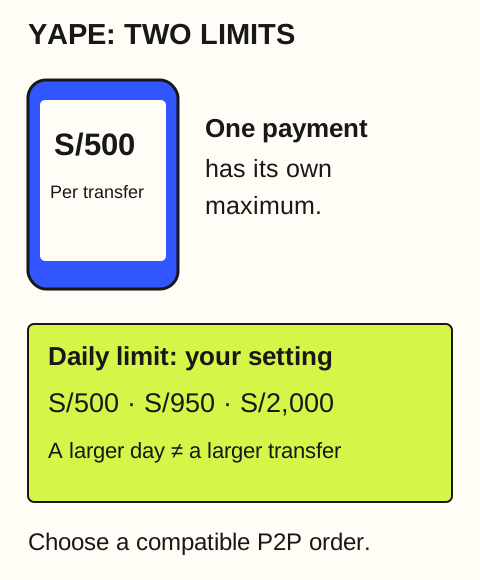
Do not assume the seller allows split payments. Choose an order that fits the permitted method and amount, or another payment method accepted by that order. Increasing your daily setting also does not change the per-transfer limit. Those two numbers solve different problems.
The best advertised rate may not be available for your budget
Suppose you want to spend S/400. An invented offer at S/3.50 per USDT with a S/1,000 minimum is not an available S/400 purchase. Another at S/3.54 accepting S/400 can be relevant despite the worse headline price. Compare offers you can actually execute rather than using the cheapest visible line as the price of your trading balance.
Binance’s P2P announcement includes PEN among markets with a small flat taker fee for USDT orders. Its published rollout figures were 0.06–0.08 USDT, but the current order preview controls what you pay. A low platform fee still leaves the seller’s exchange rate, minimum and conditions to compare.
The result you need is the transferable token amount after the complete purchase, not a screenshot of a favourable exchange rate. Keep the payment tied to its exchange order. A merchant’s use of BCP or Yape is not an endorsement of that merchant’s leveraged trading advice.
Which futures fees matter after the soles purchase?
Do not use a spot-trading tariff to rank a futures trade. Binance’s futures fee guide uses hypothetical rates of 0.02% maker and 0.05% taker to explain the calculation. Its public fee-table page did not return a personal tier in our logged-out check. Those example figures are useful for arithmetic, not proof of the rate every Peruvian account will receive.
Bybit publishes ordinary VIP 0 perpetual rates of 0.02% maker and 0.055% taker, with separate schedules for some special markets. Use the rate for the actual contract and account. A promotion, special market or personal tier can change the comparison.
| Scenario | Entry and exit rates | Execution cost |
|---|---|---|
| Binance FAQ example, both taker | 0.05% + 0.05% | 3.00 USDT |
| Bybit ordinary published VIP 0, both taker | 0.055% + 0.055% | 3.30 USDT |
| Binance example, maker entry then taker exit | 0.02% + 0.05% | 2.10 USDT |
The 0.30 USDT difference in the first two rows cannot justify calling one venue universally cheaper. It can disappear inside a slightly worse purchase quote or fill. For repeated trades, however, commissions accumulate; compare the fee tier you really qualify for instead of relying on a rate advertised for very high volume.
A fee discount can have its own cost
Binance documents a 10% futures trading-fee discount when eligible fees are paid with BNB under the applicable setup. On the 3 USDT example, that would save 0.30 USDT if the discount applied. Acquiring or holding BNB merely to obtain that small saving can introduce conversion costs and another price exposure. It becomes a different decision for a trader already using BNB and generating substantial fees.
How long will the position remain open?
For a brief trade, entry and exit quality may be the larger concern. For a position held across several funding events, the carrying payments can change the result. Read the selected contract’s current funding rate, interval and direction; the rate can move and your side can pay or receive.
A hypothetical 0.01% payment on a 3,000 USDT position is 0.30 USDT per event. Ten such unchanged payments total 3 USDT. That is already as large as the first execution-cost example. This is not a forecast of either platform’s funding; it shows why an inexpensive entry does not settle the cost of a week-long trade.
Keep the PEN purchase comparison and the futures cost comparison separate before adding them. That makes it easier to see what is expensive: the local conversion, trading frequency, holding period or exit. “Zero fees” on one part of the journey cannot erase charges elsewhere.
How do you set an exit that matches the trade you opened?
A take-profit and a stop-loss are useful only when they apply to the intended position and quantity. Binance’s documented limit-order setup lets you attach TP/SL instructions and choose the trigger reference. Bybit also documents conditional exits. Before comparing more advanced features, confirm that you can read and edit those basic instructions on the device you use.
One position or separate long and short sides?
One-way mode treats the market as one net position. Hedge mode can keep long and short sides separately. On Binance, the documented reduce-only control in one-way mode is designed to decrease rather than increase exposure. The interface and permitted combinations differ by mode, so copying the same sequence of clicks into another setup can produce a different result.
If you intend to close a long, use the position’s close function or an appropriate reducing order. Do not assume a generic Sell button always means “finish the trade”. In a setup that permits separate sides, opening a short can leave the original long in place. Two opposite positions are not automatically the same as a closed account.
Price protection is not a guaranteed stop
Binance’s price-protection feature can prevent a TP/SL trigger when the gap between the mark price and last price exceeds its threshold. The purpose is to filter certain abnormal price conditions. The trade-off is that an order may not trigger when you expected. A reassuring feature name should not be interpreted as a guaranteed maximum loss.

A stop-market order attempts an exit after its trigger but does not lock the final price. A stop-limit order adds a price condition, which may leave it unfilled during a fast move. Neither should be treated as a substitute for choosing a position small enough that an imperfect exit is survivable.
If you take profit on part of a position, revisit the remaining exit instructions. Check the actual open quantity and whether the platform resized or cancelled an attached order. This is especially useful on mobile, where the order history and position tab may be separate views.
These checks are not a reason to avoid crypto futures or to turn the article into a technical manual. They answer the practical question a trader actually has after finding an exchange: will the button I press close the exposure I intended to close?
Would a Solana trader be better off using Jupiter?
Jupiter deserves a place in the Peru comparison for readers who already manage crypto in a Solana wallet. Its official perpetual documentation includes BTC, ETH and SOL markets. Check the current market list rather than treating those examples as a permanent claim about the total number of products.
The attraction is the wallet-based trading workflow, not a guaranteed local-currency advantage. Jupiter does not turn Yape funds directly into futures margin simply because a Peruvian reader can open the site. The wallet still needs supported assets and enough SOL for applicable network activity.
Jupiter’s support material describes a 0.06% base charge on opening and closing a perpetual, plus applicable price impact, borrowing and network costs. On an unchanged 3,000-dollar position, the base two-sided charge alone would be $3.60. That does not establish the final price of the trade or make it automatically cheaper than a centralised exchange.
Choose the wallet workflow for a reason
If you already hold supported assets on Solana and want a market Jupiter offers, you can compare that direct route with sending assets to Binance or Bybit. If you are starting with soles and want an unfamiliar altcoin perpetual, adding a wallet and an extra transfer may solve no problem. The desired market should come before the preference for a DEX label.
A wallet signature authorises a transaction; it is not proof that the position has the intended size or exit settings. Review the resulting position in the application. While collateral is committed to a protocol, it has smart-contract and execution exposure even though unused funds can remain in your own wallet.
Do not confuse buying a liquidity-pool token with opening a directional perpetual. One gives exposure to the pool’s assets and trading economics; the other expresses your own long or short view with margin. A pool return shown elsewhere in the app is not a promised yield on a BTC futures position.
Can you spend futures profits through Yape or Plin?
There are two separate paths: sell available crypto to receive soles, or use a supported crypto payment service to pay a local recipient. They can have different quotes, limits and refund rules. Neither path spends an open futures position directly; the relevant balance must first be available to the payment or withdrawal service.
Binance Pay and Bybit Pay both deserve attention
Binance’s Peru QR guide describes verified Peruvian individual users paying supported interoperable QR codes, including the local Yape and Plin context. Bybit’s local-payment guide also documents Peru options. It would therefore be misleading to choose Bybit solely on the claim that Binance has no comparable local payment feature.
Compare the amount deducted in crypto for the same soles payment. The presence of the same payment logo does not prove the same conversion price. A payment feature is also not a direct futures deposit: scanning a merchant QR spends a balance, while buying USDT through a P2P order acquires one.
Refunds deserve a quick look too. Binance’s Peru guide describes USDT refunds using the provider’s applicable exchange rate. A refund can therefore be an amount of crypto rather than a reversal into the original soles bank account. Keep the payment confirmation if the intended purchase has not been delivered.
For money back in your own account, compare the sale side
If the goal is a soles bank balance, inspect a compatible crypto sale order. A useful buy advert does not guarantee a matching sale at the same price or amount. Choose the payment account and order conditions that fit the withdrawal you intend, rather than assuming every advertised local method works in both directions.
Imagine closing a trade with 120 USDT of realised profit but leaving other positions open. The total withdrawable amount may differ because some funds still support those trades. Move only the balance actually available, then compare the local sale or payment quote. That keeps the decision tied to realised money rather than the largest green number on the trading screen.
If a P2P buyer says the transfer is complete, verify the actual credit in your own banking or wallet app before releasing the crypto. A screenshot or chat message is not the credited balance. Keep a dispute inside the exchange’s order process rather than following an outside link sent by the counterparty.
Are these futures accounts regulated by Peru’s SBS?
Peru’s Resolution 02648-2024 brings locally established virtual-asset service providers into the UIF anti-money-laundering framework. The SBS explains that its scope includes exchange, transfer and custody activities. It is not a statement that every overseas futures product promoted to Peruvians has local investment approval or guaranteed repayment.
That distinction does not erase available exchanges. It tells you what the evidence can support: an account may be accessible under a provider’s residence policy while the derivatives service remains under a different legal entity and framework. Read the entity named in the account terms rather than assuming that a local payment connection changes the status of the whole platform.
For a resident, complete verification with the real documents and address. A website’s Spanish language option or a PEN price display does not settle eligibility. For a visitor or someone moving between countries, update actual residence as required; nationality alone is not the full answer.
Keep soles receipts, token transfers and realised trade exports together. That allows the local result to be reconstructed and any tax question to be assessed using actual transactions. We do not assign a universal Peruvian tax rate to every futures trader from the existence of a crypto payment service.
The overall choice remains centred on trading: Binance is the starting point for a conventional USDT perpetual workflow; Bybit is a close alternative with documented PEN offers; Jupiter is relevant when a Solana wallet is already part of the plan. Use the live matching contract and complete quote to decide between them.