














Kraken or Bybit for a Brunei futures account?
Kraken · an existing crypto balance
Compare its multi-collateral futures if you want to keep eligible coins while opening a separate crypto position.
Read the verdictBybit · a USDT trading balance
A more direct product match when you want USDT perpetuals and separate long and short positions on the same market.
Read the verdictKraken earns the first look for a Brunei reader who already owns eligible crypto and wants a futures account without treating every coin as something to sell first. Its multi-collateral product can use several supported assets to back a trade. The trade-off is that falling collateral can weaken the account even when the new position itself has not moved much.
Bybit suits a USDT trading balance when you want to keep a long and a short position separate on the same supported market. That can help you manage two strategies without one order simply cancelling the other position.
Neither recommendation means BDCB has licensed these offshore futures services. Brunei is not on the reviewed provider exclusion lists, but identity checks, the enabled product and local rules still apply. The wider catalogue remains useful for finding alternatives; it should not be read as a list of locally authorised firms.
When Kraken is the better fit
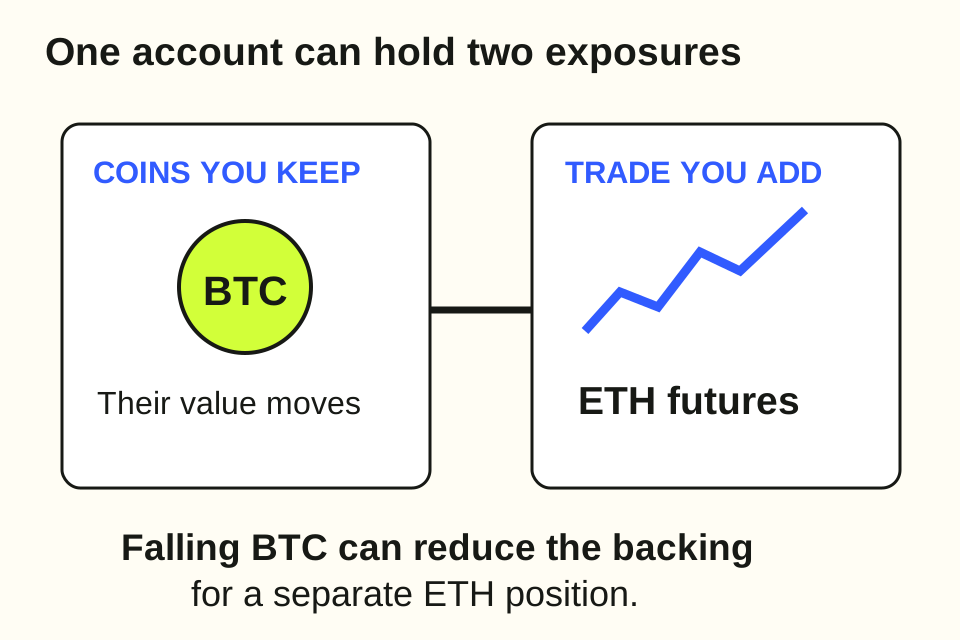
Imagine that you hold BTC and want a separate, modest ETH futures position. Selling all the BTC into a stablecoin would change your original investment as well as fund the new trade. Kraken’s multi-collateral design gives an eligible account another possibility: supported holdings can contribute to the money backing the position.
There is a catch worth understanding before using it. An exchange does not necessarily count every dollar of a coin’s market value as one dollar of usable backing. It applies a discount to some assets. If the coin falls, the usable amount falls too. This is why a large total balance can coexist with a much smaller available trading balance.
Keep the two bets visible
Holding BTC while taking a leveraged long on ETH creates two exposures. If the crypto market falls together, the ETH trade can lose while the BTC supporting it also shrinks. Calling this one account does not make it one risk. A trader who wants a simpler USDT-only budget may prefer the other product discussed below.
Kraken documents isolated margin at the contract level as well as shared margin. Isolated means allocating backing to that position rather than relying on the whole eligible pool. It is useful for deciding how much of an existing holding you actually want involved in a new trade; it is not a guarantee against every fee or account-level consequence.
Our preference here is therefore specific: Kraken suits the reader who wants to manage existing holdings and futures together and understands how the collateral is valued. It is not a claim that holding volatile coins is automatically better than keeping the trading budget in stablecoins.
When USDT perpetuals are the simpler choice
A reader with a separate USDT trading budget has less reason to choose a platform because it accepts multiple kinds of collateral. Bybit’s USDT perpetual product settles the contract in USDT, making the trading result easier to keep separate from a long-term BTC holding.
Its two-way position setting is relevant if you deliberately want a long and a short on the same USDT perpetual market. In the ordinary one-way setting, an opposing order can reduce or close the existing position instead. This is an actual product distinction to inspect, not a reason for a beginner to open both directions just because the button exists.
A useful example: closing is not the same as hedging
Suppose you are long and want to remove half the exposure. The intended result is a smaller long, not a second position that leaves two balances to manage. Check the position mode and the close controls before submitting the order. A profitable screenshot from someone using another mode may be showing a different trade from the one you think you are copying.
Brunei and Singapore should not be combined when checking this service. Bybit’s September 2026 policy excludes Singapore but does not name Brunei. Their currencies being linked does not make a Brunei resident a Singapore customer. Equally, living in Singapore with Bruneian citizenship does not remove the Singapore restriction.
Is crypto leverage legal in Brunei?
BDCB says cryptocurrencies are not legal tender and are not regulated by it. Its statement also explains that related activities, such as remittance, lending or securities issuance, may fall under financial regulation. That is a narrower and more useful description than saying either that every crypto activity is approved or that owning a coin is automatically a crime.
For this guide, the practical consequence is to distinguish an offshore product from a locally supervised account. Do not expect a foreign exchange dispute to be handled as if the platform were a Brunei bank. If a local agent says an overseas futures scheme is BDCB approved, ask for the actual authorised company and activity rather than accepting a logo.
Why the Baiduri restriction is not our exchange ranking
Baiduri’s notice restricts new transactions in complex securities, including futures and options, from October 2023 until further notice. BDCB also has investor-eligibility requirements for offers of complex securities. These are important when using that securities relationship; they do not, by themselves, establish that every international crypto exchange rejects Brunei.
Can you use Brunei dollars to trade Bitcoin futures?
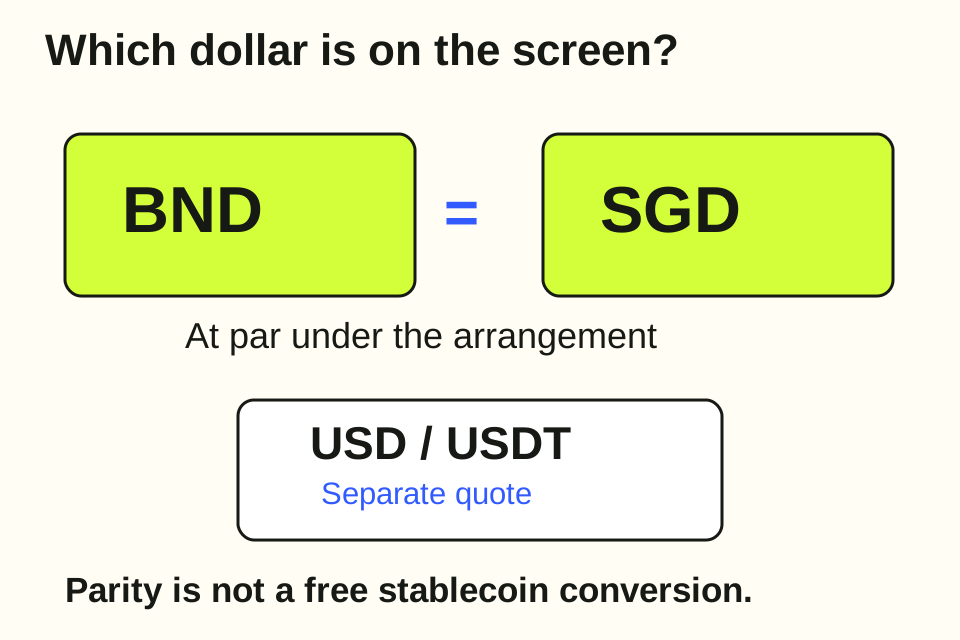
Your spending budget may be in BND; the futures account may use USD value or USDT. Those are different units. A contract labelled BTC/USD does not mean you can send Brunei dollars directly to its trading balance, and a dollar sign beside an amount does not tell you which dollar it is.
BDCB explains that BND and SGD are interchangeable at par through the monetary authorities and licensed banks covered by their agreement. This does not peg either currency to the US dollar or promise free conversion into USDT. It also does not create a Singapore bank account, Singapore exchange membership or an SGD deposit feature.
Start with the amount that reaches the trading account
For a cash-funded account, first check which funding methods are actually offered to your verified residence. Kraken publishes supported cash currencies and method-specific conditions; this review does not establish a direct BND deposit rail. Do not send BND to foreign-currency instructions and expect the receiving institution to choose the conversion for you.
Ask the bank about the intended exchange transfer before sending it. If the bank does not support that activity, an intermediary’s promise that it will look like an ordinary payment is not a solution. For an existing crypto balance, check the destination asset and network instead of assuming that the cash deposit instructions apply.
A conversion can cost more than several small trades
Here is a quote comparison, not a current exchange rate. If one lawful funding method leaves you with 300 USDT and another leaves 294 from the same BND budget, the second starts six USDT behind. A fee advertised as zero does not change that outcome if the conversion price already includes the cost.
This is why a new Brunei user should resolve the funding quote before chasing tiny differences in trading fees. Someone with USDT already available has a different decision: moving between exchanges can introduce a withdrawal charge that a cash-funded newcomer would not face in the same way.
How much do Kraken and Bybit futures cost?
For the standard international products reviewed on 29 September 2026, Kraken’s starting futures tier is 0.02% maker and 0.05% taker. Bybit’s cited non-VIP futures guide gives 0.02% and 0.055%. Maker means the order adds waiting liquidity; taker means it fills against an order already there. Personal tiers and special markets can differ.
| Order outcome | Kraken base futures | Bybit non-VIP futures |
|---|---|---|
| Both fill immediately | 1.00 USD-equivalent | 1.10 USD-equivalent |
| Both qualify as maker fills | 0.40 USD-equivalent | 0.40 USD-equivalent |
Kraken is ten cents cheaper in the immediate-fill example; there is no difference in the maker example. That small result does not justify calling either platform overwhelmingly cheaper. A worse execution price or an extra transfer can outweigh it. The calculation uses the full position size, not only the smaller sum set aside for leverage.
Perpetual funding is separate. It is a recurring payment associated with keeping a position open and can change direction. Compare the same coin at the same time if holding overnight matters to your strategy. A fee table from last month cannot tell you which exchange will have the cheaper funding tomorrow.
Kraken also documents additional charges that can arise in multi-collateral trading. Read the applicable conversion and liquidation conditions if using that product. These are different from the two normal order commissions above; they should not be quietly folded into a claim of a universally fixed round-trip cost.
Does a 100x setting mean you should use it?
The maximum is specific to the contract, position size and account. A global advertisement does not establish the amount available to a new Brunei customer. Find the market you intend to trade rather than choosing an exchange solely because another coin carries a larger multiplier.
For a simple example, 50 USDT backing a 500 USDT position means a 2% adverse move produces about a 10 USDT trading loss before costs. That is one fifth of the money allocated. The platform can close the position before all backing is exhausted because it needs a minimum amount left to keep it open.
A stop order is your chosen exit instruction; liquidation is the platform closing a position because its backing is insufficient. They are not the same price or promise. On a phone, make sure you are looking at the position’s estimated liquidation level rather than a price alert you saved earlier.
Use an order size you can explain in ordinary money. If you cannot tell whether a price move would cost five dollars or fifty, pause the live order and use the platform’s learning environment. The point is understanding the exposure, not passing a vocabulary test.
Getting the balance back to Brunei
Before funding, decide where the proceeds should end up: a personal crypto wallet or spendable BND. Those are different withdrawal tasks. Sending USDT out of an exchange is not the same as receiving a Brunei bank transfer, even when the app calls both actions Withdraw.
For crypto, match the network on both ends and check the amount after the withdrawal charge. For cash, use the currency and bank method available to the account, then establish whether the receiving bank accepts it and how it converts the money. We do not promise a tested Brunei cash-out service for either shortlist entry.
If keeping a leveraged position open, do not base the withdrawal on the headline account value. Some money is still backing that trade. Check the available amount after the proposed withdrawal; reducing the cushion while leaving the position unchanged can bring forced closure closer.
Moving between Brunei and neighbouring markets
Update a genuine change of residence before assuming the account can continue unchanged. Malaysia and Singapore are nearby but have their own rules and exchange entities. An app that worked while you lived in Bandar Seri Begawan may have a different product menu after you move.
OKX is a useful example of why the company behind the account matters. Its terms distinguish Singapore payment-token services from separately contracted derivative services, as well as other international entities. Do not select an entity simply because its advertised menu looks better: use the one assigned to your real account and confirm the relevant product.