











OKX for USDT, Kraken for an existing euro balance?
OKX is the straightforward shortlist choice for an eligible trader who already holds USDT and wants perpetual futures. Kraken is worth comparing when your funds are in euros: its Multi-M collateral table includes EUR. You do not automatically have to buy a dollar stablecoin just because the contract price is displayed in dollars.
That matters in Cabo Verde because the escudo is pegged to the euro, while many crypto trading screens use USD or USDT. Keep the three questions separate: how much it costs to send funds, what backs the position, and what currency you can withdraw. The best setup avoids an unnecessary conversion without hiding the costs that remain.
| Money already held | Platform to examine | Main trade-off |
|---|---|---|
| USDT | OKX perpetuals | Straightforward settlement unit; ongoing funding still applies. |
| EUR in an accepted funding arrangement | Kraken Multi-M | EUR can support margin, but the trade and its settlement still use the platform’s rules. |
| Only CVE at a local bank | Price the transfer first | A minimum bank charge may outweigh a small difference in trading fees. |
Can you trade crypto futures without converting euros to USDT?
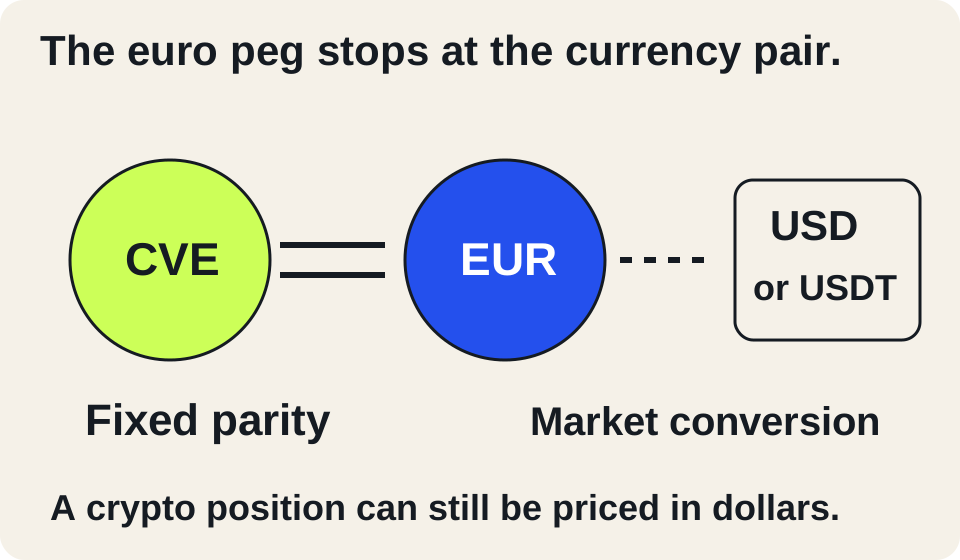
Yes, Kraken’s Multi-M documentation lists euros as supported collateral with no listed haircut. A haircut is simply a reduction in the value the platform counts towards margin. This makes an eligible EUR-funded account worth comparing with buying USDT first; it does not mean every Cape Verde bank transfer is supported or free.
The position’s profit and loss is calculated in dollars. Kraken describes USD as the default payout currency, with a choice of supported collateral assets. Inspect the payout preference and current conversion rules rather than assuming that a euro deposit makes every subsequent debit and credit a euro transaction.
When OKX is the simpler choice
If the funds are already USDT, an OKX USDT-margined contract keeps the position accounting in that unit. A trader planning a short BTC or ETH trade does not need to introduce EUR just to match the escudo peg. The earlier conversion has already happened; judge the next decision from the balance you actually own.
Our conclusion is therefore conditional on the starting asset. Prefer the USDT setup when it avoids another transfer or conversion. Examine Kraken’s EUR collateral when you have an accepted euro funding route and want to avoid buying a stablecoin solely to support the trade. A lower conversion count is useful, but the complete trading and withdrawal costs can still change the winner.
The position can still lose while your euros sit there
Collateral is the money backing a trade, not a separate guarantee that the trade will be repaid. If your Bitcoin position loses, the account must meet that loss. Holding EUR does not turn a leveraged crypto position into a euro savings account, and the CVE peg does not protect against a fall in Bitcoin.
For example, a hypothetical $4,000 position losing 3% loses $120 before costs. Whether the backing balance began in euros or USDT does not make that price loss disappear. Its final escudo cost depends on conversion and the amount actually returned.
How much does a small perpetual trade cost?
OKX’s published level-one example uses 0.05% for a taker order and 0.02% for a maker order. The fee applies to the traded position value, not just the cash set aside as margin. Your account tier is the figure to use for an actual order; the example below holds the position value constant to make the comparison clear.
| Execution | Opening + closing fees | Share of 1,000 USDT margin |
|---|---|---|
| Both orders take liquidity | 2.50 + 2.50 = 5 USDT | 0.5% |
| Both orders add liquidity | 1 + 1 = 2 USDT | 0.2% |
The lower maker total is useful only if the orders execute as intended. A limit order that crosses the book can be a taker order, while a resting order may never fill. Missing an exit to save a small fee can cost more than the saving. Compare the total expected trade, rather than treating the lower advertised number as automatic.
The holding period can reverse the result
Assume, separately, a constant positive funding rate of 0.01% every eight hours. A 5,000 USDT long position would pay 0.50 USDT each time, or 10.50 USDT across seven full days with 21 assessments. That exceeds the 5 USDT taker round trip. This is a scenario, not a forecast: the rate can change sign and the interval can change.
OKX documents one-, two-, four- and eight-hour funding intervals depending on the contract and conditions. Read both the rate and countdown. For a week-long trade, compare estimated funding against the dated future’s price, commission and any roll you would need. For a trade closed before an assessment, execution quality may matter more.
What does a CVE bank deposit really cost?
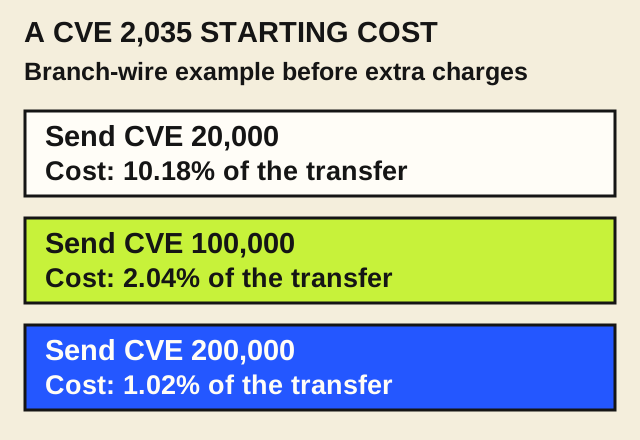
BCA’s tariff effective 30 July 2026 lists a 0.3% branch-issued foreign payment commission with a CVE 1,000 minimum in the relevant band, plus 3.5% stamp duty on the commission and CVE 1,000 SWIFT expense. On a transfer where the minimum applies, those items total CVE 2,035. Correspondent charges and conversion can add more.
| Amount sent | Illustrative listed charges | Cost as a share |
|---|---|---|
| CVE 20,000 | CVE 2,035 | 10.18% |
| CVE 100,000 | CVE 2,035 | 2.04% |
| CVE 200,000 | CVE 2,035 | 1.02% |
For someone sending CVE 20,000, even a good month of trading may not recover the starting cost. The practical choice is to avoid an uneconomic transfer, use an existing appropriate balance, or wait. Increasing leverage to “make back” the fee increases the loss exposure without reducing the bank charge.
The same tariff has a separate BCADirecto category at 0.25% with a CVE 250 minimum and its own scope. Do not apply the branch minimum to every channel, or assume the digital category covers your exchange’s beneficiary. Ask BCA for a quote against the actual receiving details. A EUR account and the ability to transfer EUR are not proof that the transfer is a domestic or free payment.
Does the euro peg protect your trading balance?
The escudo’s fixed euro parity is EUR 1 to CVE 110.265. At that reference rate, CVE 110,265 corresponds to EUR 1,000 before charges. It makes euro budgeting straightforward, but it does not fix the CVE value of USD, USDT or Bitcoin. Those add another price or currency relationship.
A flat token balance can still buy fewer escudos
Suppose you finish with 1,000 USDT and assume, only for this illustration, that each token exchanges for USD 1. At EUR 1 = USD 1.10, that is about EUR 909.09, or CVE 100,241 at the parity. At EUR 1 = USD 1.20, it is EUR 833.33, or CVE 91,888. The token count is unchanged, but the reference CVE value falls by about CVE 8,353.
A USDT balance also carries the token’s own conversion and issuer risks; the illustration deliberately holds that price at USD 1 to isolate the dollar/euro effect. Record both the trading result and the cash received. A profit displayed in the trading app is not necessarily the same percentage gain in household purchasing power.
Card conversion is a separate charge
BCV has explained that Dynamic Currency Conversion can add cost even with a fixed euro parity. If a checkout offers to show a purchase in your home currency, compare its final debit with the card issuer’s conversion. The familiar CVE label does not itself make that option cheaper, and a card’s ability to make online purchases does not establish acceptance by a particular exchange.
Can residents open foreign trading accounts?
Yes, the 2018 exchange-law framework permits residents to open and operate accounts with non-resident institutions. Article 20 states that freedom, while Article 10 addresses external financial operations subject to the law’s exceptions. An older FAQ should not be used to tell every resident that opening an overseas account automatically requires prior central-bank permission.
That answers the foreign-account question, not the suitability of a leveraged product. The provider still applies its residence, identity and product conditions. A bank can also request the purpose and supporting records of the payment. Give the real account beneficiary and product description so that a permitted investment is not confused with a transfer to an unrelated seller.
What does BCV’s virtual-asset register mean?
BCV’s May 2024 notice establishes registration requirements for entities carrying on covered virtual-asset activities in Cabo Verde. The framework is directed at anti-money-laundering and terrorist-financing supervision. It is not a blanket endorsement of a company’s investment returns or of every derivative it might advertise.
If a business claims to be registered locally, match the company name and the activity covered. A foreign platform’s licence in another jurisdiction answers a different question. Neither statement should be stretched into a promise that a leveraged balance has the protection of a domestic bank deposit.
Should you withdraw euros or stablecoins to Cape Verde?
Choose the exit that the receiving service can actually complete. A euro cash withdrawal can suit an accepted bank arrangement; a USDT withdrawal suits a receiving wallet or service supporting that exact token and network. A stablecoin transfer is not yet a CVE bank credit.
For a Kraken position backed by EUR, do not assume closing automatically leaves only euros. Check the settlement balance and payout settings, then price any conversion and withdrawal. For an OKX USDT position, compare the net tokens leaving the exchange with the final CVE quote from the receiving service. These are two distinct routes, not two names for the same payout.
| Exit chosen | Amount to compare | Do not assume |
|---|---|---|
| EUR to a supported bank account | Net EUR sent and net CVE credited | The peg makes the bank transfer free. |
| USDT to a receiving service | Net tokens after transfer fee and final CVE payout | Every USDT network is supported. |
| Partial withdrawal while a trade remains open | Withdrawable balance after margin needs | The entire account equity is spare cash. |
A test transfer should meet the receiving minimum and use the actual supported network. There is no permanent national “Cape Verde withdrawal fee”: the exchange, network, asset, payment provider and receiving bank can each affect the outcome. A quote for a different currency or a different channel is not a substitute.
Keep the original CVE outlay beside the final CVE receipt. If part of the balance remains on the exchange, record it separately. Otherwise a partial withdrawal can look like a trading loss even when funds remain available, or returned starting capital can be mistaken for profit.
Living in Praia or living abroad changes the answer
A Cape Verde passport is not the same as residence in Cape Verde. Someone living in Praia and someone living in Portugal may be assigned different provider entities, product menus and checks. An address on an old account should be updated after a genuine move; the page is written for residents of Cabo Verde, not for every member of its diaspora.
This matters especially when a relative abroad offers to open or fund the account. The account holder owns the contractual relationship, and a transfer from someone else may not fit the provider’s funding conditions. Using another person’s access can leave you unable to answer a withdrawal review in your own name.
A practical first session
Before moving funds, identify the exact perpetual, inspect its minimum quantity and preview an order with the intended exposure. Compare the possible loss with the trading funds remaining after transfer costs. Keep the EUR collateral choice separate from the dollar value of the crypto position.
Before transferring money, open the intended BTC or ETH perpetual screen and check the order value, available margin and settlement unit. Price the bank transfer separately from the trade. A supported market with an uneconomic CVE deposit route can still be the wrong choice for your particular budget.