












Start with the account you want to end up using
Bybit for a colón budget
Documented CRC deposits and sales make the return to a Costa Rican bank part of the selection.
Read the verdictKraken for crypto already owned
An international futures account without arranging a new bank payment.
Read the verdictGMX for a connected wallet
Compare the supported market and complete position cost if you already trade onchain.
Read the verdictCosta Rica’s useful distinction is the return to colones. An exchange can offer an excellent futures terminal and still leave you arranging a separate local sale. Bybit has the most directly documented CRC path of the three choices here. Kraken and GMX are stronger considerations when your starting balance is already crypto.
Why Bybit leads for Costa Rican bank users
Bybit’s deposit instructions name CRC bank transfers through SINPE, with a virtual bank account created for the deposit. Its separate selling guide lists CRC bank transfers for accounts verified in the corresponding country. Together, these documents make a locally verified account useful on both sides of a futures trade.
This is a more concrete reason to choose Bybit than a high leverage headline. If you earn and spend colones, being able to examine the local entry and exit in one service can save an extra exchange transfer. It does not guarantee that the quote is better than every P2P offer or that every customer sees the same methods.
Check these two screens before choosing a contract
First view the CRC deposit method offered to your verified account. Then view Sell with CRC as the receiving currency and your own bank details. If one side is missing, do not build a trading plan around a feature described only on a general help page. The useful result is an available method for your account, amount and receiving currency.
The product to look for afterwards is the crypto perpetual you actually want: BTCUSDT, ETHUSDT or another supported pair. A CRC cash balance is not the collateral used by a USDT contract. Conversion and any account transfer must finish before the funds can support a leveraged position.
What does the recommendation not cover?
It does not say Bybit is supervised as a Costa Rican futures exchange or that the central bank guarantees your crypto balance. SINPE is the domestic payment infrastructure; the exchange account is a separate service. We favour the documented local cash movement here, not an imagined local investment licence.
SINPE and SINPE Móvil are not the same promise
Bybit’s guide says Bank Transfer through SINPE. It does not say that you should send money to an arbitrary phone number using SINPE Móvil. Use the account information generated for that deposit. The distinction matters because familiar branding can make two different payment instructions look interchangeable.
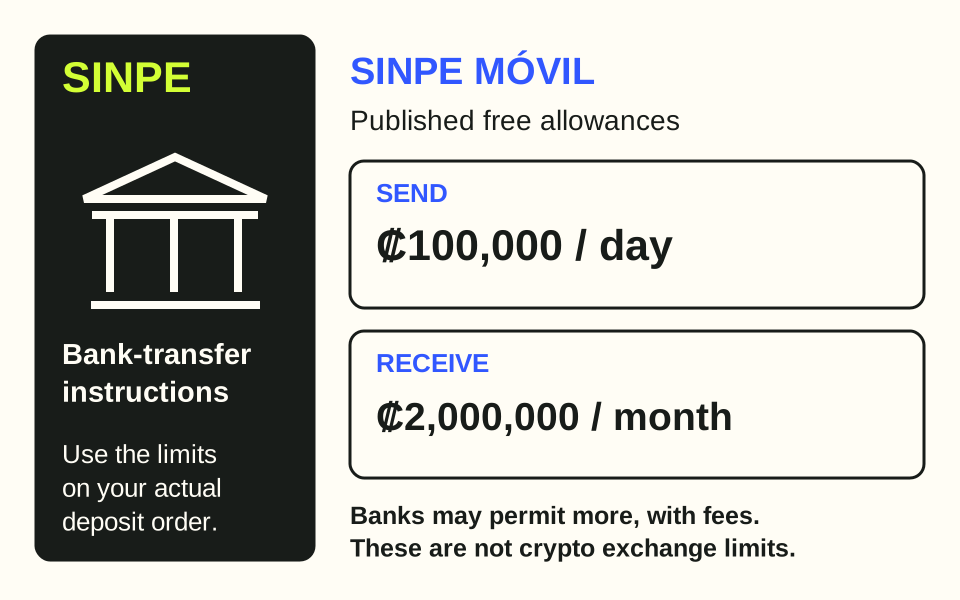
The central bank describes SINPE Móvil as the phone-linked small-payment service. Its published no-charge allowances are up to ₡100,000 sent per day and ₡2,000,000 received per month. Banks may permit larger amounts and charge above those allowances. These are not universal ceilings on crypto deposits, nor a futures account’s trading limits.
Can a larger crypto purchase be split into mobile payments?
Only follow the payment arrangement the order and bank actually allow. A seller expecting one matching payment may not accept several unrelated transfers, and a platform can ask where funds came from. Splitting payments does not establish a right to bypass a limit or review. For a larger amount, ask for an appropriate supported method instead of improvising.
For a small P2P purchase, the amount of USDT received still matters more than the word “free.” A bank transfer can carry no fee while the seller builds a margin into the quoted rate. Compare the final crypto amount for the same number of colones, including the marketplace’s displayed charge and any minimum order.
Does SINPE Móvil itself create a new tax?
The BCCR’s September 2025 clarification says using the payment method did not itself introduce a tax. The change concerned identifying that payment type in commercial electronic receipts. That clarification is not a ruling that crypto trading profits are tax-free; those are different questions.
What will a crypto withdrawal pay into your Costa Rican account?
Use the net CRC amount as the comparison, not just the exchange rate in large type. A bank payout may include a conversion spread, provider fee or fixed charge. A second route can advertise a better rate but leave less money after those charges. Get the quote for the amount you intend to sell.
| Quote | Calculation | Net received |
|---|---|---|
| A: ₡500 per USDT, no separate fee | 500 × ₡500 | ₡250,000 |
| B: ₡504 per USDT, ₡3,000 charge | ₡252,000 − ₡3,000 | ₡249,000 |
| C: ₡501 per USDT, 0.2% charge | ₡250,500 − ₡501 | ₡249,999 |
Quote A wins this example, despite having the lowest headline exchange rate. Quote C is virtually tied; Quote B’s fixed charge reverses its apparent advantage. The point is not to name a permanently cheapest provider. It is to compare the exact amount reaching your account for your actual sale size.
Order size can change that result. A fixed ₡3,000 charge consumes 1.2% of a ₡250,000 payout, but only 0.12% of ₡2,500,000. A percentage-based charge scales differently. Reusing a screenshot from a much larger withdrawal can therefore give a misleading expectation for a smaller balance.
Sell the available balance, not the open position’s value
A derivatives screen may show a position worth thousands of dollars even though the actual margin is much smaller. That position value cannot be cashed out. Close or reduce the position as intended, then check the transferable balance and move the sale amount to the account required by the selling feature.
Bybit’s sale instructions require bank details in your own name and may require funds in the Funding Account. The listed CRC option is for Costa Rica-verified accounts. A working sell quote is more useful evidence than a generic currency dropdown visible before verification.
If you expect to use the money in dollars rather than colones, compare an eligible dollar exit separately. Do not assume the USD bank-transfer row on the same help page applies to Costa Rica; that particular row is restricted to Vietnam-verified individual accounts. Different USD methods can have different rules. Keeping the output currency explicit prevents an unnecessary CRC-to-USD conversion later.
Residents, visitors and US customers: which rules follow you?
A trip to Costa Rica does not automatically turn an existing exchange account into a Costa Rica-verified account. Bybit’s CRC sale condition is tied to verification in the country, not simply being connected to Costa Rican Wi-Fi. A local phone number and a holiday booking are not substitutes for the requested identity and residence records.

If you are moving to Costa Rica
Update the actual residence and identity information through the provider’s normal process before relying on a local payment feature. Ask whether the change affects the account entity, available products or the bank details used to receive money. This is especially important if your original account came from a restricted market.
The CRC deposit instructions list several accepted document categories, including national and resident identity documents. That is useful for a resident who is not a Costa Rican citizen, but it is not a guarantee that every foreign passport alone activates the same feature. The account review still determines what you can use.
If you are a US person
Do not assume physical presence in Costa Rica removes restrictions applying to you personally. GMX’s interface terms expressly prohibit US persons from entering perpetual contracts through that interface. Bybit also has its own excluded-jurisdiction and prohibited-party rules. Follow the rule for the actual provider and product instead of treating “available in Costa Rica” as an answer for every nationality or account.
A wallet connection does not change that conclusion. The website can impose eligibility rules even where the underlying protocol is open software. We do not recommend changing location details, using someone else’s account or hiding the access location to make a blocked service appear available.
Kraken works best when you can stay in crypto
For an eligible Costa Rican resident with crypto already available, Kraken can be a cleaner decision than choosing around a domestic payment app. Its international derivatives policy does not list Costa Rica among the excluded locations. Personal customers still need full verification, and the account must actually unlock the product.
The starting derivatives fee is 0.02% for maker fills and 0.05% for taker fills. Those are futures fees; do not substitute a spot-buying fee from a general exchange review. Kraken’s multi-collateral service has additional rules for conversions and uncovered losses, so the asset you deposit affects more than the withdrawal address.
When would it beat the local-payment choice?
Consider someone who receives crypto, trades BTC perpetuals and plans to withdraw crypto again. That trader gains little from a CRC checkout they do not use. Pair availability, execution, collateral treatment and the outgoing network become more relevant than a Costa Rican bank integration. Kraken deserves consideration on those terms.
Now consider someone who needs colones after each trading session. The same Kraken account may require a separate local conversion service. That extra step can outweigh a small commission advantage and adds another place where a withdrawal may wait. Bybit retains the stronger practical fit in that case if the documented CRC sale is actually available.
Do not create an international bank-transfer dependency merely because your Costa Rican bank offers a USD account. A domestic dollar account is not evidence that a particular overseas transfer provider accepts it, nor that the route will be economical for a small balance. An existing supported crypto transfer may be simpler; compare the available methods before settling on the account.
GMX: an alternative for an existing onchain wallet
For a Costa Rican reader already using supported networks, GMX offers another way to trade crypto perpetuals. Its interface terms do not specifically exclude Costa Rica, but they do impose personal, sanctions and legal restrictions. This is an onchain trading alternative, not a locally licensed substitute for a bank account.
GMX uses external price feeds rather than matching your order against another trader in an order book. The practical difference is that a chart price and an order’s trigger are not always the same reference. You do not need to memorise the internal pricing names, but you should inspect the execution details shown for the intended order.
What should a colón-based trader inspect?
Choose the market and supported collateral first, then look at the total amount committed and the asset expected on closing. The product lets collateral and market choices affect the position. Using a volatile token as margin can add that token’s own price changes to the result; a dollar-linked margin balance isolates that part more clearly, without removing trading risk.
GMX’s charges include more than an opening percentage. Position fees, funding or borrowing, network execution charges and price impact can matter. For a small trade, a fixed network cost takes a larger share of the balance; for a longer trade, the running charges gain importance. Compare the complete preview, not a single fee label copied from a CEX table.
The reason to choose GMX here is the wallet-based account model and its supported perpetual markets, not a claim that it provides a cheaper SINPE withdrawal. It does not provide that domestic bank step. If you routinely return to colones, keep a separately verified receiving and conversion service ready before committing a larger balance.
For someone starting from a Costa Rican bank with no onchain experience, this is the more involved choice. For someone already holding the right token on the right network, the extra exchange deposit may be unnecessary. That difference in starting position is more useful than declaring every DEX easier or every centralised account safer.
Keep the trading budget separate from the money you plan to withdraw
One account can contain both money allocated to a trade and money intended for a later CRC payout. The distinction disappears if the selected margin mode lets losses draw on the wider balance. For a trader regularly cashing out to Costa Rica, that is a more immediate concern than maximising the available leverage.
In isolated margin, a position uses its assigned margin. Cross margin can use eligible balances across the account. Bybit also offers automatic margin replenishment under isolated mode, which can add available funds to the position. Turning on that feature changes the assumption that the original allocation is all that will be committed.
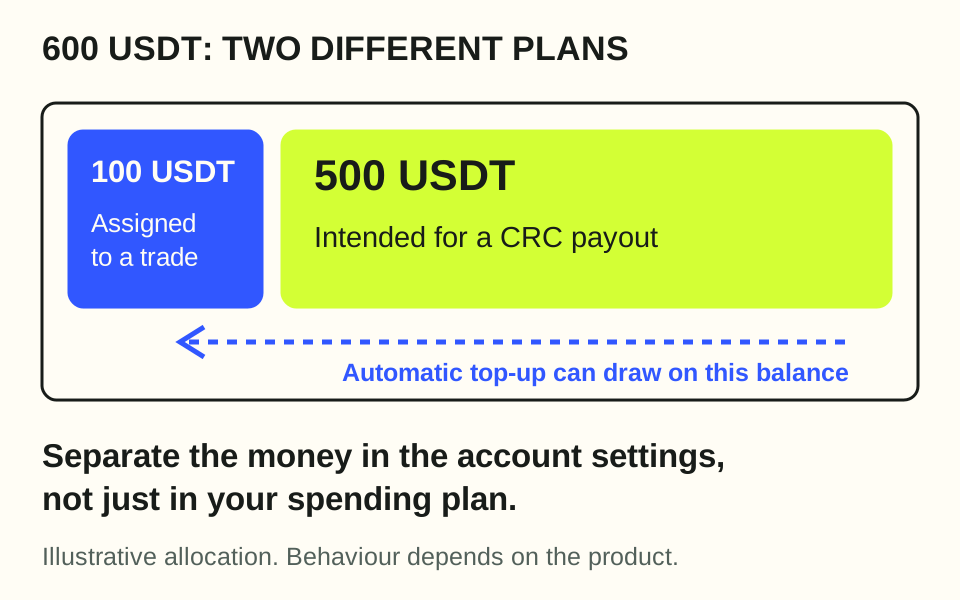
Imagine 600 USDT in the account: 100 assigned to a trade and 500 intended for a bank sale. If the setup can automatically draw on the remaining 500, the intended cash-out is exposed to more than the original trade allocation. The exact behaviour depends on the product and settings; the illustration shows the budgeting problem, not a guaranteed maximum loss.
Read those settings before opening the position, while there is time to change them. Raising leverage simply to free more of the displayed balance does not make the trade less exposed to price movement. It reduces the margin relative to the position and can bring liquidation closer. Keeping a withdrawal amount outside the trading allocation is a different decision from moving the leverage slider.
A “funded crypto account” is not the same thing as exchange leverage
SUGEVAL has warned about supposed funded trading accounts promoted through challenges and promises of access to large balances. Some offers involve a fee first and further obstacles to receiving the claimed gains. The warning is relevant to crypto traders because an advertised account size can be mistaken for money the reader actually owns.
An ordinary exchange margin position and a third-party challenge programme are different arrangements. With the exchange you choose a position against the account’s permitted collateral. In a challenge, the displayed balance may be simulated and the payout depends on separate rules. A 100,000-dollar headline does not settle who holds real funds or owes a withdrawal.
If the purpose is to trade BTC or ETH with leverage, choose an eligible exchange or protocol that actually offers that contract. Do not pay an additional release fee to an unrelated person simply to unlock a screen balance. Ask what the deposit buys, what account is real and what the withdrawal conditions are before treating the offer as trading capital.
This does not mean every funded programme is fraudulent. It means that comparing one with Bybit, Kraken or GMX solely on its headline balance is not a like-for-like comparison. The relevant question is what you can trade, what you can lose and what you can actually receive after the conditions are met.