












Kraken or OKX for a Panama-based futures account?
Kraken earns the lead here for a straightforward reason: its international derivatives account supports dollar-priced crypto perpetuals with a choice of accepted collateral, and Panama is not on the published exclusion list. That is a useful fit when you want to judge a BTC or ETH position in dollars. It still requires full identity verification and derivatives eligibility; a working homepage is not account approval.
OKX is the closer alternative for someone who wants a USDT futures account and plans to manage several positions. Its documented cross and isolated modes, alongside one-way and hedge position settings, give you different ways to organise those trades. Choose it for a function you will use, rather than because a larger menu automatically makes an exchange better.
| Your intended trade | Start here | The reason |
|---|---|---|
| BTC or ETH perpetual with eligible dollar-like or crypto backing | Kraken | A clear choice between multi-collateral and coin-backed products. |
| Several USDT positions with specific margin and position settings | OKX | Compare the required contract and account controls before moving funds. |
| A position managed from a crypto wallet | GMX | A different custody and execution model, with its own costs. |
| Buying crypto inside a Panamanian banking app | Ikigii, as a separate service | A purchase or transfer can fund a trade; it is not the futures position. |
For a single BTC trade, the practical contest is narrower than an exchange ranking makes it look. Can both accounts open the same position size? Can you close part of it? What is the actual entry and exit price? How much backing remains after fees? Those answers matter more than whether the app also sells NFTs, offers a card or lists hundreds of coins you will not trade.
We would not move an established, eligible OKX account to Kraken just to follow the order of this list. If the existing contract, costs and withdrawal route already fit, moving adds friction. Conversely, a new trader with eligible collateral and no need for a specialised USDT setup has a good reason to start the comparison with Kraken.
Which Bitcoin futures contract are you actually opening?
The clearest starting point is a linear perpetual: choose a position value, and the gain or loss follows the coin’s price move in the contract’s settlement currency. “Perpetual” means it has no scheduled expiry. It does not mean that holding it is free, or that the exchange will let a losing position run indefinitely.
Multi-collateral is useful, but it is not free extra buying power
Kraken distinguishes Multi-M contracts from Coin-M contracts. Multi-M uses a linear calculation and can accept several eligible assets as backing. Coin-M uses the relevant cryptocurrency and an inverse calculation. For someone budgeting in dollars, Multi-M is usually easier to evaluate; choosing Coin-M merely because the screen also says BTC can introduce a different profit calculation.
Suppose you want a $3,000 BTC position. Backing it with $600 is roughly 5x leverage; backing the same position with $300 is roughly 10x, before account requirements and fees. A 2% price move still changes the trade’s gross value by about $60 either way. The smaller backing changes the pressure on the account, not the number of dollars earned by the same price move.
This is why a Panama guide should not rank exchanges by the biggest multiplier. A maximum is conditional on the market, position size and account. A platform offering a larger headline number can still be a worse fit if the contract you want has awkward minimums or a poor exit price.
What happens if your backing coin also falls?
Using BTC as backing for a BTC long creates two moving parts: the trade can lose while the backing coin loses value too. Stablecoin backing removes that particular double exposure, although it brings the token’s own risks. The choice is about how you want the account to behave, not whether one asset looks more authentically “crypto”.
Kraken’s margin documentation also warns that a fall in collateral value can create account-wide liquidation risk, including in arrangements with isolated positions. Isolated margin is a useful control, but the word does not erase every account-level rule. If your aim is one bounded trade, read the collateral treatment as well as the isolated-margin amount.
Can Towerbank or Ikigii replace a futures exchange?
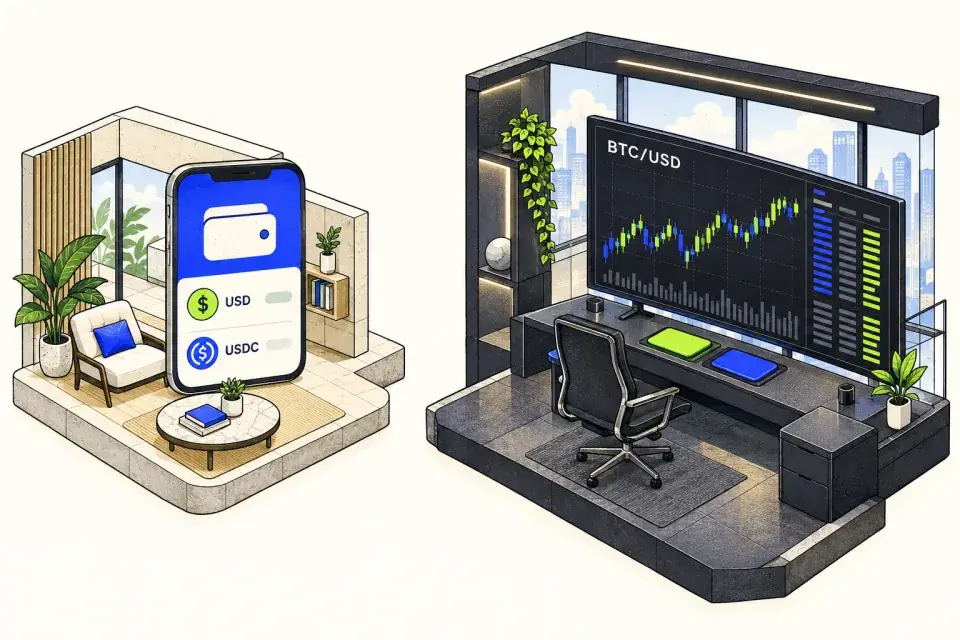
No. Ikigii’s documented service lets customers buy, hold, sell and transfer supported crypto through its banking relationship. That can be useful to a Panama-based trader, but buying Bitcoin there is not opening a leveraged Bitcoin perpetual. You still need a derivatives venue if that is the trade you intend to make.
The distinction is easy to miss because both apps may display a BTC balance and a dollar value. In the local app, you may own a quantity of BTC. In the futures account, you may instead hold collateral against a position whose value changes with BTC. Closing that position does not necessarily leave you with Bitcoin, and sending money to the local app does not automatically create exchange margin.
The local convenience has a price
Ikigii’s Spanish FAQ publishes a 2% spread for buying and 2% for selling. That is large enough to include in a trading budget before worrying about tiny differences in futures commission. The live quote remains the amount you would actually accept; the spread should not be confused with a fixed blockchain withdrawal fee.
Consider a purely illustrative conversion at $1.02 to buy a dollar-like token and $0.98 to sell it. Spending $1,000 buys about 980.39 tokens. Selling that unchanged quantity at the second quote returns about $960.78. The $39.22 difference exists without any futures trade. These invented quotes explain two-sided conversion costs; they are not a reconstruction of Ikigii’s exact pricing formula.
That does not make the service useless. A reader who values a supported local bank relationship may accept the quote. It does mean that buying and selling through it around every small scalp can dominate the economics. Compare the complete conversion with direct eligible funding, especially if you intend to trade frequently.
Towerbank’s agreement also separates the bank relationship from crypto custody involving Towertrust. The brand appearing inside a banking app should not be extended into a promise about assets later transferred to Kraken, OKX or a wallet protocol. Once transferred, the receiving service’s custody and trading rules apply.
How can you fund futures from Panama without the wrong transfer?
Already have crypto? Start with the receiving account
Open the derivatives account first, then look at the coin and network accepted by its deposit screen. If the asset lands in a main wallet, it may still need an internal transfer before it can back the trade. Do not count a pending blockchain transfer as available margin for a position that is already close to liquidation.
Ikigii’s English FAQ specifies Bitcoin’s network for BTC and Ethereum ERC-20 for ETH, USDT and USDC. A cheaper USDT withdrawal on another chain is therefore not an interchangeable way to send funds back to that service. Match the receiving instructions at the time of transfer, including the token contract where the service specifies one.
Starting with dollars? A US payment method is not a Panama payment method
Kraken publishes USD SWIFT options subject to country, account and provider eligibility. Its table includes different minimums and receiving fees: for example, Bank Frick lists a $4 minimum and $3 fee, while Customers Bank lists a $100 minimum and no receiving fee. Intermediary and sending-bank charges can still apply. Use only an option actually offered in your verified account.
The same currency does not make a domestic US rail available to a Panamanian bank account. US ACH or FedWire instructions are not a promise that Panama’s local transfer system can send the payment. If the available method is SWIFT, compare its complete cost with a supported crypto transfer. This is a funding choice for the crypto position, not a reason to replace futures with a brokerage product.
When does a fixed transfer charge beat a percentage spread?
Use the amount you intend to fund, not a general claim that bank transfers or crypto transfers are always cheaper. Suppose a complete USD transfer costs an illustrative $30, while a different purchase route costs 2% before any network charge. At $300, the percentage is $6; at $3,000, it is $60. The fixed charge becomes smaller above $1,500, provided those really are the complete comparable costs.
That $1,500 point is arithmetic using invented costs, not a tariff or recommendation to deposit more. It helps a Panama-based reader compare a quoted international transfer with a quoted local crypto purchase. A network withdrawal charge, receiving fee or conversion on arrival changes the result. Compare what actually reaches usable margin, in the asset the contract needs.
The conclusion can therefore differ for two people using the same exchange. A small test amount may favour a supported crypto route, while a larger planned balance may justify an eligible USD transfer. Someone already holding the correct token has a third cost structure because the purchase step is already complete. Keep the intended trading budget fixed while comparing the routes; a cheaper percentage is not a reason to enlarge the position.
Why a Bybit card purchase may fail despite country access
Panama appears on Bybit’s separate general fiat-service restriction list. It does not appear on the same provider’s general excluded-country list. Those are different service rules: crypto-account availability does not promise access to fiat deposits, withdrawals or one-click purchases. P2P has separate conditions and should not be inferred from either list alone.
If you already use Bybit, check the specific permitted funding route rather than repeatedly trying the same rejected payment. The restriction is relevant to the route into the account; it is not a reason to erase the exchange from Panama’s whole crypto catalogue.
What will a short BTC trade cost on Kraken versus OKX?
The published ordinary entry-level futures rates we checked were 0.02% maker and 0.05% taker on Kraken, with the same figures in OKX’s Level 1 futures example. Personal tiers, products and discounts can change those rates. At that starting point, a claim that one is much cheaper just because of its trading commission would not be supported.
| Execution | Kraken at the stated base rates | OKX at the stated base rates |
|---|---|---|
| Taker entry and taker exit | $4.00 | $4.00 |
| Maker entry and taker exit | $2.80 | $2.80 |
| Maker entry and maker exit | $1.60 | $1.60 |
A maker order adds resting liquidity; a taker order trades against what is already available. A limit order is not automatically a maker order: it can execute immediately if priced through the current market. More importantly, an unfilled cheap entry is not the same outcome as a filled trade. Do not compare them as though only the commission changed.
For fast trades, the fill can outweigh the fee
Imagine the same $4,000 purchase gets a price 0.15% worse on one venue. That is roughly $6 of extra entry cost, already larger than the $2.40 difference between the two execution patterns at opposite ends of the table. This is an invented slippage example, not a live liquidity test of either exchange.
Look at the order preview for the size you actually want. A quote for a tiny amount cannot establish the result for a much larger order. For a less active coin, compare the available depth near the price; for BTC, still check during sharp moves rather than treating its popularity as a guarantee of the fill.
For a longer trade, inspect the carrying cost
Funding is the recurring transfer associated with a perpetual, and its direction and amount can change. Kraken documents continuous calculation with hourly realisation. Other contracts can use different intervals. Read the selected market’s current rate and interval together; comparing two percentages without their time periods can reverse the apparent winner.
A multi-collateral Kraken account can incur asset conversion costs or charges for losses that are not covered in the required balance, in addition to its execution fees. For a simple dollar-like balance, check how losses are paid and leave enough eligible funds. A wider collateral menu is not a reason to ignore a cost that would not arise in the simpler balance you actually needed.
When is GMX worth choosing instead?
GMX is relevant if keeping control of the wallet outside active trades is part of your reason for trading onchain. It is not automatically better because no centralised exchange balance is involved. Opening a position puts collateral into a smart-contract system, with execution and contract risks that a wallet connection does not remove.
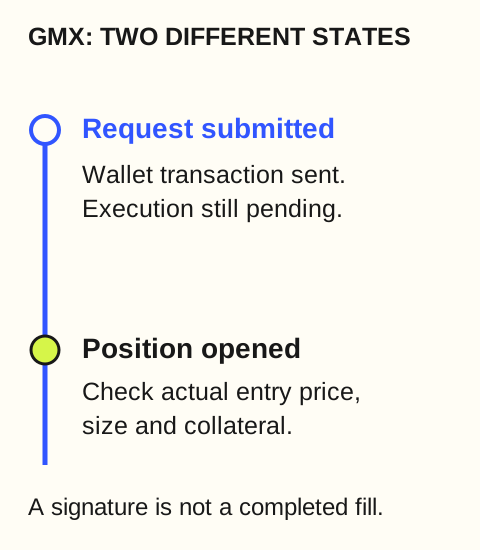
The order process differs from a familiar centralised order book. A request is submitted and then executed by the protocol’s keeper process under its conditions. A submitted transaction is therefore not necessarily a completed position. Check the final position record rather than assuming that a successful wallet signature means the trade is open at the price you saw.
For most GMX markets, its documented position fee is 0.04% when the trade reduces imbalance and 0.06% when it increases imbalance. Other costs can apply. Funding, borrowing, network fees and price impact require separate attention. This can make sense for a wallet-native trader; it does not support a blanket claim that onchain futures are cheaper than Kraken or OKX.
Our practical conclusion is to choose GMX for the wallet workflow and a supported market you actually want. For someone moving dollars out of a Panamanian bank for one BTC trade, adding a wallet, network funding and protocol transactions can be extra work with no trading benefit. For someone already holding the right assets on a supported chain, those steps may largely be familiar.
What does Panama’s crypto position mean for your account?
Do not treat Bill 697 as an enacted crypto licence. Panama’s Supreme Court declared the bill unconstitutional in its June 2023 decision. The MEF’s January 2026 publication describes institutional work on virtual assets, not a blanket authorisation for every international derivatives website.
For the reader choosing an exchange, the important consequence is specific: provider access and local regulatory approval are separate questions. Kraken’s eligibility policy can support an application from Panama without proving that its international perpetuals account is supervised as a Panamanian banking product.
When returning gains to a local account, retain the exchange trade history and the crypto sale or transfer record. Those records explain the money better than a screenshot of a green position. We do not infer a zero tax bill from Panama’s reputation or from the fact that the website is overseas; the treatment depends on the actual circumstances.
How do you take profit without leaving a trade behind?
Separate three actions: reducing the position, withdrawing collateral, and converting the withdrawal into spendable dollars. Clicking one does not necessarily accomplish the other two. This matters if you are using the same exchange balance to support several trades and expect a particular dollar amount to reach Panama.
Close the exposure you intend to close
If a $4,000 position has grown in value and you close half, the remaining half still moves with the market. Review the remaining position and any attached exit orders. An old take-profit amount should not be assumed to match the new position size; use the platform’s close or reduce-only controls where appropriate.
A positive unrealised result is also different from a completed gain available for withdrawal. Close the intended quantity, inspect realised P&L and fees, then check the withdrawable amount. If you leave another position open, its margin needs can keep some funds unavailable even while the account’s total value looks high.
Send the asset the receiving service can use
Before withdrawing to Ikigii, check the supported asset and chain in its current instructions. Before requesting a bank withdrawal, check the currency, beneficiary and provider available to your account. A deposit method listed earlier in the review does not prove that the reverse withdrawal is offered on identical terms.
For someone trading regularly, there is no need to repeat a costly local conversion after every winning trade. You can decide separately how much to keep as trading capital and how much to withdraw, while remembering that funds left on a venue remain exposed to that venue. A planned withdrawal amount is more useful than treating the entire displayed balance as disposable profit.
This is where the Panama recommendation comes together: Kraken is a strong starting point for a dollar-readable crypto perpetual; OKX deserves the comparison for its USDT trading setup; GMX serves the wallet-first case. The local banking app helps only if its conversion and transfer terms suit the way you intend to fund and exit those trades.