














Which exchange makes the most sense in Côte d’Ivoire?
Binance for an XOF starting balance
A documented local payment connection and a futures account in the same app. Compare the complete cost before moving money.
Read the verdictBybit when the overall quote is better
An alternative USDT futures venue with an XOF P2P market. A better conversion price can outweigh a slightly higher trading fee.
Read the verdictIvory Coast and Côte d’Ivoire mean the same country in exchange menus. Binance’s January 2026 prohibited-country list and Bybit’s September 2026 exclusions do not name it. This supports including them as international account candidates; product approval and local financial rules still apply. Neither is described here as an Ivorian-licensed futures exchange.
Why Binance is our first choice for an Ivorian account
The decisive advantage is practical: Binance’s June 2026 buying guide explicitly names Côte d’Ivoire, XOF, Wave, Orange and MTN. The accompanying selling guide documents the return to local mobile money. That is much more useful for an Abidjan reader than a claim that an exchange accepts hundreds of payment methods somewhere in the world.
It can remove the need to buy crypto at one business, send it over a blockchain, then trade futures at another. Fewer transfers can mean fewer network charges and fewer places to investigate when a balance is delayed. This is a workflow advantage, not a promise that Binance always has the cheapest conversion.
There is an important limit to the recommendation: a successful crypto purchase does not activate Futures automatically. Complete the residence and product checks first. If Futures is unavailable in your verified account, do not buy coins just because the mobile-money payment button works.
For ordinary BTC or ETH price exposure, decide whether a futures contract is actually needed. Buying the coin without borrowing has no futures liquidation mechanism. Futures become relevant when the intention is a short position or a deliberately chosen leveraged exposure; a payment app alone does not answer that choice.
When would we choose Bybit instead?
Bybit is a credible alternative for an existing USDT balance or a better executable XOF P2P offer. Its official P2P limits table includes XOF; that establishes the market’s currency support, not a guarantee that a suitable seller is online for your amount and payment provider. Check the whole order, including the advertiser’s minimum and the amount you actually receive.
A lower conversion cost can matter more than the small gap in basic futures fees. Suppose two permitted payment offers each cost 100,000 XOF: one delivers 160 USDT and the other 163 USDT. The second gives you 3 USDT more before trading. These are invented quotes to show the comparison, not current merchant prices.
At the standard taker rates used below, a 1,000 USDT entry and exit costs 0.10 USDT more on Bybit than on Binance. It would take thirty equal round trips to consume the illustrative 3 USDT funding advantage, before funding payments or execution differences. For occasional trading, the better conversion can therefore win. For frequent trading, calculate the repeated charges as well.
Choose Binance when the direct mobile-money checkout is available and reasonably priced. Choose Bybit when you already use it successfully or its complete funding-and-trading cost is better. Opening another account simply because its homepage looks more sophisticated is not a financial advantage.
How much does the same futures trade cost?
The comparison uses a 1,000 USDT entry and a 1,000 USDT exit, without a VIP tier or token discount. Binance’s standard example uses 0.02% maker and 0.05% taker; Bybit publishes 0.02% maker and 0.055% taker. A maker order adds liquidity; a taker order trades against an existing offer.
| Execution | Binance | Bybit |
|---|---|---|
| Both orders taker | 1.00 USDT | 1.10 USDT |
| Maker entry, taker exit | 0.70 USDT | 0.75 USDT |
| Both orders maker | 0.40 USDT | 0.40 USDT |
The result is a modest Binance advantage for taker orders and a tie for maker-only execution. It is not evidence that every Binance trade will be cheaper. An extra 0.15 USDT lost to the bid–ask spread or a worse fill would already reverse the 0.10 USDT taker difference in this example.
What happens when the exit value changes?
Imagine buying 0.01 BTC at an illustrative 100,000 USDT per BTC and selling it at 105,000. The position values are 1,000 at entry and 1,050 at exit. At a 0.05% taker rate, the two fees are 0.50 and 0.525 USDT, for 1.025 in total. Charging both sides against the original margin balance would produce the wrong answer.
The gross trading gain is 50 USDT before execution, funding and other costs. This makes the comparison easy to audit: inspect the two filled values and the two commission entries. A displayed percentage return on margin is not the amount you can withdraw.
What does 100,000 FCFA leave after getting in and out?
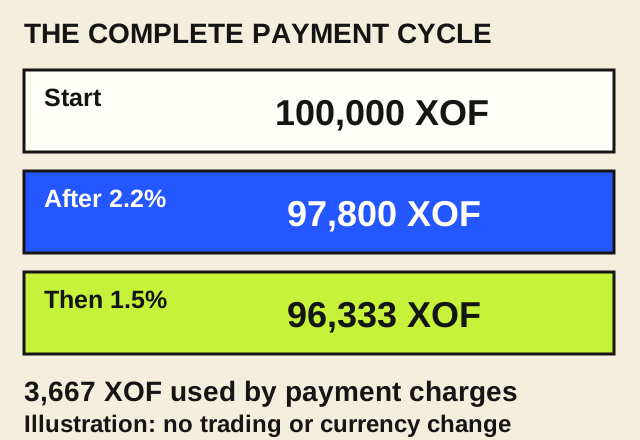
The published mobile-money tables show a 2.2% XOF buying fee and a 1.5% selling fee. Model the two stages separately. Simply adding the percentages is a convenient rough description, but it is not the exact result when the second charge applies to a smaller balance.
Assume, for illustration, that the first fee is deducted from 100,000 XOF and the remaining value later returns at the same exchange rate. After 2.2%, the value is 97,800 XOF. Deducting 1.5% from that amount leaves 96,333 XOF. The two payment stages have used 3,667 XOF before any trading loss, spread or futures fee.
Under those assumptions, the crypto balance would need to grow by about 3.81% just to return to the original local amount: 100,000 divided by 96,333, minus one. This is a payment-friction calculation, not a return target. Increasing leverage does not reduce either percentage charge.
The exchange rate shown at checkout can matter even more. Compare the final crypto credit for an identical XOF spend, then compare the final XOF receipt for an identical crypto sale. That captures a poor conversion price which a prominent “low fee” label can conceal.
Avoid moving the whole account back and forth after every small order if payment costs make that impractical. Equally, cheap internal transfers are not a reason to leave money needed for bills on an exchange. Decide the trading allocation once, with the eventual cash-out cost included, rather than treating every wallet top-up as a fresh profit opportunity.
USDC, USDT or Bitcoin: what should back the trade?
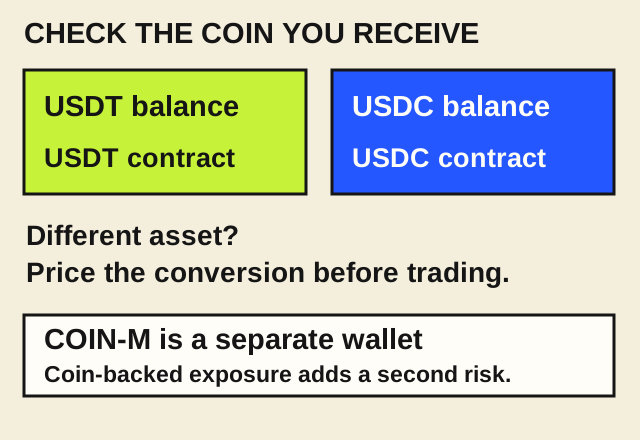
Start with the asset actually credited after the purchase. Do not assume that every local payment buys USDT. If the receipt shows USDC, either select a supported USDC contract or price the conversion needed for a USDT contract. The two stablecoins have similar dollar targets, but they are separate balances and are not interchangeable payment instructions.
Binance’s USDⓈ-M family includes USDT- and USDC-margined contracts. Its Multi-Assets Mode can share margin across supported assets, while profits and losses remain denominated in the contract’s settlement asset. That flexibility is useful for experienced users, but it operates in cross margin and can join risks that a reader intended to keep separate.
For a first single-pair account, our preference is the simpler matching balance and contract, with the chosen risk allocation clearly visible. Do not activate multi-asset collateral merely to avoid reading a conversion quote. The saved conversion cost may be small compared with the additional funds exposed by an account-wide margin setting.
Why we would not start with COIN-M
A coin-margined contract is better suited to someone deliberately managing a coin balance. An Ivorian reader measuring the experiment in FCFA would then have both the contract result and the changing coin value to track. A profitable contract in BTC can still coincide with a falling local value of the BTC collateral.
That is an additional decision, not an automatic upgrade. The exchange separates USDⓈ-M and COIN-M wallets; moving money into one does not fund the other. Match the wallet, pair and settlement asset before accepting the order, especially on a phone where the contract family can be easy to miss.
Is the lowest trading fee enough for a position held overnight?
No. A perpetual can exchange funding payments between long and short positions. A small execution saving matters less if one venue’s contract repeatedly charges more to hold. Compare the same pair and the same side; a positive displayed rate generally means longs pay shorts, while the direction can reverse.
For a 1,000 USDT long, a hypothetical 0.01% payment is 0.10 USDT. Three such payments cost 0.30, already three times the Binance–Bybit taker difference in our round-trip example. If the position stays open for several days, the history of payments matters more than the rate visible at the instant you opened it.
A rate of 0.01% per hour and one of 0.01% every eight hours are not equivalent. Over eight hours, unchanged hourly charges would total 0.08%, versus one 0.01% charge. Actual rates and intervals can change, so use the selected contract’s countdown and payment record rather than assuming every altcoin follows the BTC schedule.
For a short daytime trade, funding may be irrelevant if it is closed before a payment is due. For a multi-day view, compare cumulative funding, the spread and the cost of a dated contract where suitable. The useful choice follows the expected holding period; it is not a permanent ranking based only on one advertised commission.
How do you avoid making the first trade bigger than intended?
Write the intended exposure in USDT before touching the leverage control. If the plan is a 600 USDT position backed by 200 USDT of margin, selecting a larger leverage setting does not make the 600 USDT trade move more gently. It changes the margin requirement, not the price change of that exposure.
On a simple linear contract, a 3% adverse move on 600 USDT is about an 18 USDT loss before charges. That is already 9% of a 200 USDT allocation. Compare this local-money consequence with the original XOF budget; do not interpret an app’s maximum allowable order as an appropriate order for you.
A limit order specifies the price you are willing to accept, but it may remain unfilled. A market order prioritises execution and can trade at several prices. If you intend to open a position now, inspect the resulting filled quantity, not just the amount typed into the form. A partially filled order and an open order can coexist.
Then check the exit and the funds that support the position. Keep enough margin for the selected plan, but do not treat a future mobile-money top-up as the rescue strategy: payment processing is slower than a fast market. A payment still being processed cannot support the position already open.
What do the Ivorian rules change for the reader?
The practical distinction is between access to an international account and authorisation to operate a financial business locally. Côte d’Ivoire’s 2023 anti-money-laundering ordinance requires prior approval for professional virtual-asset services. An overseas exchange’s country list is not evidence of that local approval.
Separately, UEMOA’s external-financial-relations framework can impose documentation and approval conditions on covered overseas investments. If your funding involves a bank transfer or an investment classification, ask the authorised bank which rules apply to that transaction. A working card or mobile-money checkout does not cancel those obligations.
This review therefore compares the available products without claiming that every funding method is unrestricted. It also does not replace the exchange catalogue with a single securities broker. A BRVM share, a CME Bitcoin future and an offshore perpetual are different products, and none becomes the right substitute merely because it has a familiar investment label.
If your main objective is regional shares or bonds, use the appropriate BRVM intermediary. If it is crypto futures, verify the international account’s product and the funding permission for that use. Keep any approval and the transfer record with the account documents so the money’s origin remains understandable at withdrawal.
How do you get the final result back into XOF?
Close or reduce the intended futures exposure first, then identify the free balance. An unrealised gain is not necessarily available to move while it still supports an open position. Use the internal wallet transfer before beginning the sale to local money; do not confuse an internal transfer with an on-chain withdrawal.
For Binance’s documented mobile-money sell flow, select the coin, amount and receiving account, then review the XOF receipt before confirmation. The provider’s own guide contains different timing statements: its Wave walkthrough allows up to two days, while its FAQ describes instant credit. We therefore do not promise an immediate withdrawal. Use the order’s actual estimate and status.
The Orange Money virtual card is a separate option for online purchases inside Max it. Its ability to move value back to an Orange Money balance does not prove that an exchange can send profits to the card. Choose the documented withdrawal method instead of assuming that every way of paying is also a way of receiving.
Finally compare the XOF actually received with the XOF originally spent. Include the trading commissions and funding history, the buy and sell quotes, and any external charges. This gives a more useful answer to “did the trade make money?” than a green percentage displayed while the position was still open.