












Best crypto futures exchanges for Liberia
Kraken is the strongest fit in this comparison for someone who already holds US dollars in a transferable bank balance. Its multi-collateral derivatives account can use USD directly. That is useful in Liberia, where dollars may mean either USD or LRD: you need not buy a dollar token simply to obtain a dollar-denominated trading account.
Kraken: keep USD as USD
Best fit when your approved bank transfer reaches a USD derivatives balance.
Read the verdictOKX: start with existing USDT
A sensible alternative when usable USDT is already in your own wallet.
Read the verdictThis is a choice between two account structures, not a claim that one platform wins for every Liberian trader. A person with USDT already available has a different starting point from someone holding cash in Monrovia. Rebuilding the same balance through several currencies can erase a modest trading-fee advantage.
| Your starting point | Our preference | Reason |
|---|---|---|
| Banked USD; approved international transfer | Kraken | USD can remain the trading collateral. |
| USDT already held on a supported network | OKX | USDT-margined contracts settle in that same asset. |
| Only LRD cash or a local wallet balance | Arrange a permitted funding method first | Neither futures account accepts a handover of cash or a bare mobile-money receipt. |
The complete directory still records eight available and seven limited platforms. Those records describe provider availability; this shortlist answers a narrower question about choosing a futures account. A spot-only service or fiat gateway is not interchangeable with the derivatives products discussed here.
Why Kraken fits a banked USD balance
Kraken’s non-US derivatives eligibility page does not name Liberia among its excluded locations. Account verification and derivatives approval still apply. Select the international product appropriate to your real residence: earning or holding US dollars does not make you eligible for Kraken’s US-only futures account.
In the multi-collateral account, profits and losses are measured in USD, with USD the default profit currency. If your budget, bank balance and spending plan are already in USD, that gives you a readable result without mentally translating every gain into a second token. You can also use supported crypto collateral, but that changes how the account values your balance.
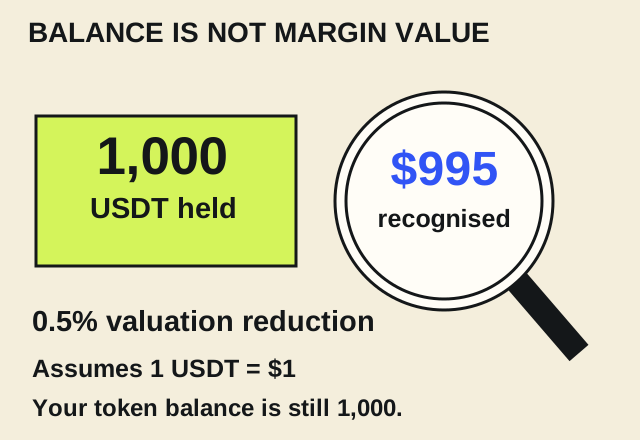
A balance is not always its full margin value
| Asset | Valuation reduction | Illustrative value of a $1,000 balance |
|---|---|---|
| USD | 0% | $1,000 |
| USDT or USDC | 0.5% | $995, assuming the token stays at $1 |
| BTC | 1% | $990 at the assumed current BTC price |
The five-dollar difference in the USDT example is a margin discount, not five dollars disappearing from your token balance. It reduces the amount recognised for supporting positions. That distinction matters when comparing a USD balance with a stablecoin balance that looks identical on the deposit screen.
Our conclusion: use the direct USD advantage only when the bank transfer is practical. If it costs a large fixed fee to send a small sum, the cleaner account structure alone does not make it cheaper. Kraken remains a good option to examine, but the transfer quotation must earn its place in the decision.
When OKX is the more practical alternative
OKX’s USDT-margined perpetuals use USDT for settlement. For a Liberian reader who already owns that asset, the appeal is direct: the trading result arrives in the asset they already know how to receive and withdraw. There is no need to create a bank-wire route just to imitate another exchange’s USD account.
Choose the USDT-margined contract deliberately. A coin-margined Bitcoin contract is a different product: collateral and results can depend on the coin’s value as well as the position. The letters beside the market name tell you what you are trading, but the settlement description tells you what you will own after closing.
Does OKX beat Kraken on normal trading fees?
The entry-level published examples use 0.02% maker and 0.05% taker rates at both exchanges. On an unchanged $2,000 position, a market entry and market exit would cost about $2 in trading fees at either venue. This comparison excludes funding, spreads, transfers and any account-specific discount. A limit order that fills immediately can still pay the taker rate.
There is therefore no honest fee victory to award here on those base rates alone. Choose OKX when staying in USDT avoids a costly detour, and Kraken when an approved USD route makes the account easier to use. An exchange that saves you a conversion can be more useful than one advertising a larger leverage number.
For example, suppose moving an existing balance to a second venue costs $6 and saves nothing on this trade’s standard commission. You begin $6 behind without gaining a demonstrated fee benefit. Staying with the suitable account is the better answer unless the other venue offers a specific order feature or market you actually need.
USD, LRD and USDT: what can actually be deposited?
The Central Bank of Liberia identifies the Liberian dollar as the official currency and the US dollar as legal tender alongside it. USDT is neither of those bank currencies. A receipt showing “$500” is consequently incomplete for this decision: the currency code and the type of account matter more than the dollar symbol.
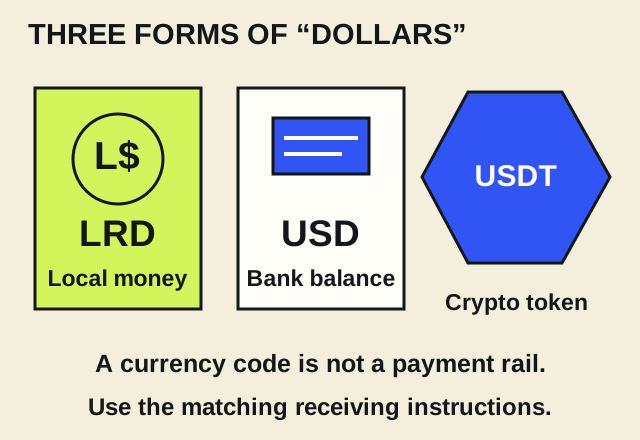
Take a salary paid in USD into your own bank account. It may support a USD wire if the bank approves the purpose and the receiving exchange supplies compatible details. Now change just one fact: the same amount is in banknotes at home. Before it becomes transferable, you need a bank willing to accept and remit it. That second situation does not have the same cost or timing.
A third person holds LRD in Orange Money. That is useful local spending power, but it is not an on-chain USDT balance. A mobile-wallet transfer to another person does not itself prove that a crypto deposit will arrive. Treat any separate purchase of crypto as a separate transaction, with its own provider, quoted amount and responsibility for delivery.
How to compare an LRD quote without guessing the exchange rate
Divide the full LRD amount paid by the spendable USDT actually received. In a hypothetical offer, L$20,000 buying 100 usable USDT costs L$200 per USDT. If a second offer delivers 98 for the same payment, its effective cost is about L$204.08. These are invented quotations to show the calculation, not Liberia’s current market rate.
This also stops a common budgeting error: calling a trade profitable because its USDT balance rose while ignoring how much LRD was spent getting into it. Use the original local cost when judging the eventual result, rather than converting both sides at today’s more flattering rate.
Can a Liberian bank send USD to Kraken?
Kraken publishes several USD funding methods, but “worldwide” in a funding table is qualified by provider and account eligibility. Its Bank Frick SWIFT entry lists a $4 minimum, a $3 deposit charge and an estimated one to five business days. These are receiving-side terms, not a promise that every Liberian bank can use the service.
The sender’s bank and intermediary banks may add costs. Do not copy account details from a review: use the instructions generated in your verified account and have your bank confirm it can send that exact payment. Domestic US payment options should not be selected merely because the balance is denominated in dollars.
Why small wires need their own calculation
Imagine a $200 transfer with a hypothetical $20 outgoing charge, $10 intermediary deduction and the published $3 receiving fee. The funding cost would total $33, or 16.5% of the intended $200. The same fixed charges on $2,000 would be 1.65%. That does not justify depositing more than you can afford; it may mean the route is unsuitable for your smaller budget.
Ask whether each charge is paid separately or deducted from the transfer. If $33 is deducted, $200 sent does not create $200 of trading collateral. If the bank charges $30 separately and Kraken deducts $3, the balance and total outlay differ again. Compare the final credited amount with the total money leaving your hands.
A working deposit is only half the arrangement. Check the withdrawal currency and bank beneficiary requirements before committing to the account. A bank that sends a payment has not automatically promised to accept a later return from an exchange, and the cheapest deposit provider need not be the cheapest withdrawal provider.
Orange Money costs: avoid an unnecessary cash detour
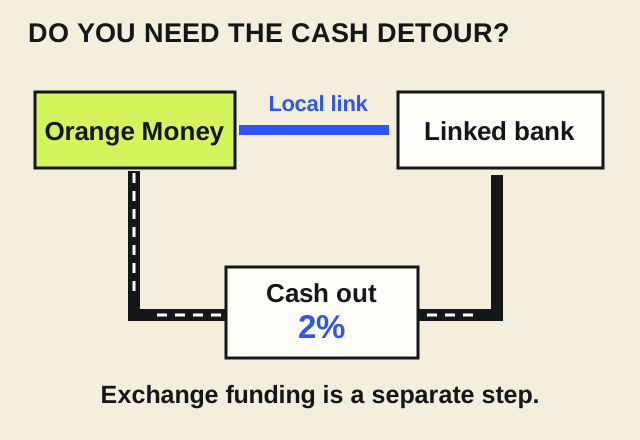
Orange’s current services page lists wallet-to-bank transfers for linked accounts at UBA, Ecobank, LBDI and GTBank. It describes that local transfer as free, while cash withdrawals carry a 2% charge. The bank link is useful to investigate before withdrawing cash and depositing it again; it is not an Orange-to-Kraken integration.
CBL’s August 2025 announcement set the mobile-money cash-out policy at 2%, effective 1 August. At that rate, cashing out USD200 costs USD4; LRD10,000 costs LRD200. Keep the two calculations in their original currencies. A free registered-user transfer is a different action and should not inherit a cash-withdrawal fee.
Why an older tariff may show a different number
An older Orange tariff page still shows tiered charges, including USD4.50 for the band containing USD200. That conflicts with the later policy and current services page. For planning, use the newer 2% information and confirm the amount displayed for your actual transaction; do not blend the old and new schedules into a single invented tariff.
The practical improvement is to remove an unnecessary step where possible. If money can reach your own linked bank account without becoming cash first, the agent withdrawal adds a cost without helping the international transfer. If the bank cannot accept the intended investment payment, however, a free local transfer does not solve that separate refusal.
What a $500 futures trade actually commits
Suppose you set aside USD100 and open USD500 of Bitcoin exposure. A 2% move against that position is approximately a USD10 trading loss before fees, irrespective of how small the initial cash allocation looks. With a market entry and exit at an unchanged position value, the base 0.05% fee example adds about USD0.50.
The purpose of this example is to separate your deposit from the size being traded. Paying USD100 into an account does not mean every subsequent cost is calculated on USD100. Equally, selecting 5× does not require you to use all the balance: the amount of Bitcoin in the order determines the exposure.
A longer holding period has a different bill
Kraken’s perpetual funding accrues continuously and is realised hourly. Its current fee page also distinguishes funding from charges related to certain non-USD-backed unrealised losses. The latter can be avoided with sufficient eligible USD or specified stablecoin balances under the published rules; they should not be presented as an unavoidable surcharge on every USDT account.
For an illustrative position of USD500, a hypothetical funding cost of 0.03% per day would be USD0.15 daily, or USD4.50 across 30 days if the exposure and rate stayed unchanged. Real funding changes and may be received rather than paid. The example explains why a plan to hold for weeks needs more than an entry-fee comparison.
Is isolated margin a complete firewall?
Kraken’s detailed multi-collateral risk documentation describes account-wide collateral circumstances that can affect isolated positions. Do not turn the word “isolated” into a promise that everything else in that derivatives wallet is protected in every situation. If you want a small experimental allocation, keep unrelated savings outside the trading account rather than relying on the label alone.
Measure the result in the money you will spend
For a USD-funded Kraken account, compare the original USD outlay with the USD that reaches your bank after the return payment. For an LRD-funded USDT account, compare the original LRD outlay with the final LRD received. Mixing those two measures can make an unsuccessful trade appear successful simply because the exchange rate moved.
Here is an illustrative LRD result. You originally spent L$20,000 for 100 USDT. After trading and exchange charges, 108 USDT remains. A permitted exit quotation of L$190 per USDT yields L$20,520 before local withdrawal costs. If a 2% cash-out charge then applies to that whole amount, L$410.40 goes to cash-out, leaving L$20,109.60. The spendable gain is only L$109.60, not the headline 8% token gain.
That example does not say cashing out is always necessary. Paying directly from a local wallet or returning to a bank account has a different cost. Decide what “withdrawn successfully” means for you: tokens in another wallet, dollars at a bank, or Liberian dollars available for daily use.
Before sending a return transfer, finish any position you intend to close and check the withdrawable balance rather than the account’s total displayed value. Collateral supporting an open trade is not a spare withdrawal balance. Keep the exchange confirmation and local receipt together so an incomplete payment can be traced to the correct stage.