










Which crypto futures platform should you use in Croatia?

OKX X-Perps deserves a close look if you want to trade both directions while keeping eligible crypto holdings in a European trading account. Its multi-asset margin is the main attraction here. Kraken is the stronger alternative when you prefer a cash-funded derivatives wallet or want to compare a true perpetual with a dated future. Neither deserves to win simply by borrowing the much higher leverage advertised on a global website.
This is a shortlist for an approved Croatian-resident account. Complete the product assessment before sending trading capital. Croatian-language pages that recommend a global 100x or 200x terminal without identifying the European product are skipping the question that determines what you can actually use.
The decision in three situations
| What you want | Candidate to inspect | The deciding question |
|---|---|---|
| Trade a BTC or ETH direction using eligible existing holdings | OKX X-Perps | Does the account accept the collateral you already own? |
| Fund in EUR and compare perpetual with dated exposure | Kraken EEA derivatives | Which contract gives the clearer total cost for your holding period? |
Start with the European contracts, Hanfa’s leverage rules and the complete trading cost. Electrocoin and Bitcoin Store appear near the end for readers who already use their Croatian conversion services or need a local cash-out route.
OKX and Kraken have equal published starting commissions for maker and taker futures fills. For a reader whose desired collateral and market are enabled on both, the next useful comparison is execution, holding cost and withdrawal, not an invented fee victory. The sections below explain what to compare without requiring a professional trading vocabulary.
Are crypto perpetuals allowed, or limited to 2x?
Hanfa’s 25 February 2026 notice relays an ESMA warning about products sold as perpetual futures or perpetual contracts. Where a product meets the definition of a CFD, the existing CFD protections apply. These include leverage limits, margin close-out, negative-balance protection and restrictions on incentives. Renaming a CFD does not remove those rules.
The established retail limit for crypto CFDs is 2:1. That does not justify saying every product with “futures” in its name has the same limit, or that every 10x advertisement is automatically approved for every Croatian reader. The contract’s legal structure and customer classification need to match the offering.
OKX describes X-Perps as expiry futures with a funding mechanism and advertises up to 10x to eligible EEA traders. Kraken publishes European perpetual and fixed-maturity specifications, with a professional maximum column. We treat those as provider specifications and access conditions, not as a statement that Hanfa has endorsed each individual market or customer.
What if your account shows a lower maximum?
Use the limit actually offered to that verified account. A review is not a way to override the provider’s classification. A lower allowance may still support the trade you intend: you can open the same position with more of your own margin, if the product and your budget permit it.
The wrong response is to switch to a false country, copy somebody else’s assessment answers or assume a global website restores the European account’s missing features. The useful response is to compare another documented product with the same intended exposure. If neither supports it, adjust the trade rather than pretending the restriction disappeared.

Did the July 2026 deadline ban Croatian crypto trading?
No. Hanfa’s July notice concerns providers’ authorisation after the MiCA transition. It does not say Croatian residents must stop owning crypto. It does mean an old VASP registration is not enough for a provider that now requires a crypto licence. Futures permissions remain a separate question from permission to exchange or safeguard coins.
What does a short trade cost from start to finish?
Imagine a Croatian trader wants $2,400 of BTC short exposure for a brief trade. At the starting taker rate of 0.05%, entering costs $1.20. Closing at the same position value costs another $1.20. Both Kraken EEA and OKX X-Perps therefore start at $2.40 for this matched commission example.
A maker entry at 0.02% followed by a taker exit would cost $0.48 plus $1.20, or $1.68. That saves $0.72, but only if the entry really receives maker treatment. A limit order that fills immediately can be charged as a taker. Avoid giving a slower unfilled order credit for a saving it never delivered.
The spread can change the winner
Suppose the execution on one venue is $2 worse across the complete trade, while its commission is $0.72 cheaper. It is still $1.28 more expensive overall. Those figures are an illustration, not a measured comparison of current order books. They explain why the best exchange for your actual order cannot always be read from a fee table.
Look at available buying and selling prices for the position size you intend to trade. BTC liquidity does not tell you how an obscure altcoin will execute. A displayed last price is simply the last completed trade; it is not a promise that your whole order fills there.
Holding the short adds another variable
OKX states that X-Perps funding settles at eight-hour intervals. A short can receive a payment when the rate is positive, but can pay when it turns negative. If the rate were negative 0.02% at a settlement, a $2,400 short would pay $0.48. Three such unchanged settlements would add $1.44. Actual rates can change.
For a position kept open through several settlements, compare the live funding and the final cash-out route as well as the entry fee. For a quick trade closed before a relevant settlement, execution may dominate. Both exchanges charge the same base commission here. The cheaper real trade depends on the fills, funding and conversion, so the first-listed brand does not win every order.
Can Croatian bank transfers fund a futures account quickly?
Croatia already uses euros, so a EUR-funded account can avoid a domestic-currency conversion at the bank-to-exchange step. The next question is whether the receiving method supports SEPA Instant, ordinary SEPA, or another route. The bank sending the money and the provider receiving it both matter.
European instant-payment rules require covered euro-area providers to offer instant euro transfers, with charges no higher than corresponding ordinary transfers. That improves the payment rail; it does not guarantee an exchange credits every customer balance within seconds. A transfer can still require a reference, verification or manual review before it becomes trading collateral.
A beneficiary-name warning is worth reading
The same payment changes introduced checks of the payee name. If a Croatian banking app warns that the name does not match the IBAN, compare both with the current instructions inside the exchange account. The proper beneficiary may be a payment company. Do not keep substituting the exchange’s brand name until the app accepts something.
OKX’s SEPA instructions explain how to obtain the receiving details and require attention to the account holder and payment information. Kraken also lists available euro funding providers. A published SEPA method confirms the payment rail, but acceptance can still depend on your bank and account. Check the beneficiary details against the exchange’s deposit instructions before sending money.
For an existing EUR balance, compare the direct transfer before using a card or a local crypto purchase. If the money is needed only for one small position, a percentage funding charge can dwarf a few cents of maker-fee savings. A sensible route leaves you with more usable collateral, not just a fast-looking confirmation screen.
Before relying on instant payment to rescue a losing position, remember that the platform must first credit and accept the funds. A transfer outside your control is not available margin. Plan the position around the collateral already accessible rather than around a top-up you hope arrives in time.
Does Croatia’s two-year rule make futures profits tax-free?
Do not assume that it does. Croatia’s income-tax law includes derivatives among financial instruments and contains a two-year rule tied to the acquisition and disposal of the relevant financial asset. Keeping an exchange account open for two years is not the same as holding every asset or contract in it for two years.
The government’s current tax overview gives a 12% rate for income from capital gains. How that applies to your trading depends on the transactions and their classification. We do not present the rate as a complete tax calculation for every individual, business activity or derivative structure.
An older Bitcoin holding and a new hedge are different records
Suppose you acquired Bitcoin in 2023 and open a short in September 2026. The older purchase date belongs to that Bitcoin holding. It does not automatically become the acquisition date of the new short contract. Save both histories rather than merging them into a single “crypto held since 2023” balance.
If the short closes profitably after a week, the contract result needs its own treatment. If Bitcoin is sold later, that disposal has its own acquisition history. The same economic intention—reducing exposure—can therefore involve distinct transactions. That is why a spot-tax slogan is an inadequate guide to a futures account.
Depositing an old coin is not proof of an old trade
A wallet transfer can demonstrate movement of an asset without showing when it was originally acquired. Keep the purchase record as well as the blockchain transfer. For derivatives, retain the opening and closing records, commission and funding entries, plus the conversion into the reporting currency where required.
For a Croatian holder choosing between a partial sale and a temporary short, this can change the after-tax result. Compare the expected cost of each option after identifying the asset being disposed of. A lower trading fee alone cannot settle which choice leaves more money after the position is closed.
What happens if your collateral falls with the market?
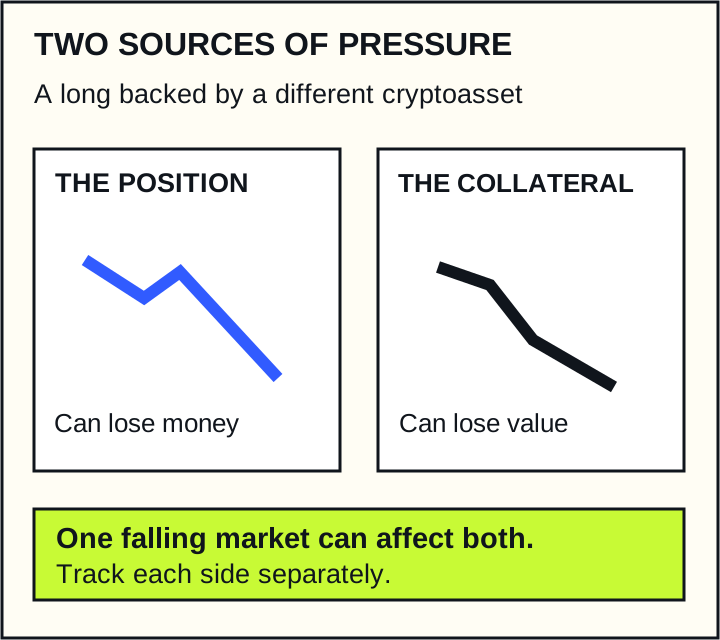
A futures position can be supported by another asset that also changes price. This is easy to miss when a platform says your existing coins can become trading collateral. The trading position and the backing behind it can both move at once.
Consider someone using ETH as collateral for a leveraged long on another cryptoasset. If the market falls broadly, the long loses money while the ETH backing may also fall. A cash-backed version of the same long would still lose on the position, but it would not suffer that particular second source of crypto-price decline.
Is coin-backed margin always a bad choice?
No. A trader may deliberately want to retain an eligible coin and use part of its value for another position. The point is to recognise the combined exposure. If the aim was simply a small BTC trade, tying a large long-term altcoin holding to it may create more complexity than the trade needs.
Collateral reductions also matter. If a hypothetical platform counts only 90% of an asset’s market value, €500 worth supports €450 before other requirements. If that asset then falls by 10%, its market value becomes €450 and the same 90% recognition produces €405. These are deliberately round illustrative numbers, not the current collateral terms of either exchange.
When comparing OKX’s multi-asset approach with a cash-funded Kraken position, decide whether retaining the coin exposure is something you actually want. If yes, the feature solves a real problem. If no, a simpler backing asset can make the position easier to understand. A longer feature list is not automatically a better account for a beginner.
Should you short Bitcoin or sell part of your holding?
A short can reduce price exposure without selling all the underlying coins, but it creates a second position to manage. Selling a portion is simpler operationally; a derivative may preserve the holding but introduces margin, funding and liquidation. The better approach depends on why you want to reduce exposure and for how long.
For a numerical illustration, take a 0.10 BTC holding and a 0.04 BTC short. Ignoring basis, fees, funding and collateral effects, the combined directional exposure is approximately 0.06 BTC long. A $5,000 fall in Bitcoin would reduce the holding by $500 and add roughly $200 to the short, leaving a net $300 price loss.
This is not an exact guarantee because a futures contract can trade differently from spot. It is also not a tax-free substitute for a sale. It shows what the hedge is trying to do: reduce a specific exposure, rather than turn the account into a bet on both directions with no plan.
Why the separate margin balance matters
A hedge can be directionally sensible and still be closed by liquidation if the short lacks margin during a sharp rise. The underlying coins may be gaining value in another wallet, but that does not automatically fund the exchange’s short. You need a plan for the account that carries the derivative, not just a combined spreadsheet result.
If that extra management is unwelcome, reducing the spot holding may fit better. If you need a temporary hedge and understand the cash commitments, compare the specific futures contract and funding. The useful choice is between complete strategies, not between a supposedly sophisticated trade and a supposedly unsophisticated sale.
If you already use a Croatian coin service, can it fund futures?
A Croatian coin-service account can fund a separate derivatives account, but it is not necessarily the cheapest path. If you already hold an eligible asset, compare its transfer cost and recognised collateral value with selling it into EUR first. If you have only euros, compare direct funding before adding a local coin purchase.
This distinction matters when comparing “fees”. A local quote for buying €700 of Bitcoin covers a conversion into an asset. A futures commission on €700 of exposure covers a trade in a contract. Those prices pay for different things, so putting them in one cheapest-exchange table can mislead readers before they have even chosen a product.
Can you use coins you already own to support a trade?
Some derivatives accounts let selected coins support positions. The platform gives those coins a recognised collateral value and can reduce it to allow for volatility. In plain English, a €500 market value does not necessarily provide €500 of usable trading backing. The accepted assets and reductions belong to the specific product.
There is also a custody trade-off. Coins transferred from a personal wallet to a trading account are no longer held only under your own wallet keys. If your goal is merely to protect part of a long-term holding for a short period, consider whether a separately cash-funded short does the job with less of that holding placed on the exchange.
That is why OKX’s multi-asset feature is useful for some readers, not a blanket reason to transfer every coin. Kraken accepts eligible crypto collateral too; it is not a cash-only venue. A separately cash-funded position, on either suitable account, can be preferable when the priority is keeping the long-term wallet separate. Neither arrangement removes the need to fund losses and maintain enough margin.
Where do Electrocoin and Bitcoin Store fit?
Hanfa authorised Zagreb-based Electrocoin as a crypto-asset service provider under MiCA in April 2026. The listed scope covers services such as exchanging cryptoassets for funds, exchanging one cryptoasset for another and transferring cryptoassets. That is a useful local development, but it should not be rewritten as an approval of an unlisted leveraged product.
Electrocoin can be relevant when you want a locally documented conversion or payment service. For a futures account funded from an existing Croatian euro bank balance, however, first compare direct exchange funding. Buying coins locally, withdrawing them and then converting them again at the derivatives venue introduces extra transactions that might be unnecessary.
What a physical branch does and does not solve
Bitcoin Store publishes Croatian branch locations, including cash buying and selling in Osijek. A staffed branch can help someone who needs in-person service or starts with cash. It does not mean the same company has a perpetual order book, nor does a face-to-face purchase remove later identity or source-of-funds checks at another platform.
Before choosing that route, request the amount of the actual coin that will reach your wallet after the purchase and any transfer charge. The number to compare is the final usable balance, rather than an isolated claim about a commission. Bitcoin Store publishes a separate withdrawal-fee schedule, which reinforces the need to distinguish buying from sending.
For example, if two routes start with €700 and leave €686 and €696 worth of the same supported asset after all quoted costs, the difference is €10. That is a hypothetical comparison method, not a quotation from either Croatian service. It helps you make a decision even when providers describe their charges differently.
Keep local conversion as an optional service rather than a mandatory gateway. A person already holding the correct supported coin may not need it at all. Someone who values Croatian-language help may reasonably pay more for it, provided they understand what they are buying and still choose the futures venue separately.
How do you withdraw after a futures trade?
Check the derivatives balance after closing, rather than treating the unrealised profit shown during the trade as withdrawable cash. Funds supporting open positions or outstanding requirements are not the same as a released balance. Cancel any obsolete orders that could reopen exposure before you move the trading funds.
For a Croatian euro bank destination, a supported direct EUR withdrawal is the first route to price. A transfer through a personal crypto wallet and a local conversion service may be appropriate when you specifically want that service, but it adds costs and separate counterparties. Compare the final euro amount after all steps.
A network withdrawal introduces a different set of questions: the coin, network, recipient address and any required memo must match. A cheap network is not useful if the destination does not support it. The withdrawal fee published by a provider is also distinct from a blockchain fee you might later pay from your own wallet.
If a bank asks about the incoming funds, the most useful package is a coherent deposit-to-trade-to-withdrawal history. A screenshot of a green profit number rarely provides that trail. Exporting the ledger while the account is active is easier than trying to reconstruct a series of transfers months later.
Which details should Croatian readers reject in a review?
Reject a recommendation that describes a local coin shop as a futures venue without showing the actual leveraged product. Reject a table that mixes a spot conversion spread, a futures maker fee and a card deposit charge as if they measured the same cost. These are especially common traps when an international ranking is adapted to Croatia by adding a flag.
Also reject a universal maximum leverage figure with no account or product qualification. A genuine regional limitation should be explained, while a provider’s documented European offering should not disappear simply because global marketing is unreliable. The aim is an accurate shortlist, not the largest list or an empty list.
The unresolved part is personal approval and live execution: a public-source review cannot pre-approve your account or measure tomorrow’s order book. The resolved part is the choice of product families. OKX X-Perps and Kraken EEA derivatives are the exchange candidates to examine; Croatian conversion services serve a different need. That is enough to begin a focused comparison without first reading a catalogue of unrelated traditional brokers.