
Which familiar futures exchanges accept Cuban residents?
| Provider | Resident of Cuba | What the rule covers |
|---|---|---|
| Bybit | Excluded | Its service-restricted-country policy |
| OKX | Restricted | Its published jurisdiction restrictions |
| Kraken | Derivatives unavailable | Its international futures eligibility list |
Do not deposit into these accounts expecting to unlock futures from Cuba. Their country restrictions answer the practical question before any fee or leverage comparison becomes useful. A working market chart, downloadable app or invitation code is not evidence that a Cuban resident can open the trading product.
There are crypto services connected with Cuba, including payments and wallet products. They should be assessed for what they actually do. A service that converts or transfers tokens is not automatically a venue where you can short Bitcoin, choose 20x leverage or set a stop on an ETH perpetual.
What Ebioro’s renewed Cuban licence actually changes
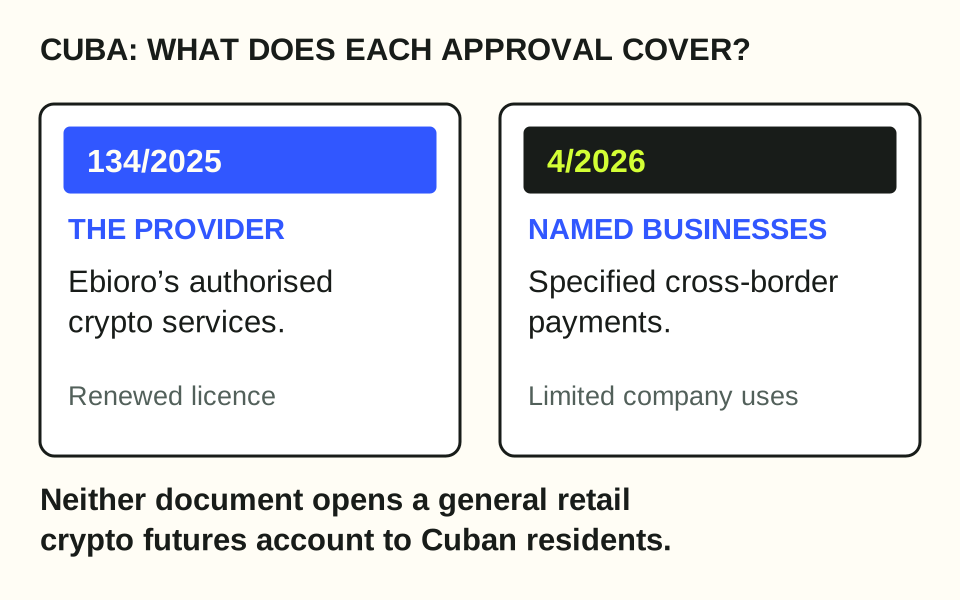
Ebioro is relevant because its Cuban licence is real and has been renewed. Resolution 134/2025 replaced the earlier Resolution 8/2025. The new one-year licence took effect on 28 January 2026; the official gazette reproducing it was published on 26 February. Those dates prevent an old licence reference from being mistaken for the current permission.
The listed activities include exchange, payments, transfers, custody and services connected with virtual assets. The licence also requires separation from services outside the Cuban regulatory scope. It does not establish that every feature on Ebioro’s wider website is available to a Cuban resident, and it does not identify a retail BTC perpetual account.
What can a crypto user recognise in the product?
Ebioro describes a non-custodial wallet using USDC on Stellar, payments and digital-asset exchange, alongside variable-return DeFi savings and a business platform. That gives a useful product identity: a wallet and payment environment with additional services. It is not a reason to place it at the top of a crypto leverage ranking.
If your actual need is to receive or use crypto, inspect the applicable wallet service. If your need is to profit from a short-term fall in BTC through a leveraged short, the wallet description does not answer it. This distinction avoids the frustrating experience of signing up through a “best futures exchange” page only to find payments and savings.
Do the 2026 business permissions open crypto trading to everyone?
No. Resolution 4/2026 names ten legal entities and permits virtual-asset cross-border payments tied directly to their business activities. It requires licensed providers and says other uses need a new authorisation. The permission belongs to those entities and that use; it is not a public invitation to fund an offshore futures account.
This matters if you run a business and see a headline saying Cuba has “approved crypto.” A permission to pay an overseas supplier answers how that specified business may settle an obligation. It does not answer whether the same business can speculate on a coin with leverage, or whether its owner can use the company’s permission for a personal trade.
What would establish an actual futures service?
Look for a real contract specification, customer eligibility, the margin asset, the order and liquidation rules, and withdrawal terms for the account being offered. A payment licence on its own cannot supply those missing product details. The same distinction applies whether the service uses Bitcoin, USDC or another token.
Why an Ebioro wallet does not promise a foreign IBAN
A particularly useful detail appears in Ebioro’s own help centre: the banking provider’s country list for creating virtual IBAN accounts includes Cuba among the excluded jurisdictions. That restriction is about the banking feature. It should not be expanded into a claim that every Ebioro service is unavailable, or ignored because the company has a Cuban virtual-asset licence.
For a reader trying to withdraw crypto, this changes the plan. Do not assume you can open a foreign bank-style account inside the same app and use it as an automatic exit. The wallet, the conversion service and the third-party banking feature each need to support the customer and transaction.
Ask about the destination before sending the token
Specify whether you need CUP in a domestic bank account, a supported token in your own wallet, or a permitted payment to a business. These are different results. “Withdraw dollars” is too vague to settle which service is being used or which customer rules apply.
A balance labelled with a dollar sign can represent a token, an internal platform balance or a bank claim. The label alone does not establish that it can be redeemed through a particular bank. Get the asset name, receiving method, total fee and expected net amount for the specific transaction before treating the balance as spendable money.
This is also why a foreign account opened by a friend does not repair a restriction on your own account. It changes the named customer and introduces another person into the transaction. A legitimate payment route should describe the real participants and the purpose, rather than depend on a mismatched identity.
Buying USDT, using P2P and trading futures are different jobs
Local crypto discussions often use “exchange” for a place to buy, sell or transfer value. That is understandable, but a futures comparison needs a narrower meaning. You need a provider that accepts the customer and offers the leveraged contract, not merely a way to obtain the token used by such contracts elsewhere.
QvaPay’s own P2P documentation illustrates the difference. It describes buying and selling offers, with an amount denominated in QUSD and a separate receiving amount in the selected payment currency, including a BANK_CUP example. It also specifies account verification for creating offers. Those are payment-market functions, not evidence of a perpetual futures order book.
What does the QvaPay example actually show?
The order has two amounts: the QUSD balance being exchanged and the sum requested through the selected payment method. In the BANK_CUP example, the receiving amount is in Cuban pesos. Read both fields together. The QUSD amount is not a promise to deliver the same number of US dollar banknotes, and the CUP receiving amount is not a leveraged position size.
Similarly, USDT, USDC and an internal QUSD balance are not interchangeable just because each uses dollar-like terminology. Before any transfer, identify the exact asset and network accepted at the destination. Sending a token with a similar name does not create a matching balance automatically.
This lets you judge a local payment offer on its real terms: the balance surrendered, the currency received and the receiving method. If the seller instead advertises borrowed buying power, ask for the separate lending or derivatives product terms. A P2P order alone does not provide them.
Does a DEX remove the Cuba restriction?
No automatic exemption follows from the word DEX. A wallet can connect to software while the website’s terms still exclude the user. Hyperliquid’s interface terms include restricted territories and, in some cases, their citizens. GMX also uses residency, nationality and sanctions conditions. Neither should be promoted as a guaranteed workaround for a Cuban resident.
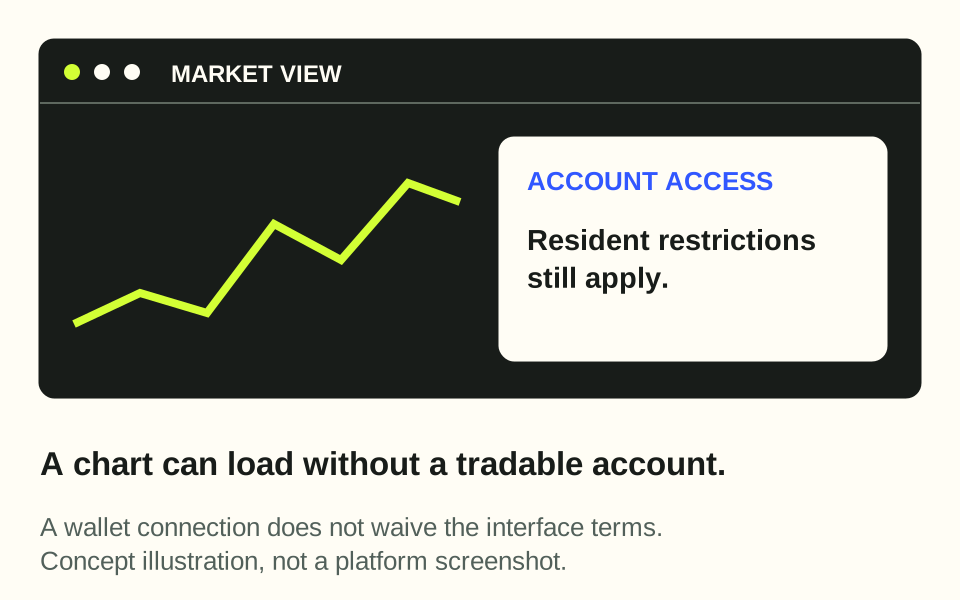
The distinction is between the software existing and the service being available to you. A public blockchain can show transactions from many places; that observation does not establish permission to use a particular hosted interface. A successful wallet connection is a technical event, not a completed eligibility decision.
What about a “no-KYC” futures offer?
A website that does not immediately ask for identification may still exclude countries in its terms or request documents before withdrawal. “No document at signup” is therefore a poor substitute for an actual Cuba policy. It also says nothing about how a withdrawal problem would be resolved after funds have arrived.
US sanctions obligations are not removed merely because a transfer uses a token instead of traditional money. OFAC’s virtual-currency guidance makes that clear for parties subject to its rules. The right question is whether the actual parties and activity are permitted, not whether the transaction happens to use a wallet.
For this reason the page does not replace the blocked centralised platforms with a DEX signup button. A different provider would need its own credible Cuba eligibility and product evidence. We have not established such a recommendation in the sources reviewed for this update.
What changes for a Cuban national living abroad?
Being Cuban and living in Cuba are related but different facts. OFAC explains that certain Cuban nationals who have established permanent residence outside Cuba can qualify as unblocked nationals under its rules. That is a reason to have the actual status assessed, not to assume nationality alone permanently excludes every service.
A provider can still have its own stricter terms, and the new country has its own product rules. Someone permanently living in Canada, for example, needs the Canadian product answer; moving abroad does not make every global perpetual account available. Conversely, an exchange’s country-residence restriction should not be paraphrased as a ban on all people born in Cuba.
How should an existing customer handle a genuine move?
Tell the provider the real residence and ask which documents it needs to review the account. Keep nationality, current residence and the country from which you access the service accurate. Do not select an unrelated location merely because its signup flow appears easier.
If the review approves a different set of products, use the terms attached to that approved account. A statement about a sanctions exemption does not force a company to offer futures, accept a particular bank or ignore another country’s retail derivatives limits. These are separate decisions and may produce different answers.
If you are visiting Cuba while maintaining a lawful residence elsewhere, ask about temporary access before travelling. Some terms address physical location as well as residence. Do not assume that an account which works at home will allow the same trading or withdrawal actions during the visit.
Already have crypto in an account that is restricted?
Stop treating it as a fresh signup problem. The immediate task is to establish what actions the provider permits for the existing balance or position. Save the restriction notice, account identifier and transaction history, then ask through the official support channel about the permitted closing or withdrawal process.
Describe the actual asset and whether there is an open trade. “My money is blocked” can mean a login restriction, an uncredited deposit, a withdrawal review or collateral still supporting a position. Those situations need different handling. For an incoming transfer, keep the transaction identifier and network; for a futures position, keep the instrument, size and order history.
Do not pay an unsolicited contact who promises to remove a country restriction or release funds through a private wallet. A request for an additional transfer does not prove the person controls the account review. Use the contact route inside the official service and verify any claimed charge against its published policy.
Is the new “Bolsa de La Habana” a place to trade crypto futures?
Ebioro’s August 2026 explanation describes Bolsa de La Habana as a controlled technical prototype, with simulated orders and no real counterparties or customer funds. Its stated subject is securities infrastructure. It is not an operating Bitcoin perpetual venue and should not appear as one in a Cuban leverage ranking.
The distinction is useful even if the demo looks convincing. A working trading screen can demonstrate software without providing a service that accepts deposits and settles real trades. Judge an announced launch by its actual product, customer terms and operating status, not by the presence of charts and Buy or Sell buttons.