













Bybit or Kraken: which fits your Jamaican trading account?
For a Jamaican resident who already holds supported crypto, Bybit provides a USDT futures account without requiring a JMD trading balance. Kraken is the alternative to compare for the intended BTC or ETH contract, particularly when its lower published base taker fee or an existing funding route suits the account.
That recommendation has a practical condition: you need a supported crypto funding method. Jamaica is absent from Bybit’s general service exclusions but is explicitly named on its general fiat-service restriction list. Do not open the account expecting a Jamaican card, a direct JMD balance or One-Click Buy to work just because the trading website loads.
Kraken’s international derivatives policy does not name Jamaica among its exclusions, subject to verification. Its published base taker commission is 0.05%, compared with Bybit’s 0.055%. The larger local obstacle is funding: an international trading account does not imply support for a Jamaican card or bank deposit.
| Your requirement | Better starting point | Reason |
|---|---|---|
| You already hold the supported crypto collateral | Bybit | USDT futures without relying on a Jamaican fiat purchase service. |
| Manual futures at the published base taker rate | Kraken | 0.05% versus Bybit’s 0.055%, before other costs. |
| Buy crypto directly with JMD first | Check the funding offer separately | A futures recommendation does not establish a usable Jamaican payment method. |
For scale, opening and closing an unchanged 6,000-dollar position with immediate orders would cost 6 dollars at 0.05% each way, or 6.60 at 0.055%. Those are commission-only examples. They do not include holding payments, a different exit value or the cost of acquiring the trading balance. Sixty cents is not enough to outweigh a better market or a working account you already understand.
How can you fund futures from Jamaica without a JMD deposit?
If you already hold supported crypto, use the deposit instructions from your own verified exchange account. The receiving network must match the sending network, and the balance still needs to reach the correct trading wallet. Move the accepted collateral to the trading wallet required by the chosen contract.
Starting with Jamaican dollars
Binance announced JMD support in its P2P marketplace in January 2023. That is a specific place to check for a current offer, not proof that sellers are present at the price or order size you need today. The article has not tested a live Jamaican P2P purchase. Do not turn an old launch announcement into a guaranteed local on-ramp.
A useful offer must match three things at once: your JMD budget, a payment method held in your own name, and the crypto you will actually receive. A seller advertising a low price but requiring a much larger minimum is not the cheaper option for your order. An unavailable payment method is not an option at all.
Ask for the total Jamaican-dollar debit and the final transferable token amount. Include any onward network charge if the tokens must move to another exchange. A low headline rate followed by an expensive second transfer can be worse than a slightly higher rate that leaves you with the right balance in the right place.
Does a USD bank account solve the problem?
It removes one possible currency conversion, but not the bank’s transfer fee or the exchange’s receiving conditions. NCB’s published guide effective September 2026 lists J$3,850 for an online outgoing international wire and J$5,312.48 in branch. Those are ordinary banking charges, not evidence that NCB will accept a transfer to the chosen crypto provider.
A J$3,850 fixed fee is about 12.83% of a J$30,000 funding budget before any exchange cost. At J$150,000 it is about 2.57%. This is why a small first account should not be chosen around trading commission alone. Get the bank’s current accepted beneficiary, currency, total fee and conversion quote before sending; intermediary charges can change the amount received.
The Bank of Jamaica explains that authorised dealers set their own exchange rates. A published average is therefore a benchmark, not the rate owed to you by a bank or a crypto seller. Compare a real purchase quote against that benchmark, while remembering that a USDT quote is not a cash-USD transaction.
Jamaican rules, JAM-DEX and real crypto trading accounts
JAM-DEX is not a perpetual exchange
Despite the letters DEX in its name, JAM-DEX is the Bank of Jamaica’s digital currency. The central bank’s FAQ distinguishes it from cryptocurrency. Holding it through a supported local wallet does not give you a Bitcoin futures position, a USDT balance or access to an onchain perpetual market.
This matters when a tutorial mixes a local payment app with a crypto exchange. Ask what asset changes hands and where the resulting balance is held. A payment in Jamaican digital money can settle a local obligation without creating any claim on an overseas futures account. There must be a separate, permitted service connecting those steps.
What the local regulator has actually warned about
The FSC’s notice dated 29 May 2026 describes fabricated balances and results used in virtual-asset, prop-trading and educational-subscription offers. It also warns about further payments demanded as taxes, insurance or withdrawal fees before access to funds. A genuine exchange name can appear in an unrelated fraudulent promotion.
An ordinary account you open with an exchange is different from giving a local promoter money to manage. The latter adds another person or business between you and the platform. The FSC says providers of securities or investment products need the relevant registration or licence. Verify that specific provider rather than accepting its use of someone else’s logo.
The Bank of Jamaica’s crypto caution is not an endorsement of offshore futures. Our access findings come from provider conditions; they do not establish Jamaican supervision of the derivatives account. If local protection is your deciding factor, a foreign registration or a working signup form does not answer that question.
These distinctions should not bury the trading decision. Choose an eligible exchange for the product you need, understand how you will fund it, and keep the account in your own name. The local warnings become especially relevant when someone offers to remove those steps in exchange for custody of your money.
When does Kraken’s lower commission justify another account?
Kraken’s published base taker rate makes it a sensible manual-trading alternative in this shortlist. That is a modest cost advantage rather than a promise of better fills. Compare the particular contract and your actual account fee; Bybit remains a valid manual platform if its market, app or existing balance better suits the trade.
Before moving funds just to change platforms, estimate how often you will trade and the saving on each completed trade. A one-off network fee can exceed months of a small commission difference. Conversely, a trader who repeatedly opens large positions has more reason to compare execution quality and cumulative fees.
If you choose to copy a trader
Will a copied trade really match the trader you follow?
No: joining a trader is not the same as inheriting their current portfolio. Bybit’s Classic FAQ says new followers copy trades opened after they successfully start following, rather than automatically taking over all the existing open positions. If the attraction was a screenshot of a profitable position already running, subscribing now does not buy that earlier entry.

Why a missed copy is not always a broken account
The product can skip an order because of insufficient funds or an entry-price control. CopyGuard, available in Smart Copy mode, is intended to avoid entering at a worse price than the leader. A skipped trade can therefore reflect a setting doing its job. It is not automatically a reason to increase the deposit or disable the control.
Imagine a leader buys during a fast breakout, while your intended copy would enter after a sharp jump. Following at any price might reproduce the direction but change the trade’s appeal. Waiting may mean missing a winner; entering late may mean absorbing a reversal the leader can survive more easily. The useful choice is the entry you are willing to accept, not the largest possible count of copied orders.
Bybit also lets followers limit the contracts they copy. A reader who wants to follow BTC and ETH can end up with a different portfolio from a leader who trades many smaller coins. That can be intentional, but the leader’s overall result then becomes an even weaker forecast of the filtered follower account. Judge the trades you actually received.
Which settings remain yours?
Forced Sync can prevent customisation of some follower parameters. Bybit’s comparison of trader and follower accounts explains another difference: a leader reducing leverage can require more backing, which a follower may not have. Even with a follow-leverage setting, the two accounts can diverge. The label describes the requested behaviour, not a promise that every adjustment can be reproduced.
The follower screen should tell you what is open, how much margin is occupied and which orders were received. Use that record when investigating a difference. Adding money before identifying the cause can solve a balance shortage, but it cannot retroactively recreate an entry that has already passed.
Bybit lists 100 USDT as the general minimum for starting Copy Trading Classic, while individual leaders can require more. Buying exactly that amount in JMD can leave you short after transfer costs. Separate the minimum needed to enter the product from the balance needed to follow the chosen trader’s actual orders.
What do you keep after a profitable copy-trading cycle?
A follower’s payout has an extra moving part: the share paid to the lead trader. Bybit’s published Classic schedule lists 10% for Cadet and Bronze, 12% for Silver and 15% for Gold. This sits alongside trading costs. The word “free” in an introduction should not be read as a promise that you keep every dollar of profit.
For a simple example, suppose the relevant settled profit after trading fees is 120 USDT. A 10% share leaves 108; a 15% share leaves 102. This is not a forecast and it assumes the stated settlement basis applies. It compares the same profit under two shares, not two leaders with proven equal skill.
Why a temporary deduction can change later
The profit-sharing documentation describes advance deductions and later reconciliation with the settlement cycle’s result. Some amounts can be returned if the final share is smaller or the cycle ends in a net loss. Read the settled record before treating an interim held amount as a permanent fee or an unexplained missing deposit.
Your JMD result adds another layer. If you spent J$50,000 to acquire a balance and eventually receive J$52,000 after all trading, sharing and conversion costs, the realised local gain is J$2,000. A larger number on the trader’s profile cannot change that outcome. Keep your own purchase and withdrawal receipts together.
The useful test for copying is whether the strategy adds something you could not reasonably obtain by trading yourself after its extra cost and reduced control. A higher-ranked leader with a larger profit share can be worthwhile, but the rank and fee do not prove that. A public record supports a comparison; it does not promise the next result.
How do you stop copying and get your trading balance back?
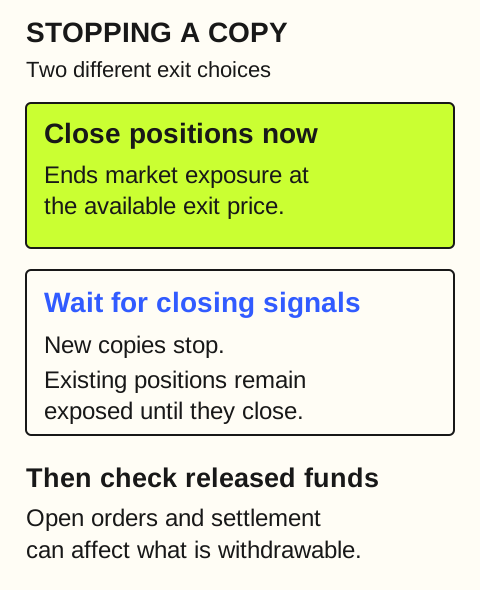
Find the exit controls before choosing a leader. On Bybit, stopping new copies and immediately closing existing positions are not always the same action. The follower guide offers an immediate market closure or continuing to copy the remaining closing signals. The latter leaves exposure open until those positions are closed.
That choice matters if you are stopping because the market is moving sharply. Waiting for a leader’s exit means accepting further price movement. Closing immediately ends that exposure but takes the available market price. Neither choice should be confused with a bank withdrawal or a promise to recover the original investment.
| Action | What it changes | What to check next |
|---|---|---|
| Stop new copies | Future entries stop under the selected exit option | Whether existing positions remain open. |
| Close the remaining positions | Trading exposure ends when orders execute | The actual realised result and any settlement amount. |
| Withdraw an available balance | Money leaves the relevant exchange wallet | Accepted asset, destination, network and final local receipt. |
A stop instruction is useful but not a guaranteed amount returned. Prices may move between the trigger and the fill. If you are choosing a copy stop on total account value, understand whether profit sharing or a changed allocation affects the displayed threshold; the product’s own explanation describes these differences.
When every copied position has closed and the copy relationship is cancelled, Bybit describes the allocated money returning to its Funding Account. From there, use an available withdrawal method. Because of the Jamaican fiat restriction, this guide does not promise a direct Bybit-to-JMD bank withdrawal.
A local conversion is a further transaction. Confirm the actual receipt in your bank or permitted payment account before concluding that you have cashed out. Do not count a screenshot sent by another person as receipt of money. If a withdrawal is held, identify whether the hold is with the exchange, the network or the local payment service before paying anyone to “unlock” it.