
















Which exchange makes sense for your balance?
Kraken for cash and mixed collateral
A useful fit when your permitted deposit arrives in USD or another supported cash currency.
Read the verdictOKX for a USDT-only position
A simpler contract choice if you already hold usable USDT and want to keep that position’s margin in USDT.
Read the verdictThese are different starting balances, not different levels of ambition. You do not need a more complicated account because you want a larger trade. For someone paid in emalangeni, the first useful distinction is whether the money will arrive as bank currency or as an existing crypto asset.
Kraken and OKX do not list Eswatini among the exclusions in the country disclosures reviewed here. That supports considering them; account verification and the actual derivatives product still apply. Neither recommendation is a claim that an Eswatini regulator has licensed the exchange locally.
Kraken: choose the collateral before the leverage
Kraken’s Multi-M account values collateral in dollars while accepting several different assets. The useful question is what happens to your margin when the asset backing the trade moves independently of Bitcoin. This is easy to miss if the account’s headline value is the only number you watch.
The current collateral schedule gives USD a zero haircut. It lists USDT and USDC with a 0.5% haircut, and BTC and ETH with 1%. A haircut means some market value is not counted toward margin; it is not money secretly removed from the wallet. On an illustrative 1,000 USD-equivalent balance, those values are 1,000, 995 and 990 respectively, before other account adjustments.
Why using your Ether can change the whole trade
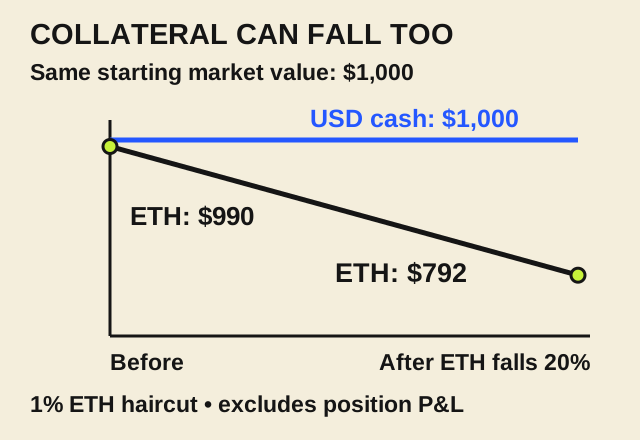
Suppose you keep 1,000 dollars of ETH as collateral and open a Bitcoin position. If ETH falls 20%, that collateral has a market value of 800 dollars; after the same 1% haircut, 792 counts toward margin. Bitcoin does not need to fall by exactly the same amount. You now have two moving parts: the trade and the asset backing it.
For someone replacing that collateral from an SZL salary, the practical advantage of cash or dollar-linked collateral is a more readable budget. It does not make the derivative safe, and stablecoins have their own issuer and market risks. It does avoid deliberately adding an Ether price bet simply to support a Bitcoin position.
When is OKX the cleaner alternative?
For a reader who already owns usable USDT, an OKX USDT-margined contract in isolated mode keeps the position’s margin in that currency. The account must have sufficient available USDT for the order. Holding a different asset somewhere in the account does not automatically make that isolated USDT position funded.
The comparison is not that Kraken cannot use USDT—it can. The difference is the isolated USDT contract’s simpler accounting versus Multi-M’s broader collateral and conversion rules. For someone who does not need those extra assets, the simpler balance can be easier to follow.
| Decision | Kraken Multi-M | OKX USDT isolated |
|---|---|---|
| Starting balance | Several supported cash and crypto assets | USDT allocated to the contract |
| Important extra check | Collateral haircut and any conversion | Available USDT and the position’s margin |
| Published basic execution rates | 0.02% maker / 0.05% taker | 0.02% maker / 0.05% taker |
On equal 3,000-dollar opening and closing values, two taker fills cost 3 dollars at either stated base schedule. There is no fee winner in that example. A 0.01% difference in somebody else’s VIP tier is not a reason to call one cheaper for your account. The comparison changes with your actual tier, collateral charges and funding while the position remains open.
Can you deposit emalangeni or South African rand?

The lilangeni is tied one-for-one to the South African rand, and rand is accepted as legal tender in Eswatini. This is helpful when comparing local prices. It does not turn an SZL bank account into a USD account or make every South African payment feature available to an Eswatini resident.
Kraken’s reviewed cash-deposit table lists neither SZL nor ZAR as a direct funding currency. A transfer must use the currency named in the receiving instruction. If the account offers USD SWIFT, ask your own bank about an authorised USD transfer; do not send rand to those details simply because it has the same local value as emalangeni.
A familiar banking brand is not the same domestic transfer
Standard Bank operates in several countries. The Eswatini pricing guide separates CMA cross-border payments from outward SWIFT and non-CMA iPAY. The correct category follows the beneficiary and payment route, not the brand name printed on the two accounts. A domestic-looking app screen can still lead to an international payment.
For an illustrative E9,000 budget, a quote of E18 per delivered dollar means 500 dollars before any additional charges. E19 per delivered dollar gives about 473.68 dollars. Both can coexist with SZL/ZAR parity; the changing comparison is against USD. These are sample quotes, not today’s exchange rates.
Which bank costs deserve attention before a small deposit?
Standard Bank Eswatini’s 2026 Personal & Private Banking guide, effective 5 December 2025, lists an outward SWIFT charge as E188 plus 0.85%, with stated minimum and maximum conditions, plus USD 10. Its separate CMA-payment row is 0.08%, minimum E30 and maximum E75. These are different services, not two interchangeable prices for the same offshore transfer.
The guide’s compact minimum/maximum notation needs a written bank quote for your actual payment. Rather than treating that formatting as a complete all-in calculator, establish whether the quoted total includes the percentage minimum, USD component, conversion and any correspondent deduction. The receiving provider may add its own charge.
A fixed USD 10 component alone is 10% of a 100-dollar transfer and 2% of a 500-dollar transfer. This arithmetic explains why a small international deposit can be uneconomic before trading starts. It is a reason to reject an expensive funding plan, not to increase the amount you risk.
A returned payment can cost more than a slow one
The personal guide separately lists USD 67.50 for returning USD funds, E350 for amending an original instruction, and 0.85% for resending returned funds. Not every failed payment incurs every item. They show why the beneficiary, supported currency and reference deserve checking before the first transfer.
Use the recipient details generated for your own approved account. If a payment requires exchange-control review, tell the bank the actual investment purpose and beneficiary. A cheap CMA transfer to somebody else’s account does not become a suitable substitute simply because that person offers to forward crypto.
What can change the cost after the trade opens?
Kraken’s current derivatives schedule says sufficiently covering the account with USD, USDC, USDG or USDT can avoid the charge for non-USD-backed unrealised losses. Other collateral can leave an uncovered-loss charge starting at 0.0025% per hour. This is separate from the perpetual funding payment and from the trading fee.
For a simple illustration, keeping an uncovered 400-dollar loss in the first stated bracket for 24 hours produces 0.24 dollars at that hourly rate: 400 × 0.000025 × 24. The loss is assumed constant for the calculation. An actual account changes as prices and balances move. Do not apply that charge to the whole position value when the schedule refers to the uncovered loss.
A long holding period can therefore change the collateral decision even when two exchanges charge the same execution rate. If the planned trade requires retaining a non-cash collateral asset, include that cost in the decision. If the purpose is a straightforward dollar-account trade, unnecessarily complicated collateral can add administration without a useful benefit.
For perpetual funding itself, read the live contract rate and the period it represents. A quoted daily figure and an hourly figure cannot be compared as written. Treat an expected funding receipt as variable, rather than counting it as salary-like income to cover an SZL expense.
Is an offshore exchange locally approved in Eswatini?
No local approval is asserted for the exchanges shortlisted here. The CBE’s 2024/25 annual report described the absence of a specialised virtual-asset framework at that time. That historical report is not enough to declare that nothing has changed since.
The Eswatini Observer reported on 10 September 2026 that Legal Notice 131 of 2026 added virtual-asset service providers to the anti-money-laundering framework. We could read the report but could not independently retrieve the underlying gazette in this review. We therefore do not turn that report into a claim that a named overseas exchange now holds an Eswatini trading licence.
For the reader, the distinction is concrete: duties on a service provider, approval of a payment, and permission for an individual futures account are different questions. Ask a business claiming local authorisation for the regulator, legal entity and activity covered. An AML reference alone does not tell you whether its advertised Bitcoin product is approved.
Digital Lilangeni is a separate payment project
The CBE’s project page describes research and experimentation for a potential retail digital currency. It does not offer an interest-bearing investment token, a Bitcoin-futures account or a presale address. A seller cannot borrow that project’s name to make a private deposit offer look like central-bank money.
Local branding is not a sufficient check either. In March 2026 the CBE specifically warned about Eswatini New Fund, also called Asset Depositor or The Financial Institution. That is a named warning, not an accusation against every crypto platform. Verify the precise entity you are dealing with.
How do you know what you actually earned in emalangeni?
Keep the trade result and the local-currency result as two separate lines. First calculate the account’s closing balance after execution, funding and collateral-related charges. Then compare the actual cash received at home with the original total local debit. A USD gain can be partly offset by the return conversion and bank costs.
Suppose E9,000 originally bought 500 dollars, ignoring charges to isolate the currency effect. The trading account later holds 525 dollars. If the return quote is E17.50 per dollar, the local value is E9,187.50: a gain of E187.50 before withdrawal costs, not the E450 suggested by reusing the original E18 rate. If the total return costs exceed E187.50, the positive trading result becomes a negative local result.
This does not mean every profitable trade must be cashed out immediately. It means a screen balance should not be described as spendable household profit until the exit costs and conversion are known. For someone with rand expenses, the local parity makes the accounting familiar, but it does not remove the USD conversion in the middle.
Before closing the account entirely, download the derivatives ledger and the cash-deposit and withdrawal history. Separate transfers between your own wallets from trades; an internal movement is not a second purchase or another profit. Retain the bank receipts with the same dates so you can reconcile a statement without reconstructing it from screenshots.