










Kraken or VALR: where should you trade?
| What you want | Our choice | Why |
|---|---|---|
| Trade with lawfully held offshore funds | Kraken, subject to account approval | Lower published entry-level maker and taker fees than VALR’s native futures. |
| Deposit ZAR and return proceeds to a local bank | VALR native futures | Local rand funding and a South African derivatives-provider disclosure. |
| Own Bitcoin for the long term | Spot buying, without leverage | A perpetual contract is price exposure, not a replacement for owning the coin. |
| Borrow rand as a personal spot-margin customer | Do not plan around that borrowing route | VALR restricts ZAR borrowing to qualifying business accounts. |
Why Kraken is our offshore futures pick
South Africa is not named in the Kraken global-prohibition or derivatives-exclusion lists reviewed. An individual still needs the required verification and derivatives approval. We describe this as conditional offshore access, not a claim that Kraken holds a South African derivatives licence or that its availability overrides exchange controls.
The commercial case is concrete: at the lowest volume tier, Kraken publishes 0.02% maker and 0.05% taker execution fees. VALR’s native-futures schedule, updated on 21 September 2026, starts at 0.03% and 0.07%. Older comparisons showing different VALR rates should not be used to price a new account.
How much does that difference save?
| How both orders execute | Kraken base tier | VALR base tier |
|---|---|---|
| Both take liquidity | $10.00 total | $14.00 total |
| Maker entry, taker exit | $7.00 total | $10.00 total |
| Both add liquidity | $4.00 total | $6.00 total |
For two immediate orders, Kraken saves $4 in this example. A trader making ten such round trips saves $40 in execution charges, if the rates and values stay the same. That is a useful advantage for funds already in place. It is not permission to overlook a larger transfer cost or a cross-border restriction.
The table holds the position value equal to make the comparison readable; real exit values change with price. It excludes funding, conversion, spread, slippage and withdrawals. Higher volume tiers can also change the result. A maker rate applies only when the order actually adds liquidity, not simply because you selected a limit price.
Keep the correct wallet funded
Kraken’s guide separates the spot wallet from the derivatives wallet. A supported balance is transferred within Kraken to fund the derivatives account; the internal transfer is not the same transaction as sending crypto from South Africa. Before opening a position, check the balance in the trading wallet rather than assuming the total portfolio figure is all available as margin.
This workflow suits someone already using an approved offshore account. It is less compelling for a casual rand-funded trader who would have to introduce several conversion and transfer steps before the first order. Price the whole journey before deciding that the lower percentage is a better product for you.
Why VALR fits a rand-funded account
VALR’s own futures offering has a local advantage that a generic global exchange list can miss: ZAR can serve as collateral, and the published deposit schedule includes rand EFT. This allows the account decision to start with a South African bank balance instead of pretending every reader already holds USDT offshore.
VALR discloses two relevant entities. VALR (Pty) Ltd holds FSP number 53308; VALR DAM (Pty) Ltd identifies itself as the futures provider, with FSP number 54897 and an Over-the-Counter Derivatives Provider authorisation. The distinction matters because a general crypto-service licence alone would not answer the derivatives question.

A local provider is not protection from a losing trade. The advantage is a clearer domestic service relationship and a direct rand starting point. If your requirement is local funding and a locally disclosed derivatives provider, those benefits are stronger than an offshore fee saving of a few dollars on occasional trades.
Enable the futures product deliberately. VALR’s instructions require a fully verified account and a futures-enabled subaccount. A normal Bitcoin purchase does not automatically mean the same balance is ready for a perpetual position. Select the specific product and read the account-level collateral display before entering an order.
How should you fund a small ZAR trading account?
Use EFT rather than a card if the published fee difference is the deciding factor and you can wait for the bank transfer to clear. VALR lists ZAR EFT deposits as free and card deposits at 3.9%. A free platform deposit does not mean your bank must process it instantly or charge nothing of its own.
On a hypothetical R5,000 card-funded amount, 3.9% is R195. That is a substantial hurdle for a small account before a futures order has even been placed. It would be inconsistent to debate a tiny maker-fee improvement while ignoring that much larger funding charge.
Do not interpret “no minimum EFT deposit” as a useful minimum futures balance. A workable trading balance still depends on the contract’s minimum order, the margin required and how much of the account you are willing to lose. A deposit can be technically accepted and still be too small for the position you intended.
Decide the account budget before the leverage setting
Suppose R5,000 is the entire amount allocated to trading. If a trade is intended to lose no more than R250 under its planned exit, that is already 5% of the budget before extra charges or a worse fill. Raising the leverage slider does not reduce that planned cash loss. It only changes the collateral required and how close the position may be to liquidation.
There is also no need to convert the full rand balance simply because a futures contract contains USDT in its name. Collateral, contract quotation and the eventual cash-out currency serve different purposes. The next section shows the actual consequence of retaining rand collateral rather than treating the label as an instruction to buy a token.
Can the rand move against my futures collateral?
Yes. VALR currently lists ZAR with a collateral weighting of 1, while BTC is weighted at 0.95 and ETH at 0.925. A weighting of 1 means there is no extra haircut in that table; it does not make the rand’s dollar value fixed. The amount available to support a dollar-referenced position can still change with the exchange rate.
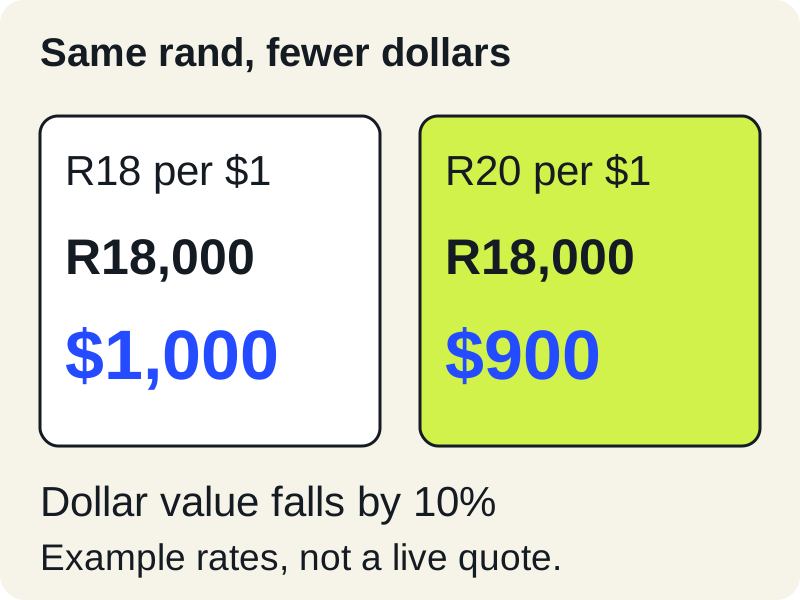
Consider R18,000 supporting a position. At an assumed R18 per dollar, that represents $1,000 before any relevant account adjustments. At R20 per dollar, the same R18,000 represents $900. The rand balance has not changed, yet its dollar value is 10% lower. These are round-number examples, not a current exchange-rate quote.
What changes if you hold crypto as collateral?
You introduce another price movement. With BTC collateral supporting a long Bitcoin position, a Bitcoin fall can reduce the collateral value while the position is also losing. A stablecoin balance avoids that particular double exposure, but brings its own issuer and peg risk. There is no asset choice that removes every risk; the point is to know which balance can change for which reason.
A common mistake is to calculate the trade only in rand, look at a dollar contract, and assume the two must behave identically. They do not. Write down the cash loss you are prepared to absorb in rand, then check whether the contract size and collateral still fit that decision after a currency move.
Separate long-term savings from the leveraged subaccount
VALR’s native futures use cross collateral within the chosen subaccount. Eligible assets there can support positions and can be called on in liquidation. Assets in another subaccount or the main account do not automatically serve that same purpose. Keeping savings outside the leveraged subaccount therefore changes which balance is exposed.
For example, putting only R2,000 into a dedicated trading subaccount is a different decision from leaving R20,000 there and mentally promising to use just R2,000. The system reads account collateral, not your intention. The smaller allocation does not guarantee a successful trade, but it makes the boundary visible and deliberate.
Futures, spot margin and VALR Perps are different products
For a straightforward leveraged Bitcoin price position, native perpetual futures are the product compared here. Spot margin involves borrowed asset balances and interest. A separate interface labelled VALR Perps can route activity through third-party providers. Do not carry one product’s costs or permissions into another simply because all three appear under the same brand.
| Product | What you are doing | The detail that changes the choice |
|---|---|---|
| Native perpetual futures | Taking a contract position on price | Funding payments and the futures margin account matter. |
| Spot margin | Borrowing a balance to trade actual assets | Borrowing interest and repayment matter, including ZAR eligibility. |
| Third-party VALR Perps | Using a separately routed product | It has separate provider terms and charges; it is not the native-futures comparison. |
An individual cannot currently borrow ZAR on VALR to buy a ZAR pair with leverage. Qualifying businesses may apply for that facility. VALR does describe another personal-account possibility: using ZAR collateral to borrow USDC and buy on a USDC pair. That creates a different debt from borrowing rand.
If your aim is simply to take a short-term price view, adding a loan repayment to the workflow may be unnecessary. If your specific aim requires holding or borrowing an asset balance, the spot-margin product may be more appropriate. Compare the interest for the intended holding period with the futures funding and execution costs before selecting the interface.
We do not promote the separately routed DEX-based product as a substitute for the domestic native-futures account. A familiar app wrapper does not erase the underlying provider difference. This is why this article avoids a “highest leverage wins” leaderboard: the product behind the number matters more than the largest number itself.
What else can change the cost after you open a trade?
Execution fees are only charged around trading activity, but a perpetual position can also have funding payments while it remains open. VALR’s native guide describes hourly funding exchanged between the two sides of the market. The rate and which side pays can change; a long position is not always the paying side.
For a purely illustrative $4,000 position, an hourly rate of 0.01% would be $0.40 per hour for the paying side. Six hours at that unchanged rate would be $2.40. It is not a forecast or a quoted live rate. The calculation shows why a position held for a weekend cannot be priced from the entry fee alone.
Check whether the order book can fill your size
Before a large order, compare the displayed prices for the amount you intend to trade. The last traded price may come from a much smaller transaction. A market order can fill across several price levels; the difference can exceed the published commission saving between two venues.
As a simple example, paying an average 0.2% worse than the reference price on a $10,000 entry adds $20. That is five times the $4 round-trip execution-fee saving in our base-tier comparison. We have not measured a resident account’s live slippage on either venue, so the example is a cost comparison, not a measured liquidity ranking.
A limit order can control the worst price you accept, but it might leave the position partly filled or unfilled. That may suit a patient entry; it can be less suitable for an urgent exit. Choose the order around the purpose of the trade, rather than treating the cheaper order type as automatically superior.
How do I withdraw futures profits back to rand?
On a local account, distinguish the closed position from the balance available for withdrawal. Open positions, orders or borrowing can keep collateral in use. Reducing a position is not necessarily closing it, and a profitable trade does not prove that every asset in the subaccount is free to move.
VALR lists thirty normal ZAR withdrawals per month as free, then R8.50 each. Its fast ZAR withdrawal charge is R30. These are different service choices. On a R600 payout, R30 is 5%; on a R30,000 payout it is 0.1%. Decide whether the speed is worth the cost for the actual amount, not just whether the button is available.
For an offshore account, plan the lawful return path at the same time as the deposit. Do not assume buying a token abroad, sending it to a South African exchange and selling it for rand is automatically an approved repatriation method. The SARB restrictions discussed below make that assumption particularly important to avoid.
Keep a record that connects the closed trade, any conversion and the eventual bank receipt. It lets you tell a trading profit from an exchange-rate movement or a withdrawal charge. It also gives you something usable for the tax calculation, instead of relying on a green profit figure photographed before the money reached your bank.
Can I send South African crypto to an overseas futures exchange?
Do not treat a local crypto purchase as unrestricted permission to export capital. SARB’s current FAQ says buying crypto in South Africa to externalise capital without the required permission falls within the exchange-control prohibition. It separately describes individuals buying crypto abroad through their own available discretionary or foreign-capital allowances.
The FAQ refers to an annual R1 million single discretionary allowance and up to R10 million foreign capital allowance with the relevant tax-compliance process. These figures are not extra balances provided by an exchange. Existing use of the allowances matters, and borrowing another person’s allowance is not an acceptable workaround.
For an intended transfer, ask your Authorised Dealer to confirm the permissible purpose, documents and return arrangement before moving money. Our Kraken recommendation assumes lawfully held offshore resources and an approved derivatives account. It does not supply a legal shortcut for funding one from a domestic crypto wallet.
What about the new 2026 crypto framework?
The joint Treasury and SARB material reviewed on 27 September 2026 still presents the Crypto Assets Manual and associated changes as drafts. The public-comment deadline shown is 30 September 2026. Proposed authorised crypto-service channels should therefore not be described as permissions already available to every resident.
That distinction changes today’s decision. A local native-futures account can be more practical for a rand-funded reader while the cross-border process remains restrictive. There is no benefit in selecting a technically accessible exchange if you cannot lawfully fund the planned transaction.
Do South Africans pay tax on futures profits?
Yes, crypto-related gains do not become tax-free because they stay on an exchange. SARS applies ordinary income-tax rules and distinguishes revenue from capital according to the facts. Frequent trading should not be labelled long-term capital investment simply because the traded instrument references Bitcoin.
SARS says eligible trading expenses can be relevant to taxable income, subject to the ordinary rules. Keep the gross proceeds and the associated charges separately instead of reporting only one final wallet balance. The opening deposit is not itself a trading profit, and a withdrawal is not a reliable substitute for the trade history.
A practical record for a rand-based trader
Export the filled trades, funding entries, conversion history and bank movements. For each realised transaction, retain the date, asset, proceeds, charges and the rand conversion used for reporting. If you move between platforms, keep enough detail to distinguish an own-account transfer from a disposal or a payment to someone else.
A small example shows the problem with using the bank statement alone: R10,000 goes into an account, trading generates a profit, and part of the balance remains there. A single R5,000 withdrawal tells you neither the whole realised profit nor the amount still exposed. The trade ledger and the cash ledger answer different questions.
What changed with CARF?
SARS’s dedicated CARF page gives 1 March 2026 as the start of provider collection obligations. The first period runs to 28 February 2027, with provider reporting due by 31 May 2027. Individual customers do not submit a separate CARF return; they continue to declare taxable crypto activity through the normal tax process.
A provider asking for tax residence or additional identity information is therefore not necessarily a sign that your account has been singled out. Keep those details consistent with your actual circumstances. CARF reporting does not replace your own return, and it does not introduce a universal flat crypto-tax rate.