









Which crypto futures exchange should you use in Lesotho?
Phemex for a deliberately separate USDT trade
Use a defined position allocation and practise the order before committing maloti.
Read the verdictBybit for active position management
Its optional automatic margin top-up needs a deliberate decision, not a default assumption.
Read the verdictPhemex’s isolated USDT account can be rehearsed in mock trading before converting maloti into a live balance. The practical exercise is to reproduce the intended order and margin allocation, then compare the actual funding cost discussed below.
Bybit is the alternative when you prefer its unified trading account and position controls. Both providers offer isolated margin; we do not pretend Phemex alone invented it. The important difference discussed here is how a user can accidentally expose additional money, including through Bybit’s optional automatic margin replenishment.
| Need | Starting point | Decision that still matters |
|---|---|---|
| A single USDT futures position with a defined allocation | Phemex | Select futures isolated margin; do not confuse it with the separate spot-margin product. |
| A unified account with optional automatic position top-ups | Bybit | Decide whether automatic replenishment may use the spare account balance. |
| A direct maloti or Vodacom M-Pesa futures deposit | Neither is established by the reviewed sources | A local wallet payment is not proof of an exchange integration. |
Lesotho does not appear in either provider’s reviewed exclusion list. This supports considering them as international options, subject to personal verification and local requirements. It is not evidence of a Central Bank of Lesotho licence. The full directory below remains five available platforms plus seven limited services, rather than being reduced to this two-exchange selection.
Phemex: keep a small trading allocation separate
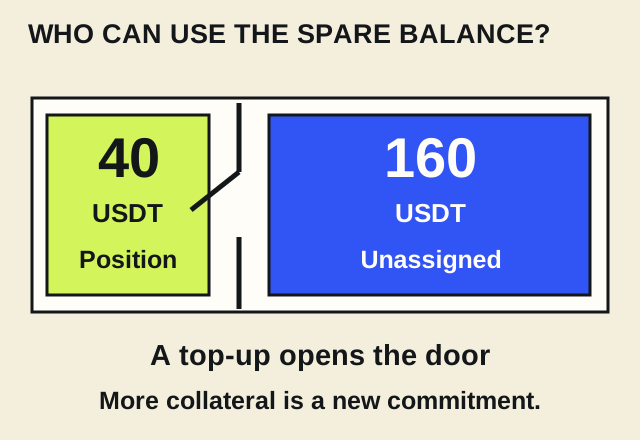
A useful first decision is how much of the exchange balance may support the trade. Imagine a reader with 200 USDT in a trading account who intends to allocate 40 to one position. In isolated futures mode, the assigned position margin is separate from the unassigned balance unless the trader adds more under the applicable settings. In cross mode, available collateral is shared.
Futures margin and spot margin are different products
Phemex’s terms describe USDT-margined perpetuals separately from coin-margined contracts. Its futures guide supports isolated or cross settings. Do not use a tutorial for borrowing assets on the spot-margin page as the instructions for this trade: a borrowed spot asset and a perpetual position are different exposures with different charges.
Bybit: when does “isolated” still use more money?
Bybit’s automatic margin replenishment is optional and available in isolated mode. When enabled, it can move available unified-account funds into a position as that position approaches its liquidation threshold. The platform allows it to be enabled or disabled from the position panel. This is a useful control for some traders, but it changes the practical meaning of a fixed initial allocation.
Who should choose this alternative?
Bybit is a reasonable alternative for a reader who actively manages a unified account and wants to decide whether spare funds support a stressed position. If the spare balance is earmarked for a local cash-out, leaving automatic replenishment off better matches that specific intention. If you deliberately allow a top-up, record the larger maximum commitment rather than calling it unchanged risk.
How much local money is exposed after a margin top-up?
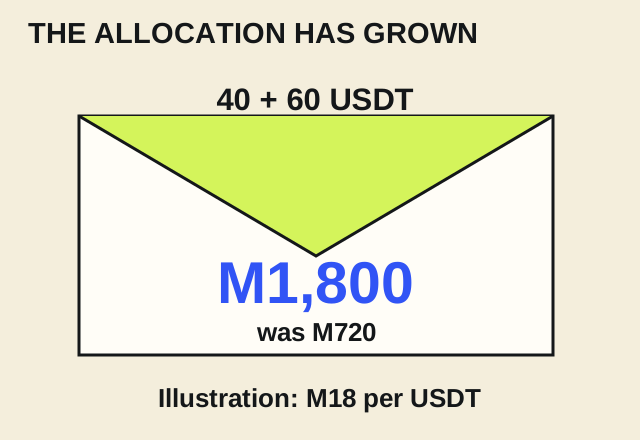
Use an illustrative conversion of M18 per USDT, not a current exchange quote. A 40-USDT position allocation represents M720. Adding another 60 USDT represents a further M1,080, bringing the total allocated collateral to M1,800. The position quantity can remain unchanged throughout.
Include execution and withdrawal costs separately
Phemex publishes contract maker and taker rates of 0.01% and 0.06%; Bybit’s general non-VIP table lists 0.02% and 0.055%. These are base schedules, not a claim about a particular account discount. For an unchanged 2,000-USDT entry and exit, two taker fills cost 2.40 USDT at the first schedule and 2.20 at the second.
At the assumed M18 conversion, the difference is M3.60. This is small enough that the user’s payment route, a withdrawal charge or a worse execution price can reverse the result. Bybit’s lower published taker fee is real in this example, but it is not sufficient to declare every complete transaction cheaper.
Funding payments are separate again. If you hold a perpetual through a funding event, the payment depends on the contract rate, direction and position value. Use the displayed next event for your contract instead of treating the opening trade fee as the whole cost of keeping the position.
Does working or travelling in South Africa change access?
It can. Phemex’s reviewed restricted-territory list includes South Africa but not Lesotho. Its terms refer to residence and location, not merely the nationality selected when an account was created. A Lesotho account should therefore not be treated as permission to use the same service while physically in a restricted territory.
For a resident who crosses the border for work, this is a practical reason to settle the access question before leaving a position open. A mobile app remaining installed does not prove that new orders, position changes or withdrawals will be available from the next location. Do not use false residency details or a VPN to work around a restriction.
The rand connection does not merge the two countries
CBL explains the loti’s one-for-one parity with the rand. That makes some everyday amounts easy to compare, but it does not make Lesotho a South African province for account eligibility. A South African residence rule, payment account or foreign-investment allowance cannot simply be copied to a Lesotho resident because both budgets use an equivalent nominal amount.
Bybit’s reviewed exclusion page does not name South Africa, but local entities and accounts can offer different products. Cross-border users need the terms of the account they will actually use, especially after relocating.
If travel is imminent and the provider has not clarified how you will manage the position there, the useful action is to resolve or close that exposure before the trip. This is a country-specific access problem, not an argument for removing all of Lesotho’s exchange choices from the directory.
Can Vodacom M-Pesa in Lesotho fund a futures account?
The reviewed material does not establish a direct Phemex or Bybit deposit integration with Vodacom M-Pesa Lesotho. Kenya-specific M-PESA instructions do not prove Lesotho support. The country, provider, currency and beneficiary all have to match; the shared M-Pesa name is not enough.
A merchant or payment provider may offer a permitted conversion into transferable crypto, but that needs a real quote and an accepted local method. Neither a Vodacom logo nor an advertisement in rand confirms the destination exchange will credit the asset. The exchange deposit screen must support the exact asset and network used.
What the published local tariff actually says
Vodacom Lesotho’s January 2025 tariff distinguishes sending to a registered M-Pesa user from cash withdrawal. For M501–M1,000, the listed fees are M6.38 to send and M9.56 to withdraw. At M4,001–M5,000 they are M10.09 and M15.13. Above M5,000, the listed registered-user send and withdrawal percentages are 0.25% and 0.35% in the next bands.
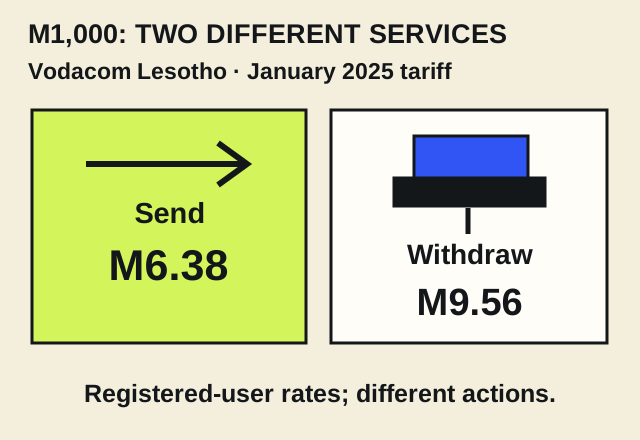
A hypothetical M1,000 payment to a registered user followed by withdrawing M1,000 would therefore involve M15.94 across those two separate operations at the stated tariff. That is before any crypto conversion spread. It is not a single M-Pesa fee, and you should not add the withdrawal charge if you will keep or spend the wallet balance instead.
The distinction matters when comparing a quote described as “cash in hand” with one described as “wallet balance”. The first includes another service. Ask which amount you will actually receive and which operation is still required. A large-looking exchange bonus may be less useful than avoiding an unnecessary intermediate cash withdrawal.
What should you practise before using real maloti?
Phemex provides mock contract trading. The useful rehearsal is not to generate a large simulated profit; it is to confirm that you can enter, inspect and close the intended order without confusion. A mock account cannot verify a Lesotho bank payment or demonstrate live liquidity.
- Open a modest simulated position and find its actual quantity, rather than reading only the leverage multiplier.
- Change the planned exit and confirm whether it applies to the complete remaining position.
- Cancel an unfilled entry and check that it is no longer pending.
- Close the position and verify that the position list is empty, rather than merely closing the app.
Why a cancelled order is different from a closed trade
An unfilled limit order is an instruction waiting for a match. Cancelling it removes that instruction. A filled order has already created or changed a position; cancelling other orders does not reverse that exposure. On a phone, the separate Orders and Positions views are worth understanding before any local money is converted.
Phemex’s order documentation also distinguishes post-only from an ordinary marketable limit order. A post-only order can be cancelled instead of taking liquidity immediately. If immediate execution matters more than waiting at a specified price, that behaviour changes the appropriate instruction. It is not a broken button.
Use the practice environment to learn those mechanics, then read the live order preview afresh. Simulated balances, fills and fee outcomes should not be presented as money earned or as evidence that a live withdrawal will succeed.
Is the exchange or a local crypto promoter protected by CBL?
CBL’s published crypto warning distinguishes cryptocurrency from legal tender and warns that public investment promotion can trigger the licensing requirements for investment advisers. It also says there is no recourse to the bank for crypto losses. This is why we do not attach a CBL-approved label to either international exchange.
An exchange account in your own name is different from paying a local person who promises to trade on your behalf. In the second arrangement, an app screenshot may show the promoter’s account rather than an asset or position you control. Ask whose name appears on the account and whether the person offering investment services holds the relevant licence.
Proof of reserves does not replace account ownership
Phemex describes periodic proof-of-reserves checks and account protections such as withdrawal-address controls. Those are relevant security measures, but they do not establish that an outside promoter has credited you with a legal claim, nor do they promise reimbursement of trading losses. A reserve disclosure and an adviser’s licence answer different questions.
For a direct account, keep the platform statement and the record of assets transferred. For a paid advisory arrangement, identify the adviser and the authority under which the service is offered. Do not assume that a familiar local phone number gives an offshore investment the protection of a Lesotho bank deposit.
What if funding or withdrawing requires a bank transfer?
CBL identifies authorised dealer banks as the channel for foreign-exchange matters. Its description of limited-authority bureaux de change concerns travel-related transactions. A brokerage investment should therefore be presented to the bank for its actual purpose, not dressed up as travel cash.
The practical request is concise: identify the account owner, receiving institution, currency, amount and investment purpose, and ask which documents and permissions apply. If the provider changes the beneficiary account, obtain fresh instructions. Do not reuse an old transfer template simply because the brand name is unchanged.
A local bank transfer problem and an offshore trading dispute also have different owners. CBL’s consumer FAQ directs customers to complain to the regulated provider first and describes escalation when the response is unsatisfactory or overdue. It does not promise to reverse an offshore liquidation or settle a disagreement with a P2P merchant.
A listed-futures brokerage remains a separate alternative for readers who specifically want that structure. Interactive Brokers lists Lesotho as an application country, but product permissions and bank funding are additional steps. It should not displace a usable exchange choice merely because the country has a difficult conversion route.