














Bybit or BingX for crypto futures in Botswana?
Bybit is the stronger starting point here for choosing your own USDT perpetual trades and controlling the price you accept. BingX deserves a separate look for practice and copy trading, but its Standard Futures and Perpetual Futures screens are different products. Pick the trading workflow before comparing a headline fee.
Botswana’s catalogue includes 14 Available platforms. That records provider access, not a Botswana licence. NBFIRA’s September warning about unlicensed VASPs is a material local limitation; neither an app download nor a working account overrides it. The product comparison below is conditional on your lawful, eligible use.
| Use | Platform to examine | Decision |
|---|---|---|
| Place and manage your own trades | Bybit | Use its execution controls for a chosen crypto position. |
| Practise the perpetual order screen | BingX Perpetual Futures demo | Test the product you intend to use, rather than a different simulation. |
| Follow another trader | BingX copy trading | Choose the allocation method and account balance exposed. |
| Buy crypto with pula | A supported local service | Confirm the actual retail service before planning the transfer. |
Which crypto companies are licensed?
NBFIRA’s notice of 25 September 2026 names seven licensed VASPs with no compliance issues: Yellow Card Botswana, Express Minds, Temtum Services, Kalahari Exchange, Lebebe Au & Bc, Xago Technologies and Transkalahari Advisory Group. It warns the public against other VASPs, including online platforms. Use the exact legal company name when checking a service.
That list settles a company-status question. It does not supply seven live retail order books, seven cash-out services or seven futures products. A business can remain licensed while changing its customer base. A licensed company can also offer a wallet or payment service without providing the leveraged contract a reader is looking for.
Why the older lists disagree
PAA Capital is a concrete example: NBFIRA’s notice dated 25 February 2026 cancels its licence and says it can no longer offer or advertise regulated virtual-asset services or enter new customer relationships for them. An old review, saved licence image or previously working account is not a reason to make a fresh deposit.
When a brand appears under a different legal name, match the company in the agreement with the regulator’s record. Do not substitute a similarly named token, international sister company or South African registration. These are straightforward checks that prevent a valid licence belonging to one business from being used to sell another business’s product.
What does Bybit let you control?
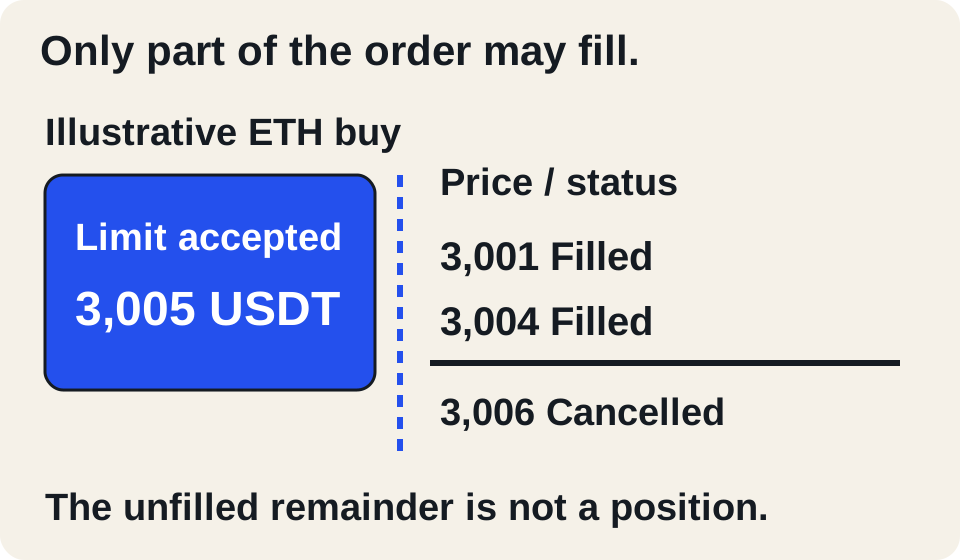
Bybit’s slippage-tolerance setting lets you put a boundary on a market order. It can fill the part available within that boundary and cancel the rest. That is a useful distinction for an altcoin trade: getting a smaller position at an acceptable price can be preferable to sweeping a thin order book simply to obtain the full amount.
For BTC and ETH, the published instructions specify a price amount rather than a percentage. For example, an illustrative ETH ask of 3,000 USDT with a 5 USDT tolerance limits the accepted buy price to 3,005. This is an explanation of the setting, not a live quote or a recommended tolerance.
Look at the filled position, not the requested one
After a partial fill, the amount you actually own is smaller than the order submitted. Size the profit target and stop around that position. Do not assume an app error when the remaining amount has been cancelled by the boundary you selected. The trade history is the record of what happened.
For someone budgeting in pula, this control concerns execution after the funds have reached Bybit. It does not protect the conversion from BWP to USDT, create a bank payout or remove NBFIRA’s licensing concerns. Its value is specific: you can decide how much price movement to tolerate while an order is being filled.
Which BingX futures screen should you use?
Use Perpetual Futures if you want a conventional order book, limit orders, post-only execution and a choice between one-way and hedge mode. Standard Futures keeps each order separate and offers a simpler market/trigger-order workflow. Its smaller menu is a different experience, not evidence of better execution.
BingX’s comparison lists a 0.05% perpetual taker charge on entry and exit, versus 0.045% on closing for Standard Futures. Those labels are not an all-in cost comparison: spreads, funding and the way the order executes can differ. At a constant 1,000 USDT value, the two perpetual taker charges total 1 USDT; the listed Standard closing charge is 0.45 USDT before its other costs. A 0.55 USDT difference is easily outweighed by a worse execution price.
Copy trading is an allocation decision
BingX’s fixed-amount mode assigns a chosen margin amount to each copied opening order. Fixed-ratio copying instead uses a dedicated allocation to follow the trader’s position proportions. These lead to different balances at risk when several trades arrive, especially when you also trade manually.
Suppose a Gaborone trader has converted a limited pula budget and earmarks 10 USDT per copied entry. Ten overlapping entries are not the same commitment as one 10 USDT trial. Fees, available funds and slippage settings can also prevent a copied trade from matching the leader. Their published return is therefore not the return your account will necessarily earn.
For an occasional manual trader, keep the manual perpetual account as the main comparison with Bybit. Choose copy trading only if you want delegated trade signals and understand the allocation method. It does not solve the local licensing or cash-out question, and it is not a yield account.
How much does a crypto purchase really cost in pula?
For a permitted spot purchase, compare the total pula paid with the tokens actually delivered. “Zero trading commission” can still leave a spread in the exchange rate, a fixed payment fee or a withdrawal charge. The useful figure is the amount in your receiving wallet after all deductions.
| Quote | Calculation | Total paid |
|---|---|---|
| A: no separately labelled commission | 100 × P14.20 | P1,420 |
| B: lower unit price plus a fixed fee | 100 × P14.00 + P30 | P1,430 |
| B for a larger 1,000 USDT order | 1,000 × P14.00 + P30 | P14,030, versus P14,200 with A |
At 100 USDT, A is P10 cheaper. At 1,000 USDT, B is P170 cheaper. The break-even point is 150 USDT because the P0.20 saving per unit must cover the P30 fixed fee. This is why a blanket cheapest-exchange label can fail even before a trading order is placed.
Include the way back before choosing
Suppose the same 100 USDT could immediately be sold for P13.80 each, with no extra fee in this hypothetical quote. The P1,420 purchase would return P1,380: a P40 round-trip gap, or about 2.82% of the starting cash. A small gain in the token’s dollar value would not necessarily overcome that gap.
A cash-purchase quote is useful only if the service can deliver the asset and payment method needed by the chosen futures account. If you already have the correct token, do not add a fictional pula purchase to each trade’s cost. Use the actual entry and exit conversions for the way you fund the account.
Why a rand quote is not a pula quote
Botswana’s 2026 Budget Speech describes the pula basket as 50% South African rand and 50% Special Drawing Rights, with a managed crawl. A South African service quoting ZAR can therefore introduce a separate conversion; neither ZAR nor USD is interchangeable with a pula bank balance.
For a pula-funded account, compare the bank’s BWP debit with the supported currency credited at the exchange. On withdrawal, record the actual pula credit. The purchase-size example above is enough to price the fixed and percentage charges without a second hypothetical trading-profit calculation.
Can a crypto ATM or mobile wallet pay out profits?
Do not assume the place where you bought crypto can also buy it back. The official national risk assessment describes Express Minds’ assessed ATM service as purchase-only, alongside larger over-the-counter purchases. That is a historical description, not a claim that the current service has never changed. It is a specific reason to confirm today’s sale and payout function before relying on it.
Separate a sale from a withdrawal
If you already hold a token, a sale needs an available buyer and an agreed pula price. A bank or mobile-wallet withdrawal then needs a supported payout channel. A receipt showing that a crypto transfer arrived completes neither step automatically. Keep the sale quote, payout amount and expected processing time together.
An Orange Money or other mobile-wallet logo on a payment page does not prove a futures exchange supports withdrawals to that wallet. It could identify a local payment collection method or a third-party merchant. Establish who owes the payout and whose name appears on the receipt. Avoid paying a different individual after a merchant changes bank details in chat.
Match the problem to the record
For a missing token transfer, retain the network, destination address and transaction reference. For a missing pula payout, retain the accepted quote and bank or wallet payment reference. For a disputed trade, retain the order and execution record. Sending a price chart to resolve a missing bank payment usually leaves out the evidence that identifies the failed step.
Still have a balance in the old Yellow Card app?
Use Yellow Card’s official closure page to begin the refund process. It asks for identity checks and either matching bank/mobile-money details or an external address for the asset and network involved. The page gives a processing estimate of three to five business days. That estimate is the provider’s guidance, not a guaranteed recovery date from this site.
Choose the destination you can actually receive into. A local-money refund and a token transfer have different receiving requirements. Check the asset and network before supplying a wallet address; for cash, keep the account name consistent with the old Yellow Card account. Follow the official support page for the full document list rather than sending identity photos to an unsolicited recovery account.
Keep a copy of the submitted request and its reference. If support asks for something further, establish whether the request relates to identity, the receiving details or the balance itself. That makes a follow-up about a specific missing item, rather than restarting the whole claim in another chat. Do not pay a supposed agent to “reactivate” an app that the company has withdrawn from retail service.
What if a licensed provider will not resolve a payment?
NBFIRA’s published procedure starts with a written complaint to the regulated company. If unresolved, escalate within the company, including to its Principal Officer. You can approach NBFIRA after exhausting that process or if the company has not acknowledged your written complaint within ten working days.
State the requested outcome in ordinary language: return the undelivered P2,000 payment, explain a specified deduction, or locate the payout attached to a named receipt. Include the transaction date, amount, provider’s legal name and previous correspondence. A precise payment complaint is easier to investigate than a general statement that crypto trading went badly.
For suspected misuse of a licence or an unlicensed operator, use the regulator’s verification/reporting contact in the September notice. A complaint route is not deposit insurance and does not reverse an ordinary market loss. The practical benefit is a documented way to challenge the provider’s conduct when a service has not worked as agreed.