









Which crypto futures exchange is best for Namibia?
OKX leads this shortlist for a Namibian resident who wants straightforward USDT futures pricing. KuCoin is the alternative for a specific contract or a coin-settled position. At their published entry tiers, OKX has the lower taker fee; both charge the same maker percentage. That is a useful distinction, but it is too small to justify ignoring the cost of getting Namibian dollars into the account.
OKX: lower standard taker fee
Our first pick for a new USDT futures balance and orders that execute immediately.
Read the verdictKuCoin: a contract-led alternative
Worth choosing for an exact market or settlement currency, not just a longer coin list.
Read the verdict| Your starting point | Choice to examine first | Reason |
|---|---|---|
| NAD savings; no existing trading account | OKX | Lower published taker pricing, after confirming the full funding quote. |
| An existing KuCoin balance and a suitable contract | Keep the account unless a move pays for itself | Transfer and conversion costs can exceed a small fee saving. |
| You require a Namibia-supervised provider | Check the local licence and approved service | International availability does not establish domestic supervision. |
The country catalogue still contains eight available and four limited options. The two featured exchanges are a focused recommendation within that catalogue, not a claim that the other services vanished. Namibia does not appear in the country exclusions we reviewed for these two providers; verification and product approval remain account-specific.
For a first leveraged trade, choose the contract and an affordable position size before considering the largest leverage setting. A setting of 20× does not make an exchange twenty times better. It changes how much margin supports the position, while the fee is still calculated on the full trade value.
OKX versus KuCoin: when does the fee difference matter?
OKX’s September 2026 standard futures table lists 0.02% maker and 0.05% taker for regular users. The September revision changed VIP 7 and VIP 8 rates, not the regular tier. KuCoin’s published VIP 0 futures rates are 0.02% and 0.06%. We compare those ordinary tiers, without assuming a bonus, token holding or negotiated discount.
| How the trade fills | OKX: entry + exit | KuCoin: entry + exit |
|---|---|---|
| Both sides take existing orders | $5 | $6 |
| Both sides rest and earn maker treatment | $2 | $2 |
| Maker entry, taker exit | $3.50 | $4 |
For this size, OKX saves $1 when both sides are taker orders. It saves nothing if both sides receive maker treatment. A limit order is not automatically a maker order: if it crosses the current price and fills immediately, it can still be charged as a taker.
The transfer decision has a break-even point
Suppose moving an existing balance would cost $12 in combined withdrawal and conversion charges. With a $1 saving on each illustrated taker round trip, twelve otherwise identical trades would only recover that move. The thirteenth produces a fee saving before considering any difference in execution. For someone making two trades, moving would be the more expensive choice.
This is why OKX ranks first for a new account but is not a blanket instruction to leave KuCoin. The calculation assumes the same contract exposure and trade values. A different spread, price movement during a transfer or funding payment can change the answer. Compare total money spent, not the number of decimal places on a fee badge.
A small order should also leave enough free balance for charges. If $500 is used to support a $5,000 position, the two $2.50 taker fees in the OKX illustration total 1% of that $500. Paying only a tenth of the exposure as margin does not reduce the fee base to one tenth.
NAD, rand and USDT: which balance are you actually using?

The Namibia dollar is pegged one-to-one to the South African rand. Both circulate as legal tender in Namibia; the Namibia dollar does not have the same legal-tender status in South Africa. That relationship helps when comparing N$ and R amounts, but it does not fix either currency’s value against the US dollar.
USDT is a dollar-linked cryptoasset, not a Namibian-dollar account. An app offering a ZAR display has not necessarily opened a rand bank account for you. A display currency, a payment currency and the asset accepted as futures margin can all be different.
A quote you can compare in your own money
Imagine two fully quoted, permitted ways of funding the same futures balance. One costs N$10,000 and delivers 550 USDT after all deductions. The other costs N$9,900 and delivers 540 USDT. The first costs about N$18.18 per credited USDT; the second costs N$18.33. Although the second bank debit is lower, the first gives you more usable trading money for each Namibia dollar.
Those are hypothetical quotes, not today’s exchange rate or a promise of an NAD deposit service. The calculation is the bank debit divided by the amount actually credited. It works whether the funding provider shows rand, dollars or a crypto amount, and it captures charges hidden inside a less favourable conversion quote.
For an eventual withdrawal, reverse the comparison: how many Namibia dollars reach your account for the amount removed from the exchange? Do not use the buying rate to estimate a sale. The return quote, any network charge and the recipient bank’s treatment may differ from the deposit.
When is KuCoin the better fit?
KuCoin is worth choosing when the exact contract or settlement asset suits an existing balance better. Its documentation distinguishes USDT-margined contracts from coin-margined contracts, where BTC or ETH supports the position and the result is paid in that coin. A USD label on a coin-margined contract does not mean the account settles in bank dollars.
For someone starting with NAD and buying USDT solely to trade, the USDT version is usually easier to budget. For someone already holding Bitcoin who deliberately wants Bitcoin-denominated results, a coin-margined contract answers a different need. KuCoin is not uniquely capable of that product; the relevant advantage must be the actual contract you want, rather than an invented exclusive feature.
Check the contract, not just the ticker
BTC/USDT and BTC/USD can describe different collateral and settlement rules even though both follow Bitcoin. Before comparing their fees, match the underlying exposure, whether the contract expires, and what asset you receive when you close. Otherwise a supposedly cheaper position may leave you holding an asset you did not intend to keep.
A coin-settled long also combines two exposures: the trade and the collateral’s own market value. If Bitcoin falls, Bitcoin collateral can buy fewer Namibia dollars at the same time as the long position loses. That is a poor fit for someone whose main concern is preserving a fixed N$ spending budget.
Our verdict is therefore narrow: use KuCoin for a concrete contract or balance-management reason, or when an existing account avoids unnecessary transfer costs. For a fresh USDT balance on a market both venues offer, the standard taker comparison favours OKX. A large advertised catalogue alone does not overcome that result.
Will a Namibian card make the deposit cheaper?
A bank’s international-payment tariff can be larger than the exchange trading charge. Standard Bank Namibia’s 2026 guide lists N$5 plus 3% for international POS purchases on its entry-level account comparison. Its separate credit-card section lists a 2.75% international currency-conversion fee. The applicable card, transaction classification and account package matter; these are not two charges to automatically add together.
For an N$5,000 transaction falling under the first tariff, the listed component is N$155. The credit-card conversion component at 2.75% would be N$137.50. Neither figure includes an exchange or payment provider’s own markup, and neither proves that a crypto-related payment will be accepted or charged as an ordinary purchase.
Ask for the full amount credited before choosing a payment method. A card advertised as convenient may be expensive for repeated small top-ups. Borrowing on a credit card to fund leverage adds a separate debt and interest obligation, even after an exchange position has closed.
The bank’s cross-border FAQ also distinguishes a percentage commission from a SWIFT communication charge. That structure makes a transfer quote worth obtaining for a larger amount, but an exchange must first provide a bank-deposit option that actually accepts your account and currency. Sending money to a guessed bank beneficiary is not an alternative funding method.
Is crypto trading legal in Namibia, and who is licensed?
Namibia’s Virtual Assets Act established a licensing framework for service providers. The Bank of Namibia explains that virtual assets are not legal tender, while voluntary acceptance is a separate matter. “Not legal tender” does not by itself mean that every personal holding is banned, and a provider licence does not automatically authorise every leveraged product.
The distinction is visible in the regulator’s January 2025 announcement: MINDEX and Landifa received provisional authorisation subject to conditions before operational approval. That dated announcement is not evidence that a six-month provisional period continued indefinitely or that both businesses currently offer retail futures.
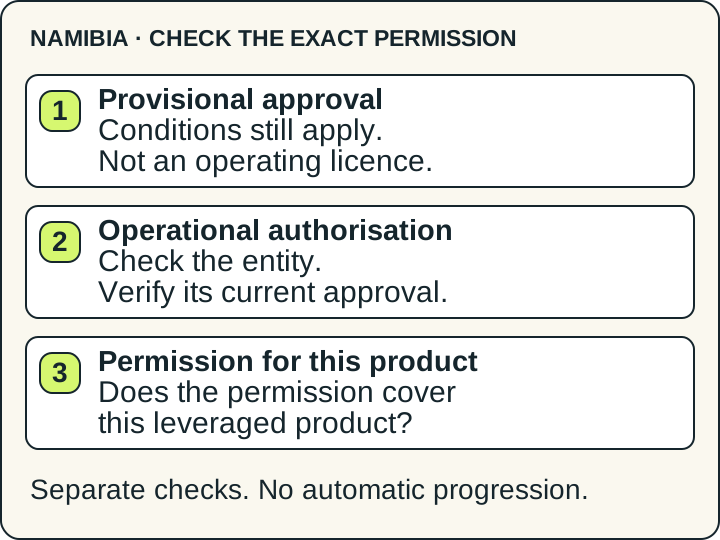
MINDEX’s current group website describes its Namibia entity as holding a licence-in-principle. It separately lists Mauritius licences. Do not attach those Mauritius permissions to a Namibia account simply because the brand name is the same. This is a reason to inspect the legal entity and approved service, not to dismiss local providers as a group.
If Namibia supervision is essential to you, obtain the current operational authorisation and product scope before paying. Our OKX and KuCoin recommendations concern international exchange products; they are not presented as Bank of Namibia-licensed futures accounts. That keeps the local licensing question separate from the practical comparison of offshore product costs.
Can you send NAD savings to an overseas exchange?
Namibia applies exchange controls, so an exchange accepting your identity does not settle how a local bank may fund it. The important question for a resident is the payment’s genuine investment purpose and the authorised process for transferring the money. Moving funds via South Africa does not make that purpose disappear.
Two Bank of Namibia publications give different headline figures. The online FAQ mentions N$4 million for an individual’s foreign investment allowance; the individual guidelines, internally dated September 2018, state N$6 million with identity and tax-clearance conditions. We cannot honestly present either as an independently confirmed new 2026 limit.
Ask your authorised dealer to confirm the current allowance and documentation for the proposed investment. Do that before treating a large exchange deposit limit as permission to transfer the same amount abroad. The platform’s account limit and the bank’s exchange-control process measure different things.
The Bank also requires reporting of cross-border foreign-exchange transactions through the banking system. Preserve the payment purpose and the exchange deposit reference together. A later return of money is easier to explain when the bank can connect it with the original outward transfer and the trading statement.
What should the first position prove?
The useful first test is a modest, fully understood position, not a search for the maximum leverage. Confirm that your account shows the intended futures contract, that the collateral arrived in the correct wallet, and that the order size is the exposure you mean to take. A quantity measured in contracts can be very different from the number of coins shown elsewhere in the app.
Set an exit that reduces the position. OKX explains that a reduce-only closing instruction cannot open the opposite position once the original holding has gone. This matters after a partial take-profit: an old order sized for the entire position should not accidentally become a new bet in the other direction.
A stop’s trigger and its execution are also different. The selected mark or last price can activate the instruction, but a market exit may fill beyond it; a limit exit may remain unfilled. Use the order-history confirmation to see what actually closed instead of assuming a price alert is an executed sale.
Finally, test the withdrawal to an account or wallet you control using the supported asset and network shown at both ends. Closing a futures position leaves a settlement balance; it does not automatically pay Namibia dollars to your bank. That final conversion belongs in the original budget, rather than becoming an unpleasant discovery after a profitable trade.