












Which futures exchange should you choose in Zambia?
Gate: smaller BTC contract increments
Our product pick for an eligible trader who needs a precisely sized USDT position. Confirm the local provider and funding requirements first.
Read the verdictBybit: explicit slippage controls
Useful when controlling the price of an immediate order matters more than entering a very small BTC position.
Read the verdict| Your priority | Our choice | Reason |
|---|---|---|
| Fine increments in a BTC/USDT futures position | Gate | Its 0.0001 BTC increment is one tenth of the reviewed Bybit BTCUSDT increment. |
| A personal ceiling on market-order slippage | Bybit | The order can cancel the unfilled portion outside the chosen tolerance. |
| Starting only with kwacha in a local account | Establish the approved payment relationship first | Banks and regulated providers cannot facilitate transactions with unregistered VASPs. |
| Owning a tokenised asset or earning project income | A separate investment review | A perpetual price position does not establish ownership rights in a project. |
How small can a Bitcoin futures position be?
At our review, Gate’s public BTC_USDT contract record showed a multiplier of 0.0001 BTC and a minimum order quantity of one contract. Those two fields answer a more useful question than the advertised maximum leverage: how much Bitcoin price exposure does one unit on the order ticket represent?
At an illustrative Bitcoin price of 90,000 USDT, one such contract represents 9 USDT of exposure. Ten represent 90 USDT, and fifty represent 450 USDT. These are position values, not required deposits or a promise that every account will accept an order of that size. Margin, fees, risk limits and any additional order rules still apply.
| Quantity | BTC exposure | Position value |
|---|---|---|
| 1 contract | 0.0001 BTC | 9 USDT |
| 10 contracts | 0.001 BTC | 90 USDT |
| 50 contracts | 0.005 BTC | 450 USDT |
The multiplier matters when the app offers a choice between contracts, coin quantity and order value. Entering 50 because you mean “50 dollars” is a different instruction from entering 50 contracts. Read the final exposure on the confirmation screen; changing the leverage slider does not turn those two amounts into the same thing.
How does that compare with Bybit?
Bybit’s guide explains the two checks: a minimum coin quantity and a minimum position value. Its worked BTC example uses a 100 USDT threshold, but the current public contract record we retrieved instead showed 5 USDT, alongside a 0.001 BTC minimum quantity and step. For a present comparison, the live contract fields are more useful than the older example.
At the same assumed 90,000 USDT Bitcoin price, Bybit’s 0.001 BTC minimum represents 90 USDT and already clears the current 5 USDT value threshold. Gate’s one-contract increment represents 9 USDT. Gate therefore provides ten times finer starting increments in this comparison. That is our concrete reason for preferring it for a deliberately small BTC position; it does not establish better execution for every trade.
Do not increase a position merely to meet an inconvenient minimum. If the smallest permitted order is larger than the loss you intended to risk, choose a smaller suitable contract or stay with practice. A platform’s willingness to lend more exposure does not make the extra exposure affordable.
What changed for crypto payments in March 2026?
The Bank of Zambia required virtual-asset service providers operating in Zambia to register by 27 March 2026. Its March journal states that, from 30 March, institutions it regulates must not facilitate transactions to or from unregistered providers. The notice covers providers based locally and abroad that serve the Zambian market.
Registration is expressly not a licence or an endorsement of the provider. For a customer, the practical question is whether the actual company receiving the payment meets the registration requirement and whether the bank or payment provider can process that transaction. A familiar brand name or a successful account login does not answer that.
We have not independently established a current Bank of Zambia registration for the offshore exchanges featured here. Treat the shortlist as a comparison of products, with live funding conditional on that local check. Ask for the company’s registered legal name and confirmation from the payment institution before sending money. If those cannot be established, do not fund the account through that institution.
Does that mean all crypto activity is banned?
No blanket personal ban is established by this particular notice. It sets a condition for service providers and the institutions facilitating their payments. That distinction is why we retain the available-product catalogue while explaining the additional local requirement. Moving through a private intermediary does not make the requirement disappear, and this guide does not suggest concealing the payment purpose.
Why can a market order leave part of the trade unfinished?
A market order is an instruction to seek an immediate fill, not a guarantee that the whole requested quantity will trade. Gate applies contract-specific protections based on price movement, the reference price and maximum order size. It can cancel the remaining quantity after a partial fill, while the already executed part stays valid.
Imagine an order for 50 units encounters only 30 units inside the permitted price range. The useful result to read is “30 filled, 20 cancelled”—not simply that the order has finished. Sending another full 50-unit order would aim for 80 units in total. A finished order and a fully completed trading plan are different things.

Bybit lets a trader specify slippage tolerance by amount or, for supported contracts, percentage. Its guide says BTC and ETH use an amount rather than percentage. A market close can also use the setting; orders outside the tolerance can remain unfilled. This is useful if your priority is defining the worst acceptable immediate price, but it still cannot create liquidity that is absent.
Our comparison is therefore not “one has protection and the other does not.” Gate has contract-level execution constraints and also exposes custom slippage settings in its API; Bybit documents an accessible order-screen tolerance. Prefer Gate for the small-size requirement above. Prefer Bybit when that explicit order-entry workflow better matches how you already trade.
A tight price boundary creates a trade-off: a more controlled fill price can mean less of the requested exit completes. Before leaving the screen, check both the remaining position and open orders. This is especially relevant if you trade a less active contract whose visible best price covers only a small amount.
What changes when a position stays open overnight?
Gate’s public BTC_USDT record showed an eight-hour funding interval at our review. Its ordinary UTC settlement times translate to 02:00, 10:00 and 18:00 in Zambia. Use the countdown on the actual contract: other markets can have shorter intervals, and an interval can change while a position remains open.
The local timing matters if you plan to close before an evening payment. An unfilled closing order at 17:59 is still an open position. Submitting an instruction before 18:00 is not the same as having the position closed before settlement, particularly if the order only partially executes.
For a hypothetical 600 USDT position, a positive 0.02% funding charge paid by the long would be 0.12 USDT for that settlement. The example is deliberately one payment: multiplying by a remembered daily schedule can be misleading if the interval or rate changes.
The platform says extreme funding conditions can trigger a shorter settlement interval without an advance announcement. A position left overnight therefore needs its current schedule checked, not simply a copy of the opening screen. Compare the actual settled charges in the history when judging the return.
A negative rate can instead make the short the payer. Funding is an exchange between position holders, not guaranteed interest earned by taking one direction. The price move can easily outweigh the payment received, so opening a position solely to collect the displayed rate is a different and riskier decision than holding cash.
How do you compare a crypto result with a kwacha budget?
Zambia’s Currency Directives took effect on 26 December 2025. The Bank’s explanation distinguishes domestic settlement in kwacha, subject to exemptions, from international transactions. A USD or USDT label on a trading screen does not by itself establish how you may settle a payment inside Zambia.
For a permitted conversion, compare what arrives after the whole quote rather than just the exchange-rate headline. Suppose one quote returns K2,500 with a K75 charge deducted, while another returns K2,470 with K20 deducted. The second delivers K2,450, beating the first K2,425 by K25, despite its less attractive headline amount.
| Quote | Gross kwacha | Deducted charge | You receive |
|---|---|---|---|
| A | K2,500 | K75 | K2,425 |
| B | K2,470 | K20 | K2,450 |
This example does not advertise a current merchant, exchange rate or approved payment route. It shows the comparison to make once the payment arrangement is permitted. If a quoted service charge is added on top rather than deducted, rewrite the calculation around your total outlay; otherwise two apparently similar quotes are not being compared on equal terms.
Yellow Card is no longer a retail shortcut
Yellow Card says its mobile app has closed as the company focuses on business services. It is not shutting down the company, but individual retail services are no longer available. Older instructions to install the retail app and buy crypto from Zambia are therefore not a dependable onboarding plan.
The corporate service and a personal futures account serve different customers. Do not create a business profile merely to reproduce an old retail payment tutorial. Former retail customers should use the company’s stated refund process rather than treating a residual app balance as a new trading deposit.
Can you take some profit and leave part of a trade open?
Yes. Gate documents both entire-position and partial-position take-profit/stop-loss orders. A partial order closes the specified amount when its condition is met; it does not make the remainder risk-free. This is more useful to a small ZMW-funded trader than a generic list of tokenised investment products.
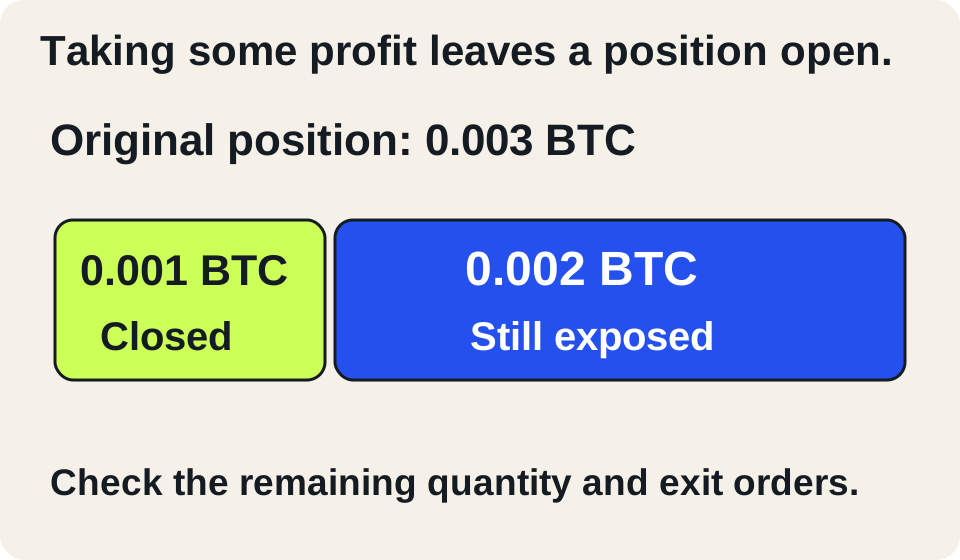
Suppose an illustrative BTC position is 0.003 BTC and you want to close 0.001 BTC at a target. If that exit fills, 0.002 BTC remains exposed. At a hypothetical $100,000 Bitcoin price, those portions represent $100 closed and $200 still open. The order must also meet the contract’s actual minimum and quantity rules.
Update the exit that is left behind
Gate’s TP/SL instructions identify oversized remaining exit orders as a possible failure case after a manual reduction. Check the quantity after changing a position. A profit target and a protective exit created for the original 0.003 BTC should not be assumed to describe the smaller trade automatically in every order mode.
Its TP/SL orders are reduce-only: they are intended to reduce the position rather than open one in the opposite direction. That is different from manually submitting an ordinary buy or sell order. Use the position’s closing controls deliberately, and read the actual filled amount before calling the trade finished.
A realised profit is not yet a kwacha withdrawal
Closing one part can realise a USDT result while the rest of the account still needs collateral. If you immediately remove the proceeds, the remaining position may have a smaller buffer depending on its margin mode. The withdrawal amount and the amount you want to keep behind the trade are separate decisions.
For a Zambian budget, record the realised result in its settlement asset first. Convert that amount using an executable ZMW quote only when you are actually arranging the permitted exit. A rising kwacha valuation of the still-open part is not cash already available to spend. The registration and payment restrictions described earlier continue to apply to that exit.
Use the demo to rehearse the partial close, inspect the remaining quantity and adjust the exit instructions. The point is to learn what the buttons do before relying on them, not to treat a successful simulation as evidence of live liquidity or a completed local withdrawal.
What should you retain after closing the trade?
Keep the filled quantity, average entry and exit, fees, funding entries and the transfer reference. This lets you distinguish trading losses from a conversion charge or a delayed payout. A single balance screenshot cannot explain which of those changed the final amount.
If an order partially filled, record only the executed quantity in the realised result. Do not calculate profit using the original requested quantity. If you transferred a token out, record the token and network separately from any later kwacha receipt; a blockchain transfer does not prove that a domestic payment has been completed.
For example, buying 30 units at 10 and selling those same 30 at 10.20 produces 6 of gross profit in the quote currency, before charges. Calculating on an unfilled request for 50 units would invent another 4 of profit. That is a small bookkeeping error with a large effect on judging whether a strategy is working.