










Which exchange fits a Zimbabwean trader?
Kraken: choose how profits are held
Our product preference for eligible traders who want USD-based accounting and a choice of supported profit currencies.
Read the verdictBinance: a token-settled contract
An alternative for someone already using a USDT or USDC futures balance and wanting the result in that token.
Read the verdict| Need | Product fit | Important limit |
|---|---|---|
| USD-based trading records with supported collateral choices | Kraken Multi-M | An exchange USD balance is not automatically USD cash in Zimbabwe. |
| An established USDT or USDC contract workflow | Binance USD-margined futures | Stablecoin settlement retains issuer and network risks. |
| Keeping money for a near-term USD expense | Do not use a leveraged Bitcoin long as a cash substitute | Bitcoin price exposure can lose value even if ZiG weakens. |
Why does Kraken make our shortlist?
Zimbabwe is not named in Kraken’s current non-US derivatives exclusion list. Full personal verification and product eligibility are still required. The geographical list is a provider rule, not the FIU registration record, so it cannot settle the local-authorisation question by itself.
The more useful product finding is in the current collateral schedule: Kraken lists USDT with a 0.50% collateral haircut and a 0% conversion fee. USDC and USDG also have zero conversion fees in the derivatives fee guide. Older explanations that apply the same stablecoin conversion charge to every asset no longer describe the present schedule.
A collateral haircut is not a withdrawal deduction
Assume 1,000 USDT is valued at exactly USD 1,000. A 0.50% haircut leaves USD 995 recognised as collateral for the margin calculation. It does not mean five tokens have been withdrawn from the wallet. Fees, losses or conversions can change the actual token balance separately.
| Measure | Amount | Meaning |
|---|---|---|
| Tokens held | 1,000 USDT | The wallet asset balance in this simplified example. |
| USD valuation before haircut | USD 1,000 | Assumes USDT trades at one dollar. |
| Collateral after the 0.50% haircut | USD 995 | Value recognised for supporting positions. |
| Conversion-fee rate listed for USDT | 0% | Does not erase trading, funding or withdrawal costs. |
That distinction makes Kraken useful for someone comparing available collateral with a household budget in dollars. It also prevents a misleading complaint that a small difference between wallet value and margin value is necessarily money missing from the account. The important question is which balance is being displayed.
Using Bitcoin itself as collateral introduces a different risk: its dollar value can fall at the same time as a Bitcoin long loses money. Stablecoin collateral avoids that particular double exposure, although it still carries the risk that the token deviates from its intended dollar value. This is a reason to choose the collateral deliberately, not a reason to increase leverage.
Kraken or Binance: which settlement is simpler?
For a trader who wants to keep eligible assets together and account for positions in USD, Kraken’s Multi-M design is the better fit of these two. For a trader who already keeps a separate USDT futures balance and wants a USDT result, Binance’s USDT-margined contract is the simpler accounting match. Neither conclusion establishes better liquidity for an unspecified pair or a cheaper route back to Zimbabwe.
| Question | Kraken Multi-M | Binance USD-margined futures |
|---|---|---|
| How is the contract result expressed? | Calculated in USD; supported profit-currency choice | Settlement in the contract’s USDT or USDC currency |
| Does the collateral have to be the coin being traded? | No; eligible collateral is valued in USD | The selected contract and account mode determine collateral treatment |
| Does a USD-looking number prove a bank payout? | No | No |
| Best fit in this comparison | Flexible collateral with deliberate payout-currency selection | An existing token-settled futures routine |
Suppose a trader closes a position with USD 12 of net trading profit after the charges already settled. On Kraken, choosing to hold that result in a supported token changes the asset received. On a USDT-settled Binance contract, the settlement is already in USDT. In either case, withdrawing to a Zimbabwean spending account is a later transaction with its own terms.
Kraken’s zero conversion fee for the stablecoins listed above removes one potential charge in that comparison. It does not establish a permanent one-to-one market price between the token and bank dollars. Compare the actual conversion value and withdrawal quote before deciding how much a USD 12 or 12 USDT gain is worth to you.
The final choice should follow the currency you genuinely want to keep. Switching from one already suitable account to another just because the interface displays a dollar sign can add work without improving the outcome. Conversely, a trader holding several accepted assets may find Kraken’s single margin wallet more useful than creating a new token balance for each trade.
Are USD, ZiG and USDT interchangeable?
No. USD is the US currency; ZiG is Zimbabwe’s domestic currency; USDT is a privately issued token intended to track the dollar. The same number written beside each label does not represent the same asset, and a transfer address for one is not a payment instruction for another.
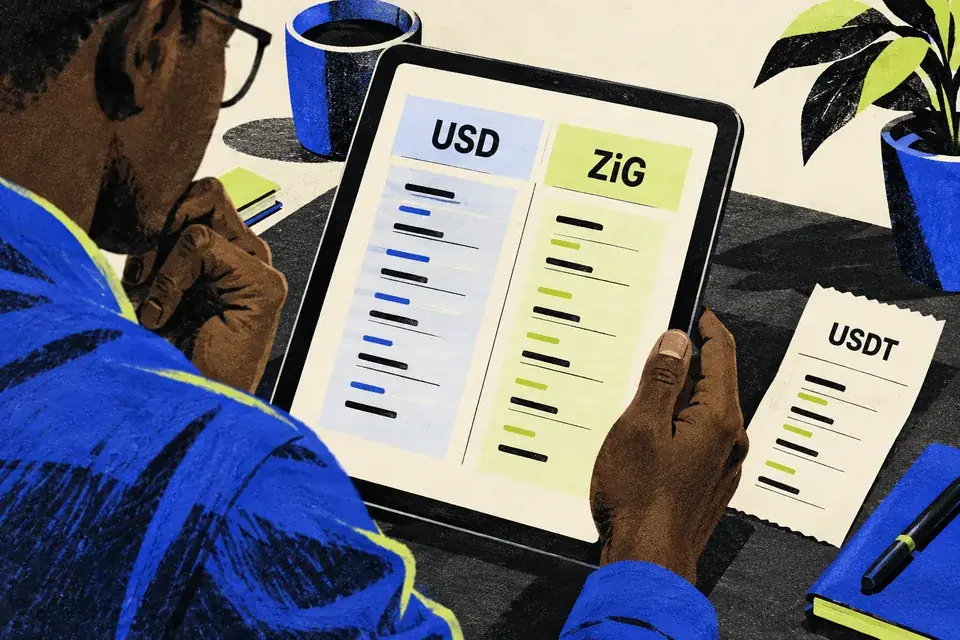
There is an additional historical trap. Zimbabwe previously used the ZiG name for gold-backed digital tokens. The RBZ’s April 2024 explanation distinguishes the new currency from those tokens and says the token naming would change. An old article about “ZiG digital tokens” is not a current instruction for depositing ordinary ZiG into a crypto exchange.
Neither ZiG nor a gold-token balance appears in the Kraken collateral list reviewed for this article. Do not send an unsupported asset because its name sounds like a supported stablecoin. A local banking balance cannot be transferred to a USDT blockchain address without a separate, valid conversion and transfer arrangement.
Why a Bitcoin long is not a dollar savings account
Imagine USD 200 supports USD 1,000 of Bitcoin exposure. A 5% fall in Bitcoin produces about USD 50 of gross loss for a linear long, before other charges. The position can lose a quarter of the starting margin while the USD itself buys more ZiG. Currency weakness and Bitcoin price direction are separate events.
If the purpose of the money is a known near-term bill, adding leveraged Bitcoin exposure changes the purpose of that money. The futures market can express a market view; it cannot guarantee preservation of the amount needed for rent, school fees or another obligation. A rising local-currency valuation may hide a loss measured against the currency of the bill.
What do Zimbabwe’s new crypto rules actually require?
The FIU’s August 2026 guidance requires providers serving Zimbabwean residents to register, including providers based outside the country. It separately says that FIU registration concerns anti-money-laundering duties and does not replace an operating licence or other permissions from the relevant regulator.
The customer’s practical test has two parts: identify the legal company providing the service, then establish the registrations and permissions applicable to that service. A global brand name, a foreign licence or a successful KYC application is not proof that both parts have been satisfied in Zimbabwe.
Our review did not produce a current official registration or operating-approval record for the featured offshore exchanges. Until that is resolved for the actual provider, use the comparison to understand the products and do not treat the affiliate button as confirmation that live funding is approved. This limitation applies to the provider’s local status, not to whether its futures interface exists.
Does a new framework mean a blanket personal ban has ended?
The guidance is about providers and their obligations. It should not be simplified into either “every personal crypto activity is banned” or “every foreign exchange is now authorised.” A reader who already holds an asset and a business offering exchange services are not asking the same legal question.
If you already hold assets, retain the acquisition and transfer history so an account review can distinguish your own holdings from a business handling funds for others. Where a provider asks for the destination owner or source of funds, use accurate records rather than changing the payment description to make a transfer pass.
Would a Bitcoin-settled contract suit you better than USDT?
It can suit someone who deliberately wants to keep a Bitcoin-denominated result, but it is a different objective from keeping a dollar trading balance. Binance’s BTC COIN-M contracts use Bitcoin for collateral and settlement. Its USDT-margined contract instead pays the result in USDT. Do not select between them using only a familiar BTCUSD label.
For a Zimbabwean reader whose spending target is denominated in USD, a BTC-settled win introduces a later conversion decision. The number of satoshis earned can stay the same while their dollar value falls. A trader trying to accumulate BTC may accept that exposure; someone trying to reserve a dollar amount needs to account for it.
A small BTC gain can change value before you withdraw
Suppose a completed trade leaves an additional 0.0002 BTC after its settled charges. At a hypothetical BTC price of $100,000, that gain is worth $20. At $90,000 it is worth $18 even though the coin quantity is unchanged. This example describes the value after settlement, not the more complex calculation of an open inverse contract.
That distinction prevents a misleading comparison with a $20 or 20 USDT trading gain. The BTC amount remains tied to Bitcoin’s price; the dollar amount does not acquire that same Bitcoin exposure merely by staying in the wallet. A stablecoin still has issuer and market risks, so it should not be described as insured bank dollars either.
Why the collateral choice matters on a long
If Bitcoin itself backs a long Bitcoin trade, a falling market can affect both the position and the dollar value of the backing coins. Increasing the leverage setting does not remove that relationship. Before choosing a coin-settled contract, decide whether retaining BTC exposure is actually part of your plan or just the result of clicking the first Bitcoin market shown.
For the dollar-accounting need described at the start of this guide, Kraken’s supported payout choices or a USDT-settled Binance contract remain easier to match to the intended result. COIN-M deserves consideration for a deliberate BTC-denominated strategy, subject to the same local-authorisation and account-eligibility limits. It is not a better Zimbabwe choice simply because it advertises another leverage multiple.
How do you get from a closed trade to money you can use?
Closing a futures position does not automatically withdraw the wallet balance. In Kraken’s workflow, the derivatives wallet and the main account are separate stages. The amount transferable depends on remaining positions and margin obligations; closing one position does not necessarily free the collateral supporting another.
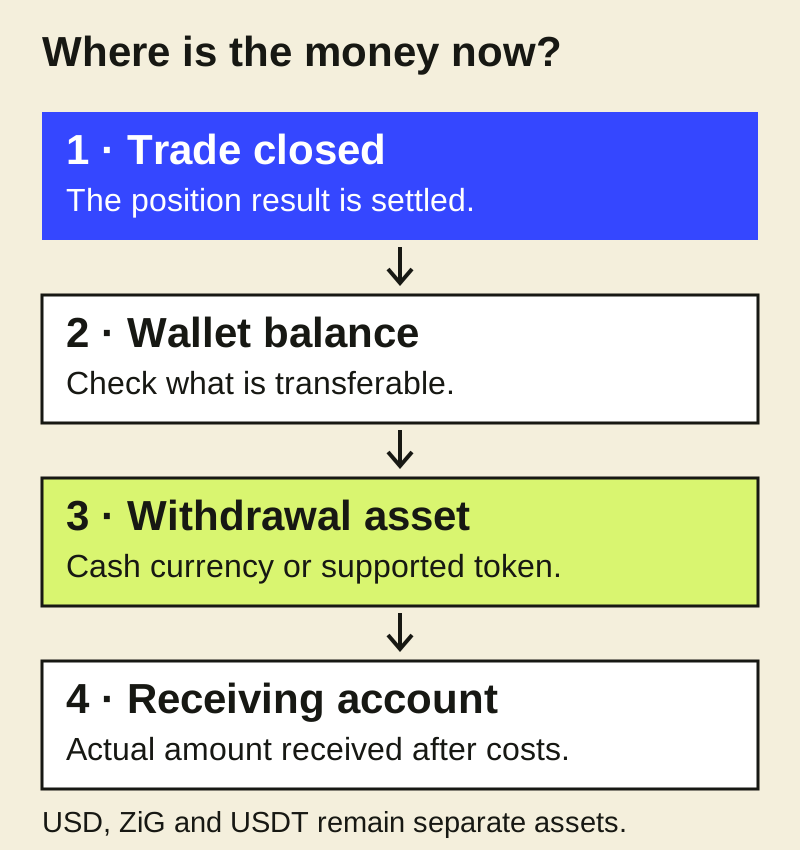
For a crypto withdrawal, match the asset and network at both ends. Kraken supports USDT on several networks, but that does not mean every recipient accepts every one. The cheapest network shown by the sender is not usable if the receiving service has no matching deposit route.
For a cash withdrawal, the destination bank and currency need to match the supported withdrawal arrangement. A USD account in Zimbabwe is not automatically eligible for every international dollar payment service, and ZiG is not an alternative spelling for USD. We do not promise a local bank or wallet integration that the provider has not confirmed.
Why might a withdrawal wait even after the trade closes?
Kraken warns that certain purchase methods can create temporary withdrawal holds, including a 72-hour hold for specified card and digital-wallet purchases. The fact that a trade can be closed does not remove a purchase-related hold. Read the account’s actual hold notice before assuming the token or cash can leave immediately.
Distinguish that delay from a request to pay an outside “unlock fee.” An agent contacting you privately is not the withdrawal system. Use the provider’s signed-in support channel to identify the stated restriction and keep the transaction reference; do not transfer more money to an unverified address to release a displayed profit.
How should a Zimbabwean trader measure profit?
Choose the comparison currency before judging performance. If the goal was to preserve a USD 500 amount, ending with tokens that can lawfully be converted into USD 480 after costs is a USD 20 loss. A larger ZiG valuation does not reverse that result. If the goal was instead a ZiG amount, use actual dated conversion values and charges.
Maintain a short record with the initial asset and quantity, the settled trade result, the asset withdrawn and the final amount received. Keep a separate line for transfers between your own accounts. Moving USD 100 into the trading wallet is new capital, not USD 100 of profit.
Zimbabwe’s March 2026 foreign-exchange directive also treats business proceeds differently from ordinary personal balances in several areas, including export-retention arrangements. A company’s receipts should not be treated as unrestricted personal trading money merely because an app will accept a deposit. The underlying purpose and conditions of those funds still matter.
For tax or business accounting, retain the original trade and transfer records with their currencies and dates rather than converting every historical entry at today’s rate. That creates a traceable result without pretending that a token valuation, a realised trading gain and a bank receipt are the same event.