

















Is there a crypto futures exchange we recommend for Vatican City?
The virtual-currency service prohibition and the IOR’s explicit exclusion of crypto services are separate obstacles: one concerns the local service framework, the other the banking product. Neither should be mistaken for a missing setting on a global futures app.
The answer is different for a person who works at the Vatican but lives in Rome. They should investigate the Italian-resident product and their own eligibility in Italy. A Vatican employer, citizenship or institutional connection does not turn a home address in Italy into an address inside Vatican City.
| Your situation | Useful next step | What this guide does not assume |
|---|---|---|
| You live in Vatican City | Read the local service prohibition and seek product-specific confirmation before funding an account. | A worldwide signup menu establishes local permission. |
| You work at the Vatican and live in Italy | Use our Italy guide and the exchange's Italian-resident terms. | Your employer decides the country of your personal trading account. |
| You hold Vatican citizenship but live elsewhere | Use the rules for your real country of residence, including any additional personal restrictions. | Citizenship gives automatic access to a European futures account. |
| You are visiting Vatican City | Keep your normal account details truthful and check any travel-related restrictions. | A visit creates a new country of residence. |
This page uses Holy See and Vatican City in the context of the country listing, while recognising that the Holy See is not simply another name for a retail financial market. The practical question is the location and status of the customer, the service being supplied and the entity offering it.
What does the Vatican's crypto rule actually prohibit?
Article 5(g) of Law XVIII lists the provision of services involving encrypted, electronic, virtual or synthetic currency among the prohibited activities in the State. Its wording covers a broad range of services, including issuance, transfer, custody, lending and exchange. The linked ASIF consolidation is the place to read the provision directly.
We do not expand that wording into an unsupported claim that every private possession of a coin, wherever its owner lives, is a criminal offence. Nor does the rule provide a useful local leverage ceiling such as 2x or 10x. The issue comes before position sizing: whether the proposed service can be supplied in the circumstances at all.
For a resident researching a cash-settled BTC future, the product's exact legal structure would matter to an individual assessment. Calling it a future rather than a coin purchase is not enough for this guide to certify an exception. An exchange would need to address the real residence and the actual contract, alongside the applicable local rules.
Living in Rome is different from living inside Vatican City

The Vatican's own population information distinguishes citizenship from residence: not every citizen lives within the walls. An article that treats everyone connected with the Holy See as the same customer would therefore miss the most useful distinction for many readers.
Imagine two colleagues with the same workplace. One has an established home in Rome, while the other resides inside Vatican City. They should not copy each other's country selection during exchange registration. The first has an Italian residence to document; the second needs an answer that specifically addresses Vatican residence. Their shared employer does not erase that difference.
Which address belongs on the application?
Use the residence requested by the provider and evidence that genuinely supports it. A work badge establishes a role. A postal address may establish where correspondence is received. Neither should be substituted for proof of a home address merely because it is easier to obtain.
For an Italian resident, the relevant comparison is between services permitted for that person in Italy. For someone moving out of Vatican City, the review should follow the completed change in circumstances, not a planned move or a borrowed address. Existing positions may need special handling during an account migration, so obtain the provider's instructions before changing the account country.
Why do other lists show Kraken, OKX or high-leverage platforms?
An exchange directory often starts with a platform's published country exclusions. If Vatican City is absent from that list, the directory may label it available. That can be useful as an initial geography check, but it is not the same as a confirmed Vatican-resident derivatives account or a local legal assessment.
Kraken's general derivatives eligibility page requires both verification and geographic eligibility. It does not name Vatican City among the listed restricted regions. That omission explains why Kraken can appear in broad catalogues; it does not establish a Vatican-specific product approval.
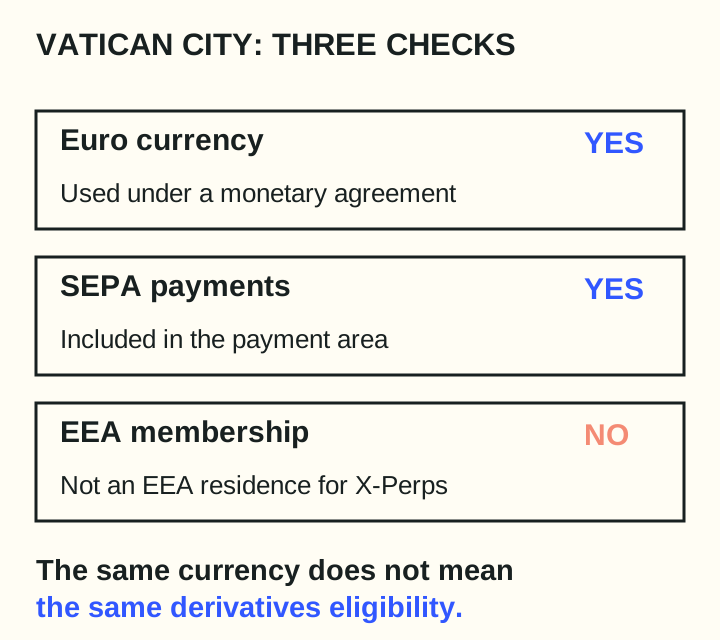
OKX describes X-Perps as a product for eligible customers in supported EEA countries. Vatican City is outside the EEA. Its use of the euro and close relationship with Italy do not place it inside that eligibility description. An Italian-resident account and a Vatican-resident account should not be treated as interchangeable.
How to read our own catalogue
The broader provider catalogue remains a record of exchange-policy availability signals. The short answer and editorial recommendations apply a further product and local-law assessment. A provider appearing in the catalogue therefore does not mean this page recommends depositing with it from Vatican City.
If support gives a general answer such as “we serve Europe,” ask whether that includes a verified Vatican City residence and the named futures product. Preserve the answer with its date and entity. Even a positive provider response concerns its service policy; it does not replace a competent assessment of the local legal position.
We have not opened a Vatican-resident account or tested a deposit. There is no useful reason to present a global 100x or 200x advertisement as though it had passed that test.
Can the IOR provide Bitcoin futures or a crypto trading account?
No. The Institute for the Works of Religion explicitly excludes services relating to cryptocurrencies or similar financial instruments. It also warns that initiatives improperly using its name or logo in connection with crypto are unauthorised. A token or trading page using religious imagery is not evidence of an IOR relationship.
IOR customer eligibility is itself limited to qualifying people and institutions connected with the Catholic Church or serving it. It is not a general-purpose exchange anyone can join by selecting Vatican City. Its ordinary financial services should not be described as a local substitute for a crypto perpetuals platform.
For an eligible customer asking about a particular payment, contact the institution through its published channels. The existence of an IOR account does not answer whether a proposed external crypto transfer is accepted, and this guide does not claim to have obtained that acceptance.
An especially clear warning sign would be someone asking for a deposit into an alleged “IOR crypto account” while refusing to identify the contracting entity. Check the official institution's own position before responding to the offer. A professional-looking logo is much easier to reproduce than a genuine financial-service authorisation.
Does using euros make a Vatican account European for trading?
Vatican City uses the euro under a monetary agreement with the European Union. The European Commission describes this arrangement separately from EU membership. It is a monetary relationship, not a blanket extension of every European investment product to Vatican residents.
The Holy See's official announcement also records the extension of SEPA's geographic scope to Vatican City and the Holy See from March 2019. SEPA concerns euro payments. An exchange can support a payment network while applying a narrower list of customer residences for a particular trading product.
Think of two separate decisions. The payment provider decides whether and how a transfer can be sent. The derivatives provider decides whether the person can open and use that contract under the relevant terms. Passing the first stage does not establish the second, and sending money first can leave a balance in an account that still cannot trade.
IOR publishes both SEPA and SWIFT payment services for its customers. That tells a reader about payment capability, not approval of a particular crypto destination. Do not infer that a successful ordinary euro transfer establishes permission for a leveraged exchange account.
What if you already have coins or an account from another country?
A pre-existing wallet or exchange account needs a different review from a new signup. Start with what you actually hold: coins under your own control, coins held by a provider, or an open derivatives position. Each involves different actions, and a general statement about buying Bitcoin cannot tell you how an existing leveraged contract will be handled.
If a move to Vatican City changes your provider eligibility, ask the provider about reducing or closing positions and recovering funds. Do not assume that the ability to log in means the old trading permissions continue indefinitely. Equally, do not transfer collateral away from an open position without checking how that affects the remaining margin.
Keep access credentials and transaction records secure while the position is resolved. Someone offering to “unlock” a geographically restricted account by taking custody of your coins is adding another counterparty, not fixing the original account terms. Use the provider's own support process for account changes and withdrawal instructions.
For tax, start with the person's actual residence and the relevant income category rather than importing Italy's crypto rate simply because Vatican City is surrounded by Rome. The IOR describes a specific tax arrangement for its customers resident in Italy; that is not a statement that every independent foreign exchange account is handled through the IOR.
An individual with an unusual institutional or diplomatic status may need advice tailored to that status. The useful material to bring is concrete: residence dates, provider agreements, closed-trade records and account balances. A generic country-ranking score is not evidence of how that person's income should be treated.
Where can you check a claimed Vatican crypto service?
ASIF is the local authority responsible for financial supervision and the relevant anti-money-laundering framework. Its official website provides legislation and information about supervised entities. Use that record when a business claims a Vatican financial authorisation, rather than accepting a certificate hosted only on the business's own website.
Check the legal name as well as the brand. A certificate for an unrelated company, a charitable affiliation or a Vatican postal address does not establish permission to supply the crypto service being advertised. For IOR-branded claims, its own explicit cryptocurrency statement is the direct reference.
The resulting answer is deliberately specific: there is no locally endorsed crypto futures shortlist on this page, while readers who genuinely reside in Italy or another country have a relevant country guide to consult. That is more useful than inventing a leverage limit or pretending that all Vatican-connected readers share the same access conditions.