











Which Japanese crypto exchange should you use for leverage?
SBI VC Trade’s leveraged menu includes ETH, XRP and SOL, giving an altcoin trader a different shortlist from bitFlyer’s Bitcoin CFD user. GMO Coin adds an order-book alternative for its supported yen pairs. The underlying requested by the reader decides which comparison comes first.
A BTC/JPY day trade, a multiday altcoin short and a hedge against Bitcoin you already own have different requirements. The shortlist below changes with those tasks; the familiar name from a spot-purchase account need not be the best derivatives product.
| Service | Best reason to consider it | Reason to choose another |
|---|---|---|
| bitFlyer Crypto CFD | A focused BTC/JPY leveraged product and Lightning trading controls | For altcoins, or when its daily holding charge is too expensive for your plan |
| SBI VC Trade | Leveraged yen pairs beyond Bitcoin and a published daily funding calendar | If you specifically want to place orders against a visible exchange order book |
| GMO Coin exchange leverage | Order-book trading for supported crypto/JPY pairs | If the desired asset is absent from its leverage menu or another service has a better executable price |
This is a product-fit shortlist, not a claim that we placed identical orders on all three. We checked public specifications and charges. Live spreads, the size available at each price and your approved account can change which service gives the better trade. Below, the comparisons explain when the initial preference changes.
Can you trade crypto with more than 2× leverage in Japan?
For individuals using the domestic products reviewed here, the published maximum is 2×. A ¥100,000 cash margin balance can therefore support up to ¥200,000 of exposure before allowing for fees, other positions and account requirements. You do not have to use the whole allowance. Putting ¥100,000 behind a ¥120,000 trade produces much less borrowing-like exposure than using it behind ¥200,000.
The distinction matters because “only 2×” can sound harmless to somebody arriving from a 100× perpetuals platform. A 10% move against a ¥200,000 position means roughly ¥20,000 of price loss: one fifth of that ¥100,000 starting margin, before charges. The lower ceiling gives more room than very high leverage, but it does not make a bad entry cheap.
Why do some Japanese pages show a higher multiplier?
Corporate customers can be subject to different ratios. Providers refer to the JVCEA’s crypto risk calculations, and the applicable figure can vary. A corporate table is not the maximum for an individual account. Nor is opening a company a simple switch that makes a personal trading plan eligible for any advertised number.
Japan’s registration rules also distinguish businesses offering crypto derivatives from ordinary crypto exchange services. That is why the shortlist starts with a named leveraged product, rather than a logo from a list of registered spot exchanges. The financial instruments registration and product terms are the useful checks for this task.

Is bitFlyer Crypto CFD the best fit for Bitcoin?
bitFlyer’s present product is Crypto CFD. Older instructions calling it Lightning FX can send you into the wrong documentation: the replacement took place in March 2024. The product follows Bitcoin’s price against the yen, lets you take a long or short position and publishes a minimum order of 0.001 BTC.
Suppose Bitcoin costs ¥10 million purely for an example. An order for 0.001 BTC has ¥10,000 of exposure, so the 2× starting-margin calculation is ¥5,000. That is an explanation of order size, not a promise that depositing exactly ¥5,000 will leave a usable trading buffer. A price move or a charge immediately uses some of that room.
Where it wins, and where it does not
The appeal is focus. Someone who mainly trades BTC in yen can evaluate one familiar market instead of choosing between several stablecoin balances and hundreds of overseas contracts. But a Bitcoin-only product has no answer to “I want to short SOL.” In that case, SBI’s relevant yen pair is the better candidate even if you already like bitFlyer’s interface.
For an entry that stays open across daily rollovers, cost is a separate decision. bitFlyer publishes daily leverage points, as well as a funding mechanism. The absence of a trading commission does not remove those holding costs. This makes an overnight or multiday trade a different comparison from entering and closing within the same charging period.
The controls worth learning before the first order
Lightning offers special order types, including paired orders that can combine a profit-taking level and a protective exit. The useful question is practical: when one side fills, what happens to the other? An exit should close the position you have, rather than accidentally create a fresh position after the first one is gone.
For example, buying Bitcoin exposure and then placing two unrelated sell orders is not the same as using a correctly configured linked exit. A trader can get the direction right and still leave an unwanted order behind. Read the order example for the selected control, try the smallest sensible size and check the open-orders panel after closing. This is more valuable than choosing a platform because a screenshot contains more indicators.
When is SBI VC Trade a better choice?
SBI VC Trade is the more relevant candidate in this comparison when the trade is about an altcoin rather than Bitcoin. The reviewed leverage list includes ETH/JPY, XRP/JPY, SOL/JPY and other pairs. Do not count the entire spot catalogue as leveraged markets: open the leverage list for the specific asset.
Its daily funding calendar is especially useful for someone deciding between a long and a short. The amount can change by coin, direction and day. SBI explains that a positive rate is charged to the customer and a negative rate is paid to the customer. A minus sign is therefore meaningful; it is not automatically an error or a borrowing rate that you owe.
Compare the cost of your direction, not the exchange name
Imagine two otherwise identical ¥200,000 positions. If one direction has a hypothetical daily rate of +0.02%, it costs ¥40 for that rollover. If the other has −0.01%, it receives ¥20. These are invented rates to explain the calendar, not today’s SBI quote. The point is that “SBI funding is cheap” is too broad: the answer depends on the actual row and direction.
You also pay through the price at which you enter and leave. A favourable funding line cannot rescue a large gap between the available buy and sell quotes on a short trade. For a planned two-hour position, compare the executable prices first; for a planned several-day position, add the changing holding charges too.
SBI is therefore a stronger candidate for an available altcoin pair or an attractive direction-specific carrying cost. It is not automatically better for every Bitcoin scalp. The decision reverses if bitFlyer or GMO offers a better entry and exit for the same size, and the holding-cost difference is too small to make up for it.
What does GMO Coin add to the comparison?
GMO Coin’s exchange service offers both spot and leveraged trading. Select the leveraged product deliberately: the same coin name can appear in more than one service. Its product page describes a visible order book and limit orders, which makes it a useful candidate for somebody who wants to choose an entry price rather than accept an immediate dealer quote.
A limit order states the highest price you will pay when buying or the lowest you will accept when selling. It may wait without filling. A market order attempts to trade against the prices available now. Neither is universally superior: a patient entry and an urgent exit have different jobs.
Do not copy a spot rebate into a leverage calculation
GMO’s page also promotes maker rebates for spot trading. Those headlines should not be pasted into a futures comparison. Select the exact leveraged coin in its rules and check the current trading charge. The separate leverage fee applies when a position crosses its daily charging point; the reviewed support explanation gives 0.04% of position value per day.
For a hypothetical ¥200,000 position, 0.04% is ¥80 for one daily charge. That simple amount is easier to compare than an annualised headline. If your plan involves ten charged rollovers at an unchanged ¥200,000 valuation and unchanged rate, that component alone would total ¥800. Actual valuations and the rest of the trade’s costs still matter.
The conclusion is fairly narrow: GMO is worth comparing for order-book execution, especially when the intended altcoin is supported. Its existence does not make SBI redundant, because SBI’s quoted prices and funding can work differently. A meaningful comparison uses the same coin, direction, yen exposure and intended holding period.
How much does a leveraged crypto trade really cost in yen?
There are three amounts to inspect: the gap between buying and selling prices, the charge for executing the orders, and the cost or credit for holding the position. They can point in different directions. An exchange with a zero execution charge can be more expensive for a week-long trade than one charging a small commission.
Here is a deliberately simple comparison between two hypothetical offers for the same ¥200,000 exposure. Offer A costs ¥100 to enter and exit, then ¥80 for each daily hold. Offer B costs ¥300 to enter and exit, then ¥20 per day. Before any daily charge, A is ¥200 cheaper. After four charged days, A totals ¥420 and B ¥380, so B is ¥40 cheaper. A ranking that ignores the holding period cannot answer both users correctly.
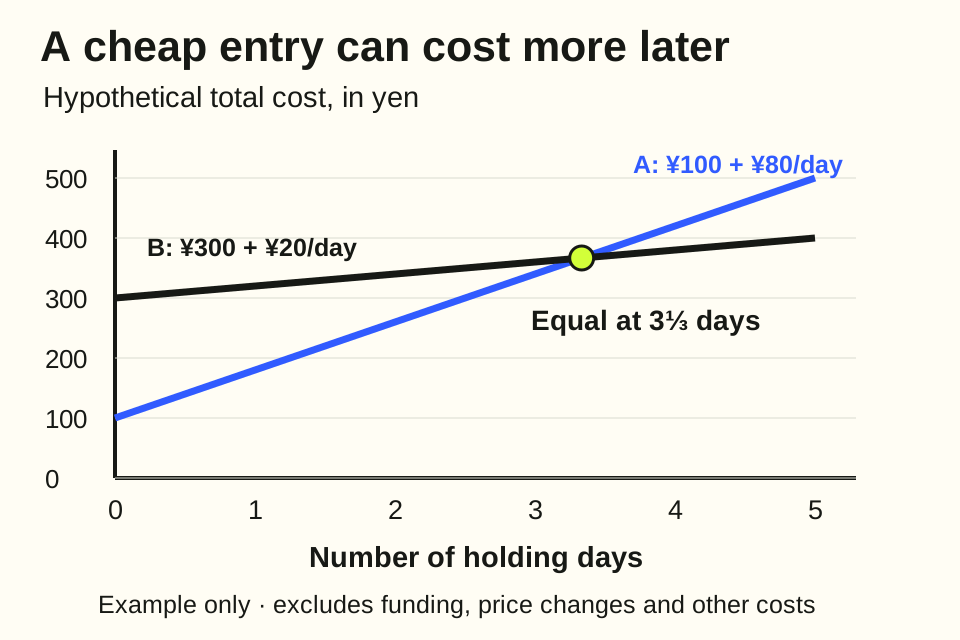
The graph is not a live bitFlyer-versus-SBI quote. Actual funding can change direction, the position value can move and spreads can widen. Use it as the arithmetic to apply to the prices shown in your own order ticket. It demonstrates why the article does not award a permanent “cheapest” badge from a single fee line.
What to record before comparing two apps
Write down the coin, buy or sell direction, position size and the two executable prices. Then record the carrying charge and when the next one applies. A BTC quote against yen is not directly comparable with a USDT perpetual quoted in dollars without allowing for the currency conversion.
If one app shows a tiny trading fee and the other shows a small spread, put both costs into yen for your planned size. For a ¥200,000 position, a 0.1% difference is ¥200. That gives you a usable answer without turning the choice into a complicated finance exercise. The open question is how often the charge occurs, not how impressive the percentage looks on a marketing page.
Should you use yen or Bitcoin as collateral?
Yen collateral is easier to understand if your bills and trading budget are in yen. Bitcoin collateral can spare you a sale of coins you already hold, but it adds a second moving part. The trade can lose value while the collateral supporting it loses value too.
bitFlyer recognises BTC collateral at 50% of its spot-yen value. For example, BTC worth ¥200,000 contributes ¥100,000 of recognised collateral at that haircut. It does not create a ¥200,000 cash margin balance. GMO’s published collateral explanation likewise describes a 50% valuation for supported substitute crypto, including BTC, ETH, XRP and SOL.
Why a Bitcoin-funded long is harder to manage
Imagine ¥200,000 worth of BTC providing ¥100,000 of recognised collateral, alongside a separate ¥150,000 Bitcoin long. A 10% fall reduces the BTC holding to ¥180,000 and its recognised collateral to ¥90,000. The long also loses approximately ¥15,000 before charges. Those two effects are different: one reduces the backing of the account; the other is a loss on the derivative.
You cannot find the remaining safety margin by looking only at the leveraged position’s percentage return. This is why cash collateral is the clearer starting point for someone learning the domestic product. Keeping coins as collateral is useful only if you understand the combined exposure and the provider’s valuation method.

A short position is not automatically a perfect hedge
A Bitcoin holder may short a derivative to soften a fall in the value of the coins. That can make sense as a purpose, but the quantities need to match and the account must survive price swings along the way. A short can lose money during a rally even while the separate Bitcoin holding rises.
For a simple illustration, owning 0.02 BTC and shorting 0.02 BTC-equivalent exposure approximately offsets the Bitcoin price direction before fees and price differences. Shorting 0.04 BTC against that holding creates a net short, not a neutral hedge. The extra leverage changes the bet. Choose the number of coins first, then the amount of margin needed to support that size.
Why can BTC/JPY move differently from BTC/USDT?
Japanese leveraged products commonly use yen pairs. This is convenient for a local budget, but it changes what the chart measures. A Bitcoin price in yen reflects both Bitcoin’s dollar price and the yen’s exchange rate. A flat dollar Bitcoin chart does not guarantee a flat yen Bitcoin chart.
Suppose Bitcoin remains at an illustrative $60,000 while USD/JPY rises from 150 to 155. Its translated price rises from ¥9 million to ¥9.3 million, a gain of about 3.33% in yen. A ¥200,000 yen-denominated long would gain roughly ¥6,667 from that movement before costs, even though the dollar Bitcoin price did not increase. These are rounded hypothetical values, not a market forecast.
This is relevant when your trade idea comes from an English-language BTC/USDT chart. Ask whether you want exposure to Bitcoin in dollars or to the value of Bitcoin in your local currency. The domestic yen product answers the second question naturally. It should not be described as an exact clone of an overseas stablecoin perpetual.
The reverse also matters. A strengthening yen can reduce a yen gain from a Bitcoin dollar rally. That does not mean the platform executed the trade incorrectly. Before disputing a result, compare the opening and closing prices of the contract you actually traded, rather than the headline price from another market.
Can foreign residents open a Japanese crypto leverage account?
Foreign nationality is not itself a blanket exclusion from bitFlyer’s Japanese identity-verification process: its official identity page explicitly covers Japanese and foreign nationals residing in Japan. The practical task is supplying the accepted resident documents and completing the additional product requirements. A holiday booking or a Japanese-language app does not establish resident-account eligibility.
Crypto derivatives also bring My Number requirements. Check the provider’s current list of accepted documents and whether information must be resubmitted for the leveraged service. Successful spot verification is not a reason to send money before confirming that the leverage account is ready.
A bank deposit and margin funding are different steps
With bitFlyer Crypto CFD, funds must be placed in the margin account. Its rules explain that you cannot directly transfer from a bank into that collateral account; the transfer happens within the service. If the order screen shows no buying power despite a successful yen deposit, inspect the internal account allocation before repeating the bank transfer.
On withdrawal, reverse the distinction: closing a position does not necessarily move all available money into the bank-withdrawable balance. Confirm that the position is closed, check for open orders still reserving funds, then use the service’s transfer and withdrawal instructions. That is an account workflow, not a reason to use a paid “unlocking” intermediary.
Does Tokyo have different leverage rules from Osaka?
The individual-product limits reviewed here are national terms. This research found no basis for giving Tokyo, Osaka, Fukuoka or Hokkaido different retail multiplier rankings. The differences that matter are your residence, account status, product and funding arrangements. Moving between Japanese prefectures does not turn a domestic 2× account into an offshore 100× account.
For someone moving out of Japan, the useful step is updating the provider about the actual change of residence. A Japanese account should not be assumed to continue unchanged overseas, and an old international account should not be assumed to regain trading access merely because travel temporarily changes an IP address.
Can you still use Bybit or Binance Futures from Japan?
Bybit is not a new-account recommendation for Japanese residents. It stopped new Japanese-resident registrations in October 2025. Its July 2026 completion notice then said the remediation measures for residents had been completed, while conversion and withdrawal functions remained available for returning assets. An account that can still withdraw is not an account that can open a fresh perpetual position.
For an existing balance, use the official account notice and the available withdrawal functions. Preserve the transaction history before treating the account as finished. Do not follow an old “best exchanges in Japan” tutorial that assumes the former trading service is still operating normally.
Binance Japan is a separate service proposition from the global futures brand. Its terms distinguish the Japanese services from other products visible elsewhere on Binance.com. A Japanese-language help article describing global futures does not, on its own, establish a Japanese-resident futures account. Our local shortlist consequently uses named domestic leveraged products instead.
What about a wallet-connected perpetual DEX?
Connecting a wallet is technically different from opening a custodial account, but it does not create Japanese authorisation or remove a frontend’s restrictions. This page does not recommend a DEX as a shortcut around domestic access rules. For a resident who wants a supported local leveraged product, the decision remains between the domestic services above.
The same distinction applies to a platform advertising no identity checks. Avoiding one form does not solve the questions of permitted use, withdrawals or responsibility when an account is restricted. A comparison that ranks it first simply because the multiplier is larger has not answered the Japanese reader’s actual problem.
Can a 2× trade lose more than you deposit?
A lower maximum does not make the position’s loss exactly capped at the starting deposit. bitFlyer’s risk documents warn that losses can exceed deposited collateral. A forced close is an attempt to close a deteriorating position; it is not a guarantee of the next executable price during a sharp move.
The margin ratio is also not the same as the percentage Bitcoin has fallen. It compares your remaining backing with the amount the provider requires for the position. The rules can cancel new orders, require additional funds or close positions at different stages. Read those stages for the selected service rather than importing a liquidation calculator from an unrelated USDT perpetual.
A useful exit question beats a universal “safe leverage” number
For a ¥100,000 exposure, a 3% adverse move means roughly ¥3,000 of price loss before charges. If that loss is already larger than you intended, a 2× limit does not fix the position size. Reduce the exposure or choose a different trade; adding more margin changes the liquidation cushion, not the yen lost from the same market move on the same exposure.
A stop order can help implement the exit, but its trigger and its execution are separate. A stop-limit order can remain unfilled if the market moves beyond its limit; a market-style exit can fill at a worse price during a fast move. Pick the behaviour you need and avoid believing an exact loss amount is guaranteed simply because it was typed into a field.
What tax and account records should you keep in Japan?
Keep the realised derivative result, trading and holding charges, and yen deposits or withdrawals separately. A ¥50,000 bank withdrawal is not necessarily a ¥50,000 profit: it may include money you deposited before opening the trade. Likewise, moving collateral internally is not the same event as realising a derivative gain.
The National Tax Agency’s crypto material is the starting point for current treatment. The 2026 tax-reform outline discusses changes to crypto taxation, including derivatives, tied to legislative conditions. Do not calculate every current trade using an assumed flat 20% simply because a headline announces a reform. The applicable tax year, commencement rules and the specific transaction need to match.
For a practical record, save the opening and closing transaction, the actual funding entries and any conversion of crypto collateral. If a local product statement is in yen, keep it as the primary record rather than replacing it with a rounded dollar figure from a portfolio app. An accountant can classify complete records; they cannot reconstruct missing trade history from the final bank balance alone.
Old comparison pages can also name services that have changed. SBI’s official DMM transfer information matters when you are trying to find an existing account or statement, but DMM should not be added to a current new-account shortlist merely because it appears in an older article. Choose the product now offered by the receiving provider.