









Can you trade crypto futures on a Korean exchange?
Upbit’s collateralised coin borrowing introduces repayment and eligibility conditions rather than a perpetual order ticket. The distinction below lets a won-funded trader compare the local product actually offered without relabelling Upbit or Bithumb spot activity as domestic futures access.
For a resident specifically seeking a leveraged BTC long or short, we do not recommend treating an unregistered offshore referral link as the missing local futures product. Korea’s financial authorities have warned about unregistered virtual-asset businesses targeting residents, including their promotional channels. An overseas platform listing South Korea is not proof of Korean registration.
| Product | What you receive | What you do not receive |
|---|---|---|
| KRW spot trading | The supported coin bought with won | An automatic leveraged futures position |
| Collateralised coin borrowing | Coins that must be repaid under the lending terms | A perpetual contract or an unlimited credit line |
| Crypto perpetual futures | Price exposure with margin, liquidation and contract-specific payments | Proof of local permission merely because the website accepts an account |
The most useful local comparison therefore starts with the job: owning crypto, borrowing a supported coin, or taking a derivatives position. Giving all three the same “up to 100x” score would conceal the distinction that matters most to a Korean reader.
Below, the local products are compared on tasks they actually document. The broader country catalogue remains visible, but a provider-access record is not an endorsement of an authorised Korean retail-futures service.
Upbit or Bithumb: what can you use each one for?
For a Korean resident wanting a won spot account, the bank and identity relationship comes before a fee comparison. Upbit’s policy links KRW-market use to a verified Kbank real-name account. Bithumb’s current materials refer to KB Kookmin Bank. An old guide pointing every Bithumb customer to NH Bank is not a reliable onboarding instruction today.
Upbit is the more relevant product to investigate in this article when the question includes its documented coin-borrowing service. Bithumb deserves a separate quote comparison for spot buying or selling, particularly if the customer already has the required account relationship. Neither conclusion turns a spot exchange into a futures venue.
Compare the order you will place, not the headline tariff
Upbit’s fee help explains that commission depends on the market and order treatment; its worked example uses a 0.139% reserved-order rate. That example should not be copied as the universal cost of every KRW trade. The linked fee screen and the order preview are the relevant checks for the order you intend to submit.
Bithumb’s published material has advertised 0.04% trading fees, while its 2026 promotion explicitly tied that reference to a registered fee coupon. The same promotion’s negative-fee offer had conditions and an end date. We do not present an expired promotion or a conditional coupon rate as a permanent default for everyone.
| Question | Upbit | Bithumb |
|---|---|---|
| Can I use the KRW account? | Confirm Kbank real-name verification and customer eligibility | Confirm the current KB Kookmin account and customer requirements |
| Which commission applies? | Use the market and order-specific rate | Check whether a coupon or promotion is required |
| Is this a futures position? | No; a spot purchase buys the coin | No; a spot purchase buys the coin |
| Can I borrow coins? | A documented product exists, with separate qualification | Do not assume its terms match Upbit’s borrowing product |
For scale, a hypothetical 0.04% commission on a KRW 2,000,000 trade is KRW 800. At 0.05% it is KRW 1,000. These are arithmetic comparisons, not a claim that every reader has those two live account tariffs. An execution-price difference of just 0.10% would be KRW 2,000 on the same amount, larger than that commission gap.
That leads to a more useful decision than awarding a winner from a single rate: compare the final coin quantity for the same won budget, using the intended order type. If you need to transfer the coin afterwards, include the withdrawal condition before deciding that a cheaper purchase is the better complete route.
What does Upbit Coin Borrowing actually let you do?
Upbit’s current guide allows eligible individuals to borrow supported digital assets against account collateral. Education and an assessment are required, and passing them alone does not guarantee eligibility. The product allows partial or full repayment and describes a maximum initial borrowing ratio of 85%, with forced repayment around the 95% threshold under its rules.
The exact available coin, borrowing quantity and fee must appear in the application. A product page is not a promise that every coin can be borrowed at all times. Nor does it mean that a new account immediately receives the largest advertised limit.
Borrowing a coin and shorting a perpetual are different trades
In a simple borrowed-coin example, you borrow a quantity of BTC and sell it. To repay, you need that BTC quantity back, plus the applicable charges. If Bitcoin becomes more expensive, buying it back costs more won. With a perpetual short, the exchange instead tracks a contract position and its margin. Similar directional intentions do not make their account mechanics identical.
Imagine borrowing 0.01 BTC and selling it for KRW 1,000,000. If the same 0.01 BTC later costs KRW 1,100,000, buying it back takes KRW 100,000 more, before borrowing and trading costs. If it costs KRW 900,000, the gross difference runs the other way. This example explains the obligation; it is not a recommendation to open the trade.
The borrowed quantity is what has to be repaid. A user looking only at the won cash received from the sale can overlook that changing obligation. The product also has collateral and repayment conditions that can force a close before the user’s preferred moment.
Who gets a borrowing limit?
The published Upbit level-one criteria require at least KRW 5 million in eligible holdings and at least ten digital-asset trades in the preceding year. That level lists a KRW 30 million maximum borrowing limit. Higher levels require additional experience or other specified conditions; the highest advertised amount is not the starting allowance.
A customer limit is also different from the amount supported by the collateral actually pledged. Someone who qualifies for a large maximum cannot borrow that amount against a tiny balance. For a beginner, the useful first check is whether both the experience criteria and the collateral budget fit, rather than focusing on the largest number on the page.
Why KRW 10 million of collateral may count as less
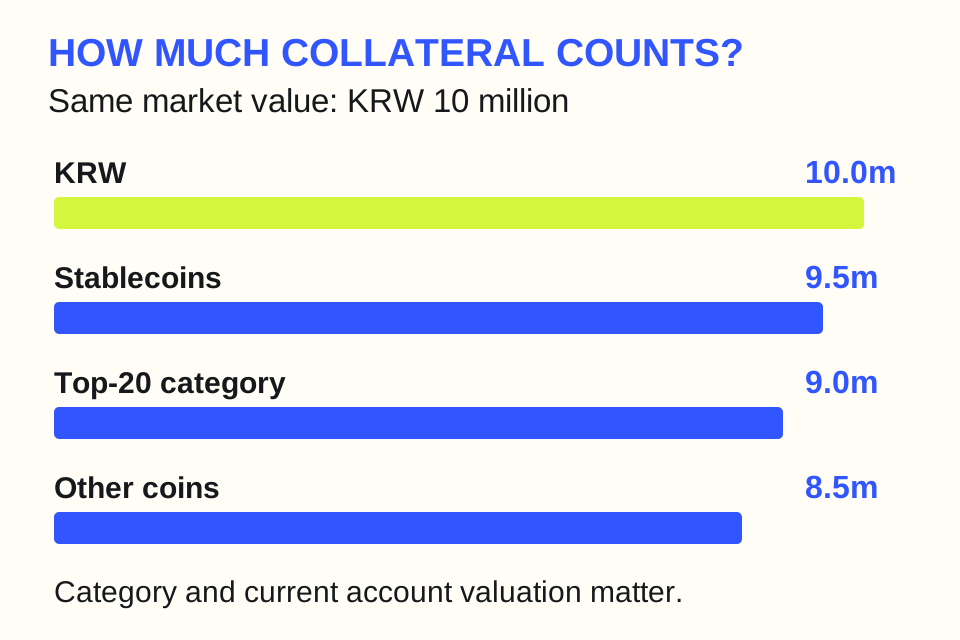
Upbit’s collateral explanation credits KRW at 100%, stablecoins at 95%, qualifying top-20 digital assets at 90%, and other digital assets at 85% under the stated categories. In plain English, the service discounts some assets when deciding how much collateral supports the borrowing.
The important comparison is recognised collateral, not just the wallet’s displayed market value. A coin can move between categories or change price, so the application’s current value matters. Do not treat every asset as interchangeable with won cash.
Two price changes can work against the borrower
If the borrowed coin rises in price, its repayment value can rise. If the collateral falls, the support behind that obligation shrinks. When those are different coins, both can move against the borrower at once. A single BTC price alert may therefore miss a problem caused by the collateral asset.
For a simplified example, KRW 8 million of borrowing against KRW 10 million of recognised collateral is an 80% ratio. If recognised collateral falls to KRW 9 million while borrowing value stays unchanged, the ratio becomes about 88.9%. If the borrowing value also rises to KRW 8.5 million, it becomes about 94.4%. These are illustrations, not the exact valuation of a live account.
That is why adding collateral changes the support for a borrowing arrangement rather than erasing the original trading loss. It also commits more assets. Check the product rules on whether pledged funds remain usable elsewhere before planning to rely on the same balance for another trade.
How expensive is it to keep borrowed coins open?
Upbit’s borrowing-fee guide lists 0.05% per day, calculated using the daily maximum borrowed quantity and collected at full repayment. The borrowing day generally has no fee, but borrowing and repaying on that same day incurs one day’s fee. This is not the same charging pattern as a perpetual funding rate.
For an unchanged illustrative borrowing of 1 ETH across ten chargeable days, 0.05% per day produces a fee quantity equivalent to 0.005 ETH before any other applicable charges. Its won value depends on the relevant settlement price. A fixed coin quantity does not promise a fixed won bill.
The cheaper-looking short may not be cheaper to hold
A trader comparing two ways to express a bearish view should separate entry commission, borrowing charge, the cost of buying back, and any forced-repayment charge. A small entry fee can be outweighed by carrying the borrowing for several days. Conversely, a perpetual’s funding cannot be assumed cheaper without checking the actual rate and account eligibility.
Repaying part of the borrowing does not necessarily recalculate that entire day as if the smaller quantity had been borrowed all along. The daily-maximum method is the relevant detail. Someone who repeatedly changes the borrowed amount should inspect the fee history rather than multiply the final balance by the total number of days.
The published lending framework is also a reason not to describe this as “Korea now allows unlimited leverage.” The FSC’s September 2025 announcement describes lending guidelines with user qualification and limits on leverage-style service structures. The current provider product, not an old offshore-futures comparison, should supply the operational details.
Does the Korean premium change your crypto trade?
A Korean BTC/KRW price and an offshore BTC/USDT price can tell different stories. The won exchange rate and the local premium sit between them. A trader can be correct about Bitcoin’s global direction and still receive a disappointing won result if the local premium contracts.
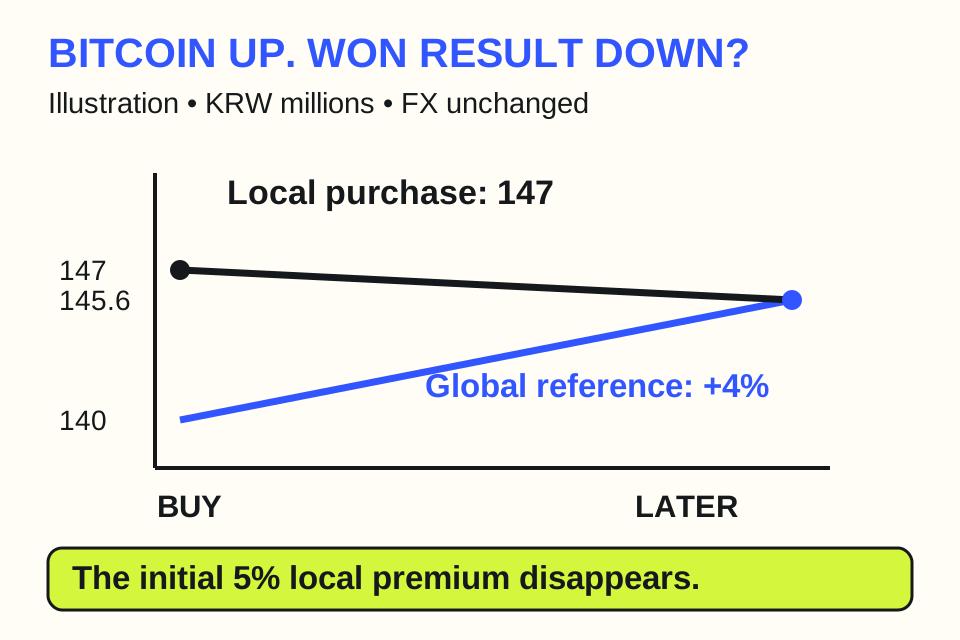
Use a hypothetical example. If Bitcoin is USD 100,000 and the comparison exchange rate is KRW 1,400 per dollar, the simple converted reference is KRW 140 million. A local price of KRW 147 million is 5% above that reference. Those figures are illustrative, not current Bitcoin or currency quotes.
Now suppose the global Bitcoin reference rises 4% to USD 104,000, the currency rate stays the same, and the local premium disappears. The resulting local reference is KRW 145.6 million. It is still below the original KRW 147 million purchase price, even though the global Bitcoin price rose.
Why this matters to a futures reader
A USDT perpetual usually follows its contract’s crypto reference, not the exact local KRW spot price at which you bought a coin. Using one to offset a Korean spot holding can leave the premium and currency movements unhedged. A matching BTC label does not make the two prices identical.
The reverse situation is possible too: a widening local premium can improve a won valuation while the global crypto price barely moves. The article’s conclusion is therefore specific: decide which price movement you want exposure to before treating a domestic spot holding and an offshore contract as substitutes.
USDT has its own local price
Buying USDT with won is not necessarily the same as exchanging won for US dollars at a bank quote. Compare the actual KRW/USDT order, including the amount it will fill. A premium in the stablecoin purchase can reduce the trading balance before a BTC position even begins.
Korea’s authorities documented an episode in 2025 in which USDT lending and subsequent selling affected local prices. That supports the practical point that the local stablecoin price can move with local market conditions. It does not establish a permanent premium, a guaranteed arbitrage or a forecast for today’s price.
Why an Upbit purchase may not be withdrawable immediately
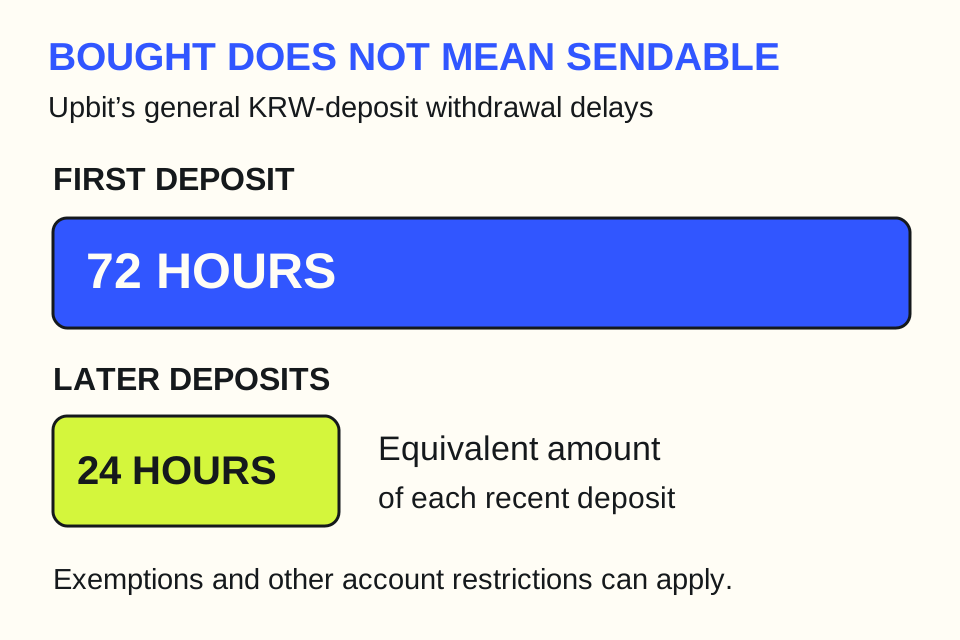
Upbit’s current help states that the first KRW deposit triggers a 72-hour digital-asset withdrawal restriction. Later KRW deposits generally impose a 24-hour delay on the equivalent amount. It also describes possible exemptions based on assessed low-risk transaction history and separate restrictions for suspicious activity.
The practical problem is specific to a trader who planned to buy locally and move the asset immediately. A successful purchase does not mean the new balance is already withdrawable. The price of the destination trade can move during the waiting period, so funding should not be assumed available for an immediate position.
Do not read the delay as proof that the entire exchange has stopped trading or that an account’s crypto has disappeared. Inspect the withdrawal-limit screen and the relevant deposit history. If another restriction remains after the stated period, the reason may be unrelated to the ordinary deposit hold.
The destination must accept the transfer too
Upbit’s travel-rule material explains the exchange of sender and recipient information for covered transfers and distinguishes supported destinations. A matching coin address does not, by itself, resolve the receiving-platform and identity checks. The same person’s accounts may also need matching identity details in the format the services recognise.
Before sending, check the destination service, token, network and required recipient information. If the receiving platform is not supported under the applicable process, choosing a different blockchain network does not necessarily cure the problem. Network compatibility and destination eligibility answer different questions.
Transfers below KRW 1 million should not be described as a universal exemption from all review. Upbit has a separate help entry for smaller transfers, and other account controls can apply. Splitting a larger transfer into small pieces is not a sound way to establish that a destination is acceptable.
What changed in the Korean rules during 2026?
The FSC’s August 2026 AML-rule announcement separates different commencement dates. Registration-related changes took effect on 20 August; other changes were scheduled for six months after promulgation. The announced extension of travel-rule coverage beyond the existing KRW 1 million threshold should therefore not be described as if every new provision already applied on the article’s September review date.
That distinction matters for account instructions. A guide written from a future rule can tell a reader that the current withdrawal screen is broken when it is simply following the current process. Use the provider’s present instructions, then recheck when the relevant change starts.
Registration is not a futures licence
DAXA’s published April 2026 list identifies registered virtual-asset businesses. It is useful for checking the operator, but inclusion alone does not establish a retail derivatives product. A company can be registered for its actual services without offering the leveraged contract a futures reader wants.
The FSC’s June 2026 warning also addresses unregistered businesses targeting Korean customers. This review therefore does not rank an offshore affiliate offer as a locally authorised alternative based solely on a global country list. The missing permission is not repaired by a higher maximum leverage or a referral bonus.
What the Bithumb incident adds to the comparison
Following the Bithumb incident, the FSC’s April 2026 inspection findings called for stronger balance reconciliation and controls, including more frequent reconciliation and measures to stop abnormal activity. These findings concern exchange operations and internal records. They are not evidence that the Bitcoin network created extra coins.
For a customer, that makes an operational question worth adding to the fee comparison: what happens if the exchange’s displayed balance or trading system behaves incorrectly? The official improvement timetable is not proof that every planned system change was completed. We do not award a “problem solved” badge without that evidence.
Foreign residents, Koreans abroad and local account access
An overseas visitor should not expect a passport alone to open a fully usable Korean won account. Upbit’s policy lists accepted identity documents and restricts non-resident access. It describes additional residence and remaining-stay evidence for foreign individuals; KRW-market use still depends on the required real-name bank verification.
Bithumb’s current foreign-applicant help states that foreign nationals cannot sign up, including foreign nationals resident in Korea. That is a meaningful difference from assuming that every local exchange has identical onboarding. An older article saying all foreign residents can simply use either exchange misses this restriction.
If you are Korean and genuinely live abroad
Compare the derivatives rules of your actual country of residence and the provider serving that account. Nationality, residence and product restrictions can be separate conditions. A Korean passport is not enough to infer that the account receives the same service as a resident in Seoul; a foreign bank account alone does not establish overseas residence either.
Gemini’s global perpetual eligibility page includes South Korea, which explains why it can appear in a provider-access catalogue. That does not establish Korean registration or override the local issues discussed here. A reader abroad needs the actual destination-country and entity assessment, rather than using that global list as a universal clearance.
Does Busan or Jeju change the futures answer?
This review did not establish a separate retail crypto-futures permission for residents of Busan, Jeju or another Korean region. A local blockchain initiative should not be converted into a different exchange ranking without product-specific evidence. Residence can affect identity and banking processes without creating a regional perpetual licence.
The differences worth acting on are the real ones: the account you qualify for, the product it supplies, recognised collateral, the exact repayment or funding cost, the won price you trade, and whether the balance can move when needed. Those details produce a more useful answer than a long offshore-exchange list promising the same maximum leverage to everyone.