








Which crypto futures platform is worth checking from the Maldives?
Kraken offers the clearest documented starting point in this comparison for an eligible account: identifiable crypto perpetuals, published collateral requirements and a detailed derivatives tariff. This is a conditional product recommendation. It does not establish that a Maldivian bank can fund the account or that the product is locally authorised.
OKX is the alternative to compare if the intended position is a USDT perpetual and the account is permitted to use it. Both reviewed location policies leave room for eligible Maldivian applications, subject to verification and other restrictions. Neither publishes an MVR bank-funding promise in the material used here.
| Starting situation | Useful next step | What must not be assumed |
|---|---|---|
| Already holding crypto that can lawfully be used for trading | Assess Kraken’s accepted collateral and live derivatives permission | A deposit address is not approval for every source of funds |
| Eligible USDT account with a specific perpetual in mind | Compare OKX’s contract and account terms | USDT support does not prove an MVR payment channel |
| Money held only in a Maldivian bank account | Resolve whether the intended payment is permitted before funding | An overseas Visa or Mastercard logo is not bank approval |
| Maldivian citizen genuinely resident abroad | Use the rules for that actual residence | Passport nationality alone does not determine product access |
For residents whose only practical funding route is a local bank card, we do not recommend depositing first and investigating afterwards. The March 2026 US government commercial guide warns that cryptocurrency transactions are not currently permitted. That warning cannot be ignored simply because an offshore exchange lists the Maldives in a country selector.
The broader catalogue retains international products for comparison. “Available” there describes the recorded platform access status, not a Maldivian licence, bank permission or a completed onboarding test. Keeping those options visible is useful; presenting them as eleven guaranteed local futures accounts would not be.
Is the Maldives opening up to crypto trading?
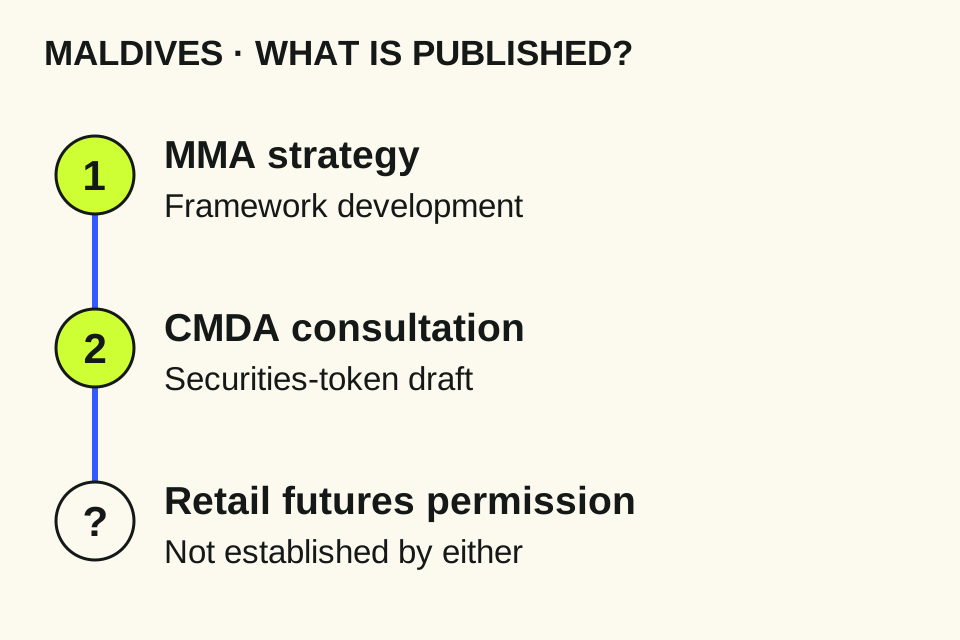
There is official work on virtual-asset regulation, but a policy project and a usable retail exchange account are different stages. The Maldives Monetary Authority’s 2025–2027 strategic plan includes developing a virtual-asset framework with the relevant authorities. A strategic target is not an approval notice for a particular futures platform.
The CMDA has also published a draft Securities Virtual Asset Service Providers Regulation for consultation. The document reviewed here is expressly labelled a draft. Its definition concerns tokens qualifying as securities and excludes assets functioning purely as payment instruments, stablecoins and central-bank digital currencies. It therefore cannot be used as a ready-made USDT perpetual licence.
What would count as a meaningful opening?
A final rule with an effective date, an identifiable authorised provider and terms covering the intended retail product would change the decision. A promotional announcement about investment in a financial hub would not supply all three. Readers should not have to infer permission from an ambitious project headline.
The CMDA’s separate regulations page is useful when checking whether a consultation document has been replaced by a final instrument. At this review, we did not establish a final retail crypto-futures permission from the cited draft and register. The page therefore does not advertise a new Maldivian-licensed crypto exchange.
What does that mean for someone who already holds crypto?
The foreign exchange’s willingness to receive the customer and the local treatment of the intended activity still need to fit. Holding an existing token balance changes the payment question, but does not automatically settle the legal one. Do not read our international product shortlist as instructions to bypass a local restriction.
If that permission cannot be established for your circumstances, use the article to understand the products without funding a live leveraged account. That is a more useful conclusion than either pretending nothing exists internationally or promising that a working app makes the whole activity approved.
Why can a BML card fail even when the website accepts cards?
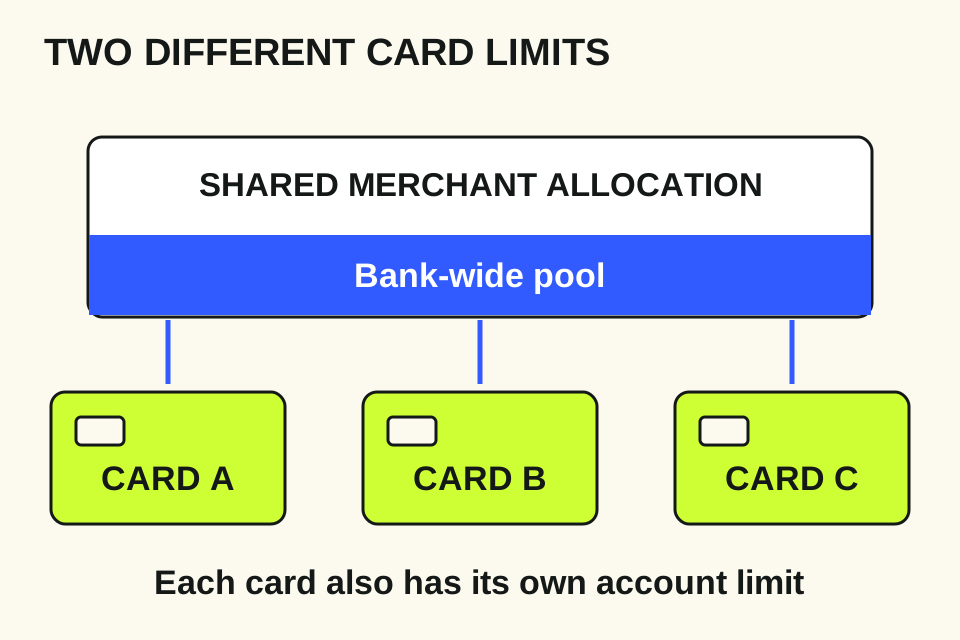
Bank of Maldives explains that foreign-currency liquidity constraints affect international payments. Its published e-commerce controls include daily allocations across merchant categories. An allocation described on that page is a bank-wide pool for the category, not an individual allowance automatically available to every cardholder.
This distinction is easy to miss. A customer can be below their personal limit while a category allocation has already been used. Conversely, an available category allocation does not mean a particular merchant or transaction is permitted for that customer. Neither situation is proof that the crypto exchange itself has rejected the account.
Do not keep retrying a payment for the wrong reason
Identify whether the failure is a bank restriction, an unsupported merchant, account verification or insufficient available funds. Repeatedly changing the amount does not resolve a prohibited payment purpose. Ask the bank about that exact transaction rather than assuming a general international-shopping facility includes leveraged crypto funding.
A USD-linked account also requires the intended payment to be supported. Its currency does not exempt the transaction from merchant rules or local restrictions. We therefore do not turn the bank’s published overseas-shopping limits into a recommended crypto deposit budget.
Why this matters more for a small futures balance
If getting funds into an account is uncertain, a trading plan that depends on topping up at a particular moment is unreliable. Decide how much capital can genuinely be committed before opening the position. Do not treat a future card payment as margin already available on the exchange.
A new QR-payment or remittance service is useful to this decision only if it supports the required transaction. Check its stated purpose and receiving currency before counting it as a way to fund the futures account.
Does a dollar salary make leveraged trading easier?
Receiving income in dollars may remove one currency conversion, but it does not turn the income into approved exchange collateral. A bank USD balance, a token tracking USD and a USD-valued derivative account are separate assets. The exchange must accept the funding method and the bank must permit the destination.
For a worker paid in MVR, the amount obtainable in the required funding currency can be more important than the exchange’s opening fee. Do not budget from an unofficial cash-market quote and then treat the quoted dollars as guaranteed. The Maldives’ September 2026 foreign-currency amendment reinforces the importance of using lawful currency channels.
The September 2026 exchange-rate change
The President’s Office announced that the first amendment to the Foreign Currency Act took effect on 1 September 2026. The announcement describes requirements to use MMA-set rates or an approved band and licensing for foreign-exchange business. It also identifies penalties for selling or advertising foreign currency above the permitted band.
The practical implication for a trading budget is straightforward: we do not recommend private above-band dollar deals as a way to prepare margin. A claimed saving on exchange commission is irrelevant if the currency acquisition itself does not comply with the applicable rules.
Keep the trading result separate from the spending result
Suppose a permitted account finishes a trade with more USD-valued collateral than it started with. That is the trading result before the final withdrawal and conversion. The amount eventually usable in MVR depends on the permitted receiving route and its charges; it should be calculated from the actual completed conversion rather than an assumed cash rate.
There is no need to make this complicated. Record the starting amount in the currency you paid, the final withdrawable asset, and the amount received at the destination. This prevents a successful crypto trade from being described as a larger local-currency gain than it actually produced.
What should you compare on Kraken and OKX before trading?
Begin with the contract’s settlement currency. Kraken’s multi-collateral derivatives value the account in USD and accept a defined set of supporting assets. OKX offers USDT-settled perpetual products. A contract name containing BTC describes the market exposure; it does not necessarily mean the profit will arrive as Bitcoin you can withdraw.
For a reader already holding USDT, compare how that asset is handled by the account, including conversion or collateral adjustments. For someone holding another coin, check whether using it as collateral creates an additional price exposure. Do not assume an asset’s wallet value is identical to the amount the platform counts towards margin.
Compare a complete trade with a complete transfer
Kraken’s reviewed entry-level taker commission is 0.05%. On a hypothetical USD 1,500 trade, that is USD 0.75 at entry. An equal-sized exit at the same rate adds another USD 0.75, before spread, funding or other charges. The small trading commission should not distract from the fixed costs of moving a small balance.
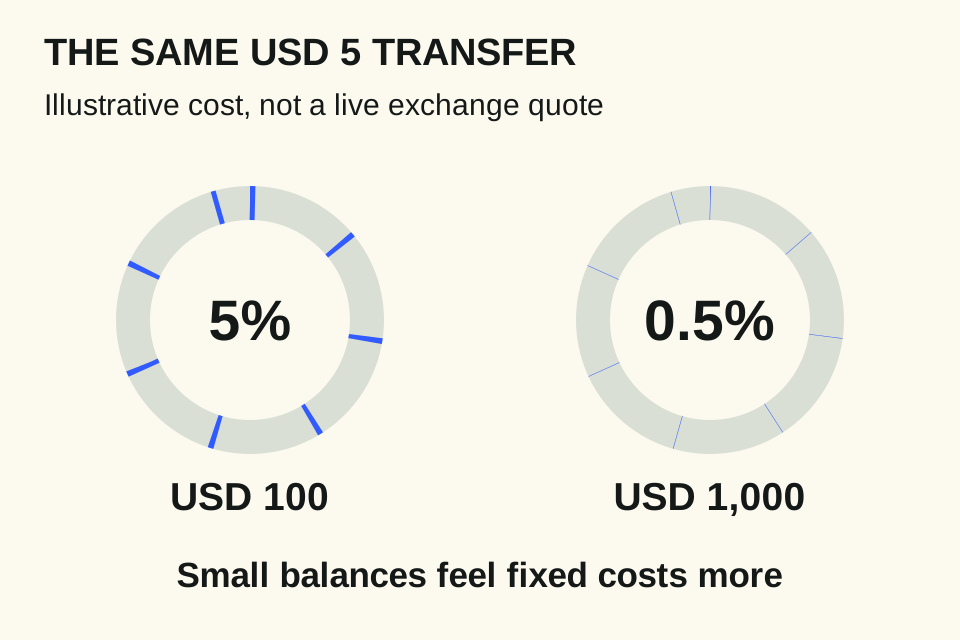
For example, a hypothetical USD 5 transfer cost consumes 5% of a USD 100 balance but only 0.5% of a USD 1,000 balance. Those are illustrative costs, not current withdrawal quotes from either platform. The comparison shows why the actual withdrawal preview matters more than a “low fees” slogan when trading with a small amount.
Is 100× available, and should it decide the exchange?
Kraken announced up to 100× on specified BTC and ETH international perpetuals in eligible regions in May 2026. That is a product ceiling with position-size and account conditions, not a Maldivian entitlement. Other contracts can have different limits.
A higher ceiling does not improve the amount you receive when withdrawing, solve a local card restriction or make a thin market easier to exit. Compare the market you actually intend to trade, the permitted leverage shown in your account and the quoted cost of closing it. This gives a better answer than ranking exchanges solely by their largest advertised multiple.
Can a phone handle the account?
The useful mobile check is whether you can clearly distinguish position size, margin balance and the close control. If a screen hides those details behind several menus, practise with the interface before relying on it for a live position. A colourful price chart alone does not make an app suitable for managing leverage.
Do not assume that closing the app closes the position. The exposure remains until the exchange executes a closing order or otherwise settles it. An accepted exit instruction is different from a notification reminding you to act, and execution can still be affected by the market.
Does living outside Malé change the exchange recommendation?
No separate island-by-island futures permission was established in the reviewed official material. A reader in Malé, Addu or another atoll should not receive a different legal answer just because a bank branch or reliable connection is farther away. The local differences to assess are the actual services available to that customer.
If managing the account would require a trip to a branch for a payment problem, do not make the position depend on an urgent transfer being resolved during that trip. If connectivity is intermittent where you work, consider whether an open leveraged trade fits the periods when you can reliably access the account. These are individual operating conditions, not a claim that every island has the same service problem.
Foreign residents working in the Maldives
Nationality and residence both need to be represented accurately. An expatriate working in the Maldives should not assume the rules from a previous home address still apply to a current exchange account. The platform may require an update and may assess the account differently once the actual residence changes.
The same applies in the other direction. A Maldivian citizen genuinely living in another country may have a different set of permitted products there. Kraken’s international derivatives policy, for example, excludes Canada and has specific restrictions for UK retail customers. A Maldivian passport is not a way around those product limits.
Visiting for a holiday is not relocation
A temporary visitor should ask the exchange how travel affects access rather than creating a new account with a hotel address. Do not move an existing leveraged position into a new eligibility situation without understanding whether the account will remain usable. The nationality of the tourist and the location of a resort do not, by themselves, establish a new financial permission.
The practical recommendation is therefore conditional on the person, not the island. Assess Kraken for its documented international product where both account access and the intended use are permitted. Compare OKX where its USDT contract fits better. If the local funding or permission question is unresolved, resolve that first rather than treating an international signup as the answer.