










Bybit, Delta or ZebPay: which is better for Indian futures traders?
Bybit is the option to inspect first when you want a crypto-funded account and USDT perpetuals. Its return to the Indian market and FIU registration are documented, rather than inferred from a signup page that happens to load. Our preference is for that specific use: keeping a transferable crypto trading balance, with an Indian purchase service available where your verified account supports it.
Delta Exchange India is the more direct match when your starting and ending point is an Indian bank account. Its INR-funded derivatives account avoids making a separate USDT purchase merely to open a crypto futures trade. ZebPay deserves a place alongside it because it supports USDT-paired futures using INR margin, with an exchange rate locked for the life of that position.
Those are three different account experiences. An existing USDT holder may gain little from selling into INR to fund Delta, while a new trader with only rupees may gain little from buying and later selling USDT to use Bybit. The best crypto futures exchange in India depends on which of those extra transactions you actually need.
| Your starting point | Closest fit | The trade-off |
|---|---|---|
| Transferable crypto or a USDT trading budget | Bybit | Indian service charges and the eventual INR cash-out still matter |
| INR in your own bank account | Delta Exchange India | The reviewed account does not accept external crypto deposits |
| INR funding with USDT-paired futures | ZebPay | The position uses its quoted conversion and margin rules |
Why consider Bybit in India now?
An old article saying Bybit is unavailable in India can give the wrong answer today. The exchange’s registration announcement and subsequent service-resumption notice document a change after its earlier compliance problems. We do not treat the earlier interruption as a permanent ban, and we do not treat the later announcement as proof that every feature is available to every account.
For this recommendation, the relevant product is ordinary crypto perpetual trading. The reason to examine it is the ability to run a stablecoin-based futures account without making an INR-settled contract the centre of your setup. That matters if your trading budget already exists as crypto or if you regularly move usable balances between supported crypto services.
What would make us choose Delta instead?
If you want to deposit rupees, trade BTC or ETH and withdraw rupees without managing crypto transfers, Delta’s local funding model solves that task more directly. Bybit is not automatically better because its global product menu is larger. Features you never use do not compensate for an extra conversion you pay on every funding cycle.
Likewise, someone who wants a particular smaller-coin perpetual should search for that actual market in each eligible account. A long spot-coin list does not prove a long futures list. Check whether you can open the direction and size you want, not merely whether the coin name appears somewhere in the app.
FIU registration is useful, but it is not a futures guarantee
India’s Finance Ministry describes FIU registration as an anti-money-laundering obligation applying to relevant virtual-asset businesses, including offshore ones. Its September 2026 notice also warns that crypto products are unregulated and that loss recovery may lack regulatory recourse. Registration should therefore not be sold as deposit insurance or as approval of every leveraged contract.
The practical conclusion is to prefer an identifiable, compliant service over an anonymous site, while keeping the trading decision separate. We have not placed matched orders, measured Indian execution or tested withdrawals for this article. The comparison is based on the cited product and access records, not a claim of hands-on testing.
Can you trade crypto futures directly with INR?
Delta Exchange India’s funding guide lists IMPS, NEFT, RTGS and UPI, and says that deposits and withdrawals use INR. It explicitly says the reviewed India account cannot receive USDT or other cryptocurrency deposits. Its user guide describes cash-settled crypto derivatives rather than a requirement to own the underlying coin.
That difference removes a step for the bank-funded trader. You can take a view on Bitcoin’s price without first acquiring Bitcoin or paying someone for a stablecoin transfer. It also sets a boundary: a profit in this account is not a BTC balance you can withdraw to your wallet.
A dollar symbol does not mean you need a dollar bank account
BTCUSD describes the price being followed. On Delta India, the documented contracts can be margined and settled in INR. The market label, the money backing the trade and the currency you withdraw are three different pieces of information.
Before confirming a first order, read the rupee value of the position and the amount reserved to support it. A chart moving by ten dollars does not tell you the profit without knowing how much of the contract you hold. That is the one calculation worth making before increasing the multiplier.
Does INR settlement remove all currency effects?
Do not compare a rupee profit screenshot with a USDT screenshot as though the numbers share one unit. A platform may use a specified conversion to translate dollar-denominated price changes into the account currency. Read that treatment for the product rather than applying a live Google exchange-rate quote to every line of the statement.
For a practical comparison, use the same approximate exposure to BTC and translate the final outcomes consistently. If one screenshot represents ₹20,000 of exposure and another represents ₹2 lakh, the larger profit does not establish a better exchange. It mostly establishes a larger bet.
When ZebPay’s INR margin is useful
ZebPay’s May 2025 product update lets a user select INR margin for USDT-paired futures. The rate shown at entry remains fixed for that position, and the provider says this internal conversion has no separate fee or TDS. It also says the same pair cannot simultaneously use both INR and USDT margin: the existing position must close before changing margin type.
That is a useful middle option for someone who recognises BTC/USDT pricing but does not want to buy transferable USDT first. It should not be described as an unrestricted stablecoin wallet feature. The conversion supports the particular trading position, with the conditions described by ZebPay.
What a locked rate changes in a real decision
Imagine two otherwise comparable trades opened on different days. If the platform’s quoted conversion changes between the entries, they can use different locked rates even though both remain open together. The older position does not automatically adopt the newer rate. Save the entry confirmation so the eventual rupee result has a clear starting point.
This can make a single trade easier to follow, but it is not proof that ZebPay will produce a better outcome than an INR-settled competitor. Compare the displayed conversion, the commission and the actual execution price. A convenient currency feature and a cheaper trade are different benefits.
UPI, bank transfer or P2P: how should you fund the account?
For an INR-funded derivatives account, use the payment instructions inside the verified account. Delta’s published methods include UPI and bank transfers; the method available for a particular deposit can still depend on the account and its payment screen. A payment to an old saved beneficiary should not be assumed to remain valid forever.
Bybit’s India purchase guide describes both peer-to-peer purchases and a third-party One-Click Buy option through Onmeta, including UPI or IMPS where supported. A third-party purchase is not the same as sending rupees into a bank account owned by the futures platform. Check who processes the payment and the amount of crypto the quote delivers.
P2P is an optional purchase method, not part of the futures contract
On P2P, another participant supplies the crypto against your payment under the platform’s order process. The price can include a local premium. A low advertised exchange commission does not make this purchase free, and the futures fee comparison later in this guide does not include an unspecified merchant quote.
Keep the transaction within the platform’s supported process. A message asking for payment to an unrelated person, a changed beneficiary or an off-platform deal is not a normal reason to ignore the order details. If the payment recipient no longer matches what the platform authorises, stop and use its dispute process.
Compare what arrives, not the word “zero”
Take a hypothetical ₹20,000 budget. A quote of ₹100 per USDT delivers 200 USDT before separately listed charges; ₹102 delivers about 196.08. The difference is 3.92 USDT. These are teaching quotes, not current market rates. They show why a purchase premium can outweigh small commission differences between futures venues.
Someone who already has USDT does not face that same initial quote. For that reader, the useful comparison is the sending exchange’s withdrawal charge and the receiving platform’s supported network. Use a transfer method supported on both ends; a familiar coin name alone does not make every network compatible.
What are the real crypto futures fees in India?
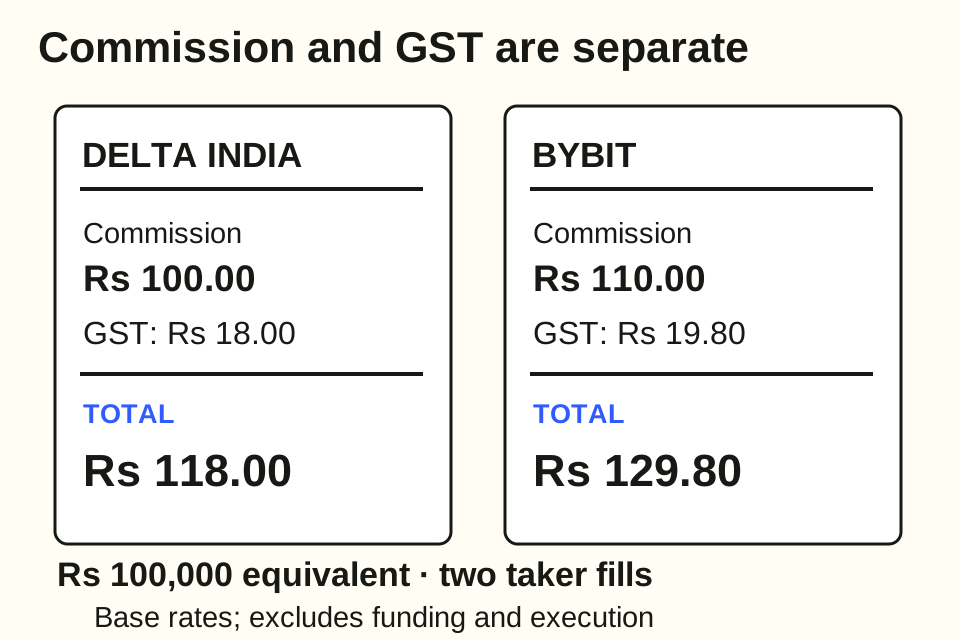
The comparison below uses published base futures rates: Delta India maker 0.02% and taker 0.05%; Bybit non-VIP maker 0.02% and taker 0.055%. It adds 18% GST to the trading commission. It excludes funding, purchase/sale costs, slippage and any personal discount. Rates were checked on 29 September 2026; promotional rates are not used as the permanent baseline.
Maker means a qualifying order adds liquidity; taker means it fills against existing orders. A limit order can still be a taker if it executes immediately. Use the actual fill classification in your statement, not the button label, when checking the charge.
| Order outcome | Delta India | Bybit non-VIP |
|---|---|---|
| Both fills taker | ₹118.00 equivalent | ₹129.80 equivalent |
| Both fills maker | ₹47.20 equivalent | ₹47.20 equivalent |
| One maker and one taker | ₹82.60 equivalent | ₹88.50 equivalent |
Does that make Delta always cheaper?
It wins this narrow taker-commission comparison by ₹11.80 on the stated round trip; the maker totals are equal. That is a completed comparison, but it is not a universal cost ranking. An existing stablecoin holder could spend more converting to INR than the amount saved, and different execution prices can overwhelm the commission difference.
For a high-frequency strategy, multiply costs by the trades actually completed. Ten round trips at ₹118 each would consume ₹1,180 before funding and execution differences. The amount initially deposited does not determine this bill; each fill is charged on its relevant position value.
A profitable chart move can still produce a loss
Suppose a position earns ₹100 before costs. Under the first Delta example, ₹118 in opening and closing commission with GST would leave it ₹18 down before other charges. A green price movement is not the same as a positive net result. This matters especially when taking tiny profits repeatedly with leverage.
A promotional fee reduction might improve that outcome, but only for eligible trades within its terms. Do not choose a long-term account solely from a temporary “zero closing fee” headline. Check what happens when the offer ends and whether the size or holding period you use qualifies.
Is 100x or 200x crypto leverage available in India?
Delta’s current initial-margin table shows that maximum leverage varies by market and position tier. Its August 2026 update includes 200x for BTC and ETH at the relevant initial tier, while several named altcoin limits are lower. That is evidence for those contract conditions, not a national entitlement to 200x or a promise for every order size.
For example, the update reduces BNB, ADA, LINK and LTC from 100x to 20x, while DOGE moves from 100x to 50x. SOL and XRP remain at 100x in that notice. A trader choosing specifically for an altcoin should use its own limit, not the BTC headline. The contract page is the place to check later changes.
What does 200x mean with a small rupee budget?
As simple arithmetic, ₹1,000 backing ₹2 lakh of exposure is 200x. A 0.3% adverse price move creates roughly ₹600 of trading loss on that exposure before costs. That consumes 60% of the allocated ₹1,000. The exchange can intervene before a theoretical 0.5% move because fees and the required remaining backing also matter.
This example does not predict an exact liquidation price. It explains why a tiny movement on a chart can be a large event for a highly leveraged account. Choosing a lower multiplier is useful only if it also results in a position and backing arrangement you intend; the profit and loss still follow the actual exposure.
Why an order might be rejected even with a positive balance
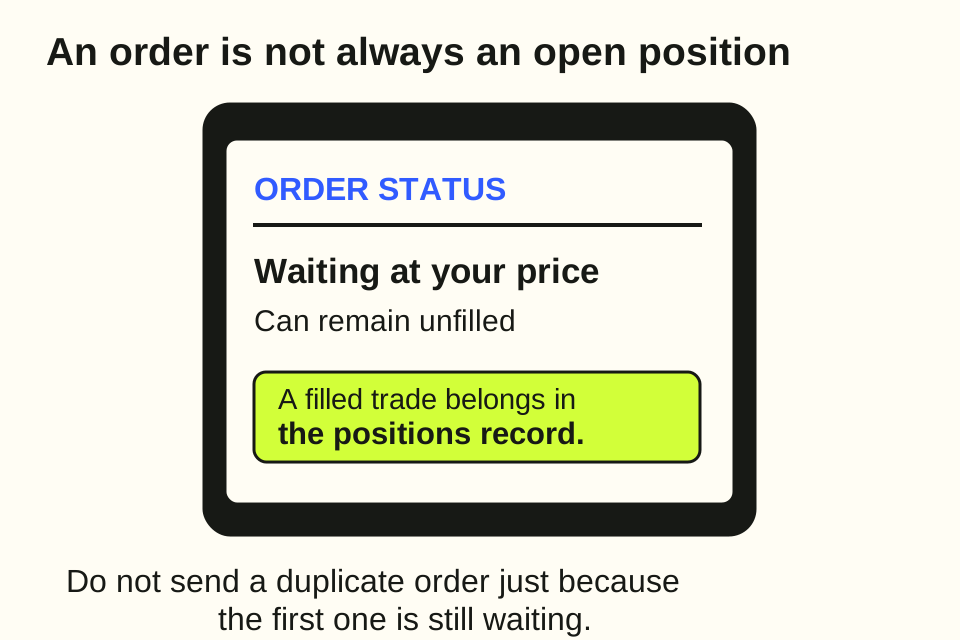
The balance at the top of the screen can include money already committed to open positions and pending orders. A new order needs available backing, including the costs reserved by that product. Cancelling a genuinely unwanted pending order may release some capacity; adding another deposit should not be the automatic response to every rejection.
On a phone, inspect the order amount before the multiplier. Confusing ₹10,000 of position value with ₹10,000 of margin can create a much larger trade than intended. Read the confirmation in ordinary money, then review the estimated liquidation level shown by the platform.
BTC, ETH or smaller coins: what should you compare?
If you only trade BTC and ETH, a platform’s total asset count tells you little about the quality of those two markets. Inspect the difference between the best buying and selling prices, the prices available for your proposed size and the contract’s funding. Those are the things that affect this trade, even if you never open another market.
For a smaller coin, begin by confirming that the product is a perpetual and that shorting is supported. Some apps show the same coin in spot, earn and futures areas. Owning the coin in one area does not create a short position in another, and a spot listing does not promise that a perpetual will remain listed.
An entry price is more informative than a maximum-leverage badge
Imagine the same intended purchase exposure quoted at an average entry of 100.00 on one venue and 100.15 on another. The second starts 0.15% worse before fees. That illustrative difference is larger than the base taker-rate gap in our table. A small commission advantage cannot rescue every poor execution price.
For a useful live comparison, enter the same approximate position size without submitting it and inspect the quoted buying or selling price. A quote for a tiny amount can look attractive while a larger order reaches less favourable offers. Large advertised daily volume alone does not reveal the fill your order would receive.
Perpetual funding matters to a trade held overnight
Funding is a periodic payment associated with keeping the perpetual aligned with its underlying market. It can be paid or received, and its rate changes. Delta’s derivatives guide describes it separately from exchange trading commission. A position held through several funding events can therefore cost more or less than the fee table suggests.
Compare the actual BTC or ETH contract’s current rate and recent history when choosing where to hold a multi-day position. Do not decide from an exchange-wide slogan about low fees. A short intraday trade and a week-long position need different cost comparisons, even when they use the same app.
Do Delhi, Mumbai or Bengaluru have different crypto futures rules?
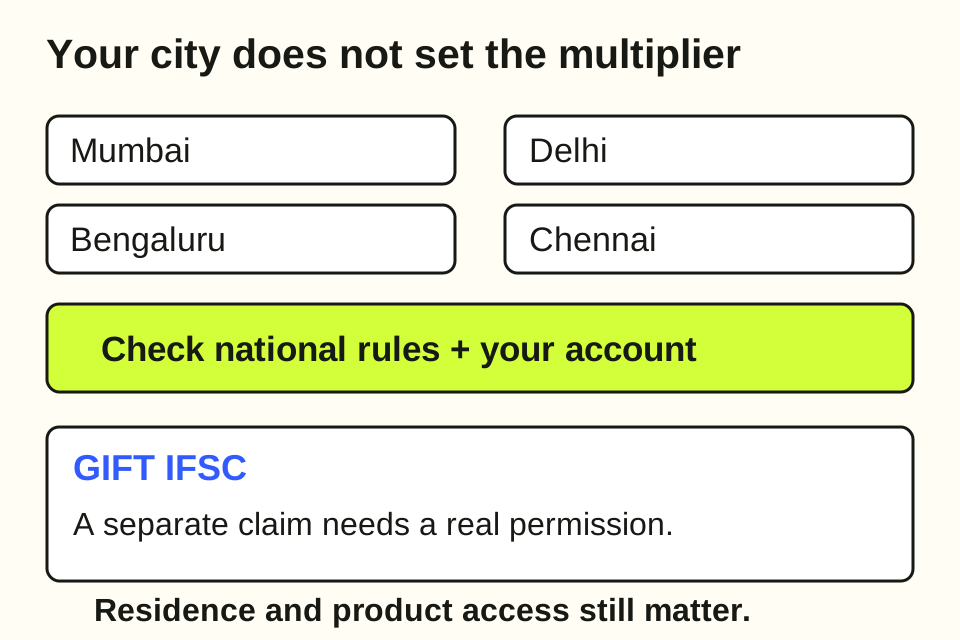
The national FIU obligations reviewed here do not create a separate retail exchange list for Maharashtra, Delhi, Karnataka, Tamil Nadu or Telangana. We found no basis in these sources for inventing a distinct leverage allowance for Mumbai, Bengaluru, Chennai or Hyderabad. Differences in state address, bank branch or language do not automatically change the contract offered by a national account.
That does not mean every Indian user has an identical experience. A payment method can be unavailable for a particular bank or account, and a rejected address document can delay access. Those are specific onboarding or funding issues. They should be checked directly rather than described as a state-wide crypto ban without evidence.
GIFT City is not a shortcut to a tax-free futures account
IFSCA’s December 2024 clarification expressly rejected reports that it was introducing regulation for crypto exchanges and cryptocurrencies in GIFT IFSC. A later consultation on tokenising real-world assets is a different subject. Neither document establishes a special retail BTC perpetual account that any Gujarat resident can use to bypass the ordinary account rules.
For a reader in Ahmedabad or Gandhinagar, the decision remains the actual service and contract. Do not send money to an operator claiming that “GIFT approved” means all crypto profits are exempt or that a local address removes verification. Ask for the precise current permission and product behind that claim.
Indians living abroad need a residence-specific answer
An Indian passport, an Indian bank account and Indian residence are not interchangeable. Someone living in Dubai or London should not assume that an article for residents of India describes the account entity or products they will receive. The overseas location may change derivatives eligibility as well as the documents requested.
Before moving, ask the platform what changes for existing positions and withdrawals when it accepts the new residence. Do not create conflicting profiles to keep a preferred product. For the tax record, preserve the actual dates of residence changes and transactions; the exchange’s interface language does not settle tax residency.
GST, TDS and income tax: which one affects your futures account?
Bybit’s India help page describes 18% GST on relevant service or trading fees and 1% TDS on specified virtual-asset transfers, including crypto-to-fiat and crypto-to-crypto transactions. These are different bases: the service fee is not the same amount as the value being transferred. A deduction visible during a coin sale should not be relabelled as the commission on a futures order.
For cash-settled INR derivatives, providers describe a different transaction structure from buying and selling transferable coins. Delta’s tax guidance discusses its treatment, but that provider explanation is not a universal government ruling for every crypto derivative. Do not turn “no TDS deducted on this order” into “no taxable income.”
Keep the cash-out separate from the contract
A person may make money on a USDT-settled futures position and then sell the resulting USDT for INR. The contract result and the subsequent asset sale are separate steps. Even if the exchange does not show the same deductions for both, the later step can have its own tax and reporting consequences.
A practical record should distinguish realised trading profit or loss, commissions, funding, conversions and tax withheld. Without that separation, it is easy to count a deposit as income or miss a withholding amount that needs reconciliation. Export records while they are available instead of relying solely on a year-end balance screenshot.
Avoid a tax claim that determines the entire ranking
We do not rank an exchange first because a promotional article calls its product tax-free. Ask a qualified Indian tax professional to classify the actual contracts and settlement you use, especially if you trade across INR and crypto-funded accounts. Supply the contract description and transaction export, not only the brand name.
This is also why the fee comparison above includes GST on commission but does not invent a single final income-tax bill. A reader deciding between exchanges can compare the observable trading charges. The final tax treatment requires the real transactions and personal circumstances, not an extra generic percentage pasted onto every trade.
How do you withdraw crypto futures profits in India?
Start by closing or reducing the intended position, then check the balance actually available for withdrawal. Unrealised profit still supporting an open trade is not automatically a cash balance. Keep enough backing for any positions you deliberately leave open; a withdrawal should not accidentally change their risk.
With the INR-funded Delta account described here, the destination is an eligible verified bank account under its current withdrawal process. With a crypto-funded account, you may instead withdraw a supported coin or use a supported sale service. A buy-only INR purchase provider does not automatically provide the reverse cash-out method.
What to check before using P2P to sell
Review the permitted payment method and payer details inside the order. A screenshot saying “paid” is not the same as a credited bank balance. Do not release crypto solely because of a chat message, and do not accept an unrelated third party’s payment as a harmless substitution for the authorised order process.
For someone who wants repeated small withdrawals, compare the fixed costs and the amount received per sale. Combining withdrawals may reduce some fixed charges, but leaving a larger balance on an exchange has its own trade-off. Choose a schedule for your actual spending needs rather than chasing a headline that ignores the return to INR.
A useful first-account test
Before committing a larger budget, check that the account accepts your documents, the intended funding method works and the withdrawal destination is valid. This is not a claim that a small successful transaction proves the platform will always work. It is a way to catch a mismatched bank account or unsupported network before the mistake involves much more money.
Keep the order IDs, bank references and any transfer hashes. If a balance is missing, those records identify which service handled the step. The futures exchange, the purchase processor and a P2P counterparty may be different parties; sending the same vague complaint to all three makes resolution harder.
Should you use Binance or a DEX instead?
The full catalogue preserves other provider options. Binance may be relevant if you already use its eligible futures account and want to avoid another transfer; check the current India-facing entity, account features and fee tier. We have not established that switching from an existing supported setup to Bybit would improve every trader’s cost or execution.
A decentralised perpetual venue changes how the account is accessed and how collateral is held, but it does not remove Indian tax obligations or the need to obey service restrictions. You also have to manage wallet approvals and network costs. That extra responsibility may make sense for an experienced wallet user; it is not automatically an easier first futures account.
For an existing account, a transfer needs a specific benefit: a missing market, a lower demonstrated cost or a funding method that removes a real problem. If none applies, opening another account adds work without improving the trade. The comparison is most useful when it resolves one of those concrete limitations.